
Tokyo Electron

Search documents
全球半导体设备_DRAM 资本支出上行周期_ Global Semiconductor Equipment_ DRAM capex upcycle_
2025-11-25 01:19
Summary of Global Semiconductor Capital Equipment Conference Call Industry Overview - The conference call focused on the **Global Semiconductor Capital Equipment** industry, particularly the **DRAM** and **foundry** sectors, with insights into **China's** capital expenditure (CapEx) trends and forecasts for wafer fab equipment (WFE) spending. Key Points and Arguments 1. **WFE Forecast Adjustments** - The WFE forecast for **2025** has been raised to **$119 billion** (+10% YoY) from **$114 billion** (+6% YoY) - The forecast for **2026** is now **$132 billion** (+10% YoY) from **$120 billion** (+5% YoY) - For **2027**, the forecast is adjusted to **$131 billion** (flat YoY) from **$115 billion** (-3%) - The upward revisions are primarily due to improved outlooks for **Global DRAM** and **China CapEx** [2][21][43] 2. **China WFE Demand** - China WFE demand has been significantly revised up by **$5.2 billion** in **2025**, **$7.0 billion** in **2026**, and **$8.4 billion** in **2027** - The increase is driven by higher demand for local AI chips and the need for more DRAM capacity to support future local HBM manufacturing - The anticipated IPO of **CXMT** is expected to provide additional cash for capacity expansion [4][43] 3. **Global DRAM and Foundry CapEx** - Global DRAM WFE is raised by **$4.2 billion** to grow **25% YoY** in **2026** (previously +13%) and another **10%** in **2027** - Foundry/logic WFE is slightly increased by **$0.8 billion** to **8% YoY** in **2026** and another **$1.4 billion** to **6% YoY** in **2027** - The increases reflect a more optimistic capex outlook from **TSMC** [3][21] 4. **Company Ratings and Price Targets** - **AMAT** (Applied Materials) and **LRCX** (Lam Research) are rated **Outperform** with price targets raised to **$260** and **$175**, respectively - Both companies are expected to benefit from key leading-edge inflections, with AMAT having more exposure to a stronger DRAM trajectory [5][17][47] 5. **Regional Insights** - In **Japan**, **Tokyo Electron** and **Kokusai** are preferred due to stronger memory capex - In **Europe**, **ASML** is viewed positively due to better advanced logic capex, although caution remains due to litho intensity and China market concerns [6][12][13][61] 6. **Chinese Semiconductor Companies** - **AMEC**, **NAURA**, and **Piotech** maintain an **Outperform** rating, with expectations of accelerated capacity expansion driven by domestic memory and advanced logic [7][62] Other Important Insights - The semiconductor industry is experiencing a shift towards **3D architectures**, which may impact future EUV adoption rates - There is a cautious outlook for **China's** WFE revenue in **2026**, with expectations of a significant decline despite strong performance in **2025** - The overall sentiment indicates a potential for short-term upside in China WFE, which could support margins due to its margin-accretive nature [13][46][63] This summary encapsulates the key insights and forecasts discussed during the conference call, highlighting the evolving landscape of the semiconductor capital equipment industry.


SoftBank sinks over 10% as Nvidia-fueled rout sweeps Asian chip names
CNBC· 2025-11-21 02:25
Core Insights - A sector-wide pullback in Asian chip stocks was triggered by a significant decline in SoftBank, following Nvidia's unexpected drop despite strong earnings and a positive outlook [1][4] Company-Specific Summary - SoftBank's stock fell over 10% in Tokyo after it recently sold its Nvidia shares, although it still retains control of British semiconductor company Arm, which provides chip architecture and designs for Nvidia [2] - SK Hynix, a major supplier of high-bandwidth memory for AI applications, saw its stock decline nearly 10%, while Samsung Electronics, another supplier, dropped over 5% [3] - Taiwan Semiconductor Manufacturing Company, the largest contract chipmaker and manufacturer of Nvidia's chip designs, experienced a decline of over 4% [3] - Renesas Electronics, a key supplier for Nvidia, fell by 2.3%, and Tokyo Electron, which supplies essential chipmaking equipment, was down 5.32% [5] Industry Overview - The overall retreat in major Asian semiconductor companies followed Nvidia's decline of over 3% in the U.S., despite the company beating Wall Street expectations for its third-quarter earnings and providing a stronger-than-expected fourth-quarter sales guidance [4]


Nvidia shrugs off AI bubble fears, tops Q3 profit expectations
Youtube· 2025-11-20 08:46
分组1 - Nvidia reported a strong third quarter, with earnings up 65% year-over-year and revenue rising 62%, leading to a 5% increase in shares after hours [5][2] - The company provided guidance for current quarter sales of $65 billion, exceeding analyst expectations by approximately $3 billion [5] - CEO Jensen Huang emphasized the robust demand for Nvidia's advanced Blackwell chips, stating that sales are "off the charts" due to accelerating AI compute demand [5][6] 分组2 - Huang addressed concerns about an AI bubble, asserting that Nvidia's position in the tech sector is strong and distinct from other companies [6][13] - Despite the positive outlook, there are concerns regarding customer concentration, with four major customers accounting for 61% of sales, which poses risks [8][9] - Nvidia's sales in China were impacted by geopolitical issues, with significant purchases not materializing as expected [10][11] 分组3 - The market reacted positively to Nvidia's earnings, with strong gains in US futures and European markets following the announcement [16][18] - Analysts noted that while Nvidia's execution was commendable, there remains uncertainty about future demand and the ability of customers to monetize their AI investments [18][29] - The broader market sentiment is influenced by Nvidia's performance, but there are concerns about the sustainability of the AI trend and its implications for other sectors [31][34]

Asian Markets Mostly Higher Led By Tech Stocks
RTTNews· 2025-11-20 08:42
Group 1: Market Performance - Asian stocks rose broadly, driven by Nvidia's strong third-quarter earnings and optimistic fourth-quarter forecast regarding the AI cycle [1] - Japanese stocks ended a four-session losing streak, with the Nikkei average rising 2.65 percent to 49,823.94, supported by a weaker yen and a potential stimulus package of 21.3 trillion yen ($135.38 billion) [3][4] - The Kospi average in South Korea jumped 1.92 percent to 4,004.85, with major tech stocks like Samsung Electronics and SK Hynix contributing to the gains [5] Group 2: Sector Movements - Technology stocks led the rally in Japan, with companies like SoftBank Group, Tokyo Electron, and Fujikura gaining between 2-6 percent [4] - In Australia, banks, miners, and gold stocks were the primary drivers of a broad-based market rally, with the S&P/ASX 200 rising 1.24 percent [5] - U.S. stocks fluctuated but ended higher, with the Nasdaq Composite gaining 0.6 percent, influenced by Nvidia's quarterly results [6][7] Group 3: Economic Indicators - The dollar strengthened due to reduced expectations for rate cuts and anticipation of the delayed September U.S. jobs report [1] - The People's Bank of China maintained key lending rates for the sixth consecutive month, contributing to a 0.40 percent drop in the Shanghai Composite index [2]

多家日韩设备企业中标维信诺8.6代OLED产线项目
WitsView睿智显示· 2025-11-19 08:57
Group 1 - The core project involves the procurement of equipment for the 8.6-generation OLED production line by Hefei Guoxian, with multiple Korean and Japanese companies winning bids for various essential equipment [1][2] - Key equipment includes Laser Lift-Off (LLO) machines, dry etching machines, and PI curing equipment, which are critical for flexible OLED manufacturing [1] - The 8.6-generation AMOLED production line is a collaboration between Visionox and Hefei's investment platform, with a total investment of 55 billion yuan and a designed capacity of 32,000 glass substrates per month [2] Group 2 - The project is notable for being the world's first high-generation AMOLED production line equipped with the no FMM technology (ViP), and it is expected to start mass production in the first quarter of 2027 [2] - The flexible OLEDs produced will primarily be used in mobile device displays, indicating a significant market potential for Visionox's new production line [1]


World shares sink, tracking a tech-led sell-off on Wall Street
ABC News· 2025-11-18 10:05
Market Overview - Global shares have declined significantly, with benchmarks in Tokyo and Seoul dropping over 3% due to the impact of Nvidia and other AI-related stocks pulling U.S. markets lower [1][2] - The S&P 500 and Dow Jones Industrial Average futures are down 0.3%, reflecting concerns over high stock prices in the AI sector [2] Regional Market Performance - Asian markets experienced a downturn, with Japan's Nikkei 225 falling 3.2% to 48,702.98, and South Korea's Kospi dropping 3.3% to 3,953.62 [5][6] - Chinese markets also faced selling pressure, with Hong Kong's Hang Seng declining 1.7% and the Shanghai Composite slipping 0.8% [6] Key Company Movements - Nvidia's stock decreased by 1.8%, although it remains up nearly 40% year-to-date [7] - Other AI-related companies, such as Super Micro Computer, saw significant losses, with a 6.4% drop [7] - Major tech firms in Asia, including Samsung Electronics and TSMC, also reported declines, with Samsung down 2.8% and TSMC down 2.8% [5][6] Economic Indicators - The yield on 30-year Japanese government bonds surged to 3.31%, indicating rising risks associated with government spending and national debt management [4] - Anticipation of U.S. employment data release is affecting market sentiment, with potential implications for Federal Reserve interest rate decisions [3][10]

全球存储市场 - 2026 年关键考量及多空情景展望-Global Memory Market_ Key considerations heading into 2026 and picturing bull_bear case scenarios
2025-11-18 09:41
Summary of Key Points from J.P. Morgan's Global Memory Market Report Industry Overview - The report focuses on the **global memory market** and its supply chain, projecting trends and investment opportunities leading into **2026**. - The analysis emphasizes a **stronger and longer memory up-cycle** driven by AI inference and supply constraints, with specific recommendations for investments in companies like **SK Hynix (SKH)**, **Samsung Electronics (SEC)**, **Micron Technology (MU)**, and **Tokyo Electron**. Core Insights - **Pricing Trends**: - **DDR5 spot prices** have surged by **177%** in the last month, with a widening contract-spot spread of **263%** as of November 13, compared to **58%** a month prior. This indicates potential upside risks to DRAM average selling price (ASP) projections of **+20%** for Q4 2025 and **+10%** for Q1 2026 [1][4]. - The demand for **SSD** is increasing, contributing to a positive outlook for **NAND pricing** due to supply issues related to QLC transition yield losses [1]. - **Margin Expectations**: - Memory suppliers are expected to reach historical peak margins (e.g., **70% DRAM operating profit margin**) in Q4 2025, with potential for further ASP strength into the first half of 2026 [4]. - The report notes a mixed investor response to higher margins, balancing optimism about the up-cycle with concerns over sustainability [4]. - **Capex Trends**: - Memory capital expenditures (capex) are projected to rise by **20%** in 2026, a slower growth rate compared to historical trends of over **50%** [7]. - The focus of capex will be on migration spending and new constructions, with significant cleanroom availability expected by **2H 2027** [7]. - **AI and Memory Demand**: - The report highlights the increasing role of memory in AI applications, particularly with the expansion of large language models (LLMs) requiring higher bandwidth **HBM** [10]. - HBM demand estimates have been raised by **15%-21%** through 2026-2027, with expectations of a tightening supply-demand situation [10][11]. Additional Insights - **Market Dynamics**: - The report discusses the **wallet share** trends among suppliers, with **SKH** maintaining the top position and **SEC** expected to increase its share from **25%** to **30%** in the coming year [21]. - The overall HBM capacity is anticipated to reach **700K wfpm** by the end of 2027, accounting for **31%** of total capacity [21]. - **Valuation Considerations**: - The top three memory makers are trading at an average of **2.6x FTM P/B**, reflecting a higher risk premium due to investor confidence in the longevity of the memory sector up-cycle [55]. - The report suggests that a transition to P/E valuation metrics may be premature without clear evidence of fundamental changes in the industry [58]. - **Risks and Catalysts**: - Key risks include potential capex acceleration and the impact of long-term supply contracts on operational flexibility during downturns [87]. - Upcoming catalysts include updates on memory makers' investment plans, strategies to balance margin and growth, and next-generation AI server specifications [87]. Companies Discussed - **KLA Corporation (KLAC)** - **Micron Technology (MU)** - **SK Hynix (SKH)** - **Samsung Electronics (SEC)** - **Tokyo Electron** This comprehensive analysis provides a detailed outlook on the memory market, highlighting significant trends, potential investment opportunities, and associated risks as the industry navigates through evolving technological demands and market dynamics.

Asian Shares Retreat Before Nvidia Earnings, Key US Data
RTTNews· 2025-11-18 08:42
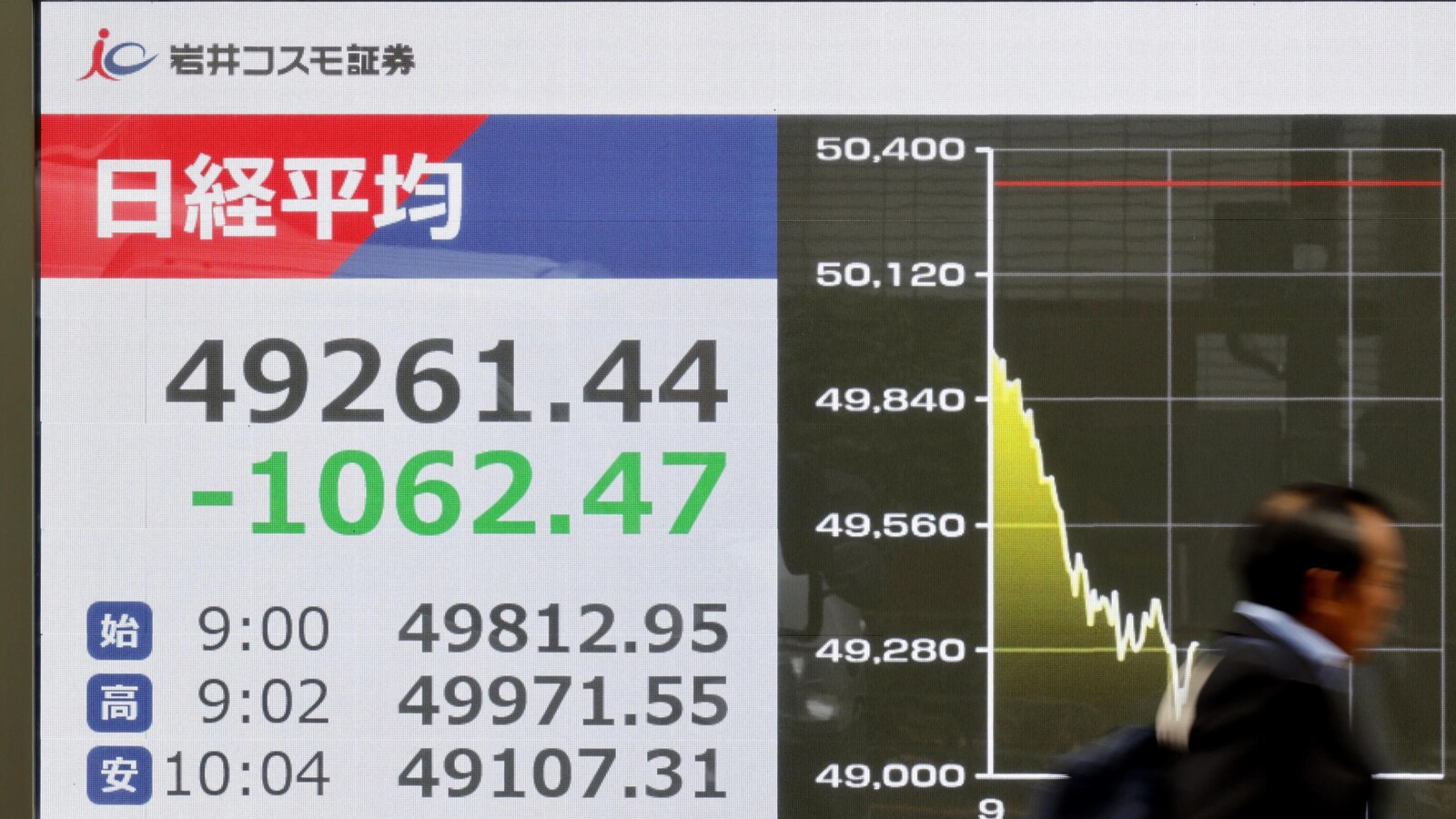
Market Overview - Asian stocks experienced a significant decline as risk aversion increased ahead of Nvidia's earnings report and delayed U.S. economic data, including a jobs report released almost seven weeks late due to a government shutdown [1] - The dollar strengthened amid rising uncertainty regarding interest rates and technology valuations, while oil prices fell following the resumption of loadings at a key Russian port [1] Commodity and Currency Movements - Gold prices fell approximately 1 percent, marking a fourth consecutive session of losses, influenced by the strength of the dollar and reduced expectations for a U.S. interest rate cut next month [2] - The yen recovered from its lowest level since early February due to intervention fears, with Bank of Japan Governor Kazuo Ueda discussing economic and monetary policy developments with Prime Minister Sanae Takaichi [5] Regional Market Performance - Chinese and Hong Kong markets declined, with the Shanghai Composite index dropping 0.81 percent to 3,939.81, primarily due to falling energy stocks, while Hong Kong's Hang Seng index plunged 1.72 percent to 25,930.03, affected by tech stock concerns related to AI valuations [2] - Japanese markets saw a significant drop, with the Nikkei average falling 3.22 percent to 48,702.98, marking its largest decline in over seven months, driven by falling tourism-related stocks due to China's travel alert [3] - Seoul's Kospi index fell 3.32 percent to 3,953.62, heavily impacted by selling from institutions and offshore investors, with major tech stocks like Samsung Electronics and SK Hynix experiencing declines of 2.8 percent and 5.9 percent, respectively [6] - Australian markets hit a five-month low, with the S&P/ASX 200 dipping 1.94 percent to 8,469.10, influenced by cautious sentiments regarding future interest rate cuts [7] Company-Specific Movements - Shiseido's stock fell 2.9 percent, while ANA Holdings dropped 1.3 percent; SoftBank Group lost 7.5 percent, and semiconductor companies like Advantest and Tokyo Electron saw declines of 3.7 percent and 5.5 percent, respectively [4]
World shares advance as tech shares rebound and the Senate takes steps to end the shutdown
Yahoo Finance· 2025-11-10 05:38
BANGKOK (AP) — Shares advanced in Europe and Asia on Monday as tentative moves by the U.S. Senate to end the federal government shutdown pushed U.S. futures higher. The Senate voted late Sunday, in a test vote that begins a series of procedural maneuvers, to move toward passing compromise legislation to fund the federal government, though final passage could be several days away if Democrats object and delay the process. The Senate may hold a vote by mid-December on extending expiring health care tax cred ...
亚洲半导体_9 月 WSTS 数据_平均售价回升带动存储业务动能增强Asian Semis_ September WSTS data_ Stronger Memory momentum, led by ASP upticks
2025-11-10 03:34
Summary of Key Points from the Conference Call Industry Overview: Semiconductor Industry Revenue Growth - Overall semiconductor revenues increased by 28% year-over-year (YoY) in September, up from 22% YoY in August [2][3] - Logic semiconductors grew by 21% YoY, slightly down from 23% YoY in August, while memory semiconductors surged by 44% YoY, compared to 18% YoY in August [2] Demand Drivers - The growth in semiconductor revenues is primarily driven by sustained demand for data centers and AI spending, particularly in leading-edge logic semiconductors and High Bandwidth Memory (HBM) [2] - Memory revenue saw a significant rally due to tight DRAM supply and improved NAND supply driven by eSSD restocking demand [2] Unit Growth - Overall semiconductor units increased by 9% YoY, down from 13% YoY in August [3] - Memory units rose by 19% YoY, driven by growth in HBM shipments and strong demand for server DRAM [3] - Logic semiconductor units increased by 8% YoY, reflecting slower growth due to destocking and AI server production transitions [3] Average Selling Prices (ASPs) - Semiconductor ASPs rose by 17% YoY in September, up from 8% YoY in August [4] - Memory ASPs surged by 22% YoY, significantly higher than the 3% YoY increase in August, driven by tight supply-demand dynamics and increased demand from major suppliers [4] - Logic semiconductor ASPs increased by 12% YoY, supported by resilient pricing for advanced nodes [4] Future Outlook - The semiconductor industry is expected to maintain robust growth, particularly in AI technology supply chains, with no signs of a bubble [5] - The growth in AI technology is anticipated to continue, supported by increased capital expenditures from major cloud service providers (CSPs) [3][5] Company Recommendations - Preferred picks among Asian semiconductor companies include TSMC, SK Hynix, ASE, Advantest, and Tokyo Electron, while caution is advised on companies like Novatek, SMIC, and UMC due to their exposure to consumer electronics [8] Additional Insights - The recovery in the automotive and industrial sectors is expected to be slow due to macroeconomic uncertainties [8] - The pricing uptick may benefit memory, leading-edge foundry, and OSATs, but Tier-2 foundries may face margin pressures [8]