
中信银行

Search documents
多家商业银行取消,5年期定存产品为何变少了?
Xin Hua Wang· 2026-01-06 12:21
Core Viewpoint - The reduction of 5-year fixed deposit products by multiple commercial banks is a direct consequence of the current low interest rate environment, reflecting a broader trend towards specialized wealth management in the financial market [5][9][15] Group 1: Market Environment - The overall market interest rates have remained low, leading banks to reduce the supply of long-term deposit products, particularly 5-year fixed deposits [6][9] - As of December 2022, the 5-year Loan Prime Rate (LPR) was 4.30%, which dropped to 3.50% by December 2025, indicating a significant decline in interest rates over the years [7] - Many banks have shifted focus to shorter-term deposit products, with 2-year and 3-year options becoming more prevalent [7][8] Group 2: Customer Reactions - Customers have varied responses to the reduction of 5-year fixed deposits; some continue to prefer bank deposits, while others are exploring alternative investment options due to declining interest rates [8][9] - A customer from Shijiazhuang expressed disappointment over the reduction of long-term deposits, indicating a shift to 3-year products as a compromise [8] - Younger customers are increasingly diversifying their investments, opting for gold and other liquid assets instead of traditional fixed deposits [8][9] Group 3: Banking Strategies - Banks are actively compressing long-term deposit offerings to maintain net interest margins, which have been under pressure due to low interest rates [9][10] - Some banks have raised the minimum investment threshold for large-denomination certificates of deposit, reflecting a strategic shift in response to the current funding market [9][10] - Financial institutions are focusing on optimizing their asset-liability structures to stabilize net interest margins and enhance profitability [10][11] Group 4: Wealth Management Trends - The trend towards wealth management is becoming more pronounced, with banks enhancing their service offerings to meet diverse customer needs [13][15] - Banks are increasingly integrating various financial products, such as insurance and investment funds, to provide comprehensive wealth management solutions [15] - The shift from savings to diversified asset allocation is expected to continue, indicating a growing market for wealth management services [14][15]



国有大行突然宣布:上调!
2 1 Shi Ji Jing Ji Bao Dao· 2026-01-06 11:50
Core Viewpoint - The recent adjustment of risk assessment levels for gold-related business by Industrial and Commercial Bank of China (ICBC) reflects the increasing volatility in gold prices and aims to protect individual investors' interests [1][5]. Group 1: Bank Adjustments - ICBC announced an increase in the risk assessment level for personal gold accumulation business, requiring clients to achieve a C3-balanced risk assessment or higher starting January 12, 2026 [5]. - ICBC is the first major state-owned bank to raise the risk rating for gold accumulation in 2026, following similar adjustments by some joint-stock and city commercial banks in the previous year [5][6]. - Other banks, such as Ningbo Bank and Citic Bank, have previously implemented similar risk assessment requirements for gold-related transactions, indicating a trend in the banking sector [6][7]. Group 2: Market Conditions - Gold prices are currently experiencing significant fluctuations, with the price reaching approximately $4,450 per ounce, reflecting a 3% increase in just a few trading days [9]. - Analysts predict that gold will remain a crucial hedging tool in investment portfolios, with forecasts suggesting an average price of $4,538 per ounce in 2026, potentially reaching $5,000 under optimistic scenarios [9][10]. - The demand for gold is expected to increase, with a 14% rise in investment demand potentially pushing prices to $5,000 and a 55% increase possibly reaching $8,000 [9]. Group 3: Regulatory and Risk Management - The adjustments in risk ratings by state-owned banks are influenced by the need to align product risks with actual market conditions, thereby preventing potential disputes and compliance risks [7]. - Regulatory bodies are emphasizing the importance of investor suitability management to promote rational investment behaviors and curb speculative actions [7]. - The proactive risk management by major banks is seen as a way to maintain financial market stability and comply with asset management regulations [7].

国有大行突然宣布:上调!
21世纪经济报道· 2026-01-06 11:44
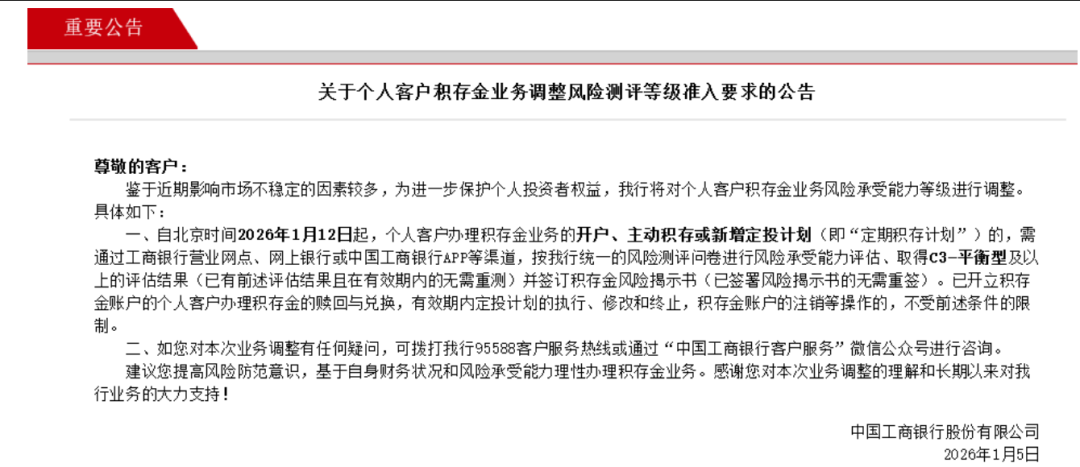
记者丨 叶麦穗 编辑丨肖嘉 金价剧烈波动下,又见银行调整黄金相关业务! 21世纪经济报道记者注意到,1月6日,工商银行发布了《关于个人客户积存金业务调整风险测评等级准入要求的公告》指出,鉴于近期影响市 场不稳定的因素较多,为进一步保护个人投资者权益,该行将对个人客户积存金业务风险承受能力等级进行调整。 这也是今年开年之后,首家 上调黄金投资等级的银行。有分析认为,随着工商银行的示范效应发酵,未来会有更多的银行跟进。 工商银行网站公告 工行上调黄金投资风险等级 具体来看,工商银行表示,自北京时间 2026年1月12日起 ,个人客户办理积存金业务的开户、主动积存或新增定投计划(即"定期积存计划") 的,需通过工商银行营业网点、网上银行或银行APP等渠道,按工商银行统一的风险测评问卷进行风险承受能力评估、 取得C3-平衡型及以上 的评估结果 (已有前述评估结果且在有效期内的无需重测)并签订积存金风险揭示书(已签署风险揭示书的无需重签)。 已开立积存金账户 的个人客户办理积存金的赎回与兑换,有效期内定投计划的执行、修改和终止,积存金账户的注销等操作的,不受前述条件的限制 。 工商银行是2026年首个宣布上调积存金风险 ...

买买买!招商银行,被四度举牌!
Zheng Quan Shi Bao· 2026-01-06 11:34
港交所披露易最新信息显示,平安人寿于2025年12月31日增持1401.25万股招商银行H股股份之后,于当 日达到该行H股股本的20%,根据香港市场规则,触发举牌。 在此之前,平安人寿曾在1月10日、3月13日、6月17日分别举牌招行H股,所持该行H股数量占其H股总 数分别突破5%、10%、15%。 以此统计,2025年合计7家上市银行被险资举牌。其中,招行H股、农行H股、郑州银行H股均获四度举 牌;邮储银行H股被三度举牌。 四度举牌招行H股 据披露易信息,早在2025年1月10日,平安人寿就首次举牌招行H股,所持该行H股数量达到该行H股股 本的5%。 2025年3月13日,平安人寿又耗资近3亿港元,在场内增持606.75万股招行H股,持股占比突破该行H股 总数的10%,构成二度举牌。 2025年6月17日,再度增持629.55万股招行H股股份之后,平安人寿所持招行H股总数已达该行H股股本 的15%,构成第三次举牌。 披露易最新消息显示,平安人寿于2025年12月31日继续增持1401.25万股招行H股股份,达到该行H股股 本的20%,完成第四次举牌。 以此计算,2025年1月10日至12月31日,平安人寿合 ...

开年继续大涨!工行上调黄金投资风险等级,未来或引发示范效应
Xin Lang Cai Jing· 2026-01-06 11:05
Core Viewpoint - The price of gold has continued to rise, currently hovering around $4,450 per ounce, with the investment market remaining active. Industrial and commercial bank (ICBC) has announced an adjustment to the risk assessment levels for personal gold accumulation business, marking it as the first major bank to raise the investment risk level in 2026, which may lead to more banks following suit [1][10]. Group 1: ICBC's Risk Assessment Adjustment - ICBC will require personal clients to undergo a risk assessment and achieve a C3-balanced rating or higher to engage in gold accumulation activities starting January 12, 2026 [3][12]. - Existing clients with valid risk assessment results are exempt from retesting, and operations such as redemption and account cancellation are not subject to the new requirements [3][12]. - This adjustment reflects a broader trend, as some other banks had already raised risk ratings for similar products in the previous year [3][12][14]. Group 2: Market Conditions and Bank Responses - The adjustment in risk ratings is primarily due to the high volatility and rising gold prices, with banks aiming to protect investors and align product risk levels with actual market conditions [5][14]. - Analysts suggest that the increase in risk levels is also influenced by regulatory pressures to enhance investor suitability management and to curb speculative behaviors [5][15]. - The move by ICBC is expected to have a demonstration effect, prompting other banks to follow suit in raising risk assessment standards [6][15]. Group 3: Gold Market Outlook - Gold has shown a remarkable performance, with a 3% increase in just a few trading days at the start of 2026, and analysts predict a continued bullish trend [7][15]. - Bank of America forecasts an average gold price of $4,538 per ounce in 2026, with a potential optimistic scenario reaching $5,000 [7][16]. - The demand for gold is expected to grow significantly, with a 14% increase in investment demand potentially pushing prices to $5,000, and a 55% increase could lead to $8,000 [8][16].

年内举牌超30次 让险资为之“疯狂”的机构都有哪些特点
Mei Ri Jing Ji Xin Wen· 2026-01-06 10:36
Core Viewpoint - Insurance capital's involvement in listed companies is increasing, with a record number of shareholding actions in 2025, particularly favoring the financial sector, especially H-shares [1][2][4]. Group 1: Shareholding Activities - By the end of 2025, insurance capital had conducted over 30 shareholding actions, marking a significant increase compared to previous years [1]. - A total of 14 insurance institutions participated in 35 shareholding actions in 2025, with Ping An Life being the most active, conducting 12 actions [2]. - The month of August saw the highest activity, with 7 shareholding actions, including Ping An Life's investments in major banks [2]. Group 2: Investment Preferences - Financial stocks, particularly H-shares of banks, are the primary targets for insurance capital, with 15 actions in the financial sector [4]. - Insurance companies prefer low-valuation, high-dividend stocks with stable performance, which aligns with the new accounting standards that favor high-dividend stocks [4][5]. - The valuation of H-shares is generally lower than A-shares, providing greater appreciation potential, along with tax benefits through the Hong Kong Stock Connect [4][5]. Group 3: Market Impact and Trends - The shareholding actions by insurance capital have positively influenced stock prices, with notable increases following such actions [7]. - Major insurance companies have shown strong stock performance, with significant annual increases in share prices, outperforming the broader market indices [9]. - The trend of insurance capital's involvement in the equity market is expected to continue, driven by considerations of dividend yield and return on equity (ROE) [10].


国有大行出手,上调!
Zhong Guo Ji Jin Bao· 2026-01-06 10:35
Group 1 - The Industrial and Commercial Bank of China (ICBC) announced an increase in the risk tolerance level for personal customers to C3-Balanced and above for its accumulation gold business starting January 12, 2026, making it the first major state-owned bank to raise the entry threshold this year [2][4] - Customers must complete a risk assessment questionnaire through ICBC's channels and obtain a C3-Balanced rating or higher to engage in new accumulation gold business, while existing customers with valid assessments are exempt from retesting [4][5] - Other banks, such as CITIC Bank and Zhongyuan Bank, have also raised their risk tolerance levels for accumulation gold business, indicating a trend among financial institutions to enhance investor protection amid market volatility [10][11] Group 2 - The gold market has shown signs of recovery, with international gold prices rising above $4,400 per ounce as of January 5, 2026, following a brief adjustment at the end of the previous year [10] - Analysts predict continued support for rising gold prices, with Goldman Sachs forecasting a price increase to $4,900 per ounce by December 2026, and UBS projecting a potential rise to $5,000 per ounce by September 2026, with higher risk scenarios suggesting prices could reach $5,400 per ounce [13]
42家A股上市银行,全面告别监事会!
Sou Hu Cai Jing· 2026-01-06 10:35
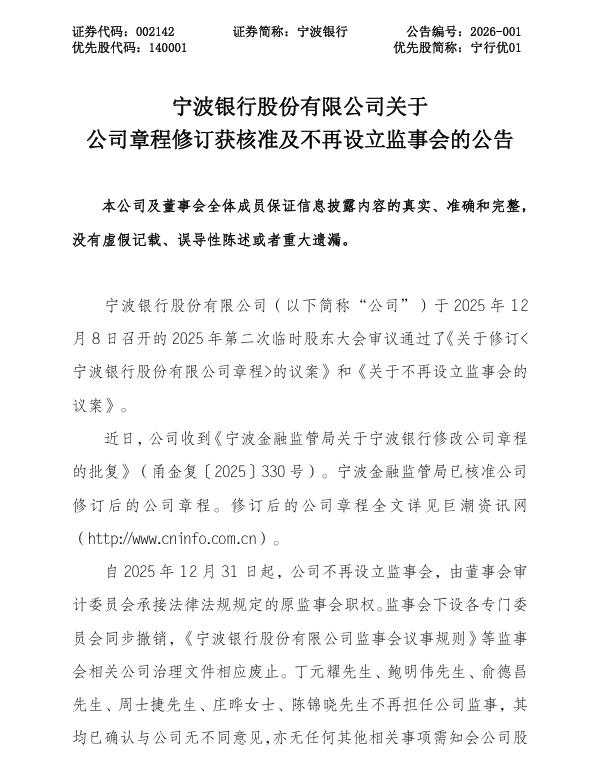
在岁末年初的关键时间节点,又有多家中小银行宣布撤销监事会。 "自2025年12月31日起,公司不再设立监事会,由董事会审计委员会承接法律法规规定的原监事会职 权。"1月4日,宁波银行发布的公告显示,近日,该行收到《宁波金融监管局关于宁波银行修改公司章 程的批复》,宁波金融监管局已核准宁波银行修订后的公司章程。 2025年最后一天,成都银行也发布了该行监事长孙波辞任的公告。根据公告内容,因工作调动另有任 用,孙波辞去成都银行第八届监事会监事长、职工监事、监事会提名委员会委员、监事会监督委员会委 员职务,自2025年12月31日起生效。 《金融时报》记者注意到,自2025年以来,这场由新《公司法》引发的公司治理体系变革,已从国有大 行全面蔓延至股份制银行及中小银行。 实际上,此次银行业集中"去监事会"并非偶然,而是顶层法制设计与监管政策协同推进的必然结果。 2024年7月1日,新修订的《公司法》正式实施,其中明确规定,股份有限公司可以按照公司章程规定在 董事会中设置审计委员会,行使监事会职权,不设监事会或者监事。 政策配套的密集落地则为改革铺路搭桥。同年12月,国家金融监督管理总局发布了《关于公司治理监管 规定与 ...
939亿增持狂潮!523家A股公司扫货,多家银行股将披露业绩
2 1 Shi Ji Jing Ji Bao Dao· 2026-01-06 10:18
Core Viewpoint - The A-share banking sector is expected to maintain a positive outlook for 2026, driven by stable performance and increased dividend attractiveness, despite a slower growth rate compared to 2024 [3][4][9]. Group 1: Annual Report Disclosure - Ping An Bank will be the first to disclose its 2025 annual report on March 21, marking the second consecutive year it leads in this regard [1]. - A total of 42 A-share listed banks will disclose their annual reports, with 10 banks, including major state-owned banks, reporting on March 31, 2026, which is the highest number for a single day [3]. Group 2: Market Performance - The banking sector index rose by 12.05% in 2025, underperforming the CSI 300 index, which increased by 17.66% [3]. - The total market capitalization of 42 banks exceeded 15 trillion yuan, an increase of approximately 2.1 trillion yuan from the end of 2024 [3]. - Agricultural Bank of China had the highest stock price increase at 52.66%, followed by Xiamen Bank and Shanghai Pudong Development Bank with increases of 35.78% and 24.56%, respectively [3]. Group 3: Investment Drivers - The strong performance of the banking sector in 2025 was supported by both liquidity and fundamental factors, including inflows from passive index funds and insurance investments [4]. - Over 500 shareholders increased their stakes in A-share listed banks, with a total investment of 93.96 billion yuan in 2025 [6]. - Nanjing Bank led in shareholder increases with 7.378 billion yuan [7]. Group 4: Future Outlook - Analysts predict that 2026 will see stable bank performance due to a recovering real economy and high dividend yields, making bank stocks attractive [9][10]. - The demand for high-dividend stocks is expected to rise, particularly for state-owned banks like ICBC and CCB, which are seen as stable investments [10]. - The banking sector is anticipated to experience a valuation recovery, with estimates suggesting a return to a price-to-book ratio of around 1 [10]. Group 5: Seasonal Trends - Historical data indicates that the banking sector has a high success rate for absolute and excess returns before the Spring Festival, with an average absolute return of 4.4% [11]. - Analysts recommend a balanced investment strategy, suggesting a 30% allocation to state-owned banks and 70% to high-quality joint-stock and city commercial banks for the upcoming Spring Festival [11].





年内举牌超30次 让险资为之“疯狂”的机构都有哪些特点⋯⋯
Mei Ri Jing Ji Xin Wen· 2026-01-06 10:17
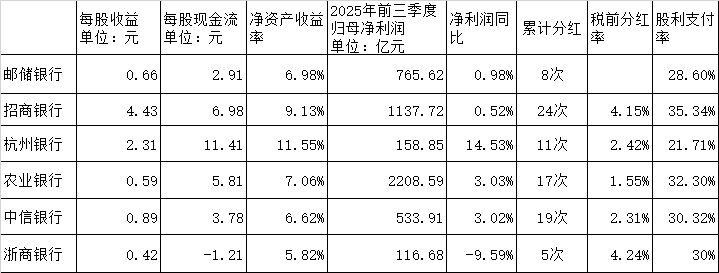
Core Viewpoint - Insurance capital's stake in listed companies has significantly increased, with over 30 instances of stake acquisitions in 2025, marking a new high in recent years [1][10]. Group 1: Stake Acquisition Trends - In 2025, insurance companies made 35 stake acquisitions, up from 20 in 2024, indicating a growing trend in equity market participation [2][11]. - The financial sector is the primary focus for insurance capital, with 15 stake acquisitions involving 6 banks and 2 insurance companies [1][4]. - The H-share market is the main venue for these acquisitions, as it offers better valuation opportunities compared to A-shares [1][4]. Group 2: Active Participants - A total of 14 insurance institutions participated in stake acquisitions in 2025, with Ping An Life leading with 12 acquisitions [2][11]. - Other notable participants include Great Wall Life and China Post Life, each with 4 acquisitions, and several others with fewer [2][11]. - August 2025 was particularly active, with 7 acquisitions, including Ping An Life's significant stake in Postal Savings Bank [2][11]. Group 3: Investment Characteristics - Insurance capital favors low-valuation, high-dividend stocks with stable performance, particularly in the banking sector [4][13]. - The new accounting standards encourage insurance companies to increase stake acquisitions to stabilize profit and loss fluctuations [3][12]. - Financial stocks, especially H-shares, are preferred due to their higher dividend yields compared to long-term bond yields [4][13]. Group 4: Financial Performance of Target Companies - Six banks targeted by insurance capital showed a range of return on equity (ROE) from approximately 6% to 11.55% [5][14]. - The banks reported stable dividend distributions, with China Merchants Bank having the highest number of cumulative dividends at 24 [5][14]. - In the first three quarters of 2025, five banks reported year-on-year profit increases, with Postal Savings Bank achieving a net profit of 765.62 billion yuan, up 0.98% [5][14]. Group 5: Market Reactions and Future Outlook - Stake acquisitions by insurance capital have positively influenced stock prices, often leading to short-term price surges [6][16]. - Insurance stocks have outperformed other sectors, with significant annual increases in stock prices for major insurance companies [8][18]. - The trend of insurance capital acquisitions is expected to continue into 2026, driven by considerations of dividend yield and return on equity [9][19].
