
成都银行

Search documents
1月20日贷款财政贴息四项政策点评:“一揽子”贷款财政贴息政策影响几何?
EBSCN· 2026-01-21 11:17
Investment Rating - The report maintains a "Buy" rating for the banking industry, indicating an expected investment return exceeding the market benchmark index by more than 15% over the next 6-12 months [29] Core Insights - The "package" loan interest subsidy policies aim to stimulate consumption and investment, focusing on enhancing effective domestic demand through financial and fiscal collaboration [2][7] - The new policies are expected to significantly increase the scale of interest subsidies compared to previous measures, with a projected subsidy scale of approximately 1000 to 2000 billion yuan for 2026 [17][19] Summary by Sections Loan Subsidy Policies - The policies include four main areas: subsidies for small and micro enterprises, equipment updates, service industry operators, and personal consumption loans, with a focus on key industries such as new energy vehicles and medical equipment [4][6] - The subsidy rate for small and micro enterprise loans is set at 1.5 percentage points, with a maximum loan amount of 50 million yuan per entity, potentially providing up to 150,000 yuan in subsidies [4][6] - The equipment update loan subsidy has been increased from 1% to 1.5%, expanding the scope to include technology innovation loans and related fields [4][6] - The personal consumption loan subsidy has removed previous restrictions, allowing for broader eligibility and a maintained subsidy rate of 1% [5][6] Economic Impact - The policies are designed to alleviate financial burdens on small and micro enterprises, encouraging investment and job stability, particularly in high-tech and essential service sectors [7][8] - The expected increase in loan demand from these sectors is anticipated to support the overall credit recovery in the economy, particularly for retail and service industries [7][8] Market Outlook - The report suggests that the coordinated fiscal and monetary policies will positively impact the banking sector's loan volume and pricing, particularly benefiting banks focused on small and micro enterprises and retail finance [23] - The banking sector has seen a decline in stock performance, and the new policies are expected to act as a catalyst for recovery, especially in the context of the "opening red" period for banks [23]
财政部印发财政金融协同促内需一揽子政策
Sou Hu Cai Jing· 2026-01-21 11:08
Core Viewpoint - The Ministry of Finance has introduced a comprehensive policy package aimed at promoting domestic demand through support for private investment and consumer spending, consisting of six specific measures. Group 1: Support for Small and Micro Enterprises - A loan interest subsidy policy for small and micro enterprises has been established, offering a 1.5% interest subsidy on eligible fixed asset loans for a maximum term of 2 years, with a loan cap of 50 million yuan and a maximum subsidy of 1.5 million yuan [5] - A special guarantee plan for private investment in small and micro enterprises has been set up, with a scale of 500 billion yuan over two years, increasing the guarantee coverage ratio to 40% and raising the individual guarantee limit from 10 million yuan to 20 million yuan [8] Group 2: Bond Risk Sharing Mechanism - A risk-sharing mechanism for bonds issued by private enterprises has been established, with the Ministry of Finance coordinating with the People's Bank of China to provide credit enhancement support for bond issuance by private enterprises and private equity investment institutions [10] Group 3: Equipment and Service Sector Support - The equipment renewal loan interest subsidy policy has been optimized to include loans for technology innovation and various new sectors, maintaining a 1.5% subsidy rate for a term of 2 years [12] - The service industry loan interest subsidy policy has been extended to the end of 2026, increasing the maximum subsidy per loan from 10,000 yuan to 100,000 yuan and adding support for digital, green, and retail sectors [14] Group 4: Consumer Loan Support - The personal consumption loan interest subsidy policy has been extended to the end of 2026, including credit card installment payments and removing restrictions on the consumption sector and individual loan subsidy caps [17] Group 5: Implementation and Future Steps - The Ministry of Finance plans to leverage the first quarter's consumption peak by coordinating central policies with local financial policies to maximize the benefits of the central fiscal policy and ensure rapid and effective implementation [19]


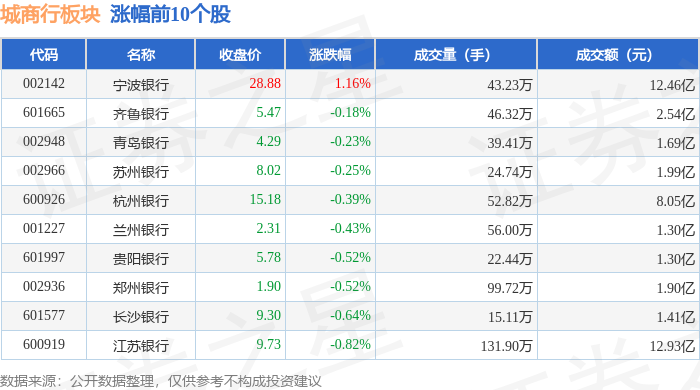
城商行板块1月21日跌0.55%,重庆银行领跌,主力资金净流入5.08亿元
Zheng Xing Xing Ye Ri Bao· 2026-01-21 08:54
Market Overview - The city commercial bank sector experienced a decline of 0.55% on January 21, with Chongqing Bank leading the drop [1] - The Shanghai Composite Index closed at 4116.94, up 0.08%, while the Shenzhen Component Index closed at 14255.12, up 0.7% [1] Individual Stock Performance - Ningbo Bank closed at 28.88, with an increase of 1.16% and a trading volume of 432,300 shares, amounting to a transaction value of 1.246 billion [1] - Chongqing Bank closed at 10.25, down 1.82%, with a trading volume of 106,800 shares and a transaction value of 110 million [2] - Other notable performers include Xiamen Bank, which closed at 7.13, down 1.66%, and Chengdu Bank, which closed at 15.72, down 1.38% [2] Capital Flow Analysis - The city commercial bank sector saw a net inflow of 508 million from institutional investors, while retail investors experienced a net outflow of 566 million [2] - The capital flow for individual stocks indicates that Hangzhou Bank had a net inflow of 158 million from institutional investors, while it faced a net outflow of 86.5 million from retail investors [3] - Shanghai Bank also saw a net inflow of 107 million from institutional investors, with a net outflow of 121 million from retail investors [3]


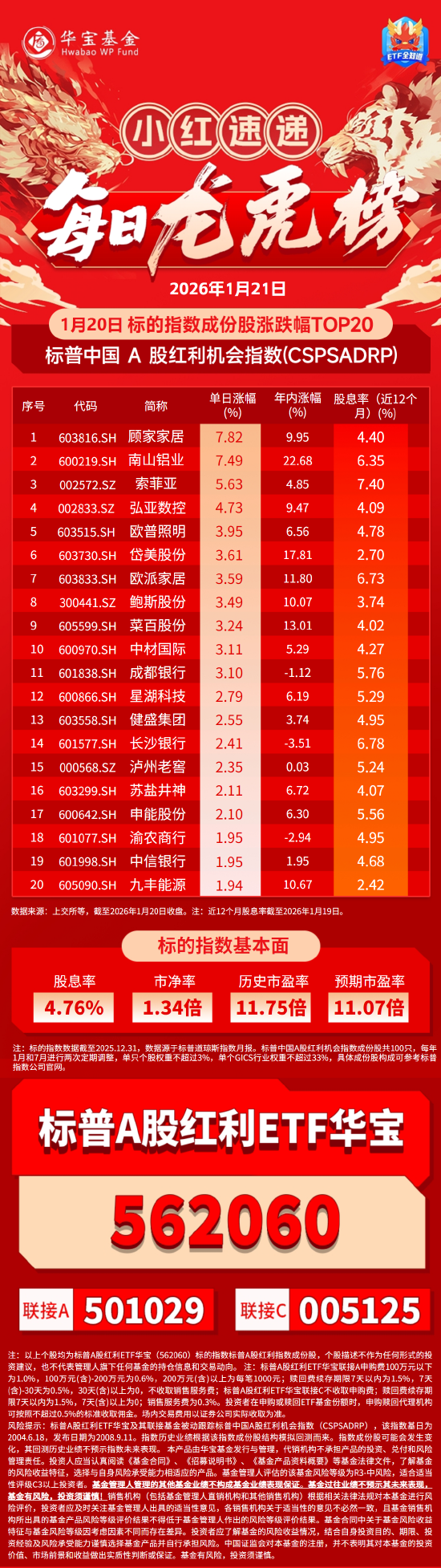
小红日报 | 顾家家居、南山铝业领涨!标普A股红利ETF华宝(562060)标的指数收涨0.74%续创新高两连阳
Xin Lang Cai Jing· 2026-01-21 01:03
Core Insights - The article highlights the top-performing stocks in the S&P China A-Share Dividend Opportunity Index as of January 20, 2026, showcasing significant daily and year-to-date gains along with dividend yields [1][5]. Group 1: Stock Performance - The top stock, Gujia Home Furnishing (603816.SH), experienced a daily increase of 7.82% and a year-to-date increase of 9.95%, with a dividend yield of 4.40% [1][5]. - Nanshan Aluminum (600219.SH) ranked second with a daily rise of 7.49% and a year-to-date increase of 22.68%, offering a dividend yield of 6.35% [1][5]. - Other notable performers include Jia Fei Industry (002572.SZ) with a daily increase of 5.63% and a year-to-date increase of 4.85%, and Hongya CNC (002833.SZ) with a daily rise of 4.73% and a year-to-date increase of 9.47% [1][5]. Group 2: Dividend Yields - The average dividend yield for the index is reported at 4.76%, with historical and expected price-to-earnings ratios at 1.34 times and 11.75 times, respectively [2]. - The dividend yields of the top stocks range from 2.42% for Jiufeng Energy (605090.SH) to 7.40% for Jia Fei Industry (002572.SZ) [1][5]. Group 3: Technical Indicators - The article mentions the formation of a MACD golden cross signal, indicating a positive trend for the stocks listed [4][8].





银行“开门红”信贷调查: 盛宴下的风险底线
Zhong Guo Zheng Quan Bao - Zhong Zheng Wang· 2026-01-20 23:26
年初历来是银行信贷投放的"黄金窗口期"。为冲刺"开门红"业绩,多家银行通过下调利率、提速审批来 争夺优质客户。在社交平台上,不少贷款中介借此宣称银行"悄然放宽了信贷审批标准"。 中国证券报记者调研发现,尽管银行员工为完成业绩指标(有的银行要求1月完成全年贷款任务的30% 以上)而积极营销,甚至承诺若后续贷款降息可协助客户调整利率,但所谓的审批"放水"仅是贷款中介 的营销话术。银行实际的贷款审批,依然严格遵循大数据风控模型,对客户资质与资金用途进行审慎把 控。 ● 张佳琳 李蕴奇 "这个贷款利率是近期最低价" 从事贷款中介多年的小李告诉记者:"在不同的月份,从银行贷款的'含金量'和'难度'是不同的。每年1 月都是银行'开门红'的关键期,此时从银行贷款能够实现额度放水、利率最低、审批开绿灯。" 小李特意嘱咐,哪怕现在不急着用钱,也要在1月把贷款办下来,别拖到2月。原因在于,经过1月的贷 款投放,很多银行的阶段性额度已经消耗殆尽。到了2月,银行会收紧口子,贷款审批标准也会变得严 格。 随后,记者分别以经营贷客户和消费贷客户身份,咨询了多家银行的客户经理。成都银行个贷经理小于 表示,1月正值银行"开门红"期间,为了争 ...
银行“开门红”信贷调查:利率“探底” 中介喊“放水” 盛宴下的风险底线
Zhong Guo Zheng Quan Bao· 2026-01-20 23:24
Core Insights - The beginning of the year is traditionally a "golden window" for bank credit issuance, with banks lowering interest rates and speeding up approvals to attract quality clients [1][2] - Despite claims from loan intermediaries about relaxed credit approval standards, banks are maintaining strict adherence to big data risk control models for client qualifications and fund usage [1][8] Group 1: Loan Market Dynamics - January is a critical period for banks to achieve "opening red" performance, with some banks potentially relaxing approval standards to attract clients [2][4] - Loan intermediaries are leveraging the perception of relaxed approval standards to market their services, often charging fees between 2% to 7% for low-interest loans [7] - Banks are actively promoting various loan products, with competitive interest rates and promotional activities to enhance customer acquisition [3][5] Group 2: Bank Performance and Strategies - Many banks have initiated project preparations by the end of the previous year to ensure strong performance in January, with some branches reporting significant loan disbursements [4][6] - Retail loan marketing strategies include comprehensive training for staff to ensure they can effectively meet customer needs and provide one-stop services [5] - Banks are focusing on differentiated marketing strategies and performance incentives to achieve their monthly targets, with some branches exceeding their goals significantly [4][6] Group 3: Risk Management and Customer Experience - Banks are maintaining strict loan approval standards, with a focus on customer creditworthiness and the intended use of funds, despite the pressure to meet performance targets [7][8] - The use of big data in loan approval processes is emphasized, ensuring that any discrepancies in customer information are identified [7] - Banks are encouraged to enhance customer experience through tailored repayment plans and personalized services, rather than solely competing on interest rates [8]
利率“探底” 中介喊“放水” 银行“开门红”信贷调查:盛宴下的风险底线
Zhong Guo Zheng Quan Bao· 2026-01-20 23:14
Core Insights - The article discusses the competitive landscape of bank lending during the "golden window period" in January, where banks aim to achieve strong performance by lowering interest rates and speeding up approvals to attract quality clients [1][2][4]. Group 1: Lending Practices - Many banks are actively marketing loans and may appear to relax approval standards during January, but actual loan approvals remain strictly governed by data-driven risk control models [1][7]. - Loan intermediaries are leveraging the perception of relaxed approval standards to promote their services, often exaggerating the ease of obtaining loans [7][8]. - Banks are offering various promotional activities, such as consumer vouchers and interest subsidies, to attract customers, with some banks reporting competitive rates as low as 2.7% for business loans and 3.0% for consumer loans [3][4]. Group 2: Performance Metrics - Several banks have set ambitious performance targets for January, with some requiring over 30% of their annual loan targets to be met within the first month [1][4]. - For instance, a regional bank reported achieving 118% of its January loan target in the first half of the month, indicating a strong push for loan growth [4][5]. - Another bank highlighted its proactive approach by preparing for the "golden window" period in advance, resulting in significant loan growth early in the year [6]. Group 3: Marketing Strategies - Banks are employing various marketing strategies, including specialized training for staff to ensure they can effectively communicate loan products and services to potential clients [5]. - Some banks are utilizing social media to promote their loan products, offering incentives such as cash discounts for applicants [8]. - The competitive environment has led to banks focusing on customer experience and differentiated services to enhance their appeal beyond just pricing [8].
利率“探底” 中介喊“放水” 银行“开门红”信贷调查: 盛宴下的风险底线
Zhong Guo Zheng Quan Bao· 2026-01-20 21:57
年初历来是银行信贷投放的"黄金窗口期"。为冲刺"开门红"业绩,多家银行通过下调利率、提速审批来 争夺优质客户。在社交平台上,不少贷款中介借此宣称银行"悄然放宽了信贷审批标准"。 中国证券报记者调研发现,尽管银行员工为完成业绩指标(有的银行要求1月完成全年贷款任务的30% 以上)而积极营销,甚至承诺若后续贷款降息可协助客户调整利率,但所谓的审批"放水"仅是贷款中介 的营销话术。银行实际的贷款审批,依然严格遵循大数据风控模型,对客户资质与资金用途进行审慎把 控。 ● 张佳琳 李蕴奇 "这个贷款利率是近期最低价" 从事贷款中介多年的小李告诉记者:"在不同的月份,从银行贷款的'含金量'和'难度'是不同的。每年1 月都是银行'开门红'的关键期,此时从银行贷款能够实现额度放水、利率最低、审批开绿灯。" 小李特意嘱咐,哪怕现在不急着用钱,也要在1月把贷款办下来,别拖到2月。原因在于,经过1月的贷 款投放,很多银行的阶段性额度已经消耗殆尽。到了2月,银行会收紧口子,贷款审批标准也会变得严 格。 随后,记者分别以经营贷客户和消费贷客户身份,咨询了多家银行的客户经理。成都银行(601838)个 贷经理小于表示,1月正值银行"开门 ...

银行“开门红”信贷调查:盛宴下的风险底线
Zhong Guo Zheng Quan Bao· 2026-01-20 21:05
● 张佳琳 李蕴奇 "这个贷款利率是近期最低价" 从事贷款中介多年的小李告诉记者:"在不同的月份,从银行贷款的'含金量'和'难度'是不同的。每年1 月都是银行'开门红'的关键期,此时从银行贷款能够实现额度放水、利率最低、审批开绿灯。" 小李特意嘱咐,哪怕现在不急着用钱,也要在1月把贷款办下来,别拖到2月。原因在于,经过1月的贷 款投放,很多银行的阶段性额度已经消耗殆尽。到了2月,银行会收紧口子,贷款审批标准也会变得严 格。 随后,记者分别以经营贷客户和消费贷客户身份,咨询了多家银行的客户经理。成都银行个贷经理小于 表示,1月正值银行"开门红"期间,为了争夺客户,有些银行可能会在审批尺度上有所放松。目前,成 都银行消费贷最低利率是3.0%,并且有消费券补贴和贴息活动。 "现在申请消费贷,能够领取100元消费券,可以抵扣现金使用。而且有贴息活动,消费贷用于消费的 话,利息最高可以返1500元,十分划算。"小于说。 1月20日,招商银行贷款经理小全在得知记者有贷款需要后,力劝即刻申请贷款。小全说,目前该行经 营贷利率最低为2.7%,消费贷利率最低为3.0%。小全说:"这个贷款利率是近期的最低价。如果您贷完 以后,我 ...
警惕“包过话术”!银行“开门红”贷款调查
Zhong Guo Zheng Quan Bao· 2026-01-20 15:02
Core Viewpoint - Banks are reportedly relaxing credit approval standards during the "opening red" period to attract quality loan customers, although this is often exaggerated by loan intermediaries as a marketing tactic [1][3]. Group 1: Bank Strategies - Banks are engaging in a "price war" and "efficiency war" by lowering loan interest rates and speeding up approval processes to capture quality clients at the beginning of the year [2]. - For instance, China Merchants Bank offers a minimum business loan rate of 2.7% and a consumer loan rate of 3.0%, while Chengdu Bank has a consumer loan rate of 3.0% with additional incentives like cash coupons [2]. - Shanghai Pudong Development Bank has a consumer loan rate of 3.1%, which can be reduced to 3.0% with coupon usage, indicating a competitive approach to attract customers [2]. Group 2: Loan Intermediaries - Loan intermediaries are capitalizing on perceived relaxed approval standards, with over half promising "guaranteed low-interest loans" [3]. - These intermediaries often misrepresent their capabilities, claiming to have "internal channels" to secure loans, which are typically just a better understanding of bank products [3]. - Industry insiders emphasize that banks maintain strict credit approval processes, and any claims of relaxed standards by intermediaries should be approached with caution [3][4]. Group 3: Regulatory Environment - During the "opening red" period, banks do increase credit supply, but they must adhere to strict regulatory requirements, ensuring thorough due diligence on borrowers' creditworthiness and loan purposes [4]. - Legal experts warn that consumers should be wary of intermediaries making false promises, as involvement in fraudulent activities can lead to serious legal consequences, including loan fraud charges [5].
