
BitGo

Search documents
X @Sei
Sei· 2025-12-18 20:06
Security & Validation - Sei ecosystem's security is anchored by institutions like Binance, Kraken, Coinbase, Anchorage, BitGo, Crypto․com, and Fireblocks [1] - These institutions form the Security & Validation System of the Market Infrastructure Grid [1] Market Infrastructure - Modern markets require enterprise-grade reliability and near-instant finality at the network layer [1] - Secure custody at the asset layer is also a necessity for modern markets [1] - Sei provides both enterprise-grade reliability and secure custody as standard [1] Global Reach - Sei is built for global markets [1] - Sei is secured by global enterprises [1]
X @Easy
Easy· 2025-12-18 14:16
It's not everyday that Messari, one of the leaders in crypto and blockchain research posts a report on a blockchain.&& I am excited to highlight && breakdown their report on @Somnia_NetworkWorking with Somnia to highlight their blockchain has been amazing, and for good reason!Messari shared some INCREDIBLE stats.Somni launched its mainnet September 2nd, 2025.Since then...⁃ Somnia has processed 10 BILLION transactions⁃ 118 MILLION+ unique wallets&& this is all before their release of their $SOMI token⁃ 14.3 ...
Morning Minute: The SEC & OCC Usher In Crypto Era
Yahoo Finance· 2025-12-15 13:43
Core Insights - The U.S. has shifted its stance on crypto regulation, allowing tokenized stock products to be launched without immediate enforcement risk [2] - The OCC has granted national bank charters to several crypto firms, integrating them into the U.S. banking framework [2][3] - These developments signal a regulatory framework for tokenized assets and stablecoins, indicating a bullish outlook for the crypto and on-chain economy [4] Regulatory Developments - The SEC's no-action letter permits certain firms to introduce tokenized stock products [2] - The OCC's approval of banking charters for firms like Circle and Ripple marks a significant step in integrating crypto into traditional finance [3] Market Implications - Tokenized stocks offer advantages such as 24/7 trading, global access, instant settlement, and programmable ownership, enhancing the appeal of crypto over traditional stock trading [5][6] - The integration of crypto into traditional finance suggests that historical barriers are diminishing, raising questions about future demand and asset performance [6] Industry Trends - The rise of tokenized equities, stablecoins, and real-world assets (RWAs) is gaining momentum across various blockchain platforms [3] - The gap between traditional finance (TradFi) and decentralized finance (DeFi) is narrowing, with stablecoins being recognized as regulated money [7]
美国银行可以“炒币”了?加密货币公司“持证”开启金融新玩法!
Sou Hu Cai Jing· 2025-12-15 11:47
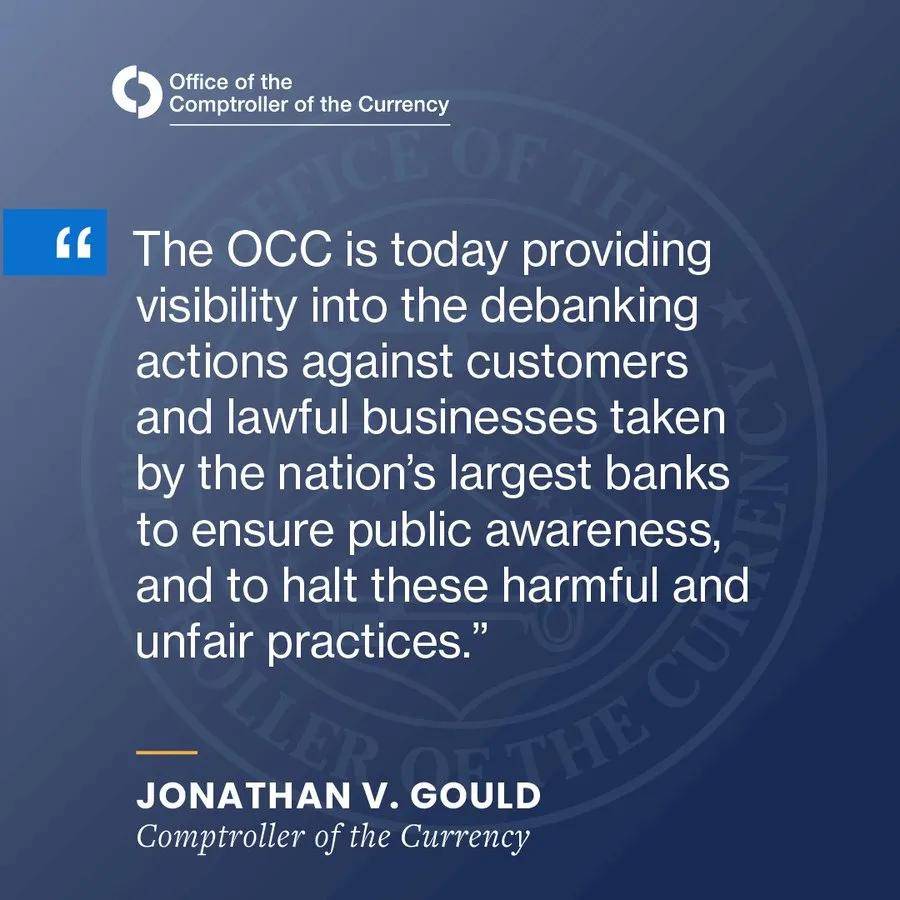
Core Viewpoint - The recent regulatory changes in the U.S. financial landscape signify a pivotal shift for the cryptocurrency industry, moving from a state of "debanking" to a new era of integration between traditional banking and digital assets [1][12]. Group 1: Debanking Issue - The OCC's report confirms systemic exclusion of cryptocurrency companies from banking services by major banks, highlighting the challenges faced in obtaining basic banking services [2][3]. - Major banks, including JPMorgan Chase and Bank of America, have been identified as engaging in discriminatory practices against politically controversial industries, including cryptocurrency [2][3]. Group 2: Regulatory Changes - The OCC has conditionally approved five major cryptocurrency companies for national trust bank charters, allowing them to operate under federal oversight rather than state-by-state regulations [6][7]. - The approved companies include Ripple, Circle, BitGo, Paxos, and Fidelity Digital Assets, marking a significant recognition of compliant crypto firms within the national financial system [8]. Group 3: Banking Participation in Crypto - The OCC's interpretive letter clarifies that banks can engage in "riskless principal trades," allowing them to facilitate cryptocurrency transactions without holding the assets themselves [10][11]. - This enables traditional banks to offer cryptocurrency brokerage services to their clients, integrating crypto trading into their existing platforms [11]. Group 4: Market Implications - The regulatory changes are expected to create a more equitable competitive environment for cryptocurrency companies, enhancing their legitimacy and access to institutional markets [14]. - Traditional banks are presented with new growth opportunities in the cryptocurrency space, allowing them to compete with native exchanges like Coinbase and Binance without incurring significant risks [14]. - The integration of cryptocurrency into the traditional financial system could lead to substantial inflows of capital into the crypto market, accelerating the convergence of crypto and traditional finance [14].

US Just Approved Ripple and Other Major Firms Into Banking System — Here’s Where XRP Fits In
Yahoo Finance· 2025-12-15 10:38
Core Insights - The U.S. banking system has opened its doors to major players in the crypto industry, with the OCC conditionally approving five firms, including Ripple and Circle, to operate as national trust banks [1][2][3] Group 1: Regulatory Developments - The OCC's decision signals a move towards integrating parts of the crypto sector into the traditional financial framework [2] - Five crypto firms received conditional approval to establish or convert into national trust banks, joining approximately 60 other national trust banks already overseen by the OCC [3][4] - The approval builds on a precedent set in 2021 when Anchorage Digital became the first crypto-focused firm to receive a national trust charter [5] Group 2: Operational Scope - The approved firms are not allowed to take deposits or issue loans but can custody assets, process payments, and provide fiduciary services under federal supervision [4] - All five firms must meet capital, governance, compliance, and risk-management conditions before becoming fully operational [4] Group 3: Industry Reactions - The OCC's move is seen as a regulatory win for crypto companies, providing long-awaited regulatory clarity [6] - Ripple's inclusion could strengthen its institutional footprint over time, particularly for its dollar-backed stablecoin, RLUSD, which is now under federal and state supervision [7][9] - Traditional banking groups expressed concerns, warning about unresolved questions regarding regulatory consistency and oversight [9]
Mike Belshe Claims BitGo Outsmarts the SEC’s Custody Rules
Yahoo Finance· 2025-12-14 21:33
Core Insights - BitGo positions itself as the only provider offering all custody options described by the SEC, following its recent regulatory approval to operate as a bank, which enhances its institutional services [2][4]. Group 1: Custody Options - BitGo allows institutions to combine self-custody and third-party custody into a single hybrid strategy, creating custom risk profiles that are unique to its platform [3][4]. - The SEC bulletin outlines two primary models of crypto custody, but BitGo enables clients to utilize both models simultaneously, providing flexibility [4]. Group 2: Asset Storage and Security - Under BitGo's framework, 90% of client assets can be stored in BitGo Trust cold storage, ensuring regulatory compliance, insurance, and security, while the remaining 10% can be in self-custody hot wallets for operational flexibility [5]. - This hybrid approach reduces single points of failure, as assets in the trust remain safe even if self-custody keys are lost, unlike traditional exchanges that risk freezing all funds during insolvency [5]. Group 3: Regulatory Compliance and Insurance - BitGo Bank & Trust, NA, a federally chartered national bank, supports the platform's third-party custody solution and is subject to regular SOC 1 Type 2 and SOC 2 Type 2 audits [6]. - The bank supports over 1,400 coins and tokens under segregated accounts, backed by a $250 million insurance policy from Lloyd's of London syndicates [7]. - BitGo maintains strict 1:1 custody standards, ensuring that client assets are not rehypothecated, lent, or commingled [7].
US Banks Warn OCC Crypto Charters Could Weaken The Banking System
Yahoo Finance· 2025-12-13 13:00
Core Viewpoint - The US banking industry is challenging the OCC's efforts to integrate cryptocurrency firms into the federal banking system, arguing that it creates a two-tier banking system that undermines traditional banking standards [1][2][3]. Group 1: OCC's Conditional Approval - The OCC has granted conditional approval for national trust charters to five digital asset firms, including Ripple, Fidelity, Paxos, First National Digital Currency Bank, and BitGo, emphasizing that these firms underwent a rigorous review process similar to traditional banks [1]. Group 2: Concerns from Banking Associations - The American Bankers Association (ABA) and the Independent Community Bankers of America (ICBA) argue that the OCC's actions allow fintech and crypto firms to obtain national charters without the necessary FDIC coverage or meeting traditional capital and liquidity standards [2]. - These groups claim that the new structure promotes regulatory arbitrage, allowing crypto firms to benefit from federal preemption of state laws while avoiding compliance obligations that apply to insured banks [3]. Group 3: Implications for Banking Definitions - ABA President Rob Nichols expressed concerns that the approvals blur the lines of what constitutes a bank, potentially weakening the integrity of the banking charter [4]. - There is a fear that expanding trust powers to non-traditional firms creates institutions that resemble banks but lack adequate oversight [4]. Group 4: Consumer Protection Concerns - Banking groups warn that consumers may find it difficult to differentiate between insured banks and national trust institutions that hold large amounts of uninsured crypto assets [5]. - They argue that the OCC has not sufficiently addressed how it would manage the failure of such entities, especially if they hold billions of dollars in digital assets outside the traditional safety net [5].
OCC Clears Circle, Ripple and Others to Launch Crypto National Banks
Yahoo Finance· 2025-12-13 08:18
Core Insights - The US Office of the Comptroller of the Currency (OCC) has approved five crypto companies, including Circle and Ripple, to establish national trust banks, marking a significant regulatory move to integrate crypto into the banking system [1][4][9] Group 1: Regulatory Developments - The approvals represent a proactive step by the Trump administration to incorporate cryptocurrency into the regulated banking framework [3] - The national trust bank charter allows these firms to custody assets and provide select banking services without accepting deposits or issuing loans [4] - The OCC has also permitted BitGo, Fidelity Digital Assets, and Paxos to convert existing state trust companies into federally chartered banks [5] Group 2: Operational Implications - The new charter enables firms to operate under a unified national standard, alleviating the challenges of navigating various state regulations [6] - Paxos is specifically authorized to issue stablecoins under federal oversight, while Ripple's charter prohibits the issuance of its US dollar-pegged RLUSD through the bank [6][9] Group 3: Industry Perspective - Crypto firms assert that a national trust bank charter enhances clarity and boosts client confidence, particularly in custody and settlement services [7] - The move is seen as a way for stablecoin issuers to gain credibility with corporate partners and differentiate themselves from less regulated competitors [7] - The OCC's actions are viewed as a means to ensure the federal banking system evolves alongside advancements in finance [7] Group 4: Market Context - The approvals come at a time when the crypto industry is striving for greater legitimacy in Washington, with several public listings anticipated in 2025 [8] - tZero Group, a blockchain infrastructure firm, has announced plans to go public in 2026, indicating growing interest in the sector [8]
X @CoinMarketCap
CoinMarketCap· 2025-12-13 00:29
LATEST: 🇺🇸 The US Office of the Comptroller of the Currency has granted conditional approval for national banking charters for Circle, Ripple, BitGo, Paxos, and Fidelity. https://t.co/kQBCxoSrFG ...