派拉蒙全球

Search documents
Trump’s Market Mayhem: A Daily Dose of Economic Whimsy
Stock Market News· 2025-10-03 06:00
Pharmaceutical Industry - President Trump's 100% tariff on branded pharmaceutical imports took effect on October 1st, causing initial declines in shares of European and Asian drugmakers, with Novo Nordisk experiencing the largest drop [2][3] - Pfizer announced a deal with the Trump administration to cut drug prices and invest $70 billion in U.S. research and manufacturing, receiving a three-year exemption from the tariffs, which led to a surge in its stock price [3][4] - Analysts suggest Pfizer's deal could serve as a model for other drugmakers, but caution that the financial impact may be more about optics than substantial change [4] Trucking Industry - A 25% tariff on heavy trucks imported from other countries began on October 1st, aimed at protecting U.S. manufacturers [5][6] - Shares of Daimler Truck and Traton fell by 2% and 2.4% respectively, with analysts estimating a potential €700-800 million impact on Daimler's earnings, though some losses could be offset by price increases [6] - Volvo Group, which produces all its U.S. trucks domestically, saw a 3.5% increase in shares, while analysts predict increased operational costs and reduced freight demand for trucking stocks like J.B. Hunt and UPS [6] Entertainment Industry - A 100% tariff on movies made outside the U.S. was announced, leading to declines in shares of Indian media stocks and major U.S. media companies, including Netflix and Amazon [9][10] - Analysts expressed concerns that the tariffs could lead to reduced content production and increased costs for consumers [10] Agriculture Sector - President Trump announced a meeting with Chinese President Xi Jinping to discuss agriculture, particularly soybeans, which led to a 1.3% increase in Chicago soybean futures [10][11] - Analysts noted that while the announcement provided support, the underlying issues caused by previous tariffs may not be resolved [11] Government Operations - The U.S. government shutdown began on October 1st, with a muted market reaction, as the S&P 500 saw a slight decline and the Nasdaq Composite managed a small gain [13][14] - Analysts viewed the shutdown as political theater with limited immediate impact, but some warned that the current economic conditions could make the situation more detrimental than in previous shutdowns [14]



Financial Market Wrap: Farmer Bailouts, AI Acquisitions, and a Stagnant Labor Market
Stock Market News· 2025-10-02 20:08
Economic Overview - The U.S. labor market is showing signs of significant slowdown, with employer hiring plans at their lowest in 16 years, indicating a stagnant labor market [3][8] - Money market funds have seen a substantial increase of $50.55 billion, reaching a total of $7.37 trillion for the week ending October 1st, reflecting investors' preference for liquidity and safety [4][8] Trade Policies and Agricultural Aid - The Trump administration is considering a bailout package for U.S. farmers, estimated between $10 billion to $14 billion, primarily targeting soybean producers and funded by tariff revenues [5][8] - Wall Street firms are purchasing Trump tariff refund rights from cash-strapped U.S. importers, betting on potential Supreme Court rulings that could lead to multibillion-dollar payouts [6][8] Corporate Developments - Uber Technologies Inc. has acquired Segments.ai, a Belgian data labeling startup, to enhance its AI service offerings and expand its data-labeling business [7][8] - Tesla reported record deliveries in Q3 2025, driven by U.S. consumers utilizing expiring federal EV tax credits, although concerns about future demand and weakness in the European market persist [10][8] - Members of USW Local 2020-05 ratified a new four-year collective agreement with Vale, securing a 5% wage increase in the first year and 3% annual increases thereafter [9]



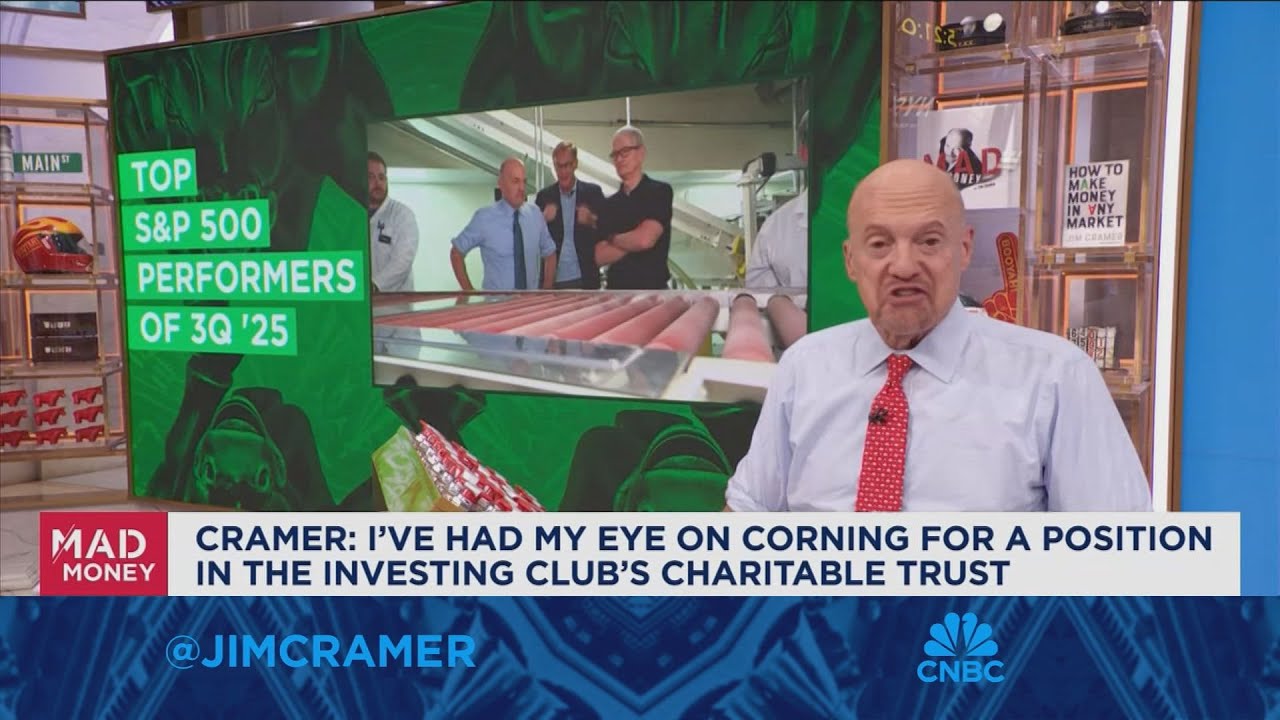
Embrace the tape Q3 winners can still rally, says Jim Cramer
Youtube· 2025-10-01 23:57
Core Viewpoint - The third quarter's stock performance reveals significant winners and losers, with a focus on the implications of the government shutdown being less impactful on stock performance than initially thought [2][4]. Group 1: Third Quarter Winners - Apploven emerged as the best-performing S&P 500 stock, rallying 105% in the third quarter, driven by its mobile technology services for app developers [5][6]. - Western Digital and Seagate Technologies also performed well, with Western Digital up nearly 88% and Seagate up almost 64%, benefiting from the market's demand for data storage solutions [7][8]. - Warner Brothers Discovery saw a resurgence with a 70% increase, attributed to an improved balance sheet and potential takeover discussions [9][10]. - Corning, known for its glass products, rallied 56% due to its fiber optic glass technology, which is crucial for data centers [12][13]. - Teradyne, a semiconductor test equipment manufacturer, increased by 53% for the quarter, showcasing its strong market position [14]. - Robinhood, appealing to younger investors, rose 53% as it integrated cryptocurrency into its offerings [17][18]. - Intel's stock appreciated nearly 50% under new leadership, focusing on balance sheet improvements and strategic partnerships [19]. - Invesco, a money management firm, saw a 45% increase, reflecting the overall positive market conditions [20][21]. Group 2: Third Quarter Losers - Chipotle was identified as a potential comeback candidate despite a 30% decline, as the company has a history of recovery after management adjustments [22]. - Other notable losers included managed care, cable, used cars, and Invisalign braces, which are viewed as less likely to rebound in the near term [23]. Group 3: Market Outlook - The overall sentiment suggests that the winners from the third quarter are likely to continue performing well through the end of the year, although the most significant gains may have already been realized [24].


Trump's threats against late-night TV could spell more trouble for advertisers
CNBC· 2025-10-01 13:15
Core Insights - The recent turmoil in late-night television, including the cancellation of "The Late Show with Stephen Colbert" and the temporary suspension of "Jimmy Kimmel Live!", has raised concerns about ratings and revenue in this segment [2][3] - The situation has highlighted the importance of live programming for advertisers and media companies, as it represents one of the few remaining options for reaching engaged audiences [3][4] - The cancellation of Colbert's show and the suspension of Kimmel's show have led to significant viewer interest, resulting in temporary ratings surges that advertisers missed out on [6][7] Industry Impact - The cancellation of "The Late Show with Stephen Colbert" by CBS parent Paramount was driven by financial considerations, indicating a shift in the economic landscape of late-night programming [6] - Disney's ABC faced challenges when "Jimmy Kimmel Live!" was pulled off the air, with over 20% of the country unable to watch the show for several days due to preemptions by major broadcast station owners [5] - The advertising landscape for late-night television is under pressure, as the loss of key shows diminishes options for advertisers who rely on live content to engage viewers [3][4]


Some employers are offering reluctant RTO employees severance packages instead — but they come with a catch
Yahoo Finance· 2025-09-30 12:30
Core Insights - The article discusses the shift in employer policies regarding return-to-office (RTO) mandates and severance packages, indicating a trend towards less favorable conditions for employees [5][6]. Group 1: Employer Policies - Companies like Amazon, NBCUniversal, and Microsoft are enforcing RTO mandates, with Amazon requiring employees to return to specific locations or resign without severance [4][5]. - NBCUniversal has implemented a universal severance package that does not account for years of service, offering a flat-rate severance of eight weeks' salary and three months of healthcare coverage [2][3]. Group 2: Employee Sentiment - A survey by GoTo revealed that only 46% of Americans support returning to in-person work, with 35% considering job changes if forced back full-time [6]. - The article notes that many employees are dissatisfied with the RTO policies, reflecting a shift from the previous employee-friendly market during the pandemic [5]. Group 3: Economic Context - The Bureau of Labor Statistics reported that only 22,000 jobs were added in August, with the unemployment rate rising to 4.3%, indicating a challenging job market for employees [5]. - The article suggests that the current labor market dynamics are favoring employers, allowing them to impose stricter RTO policies and severance terms [5].


YouTube Agrees To Settle Donald Trump Lawsuit For $24.5 Million
Deadline· 2025-09-29 22:17
Core Points - YouTube has agreed to pay $24.5 million to settle a lawsuit filed by Donald Trump after his account was suspended following the U.S. Capitol riot [1] - This settlement makes YouTube/Google the last of the three tech giants, including Meta and Twitter, to resolve legal actions initiated by Trump [1] - Meta previously settled for $25 million, with $22 million allocated to Trump's presidential library and the remainder for legal fees [2] - Twitter, now known as X, settled for $10 million [2] - Google executives aimed to keep their settlement amount lower than Meta's, with Trump's share of the YouTube settlement designated for a new ballroom at the White House [3] - Trump has been successful in securing cash from various legal settlements, including $16 million from Paramount and Disney for separate defamation lawsuits [4]


A Universal-DreamWorks movie is bringing the winning formula of kids content frenzy to the big screen
CNBC· 2025-09-28 12:00
Core Insights - The transition of "Gabby's Dollhouse" from streaming to theatrical release reflects the growing importance of children's programming in the media landscape, aiming to leverage existing fandom and expand brand awareness [2][3][4] Group 1: Industry Trends - Children's programming has gained significance as studios seek to drive subscriber growth amidst the shift from linear TV to streaming [3][7] - The pandemic and Hollywood labor strikes have caused a production slowdown, leading to a scarcity of family-friendly films, which "Gabby's Dollhouse: The Movie" aims to address [6][7] Group 2: Company Strategy - DreamWorks Animation is capitalizing on the established popularity of "Gabby's Dollhouse," which has run for 11 seasons since its Netflix launch in 2021, to create a theatrical experience that engages young audiences [4][6] - The film's release is strategically timed to fill a gap in family-friendly content in theaters, following limited options in recent months [6][7] Group 3: Audience Engagement - Young viewers are highly engaged with streaming content, often rewatching their favorite shows, which presents a unique opportunity for studios to expand their reach through theatrical releases [8] - The interactive elements of "Gabby's Dollhouse," such as audience participation, are designed to enhance the theatrical experience for children [5][6]

Disney doesn't need ABC and ESPN, analyst argues
Youtube· 2025-09-27 03:45
Group 1: Media Landscape and Company Strategies - The refusal of Sinclair and NextStar to air "Jimmy Kimmel Live" on their ABC affiliates raises questions about Disney's future in linear TV, with suggestions that Disney might consider divesting from ABC entirely [1][4] - The situation with Kimmel highlights the challenges for traditional media companies, as content is increasingly pushed towards streaming platforms, which could harm the long-term viability of broadcast television [7][10] - The ongoing trend of cord-cutting and the shift of advertising to streaming platforms are significant headwinds for broadcast networks, making consolidation within the industry a potential necessity for survival [9][14] Group 2: Consolidation and Future of Streaming Services - Industry experts predict that more media companies will need to consolidate due to the structural challenges in the market, with a focus on creating larger, more competitive streaming services [14][18] - The integration of Hulu into Disney Plus is anticipated, indicating a trend towards fewer standalone streaming services as companies seek to streamline operations and enhance scale [15][16] - The potential acquisition of Warner Brothers by Paramount is under scrutiny, with concerns about the financial feasibility of such a deal given the current market conditions [20][22] Group 3: TikTok and Competitive Landscape - The recent joint venture involving TikTok suggests that the platform will maintain its existing user experience and algorithm, countering expectations of significant changes following the deal [26][28] - The partnership is seen as beneficial for both TikTok and its parent company ByteDance, while also indicating that competitors like Meta and Snapchat will not see a reduction in competition from TikTok [28][29]

Trump Approves TikTok Deal Separating U.S. Operations From China HQ; Oracle Among Backers Of New Joint Venture
Deadline· 2025-09-25 20:34
Core Points - President Trump signed an executive order allowing ByteDance to divest TikTok's U.S. operations, complying with a 2024 law [1][6] - A consortium led by Oracle chairman Larry Ellison and Dell Technologies CEO Michael Dell is set to take control of TikTok's U.S. operations through a joint venture [1] - ByteDance will retain a 19.9% stake in the joint venture, while its current investors will hold 35% [2] Data Management and Structure - Oracle will manage TikTok's data, leveraging its existing cloud deal with ByteDance [3] - The new joint venture will have a board consisting of seven members, with six being American [3] - The consortium structure ensures equal shares among members, preventing any single entity from merging TikTok with other media assets [5] Legislative Context - Last year, Congress passed a law mandating ByteDance to divest TikTok in the U.S. or face a ban, which was upheld by the Supreme Court [6] - Trump's executive order has extended the deadline for this divestment as the new business arrangement is finalized [6]


Reshaping the Landscape of TMT M&A Through Intellectual Property
Medium· 2025-09-25 03:01
Core Insights - The Federal Reserve's recent 25bps rate cut and potential fiscal easing are expected to stimulate M&A activity, particularly in the TMT sector, which has shown resilience with a 33% increase in deal value to $146 billion [1] - Intellectual property (IP) is becoming a central asset in TMT M&A, influencing valuations and strategic directions, as companies seek to acquire content libraries and franchises to enhance user engagement and competitive positioning [2] M&A Activity Highlights - Microsoft's acquisition of Activision Blizzard for $68.7 billion in 2023 is the largest gaming deal in history, allowing Microsoft to control significant IPs and become the third-largest gaming platform by revenue [3][4] - The deal was justified by the recurring monetization potential from subscriptions and in-game purchases, supported by Activision's 400 million monthly active users [4] - Skydance Media's merger with Paramount Global for $28 billion aims to create a media and technology leader, leveraging Paramount's extensive IP and streaming platforms to enhance distribution and production capabilities [6][7] Strategic Importance of IP - The integration of Activision's library into Microsoft's Game Pass and Xbox Cloud Gaming has proven beneficial, with gaming revenue reaching $2 billion and Xbox content growing by 16% [5] - Paramount's acquisition of UFC for $7.7 billion is positioned as a strategic move to enhance its sports IP portfolio, transitioning UFC events from pay-per-view to subscription models, thereby increasing engagement and retention [9][10] - The valuation of IP in these transactions reflects a shift towards viewing IP as a recurring, ecosystem-driven asset rather than just a one-time revenue generator [16][20] Future Outlook - The long-term growth potential of the media industry remains strong, driven by increasing consumption and the central role of IP across various entertainment formats [22] - Companies must be cautious in their M&A strategies, ensuring they have the scale and platforms to fully leverage acquired IP, as today's high premiums could lead to future valuation challenges [23]