
Samsung

Search documents
人工智能供应链:台积电展望、ASIC 最新动态、OCP 对 AI 半导体的影响- Technology-AI Supply Chain TSMC outlook, ASIC updates, OCP implication for AI Semis
2025-10-21 01:52
Summary of Key Points from the Conference Call Industry Overview - The conference call primarily discusses the **AI semiconductor industry**, with a focus on **TSMC** (Taiwan Semiconductor Manufacturing Company) and its outlook for 2026, as well as implications for AI supply chains and related technologies [1][2][58]. Core Insights and Arguments - **Strong AI Demand**: TSMC reported that AI demand is stronger than previously anticipated, with expectations of a **mid-40% CAGR** over the next five years, even with potential restrictions on foreign AI GPUs in China [2][58]. - **Capacity Management**: TSMC is actively working to close the gap between demand and supply for both CoWoS (Chip on Wafer on Substrate) and wafer front-end capacity. The company maintains that its capacity for CoWoS can be expanded within **six months** if needed [2][58]. - **Prioritization of AI Semiconductors**: TSMC's wafer front-end capacity is tight, but AI semiconductors will be prioritized over other applications like crypto mining and Android smartphone SoCs [2][58]. - **Bottlenecks in Supply Chain**: Potential bottlenecks in the AI semiconductor supply chain may arise from niche memory and server racks rather than TSMC's production capacity [1][58]. Key Developments in AI Infrastructure - **OCP Initiatives**: The Open Compute Project (OCP) introduced standards for AI infrastructure, including **Open Datacenter for AI** and **Open Cluster Design for AI**, which aim to streamline procurement and deployment processes [3][10][58]. - **AI Clusters**: The industry is moving towards clusters with **100k GPUs or more**, which necessitates ethernet-first designs and liquid cooling solutions as standard for new AI racks [8][10][58]. Market Dynamics and Customer Insights - **Customer Demand**: Major customers like NVIDIA, Broadcom, and AMD are expected to see significant growth in CoWoS capacity demand, with NVIDIA's demand projected to increase from **53k wafers in 2023** to **685k wafers in 2026** [36][39][58]. - **AI Capex Growth**: The AI server capital expenditure (capex) is expected to grow by approximately **70% year-over-year in 2026**, driven by strong demand for AI infrastructure [57][58]. Additional Insights - **Data Center Constraints**: While semiconductor capacity is no longer the primary constraint, challenges now lie in data center space, power availability, and supporting infrastructure, which require longer planning cycles [26][58]. - **Growing AI Inference Demand**: There is a notable increase in AI inference demand, with significant growth in token processing by major cloud service providers (CSPs) [60][58]. - **Investment Recommendations**: The report maintains an **overweight (OW)** rating on several companies in the AI semiconductor space, including TSMC, Samsung, Alchip, and MediaTek, indicating a positive outlook for these stocks [58][72]. Conclusion - The AI semiconductor industry is poised for robust growth, driven by strong demand and strategic capacity management by key players like TSMC. However, potential supply chain bottlenecks and infrastructure constraints may pose challenges moving forward.


Grail Inc. Early Cancer Detection News Boosts Healthcare Tech ETF HTEC
Etftrends· 2025-10-20 21:21
Core Insights - Healthcare technology is positioned as a durable investment sector with significant potential for innovation, particularly in uncertain market conditions [1] - Grail, Inc (GRAL) has partnered with Samsung to expand its early cancer detection services into Asia, with an initial focus on South Korea and potential expansion to Japan and Singapore [2] - The partnership includes a $110 million investment from Samsung, which will enhance GRAL's financial stability as it seeks FDA approval in the U.S. [2] - The deal is expected to positively impact the broader Multi-Cancer Early Detection (MCED) market, potentially benefiting companies like Guardant Health (GH) and Exact Sciences (EXAS) [2] - The HTEC ETF, which tracks healthcare technology companies, has shown strong performance, returning 13.5% over the last three months and outperforming the category average [3] Company Developments - GRAL's collaboration with Samsung marks a significant market expansion for its early cancer detection technology [2] - The investment from Samsung is a crucial cash injection that will support GRAL's operations and regulatory efforts [2] Market Trends - The MCED market is gaining momentum, with potential regulatory advancements in East Asia that could benefit other companies in the sector [2] - The HTEC ETF provides exposure to a range of healthcare technology firms, focusing on diagnostics, lab automation, regenerative medicine, and more [3] - The strong performance of the HTEC ETF indicates growing investor interest in healthcare technology as the MCED market evolves [3]



GRAIL (NasdaqGS:GRAL) Update / Briefing Transcript
2025-10-20 13:02
Summary of GRAIL Analyst Call Company and Industry - **Company**: GRAIL - **Industry**: Multicancer Early Detection (MCED) Key Points and Arguments 1. **Pathfinder 2 Study Results**: GRAIL presented results from the first 25,000 participants of the Pathfinder 2 study, which will be included in the PMA submission to the FDA in the first half of next year [4][10] 2. **Study Size and Design**: Pathfinder 2 is a large-scale study with 35,000 participants, focusing on the performance and safety of the Galleri test in a diverse population [4][5] 3. **Galleri Test Performance**: - Positive Predictive Value (PPV) improved to 62% from 43% in the first Pathfinder study [11] - Specificity was reported at 99.6%, indicating a false positive rate of 0.4% [12] - Negative Predictive Value (NPV) was 99.1% [12] - Episode sensitivity for all cancers was 40.4%, with higher sensitivity for aggressive cancers [12][13] 4. **Cancer Detection Rates**: - Adding Galleri to standard screenings resulted in a seven-fold increase in cancer detection rates [16] - 73% of cancers detected by Galleri do not have recommended screening options [17] - More than half of the cancers detected were in early stages (1 and 2) [20] 5. **Safety and Diagnostic Resolution**: - Only 0.6% of participants underwent invasive procedures, with no serious study-related adverse events reported [19][20] - Median time to diagnostic resolution was 36 days for true positives [19] 6. **Strategic Partnerships**: GRAIL announced a strategic partnership with Samsung, including a $110 million equity investment to commercialize Galleri in South Korea [6][8] 7. **Financial Position**: GRAIL raised $325 million through a private placement, enhancing its financial stability with a runway expected into 2030 [9] 8. **Regulatory Considerations**: The FDA has emphasized the importance of cancer signal-of-origin (CSO) directed workups and the low false positive rate as critical factors for approval [45][46] Other Important but Overlooked Content 1. **Diversity in Study Population**: The enrollment demographics were intentionally diverse to ensure the test's performance is representative of the intended use population [10] 2. **Long-term Follow-up**: Pathfinder 2 will follow participants for three years to monitor for later cancers, while NHS-Galleri will involve three rounds of screening [51] 3. **Economic Analysis**: Discussions regarding the economic benefit analysis for NHS are anticipated, with the need for cost-effectiveness evaluations based on the NHS-Galleri trial results [34][42] 4. **Clinical Utility and Reimbursement**: The relationship between clinical utility, stage shift, and reimbursement remains a key focus, with ongoing discussions expected with the NHS [42][47] This summary encapsulates the critical insights from the GRAIL analyst call, highlighting the advancements in cancer detection technology and the strategic direction of the company.
One Month With the iPhone Air: Design and Function Really Can Coexist | All Things Mobile
CNET· 2025-10-20 12:01
Camera Performance - The iPhone Air features a single 48-megapixel wide-angle rear camera with 2x optical quality zoom, a departure from multi-camera systems [3] - Image quality is comparable to other new Apple phones, excluding zoom capabilities, but may not meet expectations for a phone in the $1,000 price range [5] Battery Life - The iPhone Air's battery generally lasts a full day with moderate use on Wi-Fi, with approximately 20% remaining at bedtime [7] - Heavier usage with cellular data may require recharging during the day [7] - A 30-minute charging test showed the phone going from dead to 54% [10] - Wireless charging increased the battery from 17% to 64% in 30 minutes [10] Durability - The iPhone Air is durable and can withstand bending forces without damage [13] - Some users reported scratches potentially caused by material transfer from old in-store MagSafe displays, which can be wiped away [14] Audio Quality - The iPhone Air has a single speaker at the top, unlike the dual stereo speakers found in other iPhones [16] - The single speaker can result in lopsided audio when watching videos, which is a notable shortcoming given the phone's price [16][17]


GRAIL (NasdaqGS:GRAL) Earnings Call Presentation
2025-10-20 12:00
PATHFINDER 2 Study Key Findings - The PATHFINDER 2 study evaluated the performance and safety of the Galleri MCED test in individuals eligible for cancer screening [15, 18] - The study involved approximately 35,000 participants [11, 16] - The observed positive predictive value (PPV) across all cancers was approximately 61.6% (95% CI: 54.9-67.8%) [19] - The negative predictive value (NPV) was 99.1% (95% CI: 99.0-99.3%) [19] - The episode sensitivity was 40.4% (95% CI: 35.3-45.8%), and specificity was 99.6% (95% CI: 99.5-99.7%) [19] - For 12 cancers responsible for two-thirds of US cancer deaths, the episode sensitivity was 73.7% (65.6-80.4%) [23, 25] - MCED testing increased the number of screen-detected cancers by over 7 times when added to recommended screening [26, 43] - 73% of all MCED-detected cancers do not have recommended screening options [32] - The median time to diagnostic resolution for true positive MCED test results was 36 days (IQR: 24-61 days) [38] - 0.6% of participants had an invasive procedure to evaluate a positive MCED result, with no serious study-related adverse events reported at the time of initial analysis [41, 42]
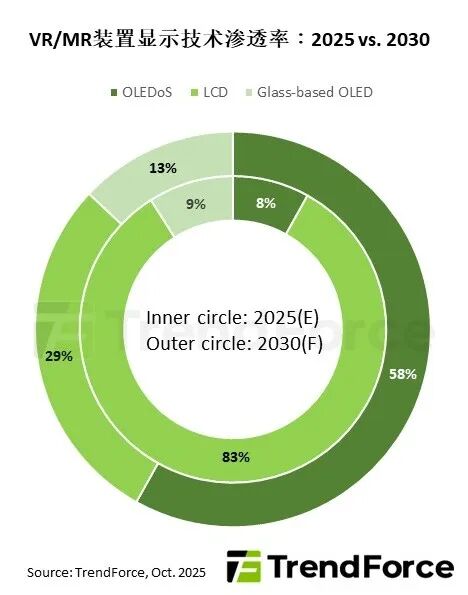
TrendForce集邦咨询:预计2030年OLEDoS于VR/MR渗透率将快速增长至58%
智通财经网· 2025-10-20 09:16
Core Insights - OLEDoS technology is experiencing breakthroughs in both supply chain and application, with a projected VR/MR penetration rate reaching 58% by 2030 [1] - Global VR/MR product shipments are expected to decline to 5.6 million units in 2025 due to underperformance from major brands, but long-term projections estimate shipments will rise to 14.4 million units by 2030 [4] - Display technology is crucial for VR/MR product pricing, with LCD remaining the mainstream choice, while OLEDoS is anticipated to gain market share as Chinese suppliers expand production [4][6] Industry Developments - Apple is enhancing its Vision Pro with the new M5 chip to improve computational power and battery life, focusing on better software experiences through generative AI [5] - Samsung is collaborating with Google and Qualcomm to launch the Galaxy XR, featuring a 4K OLEDoS display, integrating applications across mobile and tablet platforms [5] - Meta plans to utilize a 0.9-inch OLEDoS with Pancake optical architecture to meet the demand for thinner VR/MR devices, indicating a shift towards mainstream market penetration for OLEDoS [6] Supply Chain Dynamics - Over ten Chinese companies, including Seeya, BOE, and Sidtek, are establishing 12-inch OLEDoS production lines, which will help reduce production costs as yield rates improve [4][6] - The competitive landscape is shifting as international brands increasingly adopt OLEDoS technology to achieve high-resolution and lightweight VR devices [4]




研报 | 供应链与应用端双重突破,预估2030年OLEDoS于VR/MR渗透率将快速增长至58%
TrendForce集邦· 2025-10-20 09:03
Core Insights - Apple is re-entering the market with an upgraded Vision Pro, focusing on enhancing computational performance and improving weight distribution in VR/MR headsets [2] - The OLEDoS display technology is expected to see a significant increase in penetration, projected to reach 58% in VR/MR applications by 2030 [2] Market Performance - Global VR/MR product shipments are estimated to decline to 5.6 million units in 2025 due to underperformance from major brands like Meta, Apple, and Sony [4] - Long-term projections indicate that global shipments could reach 14.4 million units by 2030, driven by software and hardware upgrades from key brands [4] Technology and Supply Chain - Display technology is crucial for pricing VR/MR products, with high-cost performance LCDs remaining mainstream; however, OLEDoS is expected to gain traction as Chinese suppliers expand production [5] - Companies like Seeya, BOE, and Sidtek are establishing 12-inch production lines, which will help reduce OLEDoS production costs through improved yield rates [5] Application Development - Apple and Samsung are enhancing user experience through application platforms and generative AI, with Apple's Vision Pro utilizing the new M5 chip for better performance and battery life [5] - Samsung is collaborating with Google and Qualcomm to launch the Galaxy XR, featuring a 4K OLEDoS display, integrating applications across mobile and tablet devices [5] Industry Trends - Meta is focusing on its ecosystem while planning to use 0.9-inch OLEDoS with Pancake optical architecture to meet the demand for thinner VR/MR products [6] - OLEDoS is anticipated to penetrate from mid-to-high-end markets into mainstream markets, becoming a key driver for the transformation of the VR/MR industry [6]
Why OpenAI's deals have markets fearing a crash
Youtube· 2025-10-20 07:26
Group 1: OpenAI and Chip Deals - OpenAI has announced a deal to purchase 10 gigawatts of computer chips from Broadcom, continuing its trend of significant acquisitions in the AI sector [1] - This follows similar agreements with AMD and Nvidia, raising concerns about OpenAI's extensive connections with major US companies and the potential for an AI-driven market bubble [2][5] Group 2: Impact on European Companies - Analysts suggest that OpenAI's success could positively impact European companies like ASML, as demand and revenues flow through the supply chain from data center companies to chip manufacturers [3][4] - ASML's lithography machines are crucial for producing advanced chips, and there is optimism about ASML's earnings recovering by 2027, indicating strong market demand [15][16] Group 3: Market Valuations and Risks - The IMF's global financial stability report warns that equity and corporate credit valuations are stretched, driven by enthusiasm for AI mega-cap stocks, which could lead to a sudden market correction [5][8] - Current stock valuations are estimated to be about 10% overvalued on average, which is less than the 20% overvaluation seen during the tech bubble of 1999 [8] Group 4: Supply Chain Concerns - There are concerns about the interconnectedness of the supply chain, where issues in major tech firms could have significant knock-on effects throughout the semiconductor industry, impacting companies like Nvidia and TSMC [14][17] - If demand from hyperscalers decreases, it could lead to reduced orders for chips, affecting TSMC's capacity and subsequently ASML's machinery sales [17]
Nvidia's Real 'Bottleneck' Isn't Chips, It's Power, Says Beth Kindig, Tech Analyst Shares What It Means For AI Investors - NVIDIA (NASDAQ:NVDA)
Benzinga· 2025-10-20 06:34
Core Insights - The primary bottleneck for the AI industry's growth is shifting from chip performance to power supply, as highlighted by tech analyst Beth Kindig from I/O Fund [1][2]. Energy Sector: The Next AI Investment Frontier - The energy demands of next-generation GPUs are expected to drive "at least 10x growth" in strategically selected energy stocks, positioning the energy sector as a significant investment opportunity in AI [2]. - Kindig's firm has begun transitioning into energy investments, driven by major tech companies' increasing need for alternative power sources to support their AI infrastructure [3]. GPU Energy Requirements - Nvidia's upcoming Blackwell platform is projected to require around 100 to 140 kilowatts, with expectations that GPU energy needs could reach 1 megawatt by the end of the decade, indicating a tenfold increase in power demand [4]. - This rising energy requirement presents a compelling investment opportunity in the energy sector [4]. Power Supply Concerns - Without sufficient power supply, expensive GPU systems may remain unused, prompting major tech companies to proactively secure power resources to avoid future bottlenecks [5]. - Kindig anticipates that Nvidia's forthcoming "Ruben" chip, expected in the next one to two years, could significantly strain the power grid, further emphasizing the urgency for companies to accumulate power resources [6]. Innovative Energy Solutions - The energy crisis in AI has led to proposals for unconventional solutions, such as floating data centers by OpenAI and Samsung, which aim to utilize cold seawater for cooling, potentially reducing energy consumption by up to 70% [8]. - Concepts like orbital data centers, proposed by Jeff Bezos and Chamath Palihapitiya, could harness solar power and natural cooling from space, becoming cost-competitive within two decades [9]. Energy Investment Performance - While the broader energy sector has underperformed, nuclear energy ETFs have shown strong performance, with some funds achieving year-to-date gains of over 79% [10][12]. - Industry experts suggest that nuclear energy could emerge as a lower-cost electricity source compared to solar [11].
无限人工智能计算循环:HBM 三巨头 + 台积电 × 英伟达 ×OpenAI 塑造下一代产业链-The Infinite AI Compute Loop_ HBM Big Three + TSMC × NVIDIA × OpenAI Shaping the Next-Generation Industry Chain
2025-10-20 01:19
Summary of Key Points from the Conference Call Industry Overview - The AI industry is experiencing unprecedented acceleration, with a focus on compute architectures, interconnect technologies, and memory bottlenecks, primarily driven by key companies like NVIDIA, TSMC, and OpenAI [4][16][39] - The concept of the "AI perpetual motion cycle" is introduced, where AI chips drive compute demand, which in turn stimulates infrastructure investment, further expanding AI chip applications [4][16] Key Companies and Technologies - **NVIDIA**: Significant investments have popularized the AI perpetual motion cycle, with a shift in strategy from Scale Up and Scale Out to Scale Across, promoting Optical Circuit Switching (OCS) [4][10] - **TSMC**: Central to the entire AI infrastructure, TSMC's advanced process and packaging capabilities support the entire stack from design to system integration [6][8][17] - **OpenAI**: Transitioning from reliance on NVIDIA to developing custom AI ASICs in collaboration with Broadcom, indicating a shift in power dynamics within the supply chain [60][62] Memory and Bandwidth Challenges - The widening "memory wall" is a critical focus, as GPU performance is advancing faster than High Bandwidth Memory (HBM), leading to urgent needs for new memory architectures [12][18][121] - Marvell Technology is proposing solutions for memory architectures and optical interconnects to address these bottlenecks [12] - HBM is evolving beyond just memory technology to a deeply integrated system involving logic, memory, and packaging [13][58] Technological Advancements - The industry is moving towards a focus on "System Bandwidth Engineering," where electrical design at the packaging level is crucial for sustaining future performance scaling [91] - CXL (Compute Express Link) is enabling resource pooling and near-memory compute, which is essential for addressing memory allocation challenges [25][126] - Companies like Ayar Labs and Lightmatter are innovating in silicon photonics to achieve high bandwidth and low latency, reshaping memory systems [26] Strategic Implications - The year 2026 is identified as a critical inflection point for the AI industry, with expected breakthroughs in performance and systemic transformations across technology stacks and capital markets [18][39][55] - The shift from NVIDIA-centric control to a more distributed approach among cloud service providers (CSPs) is reshaping the HBM supply chain, with companies developing their own ASICs [23][57] - Geopolitical implications arise as U.S. companies strengthen ties with Korean memory suppliers, reducing reliance on Chinese supply chains [65] Future Outlook - By 2026, significant changes in pricing for electricity, water resources, and advanced packaging capacity are anticipated, with winners being those who can leverage bandwidth engineering for productivity [28][50] - The AI chip market is transitioning from a GPU-driven economy to a multi-chip, multi-architecture landscape, with emerging pricing power centers in Samsung and SK hynix [69][70] - The integration of HBM with advanced packaging technologies will be crucial for future AI architectures, with TSMC playing a pivotal role in this evolution [92][96] Conclusion - The AI industry is on the brink of a major transformation, driven by technological advancements, strategic shifts in supply chains, and the urgent need to address memory and bandwidth challenges. The developments leading up to 2026 will redefine the competitive landscape and the value chain within the AI ecosystem [39][70][71]


