
Klarna

Search documents
Walmart Becomes Klarna's Biggest Retail Partner in Canada
PYMNTS.com· 2025-08-25 18:41
Core Insights - Klarna has partnered with Walmart Canada to offer its flexible payment solutions, making Walmart Canada the largest retailer in the country to host Klarna's services [2][3] - The partnership allows Walmart Canada customers to utilize Klarna's buy now, pay later (BNPL) option both online and in-store, with the ability to split purchases over $50 Canadian into four installments [3][4] - Klarna has secured significant funding, including a $26 billion agreement with Nelnet and a €1.4 billion ($1.6 billion) warehouse financing facility with Santander, enhancing its financial capacity [5] Company Developments - Walmart Canada aims to enhance customer experience by introducing BNPL options powered by Klarna, serving approximately 1.5 million customers daily [2][3] - Klarna has become Walmart's exclusive provider of installment loans, allowing for the integration of installment loans into Walmart's consumer finance platform, OnePay [4] Industry Trends - Research indicates that 43% of consumers would cancel a payment or purchase if BNPL options were unavailable, while 42.4% would opt for cheaper alternatives, highlighting the importance of BNPL in consumer spending [6] - Klarna holds the largest market share in the American BNPL space at 26.2%, followed by Afterpay at 21.9% and Affirm at 19.3%, indicating a competitive landscape [7]



华泰证券:AI的快速渗透将对就业市场、宏观走势、产业格局、收入分配等产生深远的影响
Sou Hu Cai Jing· 2025-08-25 00:06
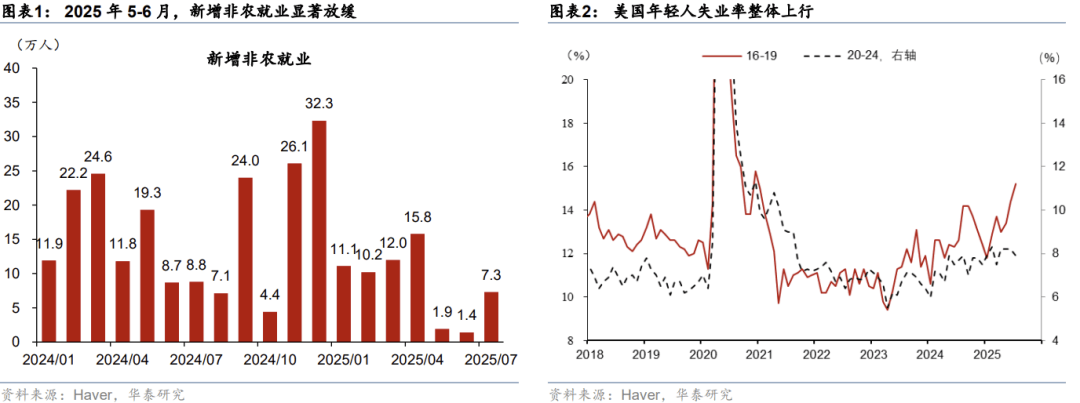
Group 1 - The U.S. job market is weakening rapidly in the first half of 2025, with AI penetration accelerating, but AI is not the primary driver of this slowdown. Other factors such as tariffs, immigration policies, and the DOGE initiative are more significant contributors [1][4][11] - Since April 2025, employment in the U.S. has noticeably slowed, particularly affecting younger demographics and those with graduate degrees. The unemployment rate for ages 16-19 reached 15.2% in July, while for ages 20-24 it was 7.9% [2][11] - AI's impact on employment is currently limited, with some industries experiencing job losses, but overall, sectors with high AI exposure have shown better employment trends compared to others. For instance, non-farm employment in AI-exposed industries has not declined as sharply as in other sectors [3][12] Group 2 - Tariffs, immigration, and the DOGE initiative are identified as primary factors contributing to the slowdown in job growth since 2025. Tariffs have increased significantly, with the weighted tariff rate rising by 6.6 percentage points to 8.9%, the highest since the 1930s [4][27] - Immigration inflow is expected to decrease significantly, potentially dropping to near zero in 2025, which will further constrain labor supply and negatively impact non-farm employment [34][38] - The DOGE initiative has led to a reduction in federal government employment, with a cumulative loss of 84,000 jobs from January to July 2025, affecting overall job growth [43][51] Group 3 - The job market is expected to remain weak in the third quarter of 2025, with a gradual increase in the unemployment rate. Factors such as rising tariffs and limited improvements in hiring intentions are likely to continue impacting the job market [55][60] - There is an expectation of a marginal rebound in non-farm employment in the fourth quarter, driven by improved corporate investment and hiring intentions, although this will be constrained by declining labor supply [60][68] - AI's penetration in U.S. industries is currently at about 9%, with significant potential for growth, which could have profound implications for employment, industry structure, and income distribution in the future [24][11]

Investing in buy now, pay later stocks: Analyst's 2 top picks
Yahoo Finance· 2025-08-23 16:00
Buy Now Pay Later (BNPL) Market Overview - US e-commerce is approximately a $1 trillion business, with BNPL pushing $70-80 billion, a small fraction of the overall opportunity [2] - BNPL is mostly skewed towards a younger demographic, particularly the 18-34 cohort, who may not trust traditional credit cards or banks [3][4] - The growth of the BNPL market primarily impacts banks, as BNPL transactions are often settled using debit cards [9][10] BNPL and Economic Conditions - The common perception is that BNPL will struggle in a weak economy, but it could be countercyclical, helping retailers increase conversions [5][6][7] - Merchants may steer consumers towards BNPL to facilitate sales during economic downturns [7][8] Company Specific Analysis - Affirm (AFRM) is considered a buy due to its unlimited total addressable market (TAM) and strong execution, offering various payment options beyond just "pay in four" [12][14] - PayPal's (PYPL) buy now pay later offering is integrated into its branded checkout button, expected to drive growth, and is performing well in Europe [16][17][18] - Circle (USDC) is rated as underperform due to flat distribution of USDC at $68 billion and increasing distribution costs, impacting revenue potential [21][22]

X @Bloomberg
Bloomberg· 2025-08-21 15:08
Klarna secures a warehouse facility with Santander worth as much as €1.4 billion in its first ever deal of this kind https://t.co/2pMbHpkWRq ...
美国IPO一周回顾及前瞻:上周有8家企业IPO,15家企业递交申请
Sou Hu Cai Jing· 2025-08-18 08:24
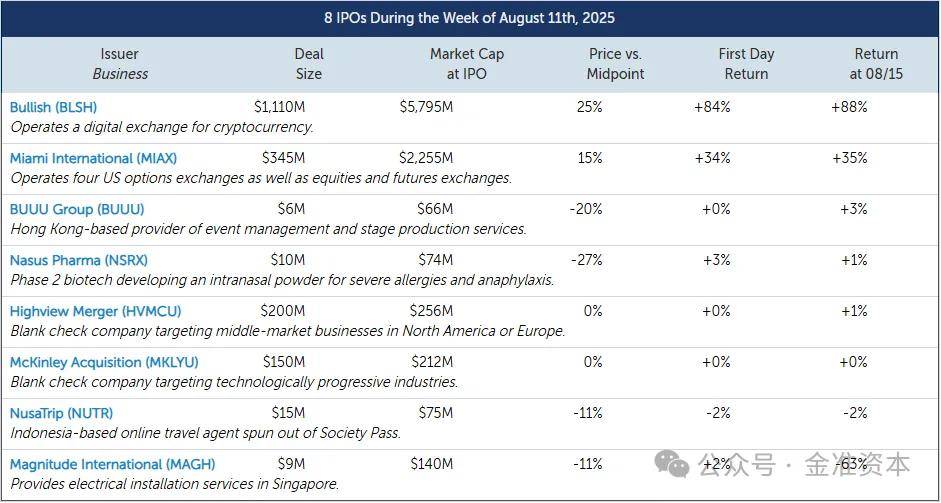
Group 1: Recent IPO Activity - Eight companies went public in the US last week, including two SPACs, with seven IPOs and eight SPACs filing initial applications [1][4] - Bullish, a cryptocurrency exchange, raised $1.1 billion at a valuation of $5.8 billion, with a first-day return of 84% and a closing increase of 88% [1][4] - Miami International Holdings raised $345 million at a valuation of $2.3 billion, with a first-day return of 34% and a closing increase of 35% [1][4] Group 2: Performance of Other IPOs - NusaTrip, an Indonesian online travel agency, raised $15 million at a valuation of $75 million, closing down 2% [2][4] - Nasus Pharma, an Israeli biotech company, raised $10 million at a valuation of $74 million, closing up 1% [2][4] - Magnitude International, a Singapore-based electrical installation company, raised $9 million at a valuation of $140 million, closing down 63% [2][4] Group 3: Upcoming IPOs and Market Outlook - No IPOs are scheduled for the current week, but some smaller issuers may still price [7] - Major issuers like Gemini and Via Transportation have joined the IPO pipeline, with expectations for larger listings after Labor Day [7]

8月美股IPO活跃度倍增:新股需求强劲!企业抢抓窗口期
智通财经网· 2025-08-18 00:20
智通财经APP获悉,对于投资银行家而言,夏季末本是一年中最清闲的时段之一,但今年市场却打破了 惯例。8月中旬,IPO市场已呈现爆发态势:共有12家新公司完成发行(单笔融资至少5000万美元),总筹 资规模约29亿美元,活动量较往年同期增长约一倍。对比过去十年的数据,8月IPO平均家数为9家,总 融资额约15亿美元,今年的活跃度显著提升。 IPO研究公司Renaissance Capital的投资策略总监艾弗里·马克斯指出:"市场对新股的需求非常明确,这 些企业正在抓住窗口期推进上市。"他提到,尽管过去几年IPO市场基本处于停滞状态,但当前的需求 激增并不意外,"若没有如此强劲的市场需求,这些公司可能不会选择此时上市"。 科技与加密货币领域成为今年IPO市场的核心驱动力。稳定币发行商Circle(CRCL.US)、金融科技公司 Chime(CHYM.US)及人工智能数据中心企业CoreWeave(CRWV.US)等均在首日交易中获得良好反馈。展 望2025年底,Klarna、StubHub等公司也可能加入上市队列,渠道储备充足。 第二季度,摩根大通、高盛、花旗集团和摩根士丹利的股票承销费收入均实现季度环比增长( ...
Klarna(KLAR) - Prospectus(update)
2025-08-15 01:47
As filed with the Securities and Exchange Commission on August 14, 2025. Registration No. 333-285826 UNITED STATES SECURITIES AND EXCHANGE COMMISSION Washington, D.C. 20549 United Kingdom Tel.: +44 8081 893 333 Amendment No. 2 to FORM F-1 REGISTRATION STATEMENT UNDER THE SECURITIES ACT OF 1933 Klarna Group plc (Exact Name of Registrant as Specified in Its Charter) (Primary Standard Industrial England and Wales 6199 N/A (I.R.S. Employer Identification Number) (State or Other Jurisdiction of Incorporation or ...

Airbnb Launches $0-Upfront Booking Option for US Stays
PYMNTS.com· 2025-08-14 18:49
Core Insights - Airbnb Inc. has launched a "Reserve Now, Pay Later" feature for U.S. customers, allowing travelers to book certain domestic stays without upfront payment [1][2] - The feature is designed for listings with moderate or flexible cancellation policies, enabling guests to delay full payment until just before the property's free cancellation window closes [2][3] - This new option aims to provide more flexibility for travelers, particularly for groups coordinating payments, and complements existing payment options like "Pay Part Now, Part Later" and "Pay Over Time" [3][4] Industry Trends - The introduction of the "Reserve Now, Pay Later" feature aligns with a growing consumer preference for installment and deferred payment products, as evidenced by an estimated $175 billion in BNPL transactions in the U.S. in 2024 [6] - The demand for flexible payment options is increasing, with consumers seeking greater financial management and convenience in uncertain economic conditions [6] - Airbnb's expansion of payment flexibility tools is expected to lower the barrier to commitment for cost-conscious travelers, potentially driving more bookings [4][5]


IPO前夕业绩承压!Klarna(KLAR.US)拨备激增64% 季度亏损扩大至5300万美元
Zhi Tong Cai Jing· 2025-08-14 13:37
Core Insights - Klarna faces profitability pressure due to a significant increase in loan loss provisions ahead of its IPO, with provisions rising 64% year-over-year to $174 million [1] - Despite the increase in provisions, Klarna maintains a low credit loss rate of 1%, which is less than 1% of total transaction volume [1] - The company reported a pre-tax loss of $53 million, widening from a loss of $18 million in the same period last year [1] Financial Performance - Klarna's quarterly revenue grew by 25% year-over-year to $823 million, with adjusted operating profit slightly increasing by $1 million to $29 million [1] - The implementation of AI technology has led to a 46% year-over-year increase in revenue per employee, surpassing $1 million [2] - Klarna has streamlined 40% of its workforce over the past two years as part of its AI efficiency strategy [2] Market Position and Future Plans - Klarna has 111 million active users globally, a 31% increase year-over-year, and partners with 790,000 merchants [2] - The company is considering restarting its IPO plans as early as September, having submitted a confidential listing application to the SEC in March [2] - Klarna has reached an agreement to securitize some new BNPL loans in the U.S. to optimize its capital structure ahead of the IPO [2]
X @Bloomberg
Bloomberg· 2025-08-14 12:24
Financial Performance - Klarna allocated more funds for potential loan defaults in Q2 [1] - This action exerted pressure on profits [1] Market Dynamics - The increased allocation occurred before Klarna's anticipated IPO (Initial Public Offering) [1]