CRIC

Search documents
行业透视 | 京沪深刚需和豪宅新挂牌房源占比稳增
Sou Hu Cai Jing· 2025-08-16 05:13
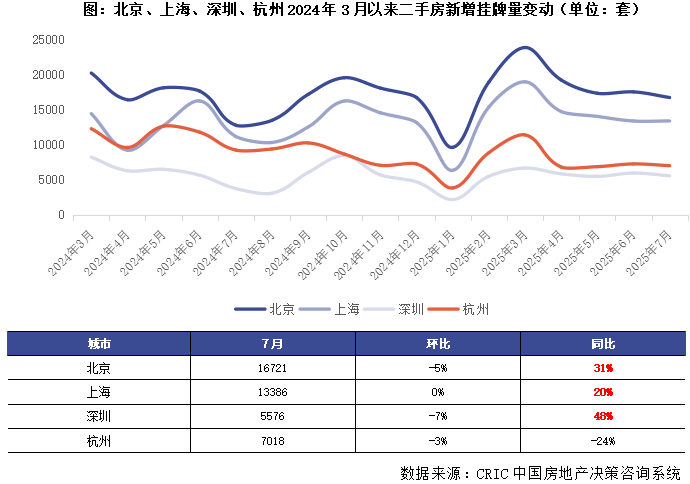
Core Viewpoint - The high-end real estate market in Beijing, Shanghai, and Shenzhen is expected to experience a steady decline in heat, with increasing supply and changing buyer sentiment impacting market dynamics [1][7]. Group 1: Market Trends - In July 2025, the second-hand housing market transaction volume in 30 key cities decreased by 14% month-on-month and 9% year-on-year, indicating a slowdown in growth momentum [1]. - The new listing volume in Beijing, Shanghai, Shenzhen, and Hangzhou showed a seasonal decline in July, with only Shanghai remaining flat compared to the previous month [1][7]. - The overall new listing volume in July for Beijing, Shanghai, and Shenzhen was significantly higher than the same period last year, with year-on-year increases exceeding 20% [1]. Group 2: Listing Characteristics - The new listings in the mid-price segment (100-500 million yuan) have decreased, while the lower and higher price segments (below 300 million yuan and above 600 million yuan) have seen an increase in listing proportions [5][6]. - In Beijing, the listing proportion for the 300-500 million yuan segment dropped by 0.98 percentage points, while the lower segment (below 300 million yuan) and the higher segment (above 3000 million yuan) increased by 0.42 and 0.63 percentage points, respectively [5]. - In Hangzhou, the high-end property listings (above 600 million yuan) have structurally increased, while lower price segment listings have decreased [6]. Group 3: Area Segment Analysis - The most significant increases in listing proportions for small-sized properties were observed in Beijing (below 70 square meters), Shanghai (50-90 square meters), and Shenzhen (50-70 square meters) [6]. - In contrast, larger property segments (above 140 square meters) have shown a steady increase in listing proportions across the three cities [6]. Group 4: Market Outlook - The market is characterized by a "K-shaped" differentiation, where demand for affordable small units and luxury properties remains strong, while mid-range improvement properties face hesitance from owners [7]. - The high-end market in Beijing, Shanghai, and Shenzhen is likely to see a steady decline in heat due to increased supply and competition from new high-quality developments [7].

半月追踪 | 8月推盘“提质”拉动来访认购结构性回升
克而瑞地产研究· 2025-08-13 09:49
Core Viewpoint - The real estate market in August shows a phase of recovery, with a focus on "quality over quantity" in supply, leading to increased project sales rates in cities like Hangzhou and Wuhan [1][35]. Group 1: Market Trends - Since 2025, the overall real estate market has shown signs of stabilization after a decline, with a traditional "small spring" in March-April, followed by sustained market activity in May-June and a temporary adjustment in July [3]. - In early August, the average sales rate for projects in 30 key cities increased to 37%, a rise of 7 percentage points from June 2025 and 16 percentage points from August 2024 [5]. Group 2: City Performance - Cities are categorized into three types based on their recovery characteristics: 1. Core first and second-tier cities like Beijing, Shenzhen, Hangzhou, and Chengdu, where sales rates are significantly influenced by the quality of new supply [8]. 2. Cities like Wuhan and Nanjing, which are experiencing a weak recovery with low visitor and purchase rates starting to improve [9]. 3. Cities such as Xi'an and Zhengzhou, where visitor numbers are stable but purchase rates are declining, indicating a lack of momentum for growth [9]. Group 3: Specific City Insights - In August, Beijing's sales rate dropped to 5% due to individual project impacts, while Shenzhen, Hangzhou, and Chengdu maintained higher activity levels compared to the previous year [11]. - Wuhan has seen a significant increase in visitor and purchase rates, with the average sales rate rising to 45% in early August, up from 26% in July [17]. - Nanjing and Zhengzhou have shown stable visitor and purchase rates, with low conversion rates continuing to fluctuate [21][23]. Group 4: Challenges in Other Cities - Cities like Guangzhou, Xi'an, and Tianjin are facing significant declines in purchase rates, with conversion rates dropping as buyer sentiment remains cautious [27][28][31]. - In Guangzhou, visitor and purchase numbers fell sharply in early August, leading to a decrease in conversion rates [27]. - Xi'an has also experienced a continuous decline in conversion rates, indicating weak market growth potential [28].

房地产投资前景TOP50城洗牌:深圳反超广州,二线崛起!
3 6 Ke· 2025-07-29 02:29
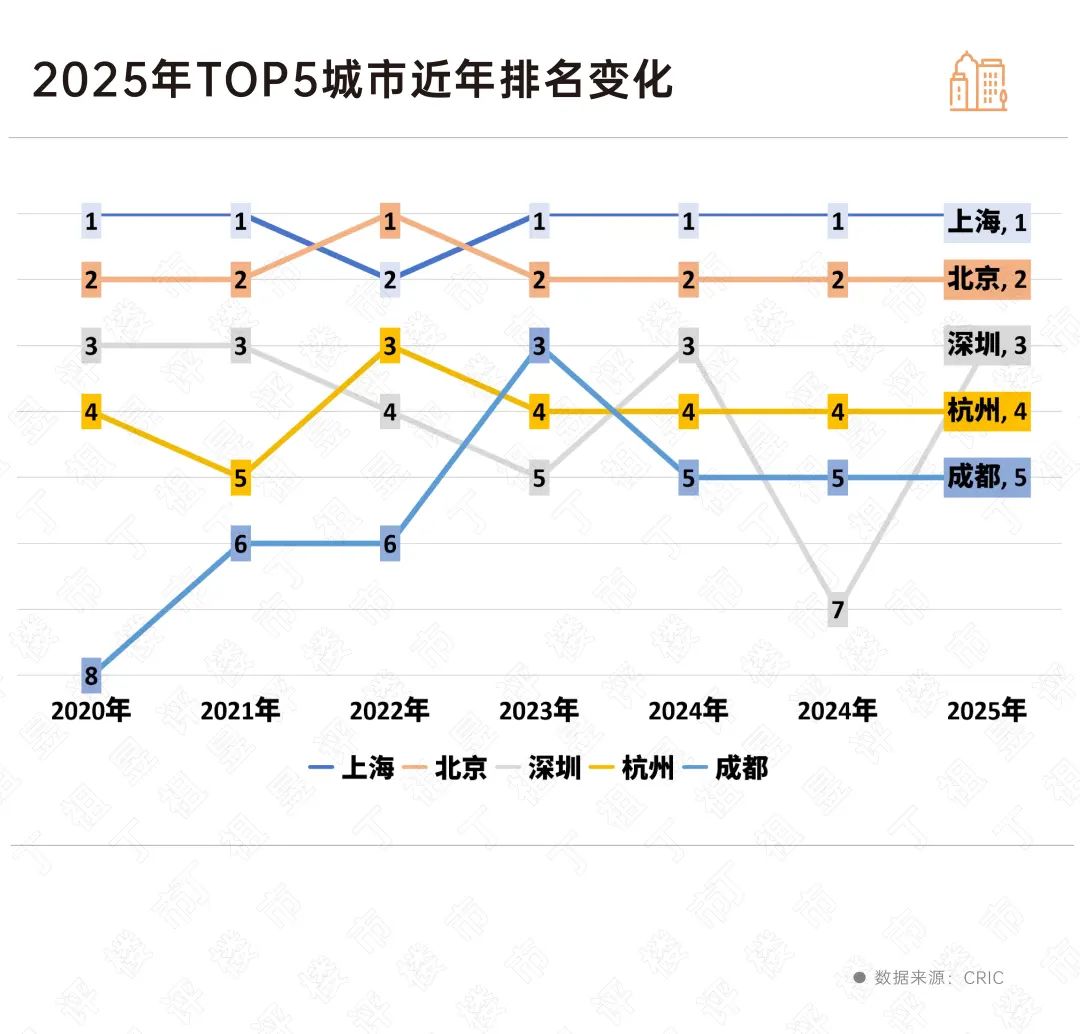
Core Insights - The latest report by CRIC reveals a reshuffling in the 2025 China Real Estate Investment Outlook, with the top 50 cities showing significant changes in rankings [1][4] - Shanghai and Beijing maintain their positions as the top two cities for real estate investment, while Shenzhen has risen to third place, displacing Guangzhou [2][4] - The top 50 cities account for 34% of the national population and 50% of GDP, indicating a concentrated demand for housing in these areas [1][5] Group 1: City Rankings and Changes - Shanghai and Beijing have held the top two positions for 11 consecutive years, benefiting from strong supply and demand dynamics [2][4] - Shenzhen's rise to third place is attributed to its economic vitality, population growth, and the presence of numerous high-quality enterprises [4] - Guangzhou has dropped to sixth place, while Hangzhou and Chengdu remain stable at fourth and fifth, respectively [1][4] Group 2: Market Demand and Future Outlook - The top 20 cities are projected to have an annual housing demand of 300 million square meters, driven by population growth and housing upgrades [8][9] - The demand for improved housing in these cities is also significant, with an annual increment of 140 million square meters expected [8][9] - The report suggests that the real estate market may stabilize in the second half of 2025, supported by policy measures and pent-up demand [1][9][12] Group 3: Inventory and Supply Dynamics - The report highlights a need for cities to address high inventory levels while promoting new housing developments to meet demand [12] - Cities with lower inventory issues and higher influx of population are expected to perform better in the market stabilization process [12] - The focus for real estate companies should be on core cities with positive inventory trends and high transaction speeds [12]
半月追踪 | 沪深津汉等部分城市“小阳春”成色足
克而瑞地产研究· 2025-03-20 09:04
Core Viewpoint - The real estate market is showing signs of recovery, particularly in first-tier cities like Shanghai and Shenzhen, with expectations for continued stabilization and potential growth in the second quarter of 2025 [1][17]. Group 1: Market Recovery Indicators - As of mid-March 2025, new home sales in key cities have seen a significant increase, with a 28% week-on-week rise and a 16% year-on-year growth [4]. - First-tier cities are leading the recovery, with weekly sales volumes in Shanghai and Shenzhen matching the average levels of the second half of 2024, driven by policy stimuli and the introduction of appealing properties [4][5]. - The overall new home transaction volume in March is expected to exceed a 20% year-on-year increase, indicating a robust recovery trend [3][4]. Group 2: City-Specific Trends - Shanghai and Shenzhen are experiencing a "quality over quantity" approach in new home launches, resulting in high sales rates, with Shanghai's sales rate reaching 74% and Shenzhen's at 66% as of mid-March 2025 [6]. - Cities like Guangzhou, Tianjin, and Wuhan are showing signs of gradual recovery, with transaction levels returning to those of the previous year, particularly in Wuhan where sales have increased by 34% year-on-year [8][11]. - Conversely, cities such as Zhengzhou and Nanjing are witnessing increased visitor numbers but declining conversion rates, indicating a lack of purchasing momentum [14][15]. Group 3: Future Outlook - The overall market is expected to maintain a high level of activity, particularly in first-tier cities, as promotional efforts and new listings are anticipated to increase supply and demand [17]. - Core second-tier cities like Tianjin and Wuhan are projected to experience a recovery in transaction volumes following previous adjustments, with a steady upward trend expected [17].