Qlik

Search documents
15亿美元!中东主权财富基金加持全球资管龙头普洛斯
财富FORTUNE· 2025-08-29 13:04
Core Viewpoint - The partnership between GLP and ADIA signifies a strategic investment aimed at accelerating growth in the new economy sectors, particularly in supply chain, big data, and renewable energy, leveraging ADIA's financial strength and GLP's operational expertise [1][3][12]. Investment and Financial Overview - ADIA has invested $1.5 billion in GLP, with an initial deployment of $500 million, highlighting its commitment to long-term value investments [1]. - ADIA manages over $1 trillion in assets and has a 20-year and 30-year annualized return rate of 6.4% and 6.8%, respectively, indicating a strong track record in sustainable growth [1]. Strategic Collaboration - ADIA has been a long-term limited partner in various GLP funds and has upgraded its role to a strategic investor, providing significant endorsement for GLP's team and operations [2]. - The collaboration is expected to enhance GLP's capital structure and investment capabilities, allowing it to attract a broader range of clients and partners [3]. Core Competencies of GLP - GLP excels in asset management, balancing asset investment development with operational management, which is a key reason for ADIA's strategic investment [5]. - The company has established strong relationships with global institutional investors, sovereign funds, and pension funds, facilitating efficient capital linkage through asset fundization and securitization [5][7]. Focus on New Economy - GLP has built professional barriers in logistics supply chain, big data infrastructure, and renewable energy, achieving rapid growth and market recognition [8]. - Since entering the Chinese market in 2003, GLP has expanded its logistics facilities to cover over 3,000 square kilometers and serve nearly 3,000 clients [8]. Growth in Specific Sectors - GLP has developed 20 data centers across key regions in China, providing 1,400 MW of IT load, positioning itself as a leading independent data center operator [9]. - In renewable energy, GLP has developed over 2 GW of capacity and manages over 1 GW, supporting low-carbon operations across its facilities [11]. Long-term Value and Market Potential - The infrastructure sector serving the new economy is experiencing a revival, with current valuation levels attractive to long-term investors [12]. - The partnership between GLP and ADIA is seen as a recognition of China's long-term market potential, with both entities poised to capitalize on emerging growth cycles [12][13].


全球位置智能软件市场前10强生产商排名及市场占有率
QYResearch· 2025-08-21 09:42
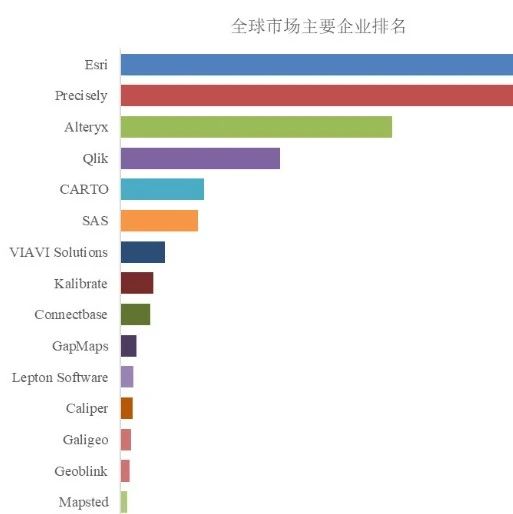
Core Viewpoint - The global location intelligence software market is projected to reach $1.95 billion by 2031, with a compound annual growth rate (CAGR) of 8.1% in the coming years [1]. Market Overview - The leading manufacturers in the global location intelligence software market include Esri, Precisely, Alteryx, Qlik, CARTO, SAS, VIAVI Solutions, Kalibrate, Connectbase, and GapMaps, with the top ten companies holding approximately 73.0% market share in 2024 [5]. - Cloud-based solutions dominate the product type segment, accounting for about 58.2% of the market [6]. - Large enterprises represent the primary demand source, capturing around 64.8% of the market share [7]. Key Drivers - The advancement of mobile devices, social media, and the Internet of Things (IoT) has generated a vast amount of location-related data, which location intelligence software can leverage for deeper analysis and insights [8]. - Location intelligence software aids businesses in gaining competitive advantages by enhancing customer experience, service, marketing strategies, and optimizing operations and resource management [8]. - Government regulations regarding the collection, storage, sharing, and use of location data can promote the development and application of location intelligence software while ensuring user privacy and security [8]. Major Obstacles - The need to collect and analyze user location data may involve sensitive personal information and trade secrets, posing risks if data is leaked, altered, or misused [9]. - Integrating multiple data sources, platforms, and tools can increase technical complexity and costs, with potential compatibility issues due to a lack of unified standards [9]. - Location intelligence software is subject to legal regulations that may change over time, such as the EU's General Data Protection Regulation (GDPR), which imposes strict requirements on location data handling [9]. Industry Development Trends - Location intelligence software is applicable across various industries, including retail, logistics, tourism, healthcare, education, and government, helping organizations improve efficiency, reduce costs, increase revenue, and enhance competitiveness [10]. - As user awareness and trust in location intelligence software grow, its applications may expand into areas like smart cities, autonomous driving, social media, gaming, and advertising [10]. - The quality and accuracy of data are crucial for the performance and value of location intelligence software, with advancements in data collection, processing, and analysis technologies expected to enhance data quality [13]. - Artificial intelligence and machine learning are vital supporting technologies for location intelligence software, enabling the extraction of valuable information from large datasets and the discovery of hidden patterns [13].
数据民主化×智能进阶化:AI+BI不可逆的决策革命已至
Sou Hu Cai Jing· 2025-08-15 07:15
Core Concept - The combination of AI (Artificial Intelligence) and BI (Business Intelligence) is transforming business analysis from "describing the past" to "predicting the future" [1] Group 1: AI and BI Integration - The emergence of AI assistants like Microsoft's Power BI Copilot, Tableau GPT, and Qlik's AutoML Copilot signifies the shift to "conversational analytics" in the BI sector [3] - The integration of generative AI into BI tools is an irreversible trend driven by the need to address traditional BI pain points and market demands [3][5] Group 2: Technological Breakthroughs - Generative AI enables BI to transition from being an "expert tool" to a "universal assistant," allowing users to interact using natural language instead of complex technical skills [5] - This shift democratizes data access, enabling business personnel to conduct analyses without relying on IT or data teams [6] Group 3: Business Needs and Market Dynamics - Businesses require more agile, intelligent, and widespread data-driven insights, which generative AI facilitates by providing immediate answers to queries [6] - Generative AI not only generates reports but also offers actionable insights and recommendations based on data analysis, enhancing the practical value of BI [7] Group 4: Competitive Landscape - As core BI functionalities become standardized, the differentiation among BI tools increasingly relies on their ease of use and intelligence, making AI capabilities a critical competitive factor [8] - Major BI players like Microsoft, Tableau, and Qlik are heavily investing in intelligent assistants to attract and retain users, particularly non-technical users and small to medium enterprises [8] Group 5: Microsoft Power BI Copilot - Microsoft’s Power BI Copilot is continuously evolving, enabling users to perform various tasks such as content planning, report creation, and DAX query writing efficiently [9] - Real-world applications of Power BI Copilot include generating dashboards and optimizing inventory management through natural language queries [10][12] Group 6: Future of AI and BI - The essence of AI+BI is a "human-machine collaboration revolution," where AI takes over routine data tasks, allowing analysts to focus on strategic decision-making [20] - This trend is reshaping corporate data culture, emphasizing the importance of using natural language to interact with AI assistants as a core competency for professionals [21]


NowVertical to Attend Qlik AI Reality Tour, Deepening Strategic Partnerships and Showcasing AI Leadership
Globenewswire· 2025-07-24 12:00
Core Insights - NowVertical Group Inc. is participating in the Qlik AI Reality Tour in São Paulo, Brazil on July 29, 2025, highlighting its role in the enterprise AI landscape [1][2] - The company was recently recognized as Qlik's 2024 Latin America Channel Growth Partner of the Year, indicating its expanding global presence and commitment to technology partnerships [2] - NowVertical will showcase a case study on Natural One, demonstrating how its collaboration with Qlik transformed the company's data architecture and operational processes [2][3] - The event allows NowVertical to engage with enterprise customers and peers, emphasizing its capability in delivering measurable results through data intelligence [3][4] - CEO Sandeep Mendiratta stated that NowVertical is positioned to help organizations operationalize AI effectively, enhancing its role as a trusted transformation partner [4] Company Overview - NowVertical is a global data and analytics company focused on transforming data into business value using AI [5] - The company offers a comprehensive suite of solutions that enable clients to harness their data for improved decision-making and operational efficiency [5] - NowVertical is pursuing growth both organically and through strategic acquisitions, enhancing its capabilities in the data analytics and AI sectors [5]


数据可视化工具软件全解析:从入门到专业
Sou Hu Cai Jing· 2025-05-29 17:29
Core Insights - Data visualization has become a core skill for businesses and individuals to interpret information and identify trends in the era of big data. The article reviews over 30 mainstream data visualization tools across seven categories to help match business needs accurately. Group 1: Business Intelligence (BI) Tools - Tableau is a leading BI platform offering a complete solution from data connection to advanced analytics, with a unique VizQL technology that optimizes visualization logic. Walmart saved millions in inventory costs using Tableau [1] - Microsoft Power BI integrates deeply with Office 365, providing advanced features at a subscription price of $9.9 per month. A retail company reduced sales report generation time from 3 days to real-time updates using Power BI [1] - Qlik Sense utilizes in-memory computing to perform data association analysis in 10 seconds, improving fraud detection accuracy by 40% for a bank [1] Group 2: Programming Visualization Libraries - Matplotlib, a standard Python library, supports over 50 basic chart types but requires extensive coding for customization [2] - D3.js allows pixel-level control through data binding with DOM elements, used by GitHub for rendering code submission heatmaps, though it has a steep learning curve [2] - Plotly, based on React, supports complex visualizations like 3D surfaces and is used by a meteorological agency for dynamic typhoon path analysis [2] Group 3: Online Visualization Platforms - Google Data Studio integrates seamlessly with Google services, allowing real-time collaboration for up to 20 users, enhancing reporting efficiency by 70% for a marketing agency [4] - Infogram offers over 200 magazine-quality templates, increasing donation conversion rates by 25% for an NGO [4] - Flourish is used by The New York Times for creating animated election maps, although exporting dynamic charts can be costly [4] Group 4: Open Source Tools - Apache Superset, an open-source solution from Airbnb, supports real-time freight monitoring systems but requires a professional operations team for cluster deployment [6] - Metabase allows business users to generate reports without SQL knowledge, improving response times for an e-commerce customer service team by three times [6] - Redash connects to over 200 data sources and allows for custom plugin development, but requires self-hosting with associated hardware costs [6] Group 5: Specialized Tools - ArcGIS supports geospatial analysis and was used by a city planning bureau to optimize traffic light configurations [8] - Ruanqian BI offers open-source front-end pages for customization and integration into Java applications [8] - RAWGraphs specializes in complex visualizations for multi-variable data, used by a gene research institution to identify potential targets [8] Group 6: Emerging Intelligent Tools - Observe.AI integrates GPT-4 to automatically generate analysis reports from data tables, significantly reducing report preparation time [9] - Airtable combines spreadsheet and database functionalities, helping product teams manage development timelines effectively [9] Group 7: Tool Selection Decision Matrix - The article suggests evaluating tools based on technical capability, interaction needs, data scale, and collaboration requirements, providing examples for different types of organizations [11]