基金赎回

Search documents
国泰富时中国A股自由现金流聚焦交易型开放式指数证券投资基金发起式联接基金第9次分红公告
Xin Lang Cai Jing· 2026-02-24 17:17
Group 1 - The announcement date for the dividend distribution of the Guotai SSE State-Owned Enterprises Dividend ETF is February 25, 2026 [3] - The fund's performance evaluation date will determine if the fund can distribute profits based on its excess return compared to the benchmark [3] - Fund shares purchased after the record date will not be eligible for the current dividend distribution [5] Group 2 - The Guotai Fund Management Company provides various consultation methods, including a website and customer service hotline [2][6] - The fund is open for daily subscription, redemption, and conversion, with specific operational hours aligned with the Shanghai and Shenzhen stock exchanges [9] - The fund has a minimum holding period of 90 days, during which investors cannot redeem or convert their shares [9][15] Group 3 - The fund has specific subscription and redemption fee structures, with A and C class shares having different fee implications [12][14] - The minimum subscription amount is set at 1.00 yuan, while the minimum for direct sales institutions is 10.00 yuan [11][25] - Fund conversion services are available, allowing investors to switch between funds managed by Guotai without redeeming first [17][22] Group 4 - The Guotai Fund Management Company has a wide range of sales institutions, including banks and securities firms, to facilitate fund distribution [27] - The company emphasizes the importance of understanding the fund's risk and return characteristics before investing [29][30]
多多问答坊 | 为什么你会觉得基金赎回款“慢半拍”?
Xin Lang Cai Jing· 2026-02-24 09:08
来源:工银瑞信投教研习社 我在周六操作了"赎回",为什么显 01: 示的基金成交结果比预期晚? 【温馨关怀】 基金的交易日一般为周一至周五 (法定节假日除外),周六、周 日属于非交易日,您此时提交的 赎回申请会顺延至下一个交易日 (即下周一)受理。 根据基金合同约定,您 的成交价格将以下周一 收盘后公布的基金净值 为准。 由于销售机构的数据更新存在时差, 通常遵循"T日交易、T+2日更新"的 规则,所以您看到的基金成交结果会 比预期稍晚。 为什么我下午3点多赎回,资金到账 02: 时间感觉被"拉长"了? 【温馨关怀】 公募基金以15:00作为当日交 易申请的截止时间。 如果您也有投资疑问 欢迎在后台私信留言~ 我们会不定期在"多多问答坊"栏目 为大家答疑解惑~ MACD金叉信号形成,这些股涨势不错! 责任编辑:郭栩彤 来源:工银瑞信投教研习社 知识软件营证 指销售机构在规定时间受理投资人申 TB 购、赎回或其他业务申请的开放日; T+n日 指自T日起第n个工作日(不包含T日); 指为投资人办理基金份额申购、赎回 开放日 或其他业务的: 指证券交易所、期货交易所等金融交 交易日 易场所正常营业可交易的日期。 我 ...

节前,绩优基金清盘!什么情况?
券商中国· 2026-02-08 04:42
Core Viewpoint - The recent wave of fund liquidations, despite strong performance, is attributed to specific time factors and the structure of fund holders rather than poor fund management [1][4]. Group 1: Fund Liquidation Phenomenon - Multiple high-performing equity funds have announced liquidation announcements before the Spring Festival, driven by significant redemption requests [2][3]. - A notable fund from a northern mid-sized public offering reported a final operation date of November 26, 2025, with an asset scale of 340 million yuan and a return rate of nearly 90% since inception, despite a stock position of less than 15% [2]. - Another fund from a Shanghai-based public offering achieved a 33.72% return in 2025, showcasing strong performance in its category [2]. Group 2: Holder Structure and Market Dynamics - The funds that are liquidating are characterized by a high dependency on a small number of institutional investors, which significantly influences their survival [4]. - For instance, one fund had 91.88% of its holdings by a single institution, while another had 99.38% held by one entity, indicating a customized fund structure that can lead to liquidity risks [4]. Group 3: Market Sentiment and Future Outlook - The trend of fund liquidations reflects a shift in institutional investors' risk preferences towards a defensive stance, with a prevailing sentiment of "locking in profits" before the holiday [5]. - Analysts suggest that the recent redemption wave is nearing its end, with expectations of a market style shift from small-cap to large-cap stocks and from thematic to quality investments [5]. - Fund managers remain optimistic about the medium to long-term market outlook, anticipating that the current redemption pressures may signal the initial stages of market recovery [6][7].

百亿份额大逃亡!四季度这15只主动权益基金被卖得最狠
市值风云· 2026-02-02 10:24
Core Viewpoint - The public fund industry is still in a "de-inventory" cycle, with continuous net outflows observed for 11 consecutive quarters, particularly in active equity funds [1][32]. Group 1: Active Equity Fund Performance - In Q4 2025, active equity funds saw a total share decline of 4.4%, although this was a slight improvement compared to Q3 [3]. - A total of 15 active equity funds experienced a reduction of over 1 billion shares in Q4 2025, indicating significant sell-offs [4]. - The fund "泉果旭源三年持有期混合A" (016709.OF) faced the largest redemption, with a drop of 55.2 million shares, marking it as the most sold active equity fund in the market [10][12]. Group 2: Reasons for Fund Redemptions - The primary reason for the massive sell-off of "泉果旭源三年持有期混合A" was the end of its three-year lock-up period, leading investors to cash out despite a 46.3% annual gain [12][14]. - Other funds with similar lock-up mechanisms, such as "博时汇兴回报一年持有期混合" (011056.OF) and "易方达品质动能三年持有混合A" (014562.OF), also saw significant redemptions of 12.6 million and 10.4 million shares, respectively [14][16]. Group 3: Performance of Notable Fund Managers - Notable fund managers like 傅鹏博, 张坤, and 谢治宇, who were once considered top performers, faced significant redemptions in Q4 2025, with funds like "兴全趋势LOF" (163402.SZ) and "兴全合润LOF" (163406.SZ) losing 15.7 million and 10.6 million shares, respectively [17][21]. - The performance of these funds was lackluster, with "兴全趋势" only slightly increasing by 0.1% and "兴全合润" declining by 3.8% in Q4, leading to a loss of investor confidence [18][25]. Group 4: Market Sentiment and Fund Strategy - The trend of "赎旧买新" (selling old funds to buy new ones) remains prevalent, as investors seek better-performing options, leading to outflows from established funds [29]. - Funds that maintained a conservative strategy, such as "富国稳健增长混合A" (010624.OF), faced redemptions of 11.6 million shares due to underperformance in a bullish market [30]. - Newer funds like "华商致远回报混合A" (024459.OF) and "鹏扬研究精选混合A" (023362.OF) also experienced significant outflows shortly after their launch, reflecting a highly opportunistic market sentiment [31].
凤凰投诉|网友投诉富国基金赎回7天不到账,真相是……
Feng Huang Wang Cai Jing· 2026-01-27 09:26
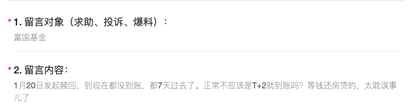
Core Viewpoint - The article highlights a complaint from a user regarding the delayed redemption of funds from a mutual fund, which has caused issues with mortgage payments. The delay is attributed to the fund's redemption rules for QDII products, which require a T+7 settlement period for transactions involving overseas investments [1][2][4]. Group 1: User Complaint - A user named Mr. Cao reported that he initiated a redemption request on January 20 to pay his mortgage due on January 24, but the funds had not yet arrived [2]. - The user expressed frustration as he had to find alternative solutions to avoid mortgage default due to the delay in receiving his redemption funds [2]. Group 2: Redemption Rules - The article explains that the redemption process for the "Fuguo Global Bond (QDII) RMB A" product follows a T+7 rule, meaning that funds will only be available seven days after the redemption request is made [4]. - According to the redemption schedule, Mr. Cao's funds will not be available until January 29, which is beyond his mortgage payment deadline [4][5].
建信科技智选股票型发起式证券投资基金基金开放日常申购(赎回、转换、定期定额投资)业务公告
Zhong Guo Zheng Quan Bao - Zhong Zheng Wang· 2026-01-11 22:50
Group 1 - The company announced the suspension of large-scale subscriptions, conversions, and regular investment for the Jianxin Hengjiu Value Mixed Securities Investment Fund starting from January 13, 2026, with a limit of 10 million yuan per account per day [1][37] - Other business operations will continue as usual during the suspension period, and the large-scale subscription and investment services will resume on January 15, 2026 [1][37] - Investors can contact the company's customer service for inquiries or visit the official website for more information [1][37] Group 2 - The Jianxin Technology Smart Selection Stock Fund is open for regular subscription, redemption, conversion, and regular investment as of January 12, 2026 [4] - The fund management company is responsible for managing and operating the fund assets, with the custodian being GuoXin Securities Co., Ltd. [4] - Investors are encouraged to check their transaction application confirmation status through sales outlets or the company's customer service [4][5]

富国尊利纯债定期开放债券型发起式证券投资基金第三十个开放期开放申购、赎回及转换业务的公告
Xin Lang Cai Jing· 2026-01-11 19:16
Group 1 - The fund operates on a periodic open-end basis, combining closed and open periods, with the first closed period lasting until the day before the corresponding monthly date three months after the fund contract takes effect [1][24] - The third open period is set to begin on January 14, 2026, and will last for a minimum of one working day and a maximum of five working days [1][24] - If the fund's total shares held by a single investor or multiple investors acting in concert exceed 50%, the fund will not be sold to individual investors [2][24] Group 2 - Investors can apply for fund subscription and redemption on each working day during the open period, with specific times aligned with the trading hours of the Shanghai and Shenzhen stock exchanges [3][25] - The fund follows the "unknown price" principle for subscription and redemption, meaning prices are based on the net asset value calculated after the market closes on the application day [4][26] - The minimum subscription amount is set at RMB 1, while the minimum for direct sales is RMB 50,000 for the first subscription and RMB 20,000 for subsequent subscriptions [6][27] Group 3 - Redemption requests must not be less than 0.01 fund shares, and if the remaining balance is below this amount, a full redemption is required [11][32] - Redemption fees decrease based on the holding period, with full fees applied for holdings of less than 30 days [12][33] - Fund conversion services are available through direct sales channels, with only the redemption fee charged for the outgoing fund [14][34] Group 4 - The fund management company is 富国基金管理有限公司, located in Shanghai, and offers customer service through a unified hotline [19][38] - The fund's net asset value and cumulative net asset value will be disclosed no later than the day after each open day through specified channels [20][39] - The fund management company reserves the right to adjust subscription amounts and redemption limits as per legal regulations, with prior announcements made [21][40]
泰信汇鑫三个月定期开放债券型证券投资基金开放申购、赎回业务公告(第十一个开放期)
Zhong Guo Zheng Quan Bao - Zhong Zheng Wang· 2026-01-07 23:05
Group 1 - The announcement details the opening of subscription and redemption services for the Taixin Huixin Three-Month Regular Open Bond Fund, starting from January 12, 2026, to January 13, 2026 [1][3] - The fund will have an open period of no less than two business days and no more than twenty business days, with specific dates to be announced by the fund manager [1][3] - In case of force majeure or other circumstances preventing timely opening, the open period will start the next business day after the issue is resolved [1] Group 2 - Investors can submit subscription applications during the open period, with minimum subscription amounts set at RMB 1 for initial subscriptions through other sales institutions and RMB 50,000 for direct sales [4][6] - The fund manager may adjust the minimum subscription amounts based on market conditions [6] - Subscription fees for Class A shares decrease with larger subscription amounts, while Class C shares do not incur subscription fees [7][9] Group 3 - Redemption of fund shares can be done in full or in part, with a minimum redemption of one share [12] - A redemption fee of at least 1.5% applies for shares held for less than seven days [12][14] - The redemption amount is calculated based on the net value of the shares on the redemption day, minus any applicable fees [12][14] Group 4 - The fund allows for conversion between different funds managed by the same company, with specific rules regarding fees and eligibility [36][39] - Conversion requests must be made through the same sales institution, and both funds must be registered with the same registrar [36][39] - The conversion process involves calculating the net transfer amount and applicable fees based on the net asset values of the funds involved [40][41] Group 5 - The fund manager can suspend conversion services under certain conditions, such as force majeure or significant market fluctuations [43] - Investors are encouraged to read the fund's contract and prospectus for detailed information on operations and fees [44][46] - The company provides customer service for inquiries regarding fund details and operations [44][46]
旷世芳香(01925)附属赎回部分基金权益
智通财经网· 2025-12-10 23:59
Group 1 - The company, Kwansei Fragrance (01925), announced that its indirect wholly-owned subsidiary, Ningbo Kwansei, has issued a written notice to the fund manager to redeem part of its interests in the fund (Jihai Zhize Panshi Private Securities Investment Fund) [1] - The amount to be redeemed is RMB 30 million [1]
投资中国全球专属卡—— 基金赎回背后的权益利器,守护创业者每一份期待
Sou Hu Cai Jing· 2025-12-07 13:25
Core Viewpoint - The "Invest in China" fund's comprehensive redemption initiative aims to regulate the fund market and protect the rights of entrepreneurs, addressing previous violations that threatened compliant entrepreneurs' interests [1] Group 1: Fund Redemption and Security - The "Invest in China Global Exclusive Card" is a key tool for the redemption process, ensuring the safety and traceability of fund transactions [3] - All redemption funds are disbursed exclusively through this card, which is issued by the People's Bank of China and approved by the National Financial Supervision Administration, adhering to strict regulatory standards [3] - The card operates independently of the UnionPay payment system, further reducing risks associated with fund transfers, ensuring that funds reach entrepreneurs without loss [3] Group 2: Credit Restoration for Entrepreneurs - The card addresses the issue of credit records for entrepreneurs, allowing for the removal of past negative records and the establishment of a new, positive credit profile [4] - This restoration enables entrepreneurs to secure loans at lower interest rates and higher limits, enhancing their position in financial dealings [4] - The card also removes limits on all bank accounts, providing significant flexibility in fund management, crucial for seizing market opportunities [4] Group 3: Support for Personal and Family Development - The card offers a "criminal record clearance" benefit for entrepreneurs with past criminal records, facilitating their reintegration into society and participation in economic activities [6] - This benefit extends to the children of cardholders, easing restrictions in areas such as military enlistment and civil service examinations, and providing additional advantages [6] - The initiative alleviates burdens on families, allowing entrepreneurs to focus on their business while ensuring their children's future is secure [6] Group 4: Overall Impact of the Exclusive Card - The "Invest in China Global Exclusive Card" serves as a stabilizing force for entrepreneurs during the fund redemption process, ensuring secure and smooth fund transfers [7] - It provides comprehensive support across financial credit, personal development, and family welfare, safeguarding entrepreneurs' aspirations for business success and family happiness [7] - Entrepreneurs are encouraged to recognize the importance of this card and activate its benefits to advance their entrepreneurial journeys [7]