
智能手机高端化

Search documents
Counterpoint Research:全球智能手机单季度平均售价首次突破400美元关口
Di Yi Cai Jing· 2026-02-05 07:58
(文章来源:第一财经) 根据Counterpoint Research最新报告,2025年第四季度,全球智能手机市场收入同比增长13%,达到 1430亿美元,创单季度历史新高。同时,在高端化趋势持续推进以及物料清单(BOM)成本上升的双 重推动下,智能手机平均售价(ASP)同比增长8%,首次在单季度内突破400美元。出货量同比增长 5%,整体表现仍较温和,表明随着越来越多消费者选择更高价位的设备,市场增长继续以"价值扩 张"而非"规模扩张"为主。 ...
全球智能手机单季度平均售价首次突破400美元关口
Feng Huang Wang· 2026-02-05 06:22
Core Insights - The global smartphone market revenue is projected to grow by 13% year-on-year in Q4 2025, reaching a record high of $143 billion [1] - The average selling price (ASP) of smartphones increased by 8% year-on-year, surpassing $400 for the first time in a single quarter, driven by a trend towards higher-end devices and rising BOM costs [1] - Smartphone shipment volume grew by 5% year-on-year, indicating a market growth driven by "value expansion" rather than "scale expansion" [1] Company Performance - Apple experienced the fastest revenue growth among the top five brands, with a 23% year-on-year increase, primarily due to the performance of the iPhone 17 series, achieving a revenue market share of 59% [1] - Samsung's shipment volume grew by 17% year-on-year, the fastest among the top five brands, supported by strong performance of the Galaxy A series across various regions, with a revenue growth of 12% [1] - Xiaomi's revenue declined by 9% year-on-year, and shipment volume decreased by 11%, impacted by supply constraints and rising component costs affecting its entry-level and mid-range product lineup [1] - OPPO's revenue and ASP grew by 23% and 6% year-on-year, respectively, marking the second-fastest growth among the top five brands [1] - Vivo's revenue also increased by 6% year-on-year, supported by strong performance in the Chinese and Indian markets [2]


2025年全球智能手机出货量同比增长2%
Zheng Quan Shi Bao Wang· 2026-01-13 08:49
Group 1 - The global smartphone shipment is expected to grow for the second consecutive year in 2025, with a 2% year-on-year increase driven by high-end market trends and the rising adoption of 5G devices in emerging markets [1] - The smartphone market is gradually shifting towards higher price segments, with consumer demand for premium models being a major driver, while the demand for 5G phones is surging in developing regions [1] - The top five smartphone brands by market share in 2025 are Apple (20% market share, 10% year-on-year shipment growth), Samsung (19% market share), Xiaomi (13% market share), vivo, and OPPO [1] Group 2 - Apple's growth in 2025 is attributed to its expansion in emerging and mid-tier markets, improved product mix, and a significant upgrade cycle as millions of users seek to replace their devices [2] - Samsung's overall shipment growth in 2025 is supported by strong performance in Japan and continued growth in core markets, despite facing challenges in Latin America and Western Europe [2] - Xiaomi maintains stable performance due to its high-end strategy, strong demand in emerging markets, and effective channel management, particularly in Latin America and Southeast Asia [2] Group 3 - vivo's growth of 3% year-on-year is driven by its high-end strategy and strong offline channel execution in India, while OPPO's shipment volume decreased by 4% due to weak demand in China and intense competition [3] - OPPO's integration with realme aims to enhance resource synergy and create a differentiated strategy, with the combined shipment share expected to be 11%, ranking fourth in the global smartphone market [3] Group 4 - The global smartphone market is projected to weaken in 2026 due to DRAM/NAND storage shortages, rising component costs, and chip manufacturers prioritizing resources for AI data centers, leading to a 3% downward revision in shipment forecasts [4] - Despite supply constraints, Apple and Samsung are expected to remain resilient due to their strong supply chain capabilities and positioning in the high-end market, while Chinese brands focusing on lower price segments may face greater pressure [4]
北水成交净卖出52.87亿 北水明显调仓科网股 继续抛售芯片股
Zhi Tong Cai Jing· 2025-12-13 06:08
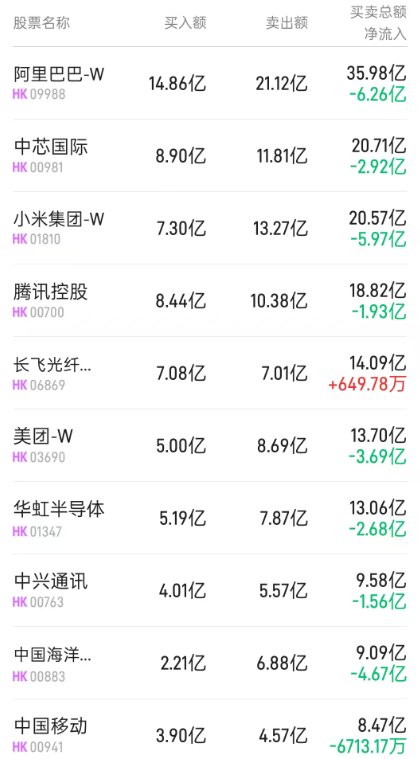
Core Viewpoint - The Hong Kong stock market experienced significant net selling from northbound capital, with a total net outflow of 52.87 billion HKD on December 12, 2023, indicating a cautious sentiment among investors [2]. Group 1: Northbound Capital Activity - Northbound capital recorded a net selling of 65.95 billion HKD through the Shanghai Stock Connect and a net buying of 13.09 billion HKD through the Shenzhen Stock Connect [2]. - The most bought stocks by northbound capital included Meituan-W (03690), Xiaomi Group-W (01810), and Beike-W (02423) [2]. - The most sold stocks were Alibaba-W (09988), Tencent (00700), and Huahong Semiconductor (01347) [2]. Group 2: Stock Performance and Net Inflows - Alibaba-W had a buy amount of 14.86 billion HKD and a sell amount of 21.12 billion HKD, resulting in a net outflow of 6.26 billion HKD [3]. - Xiaomi Group-W saw a buy amount of 7.30 billion HKD and a sell amount of 13.27 billion HKD, leading to a net outflow of 5.97 billion HKD [3]. - Meituan-W recorded a net inflow of 5.00 billion HKD, with a buy amount of 5.00 billion HKD and a sell amount of 8.69 billion HKD [3]. Group 3: Market Insights and Analyst Reports - Morgan Stanley noted that competition in the food delivery sector is expected to peak in Q3, with both Alibaba and Meituan committing to rational competition [6]. - Longzhong Securities reported that Xiaomi's high-end smartphone strategy and IoT business are showing significant growth, projecting adjusted net profits of 446 billion, 515 billion, and 622 billion HKD for 2025-2027 [6]. - Guojin Securities expressed optimism about Beike's ability to leverage AI technology and cost control, despite expected revenue and profit declines due to the real estate market [7]. Group 4: Specific Stock Movements - ZTE Corporation (000063) faced a net outflow of 1.56 billion HKD, with plans to repurchase shares using 1 to 1.2 billion HKD of its own funds [7]. - SMIC (00981) and Huahong Semiconductor (01347) experienced net outflows of 5.78 billion HKD and 7.35 billion HKD, respectively [8]. - China Mobile (00941) and Tencent (00700) also faced net outflows of 6713 million HKD and 9.96 billion HKD, respectively [8].
Counterpoint:第三季度全球智能手机营收同比增长5% 创下九月季度历史新高
Zhi Tong Cai Jing· 2025-11-06 07:25
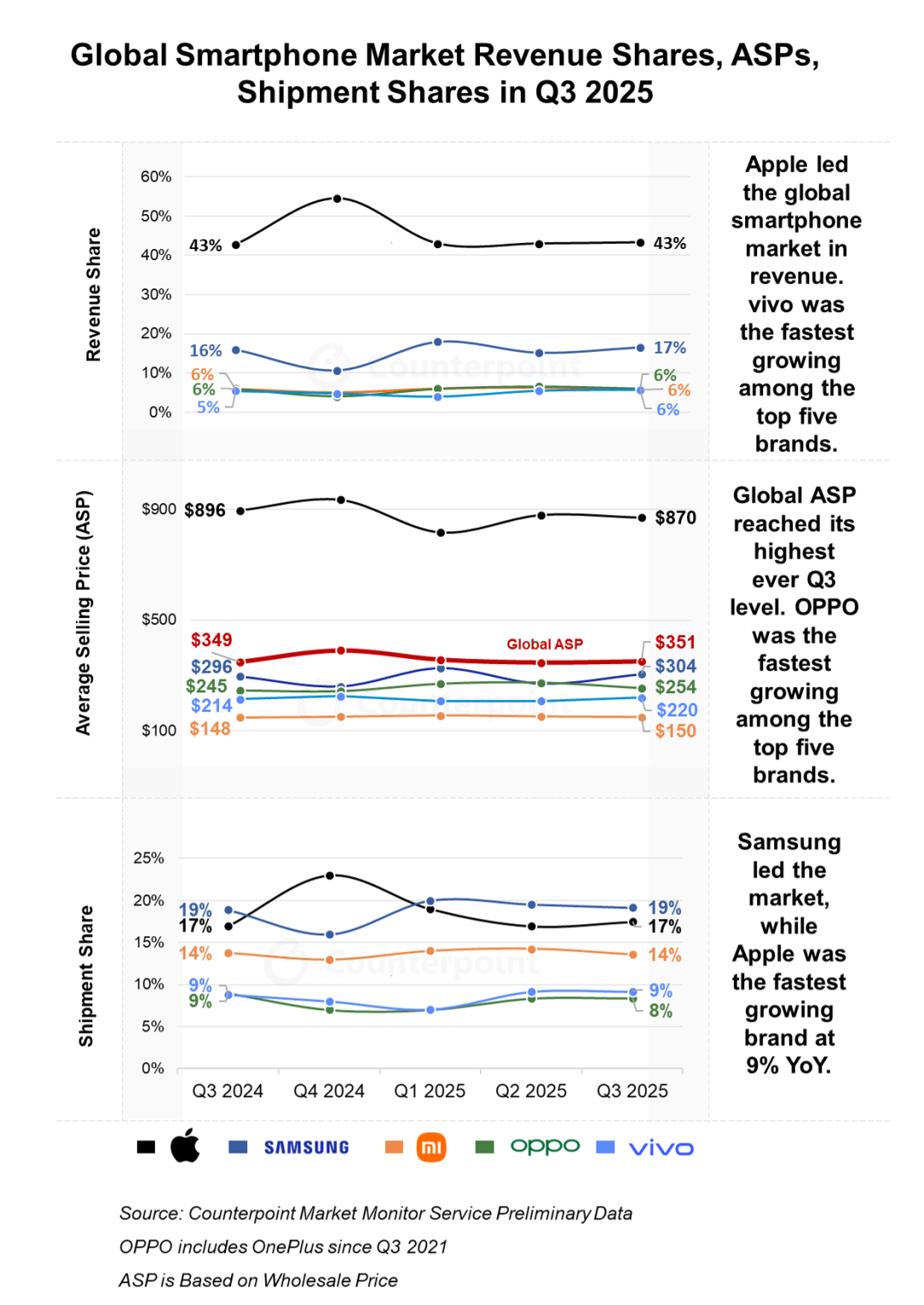
Core Insights - The global smartphone market revenue is projected to grow by 5% year-on-year in Q3 2025, reaching $112 billion, marking the highest revenue for this quarter in history [1] - Global smartphone shipments are expected to see a moderate growth of 4% year-on-year, totaling 320 million units [1] - The average selling price (ASP) of smartphones has reached a record high for Q3 at $351, driven by an expanding mature user base upgrading to more expensive devices [1] Market Performance - Apple led the global smartphone market with a 60% revenue share, achieving a 6% year-on-year revenue growth and a 9% increase in shipments [2][5] - Samsung holds the largest market share in shipments at 19%, with a 9% revenue growth and a 3% increase in ASP, attributed to the success of high-end products like the Galaxy S25 series [5] - Xiaomi ranks third in global shipments with a 14% market share, experiencing a 2% growth, supported by demand in emerging markets [5] Brand Analysis - OPPO recorded the highest ASP growth among the top five brands, increasing by 3.4% year-on-year, with a 1% revenue growth driven by the strong performance of the Reno14 series [5] - Vivo achieved the fastest revenue growth among the top five brands at 12% year-on-year, fueled by strong shipment growth in India and Southeast Asia [6] - The overall trend indicates a shift towards high-end devices and an increase in the adoption of foldable smartphones, which is expected to further boost ASP and revenue in the global smartphone market by 2025 [6]
小米17热销,iPhone 17紧俏!实探假期换机潮
Zhong Guo Zheng Quan Bao - Zhong Zheng Wang· 2025-10-05 14:19
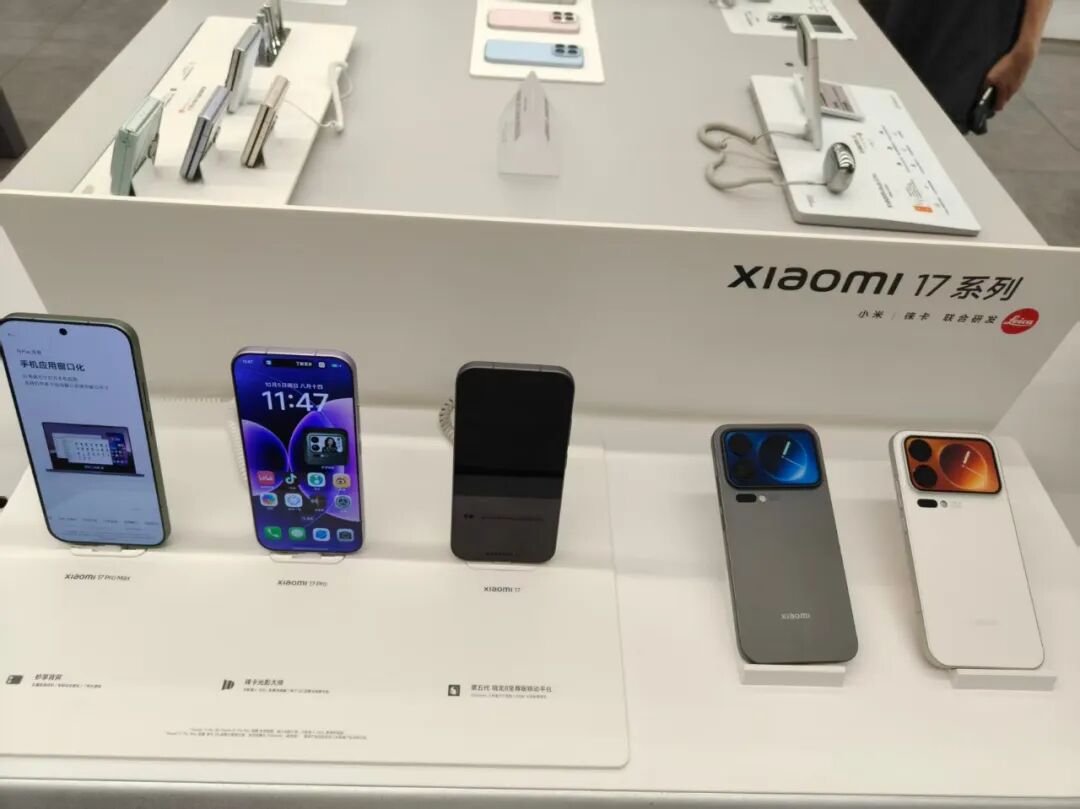
Core Insights - The Chinese smartphone market is experiencing a surge in demand during the National Day and Mid-Autumn Festival holidays, with high-end models from brands like Apple, Huawei, and Xiaomi seeing significant interest [1][2]. Group 1: High-End Smartphone Sales - Apple's iPhone 17 series is in high demand, with limited stock available, particularly for the iPhone 17 model [2][4]. - Xiaomi's 17 series has sold over 1 million units since its launch on September 27, 2023, indicating a faster sales pace compared to previous models [4]. - Huawei's new Mate XTs foldable phone requires advance reservations due to high demand, while the Pura 80 series has sufficient stock [4][5]. Group 2: Market Trends and Projections - Counterpoint Research predicts an 8% year-on-year growth in the global high-end smartphone market (priced above $600) by the first half of 2025, with Apple holding a 62% market share [5][6]. - Xiaomi's high-end smartphone sales increased by 55% year-on-year, primarily driven by the Chinese market [5]. - Upcoming releases from brands like vivo, OPPO, and Honor are expected to provide consumers with more high-end options, further enhancing competition in the market [5][6]. Group 3: Technological Advancements - The acceleration of high-end smartphone development is being driven by AI technology, with the global AI smartphone market share projected to rise from 16% in 2024 to 54% by 2028 [6].

小米17热销 iPhone 17紧俏!实探假期换机潮
Zhong Guo Zheng Quan Bao· 2025-10-05 14:15
Core Insights - The Chinese smartphone market is experiencing a surge in demand during the National Day and Mid-Autumn Festival holidays, with high-end models from brands like Apple, Huawei, and Xiaomi seeing significant interest [2][3][4]. Group 1: Market Trends - The iPhone 17 series is in high demand, with limited stock available, particularly for certain models [3]. - Xiaomi's 17 series has surpassed 1 million units sold, indicating a faster sales pace compared to previous models [4]. - Huawei's new Mate XTs foldable phone requires pre-order due to high demand, while other models like the Pura 80 series are readily available [4]. Group 2: Competitive Landscape - Counterpoint Research indicates that the high-end smartphone market (priced above $600) is expected to grow by 8% year-on-year in the first half of 2025, with Apple holding a 62% market share [7]. - Xiaomi's high-end smartphone sales increased by 55% year-on-year, primarily driven by the Chinese market [7]. - Upcoming releases from brands like vivo, OPPO, and Honor are expected to provide consumers with more high-end options, further intensifying competition [7]. Group 3: Consumer Preferences - The foldable smartphone segment is seen as a niche but growing category, offering unique experiences that attract consumers [6]. - The recognition of domestic brands in the high-end smartphone market is increasing, as evidenced by Xiaomi's strong sales performance [7]. - Innovation and product differentiation are identified as key factors for sustaining consumer interest in the smartphone market [8].
智能手机高端化成行业发展新引擎
Zheng Quan Ri Bao· 2025-09-11 16:14
Core Insights - The global smartphone market is undergoing a transformation, with the high-end smartphone segment becoming a new growth engine, projected to grow by 8% year-on-year in the first half of 2025, surpassing the overall smartphone market growth of 4% [1][2] Group 1: High-End Market Growth - The high-end smartphone market saw Apple leading with over 62% market share and a 3% increase in sales, primarily driven by emerging markets, although its share in China is being challenged by Huawei and Xiaomi [2] - Consumer reliance on smartphones has reached unprecedented levels, making them central to digital life, which encourages investment in higher-performance and more durable devices [2] - The market is nearing saturation, with the high-end segment emerging as the primary growth area, shifting competition from market share to high-value users and profit margins [2] Group 2: AI Integration in Smartphones - AI capabilities are rapidly becoming standard in high-end smartphones, with devices featuring generative AI expected to account for over 80% of high-end smartphone sales by the first half of 2025 [4] - Major brands are focusing on AI as a key differentiator, with Apple integrating AI into its iOS ecosystem, Samsung promoting AI features through its GalaxyAI series, and Google leveraging its AI-native advantages [4] - Chinese brands like Huawei, Xiaomi, OPPO, and vivo are competing in AI imaging, fast charging, and foldable screens, accelerating their presence in the global high-end market [4] Group 3: Strategic Shifts in Competition - The competition in the smartphone industry is shifting from hardware specifications to AI-driven user experiences, with companies collaborating with major AI model providers to enhance software capabilities [5] - The rapid adoption of AI signifies a shift in competitive focus, where the ability to deliver innovative and useful AI experiences will determine success in the high-end market [5] - Companies are encouraged to move beyond fierce competition in the low-end market and invest in technological innovation and experience upgrades to define their future brand value [5]
21现场|华为苹果新品引爆深圳产业链:工厂急招,企业满产
2 1 Shi Ji Jing Ji Bao Dao· 2025-09-10 14:57
Core Viewpoint - The recent launch of new smartphone models by major manufacturers Apple and Huawei has sparked a global consumer electronics boom, driving demand across the supply chain and leading to significant growth in the high-end smartphone market [4][5][6]. Group 1: Smartphone Launches - Apple officially launched the iPhone 17 series, which includes four new models [2]. - Huawei released the Mate XTs, its second commercial foldable smartphone, featuring the new Kirin 9020 chip, marking a significant performance improvement of 36% [3][6]. - The competition between Apple and Huawei is intensifying, with both companies innovating in design and technology to attract high-end consumers [7]. Group 2: Market Trends - According to CounterPoint Research, global high-end smartphone sales are expected to grow by 8% year-on-year in the first half of 2025, reaching a historical high [4]. - The global smartphone shipment volume increased by 3% year-on-year in Q2 this year, with market revenue growing by 10%, surpassing $100 billion for the first time in Q2 history [7]. Group 3: Supply Chain Dynamics - Shenzhen, as a major hub for the consumer electronics industry, is experiencing a surge in hiring and production activity in response to the new product launches [5][9]. - Labor costs in Shenzhen's electronics factories have risen, with hourly wages reaching up to 33 yuan, reflecting the increased demand for production [9]. - Companies like Lens Technology and Luxshare Precision are reporting full production capacity and robust growth in their consumer electronics segments [10]. Group 4: Capital Market Response - The stock market has reacted positively to the new product announcements, with companies in the Shenzhen supply chain seeing significant gains [13]. - Key players such as Lens Technology, GoerTek, and Luxshare Precision have reported substantial revenue and profit growth, with Luxshare Precision achieving a revenue of 124.5 billion yuan, up 20.18% year-on-year [14]. - The overall performance of Shenzhen's consumer electronics sector has shown a 35% increase in stock prices, with total revenue reaching 579.72 billion yuan and net profit growing by 17.4% [14]. Group 5: Future Opportunities - Companies in the consumer electronics supply chain are actively exploring new markets, including automotive electronics and AI technologies, to diversify their business [15]. - The integration of AI technology into product development is expected to enhance manufacturing efficiency and reduce costs, positioning companies to capture new market opportunities [15].
瑞声科技半年净利飙升六成,光学与结构件撑起新增长曲线
Jing Ji Guan Cha Bao· 2025-08-21 08:29
Core Insights - AAC Technologies reported a strong half-year performance, exceeding market expectations with a revenue of 13.32 billion yuan, a year-on-year increase of 18.4%, and a net profit of 876 million yuan, up over 60% [1][2] - The company's net profit margin improved from 4.8% in the same period last year to 6.6%, indicating a clear trend of profit recovery [1] Revenue Breakdown - The optical business continued its high growth trajectory, generating revenue of 2.65 billion yuan, a nearly 20% year-on-year increase, with a gross margin improvement to 10.2% [1] - Precision structural components and electromagnetic drive businesses also performed well, with revenue growth exceeding 27%, driven by new products like ultra-thin motors and liquid cooling heat sinks [1] - The sensor and semiconductor business saw a significant revenue increase of 56% year-on-year, driven by AI interaction demand, with high signal-to-noise ratio microphones achieving scale production [1] - The automotive acoustics segment maintained its expansion, generating revenue of 1.74 billion yuan, a 14% year-on-year increase, further enhanced by the acquisition of Hebei Chuguang for smart microphones and sensors [1] Traditional Business Performance - Traditional acoustic business remains a core segment, with revenue of 3.52 billion yuan, a year-on-year increase of 1.8%, supported by mid-to-high-end products and innovative designs [2] Financial Health - The company's financial position remains robust, with operating cash flow of 2.89 billion yuan, a 9% increase year-on-year, and cash on hand of 7.75 billion yuan, resulting in a net debt ratio of only 4.7% [2] - Capital expenditures increased significantly to 1.44 billion yuan, a 57% rise compared to the same period last year, primarily directed towards optical, automotive, and semiconductor sectors [2] Shareholder Returns - The company maintains a year-end dividend policy with a payout ratio of 15%, while not declaring an interim dividend, ensuring strong cash flow and prudent capital management to support future business development [2] Strategic Transition - AAC Technologies is undergoing a critical phase of business structure transformation, with traditional acoustic business growth slowing, while optical, structural components, and sensor businesses are rapidly expanding, creating new growth opportunities [2] - The ongoing trends of smartphone premiumization and automotive intelligence are expected to further enhance the company's profitability in optical lenses, automotive acoustics, and sensors [2]