
水资源刚性约束制度

Search documents
青海水利“十五五”惠民蓝图出炉
Xin Lang Cai Jing· 2026-02-06 17:54
Group 1 - The core objective of the water resources strategy in Qinghai Province is to achieve a river embankment compliance rate of over 95% by the end of the 14th Five-Year Plan, with a target of reducing water usage per unit of GDP and ensuring a water supply safety coefficient of 1.15 [1] - The province aims to utilize over 130 million cubic meters of unconventional water and improve the effective utilization coefficient of irrigation water in farmland to 0.52, while increasing the rural self-supplied water coverage rate to 88% [1] - Key ecological flow compliance rates for major rivers and lakes are targeted to reach over 90%, with a digitalization rate of major water conservancy projects set at 44% [1] Group 2 - The development path focuses on ensuring flood safety and establishing a new framework for disaster prevention, including the construction of high-standard flood control projects along the Yellow River and the management of tributaries and small rivers [2] - The strategy includes the integration of various water monitoring systems to enhance flood forecasting accuracy and extend the lead time for flood warnings [2] - The plan emphasizes the importance of unified scheduling and emergency response mechanisms to protect vital infrastructure and public safety [2] Group 3 - The initiative aims to create a comprehensive and efficient highland water network, enhancing the benefits of major water diversion projects and ensuring the integration of water supply systems [2] - The focus is on modernizing irrigation systems and improving water distribution capabilities, with a goal of achieving a 50% coverage of rural populations by centralized water supply [2] - The strategy includes the implementation of a rigid water resource constraint system to manage water usage effectively and enhance soil and water conservation efforts [3]
“有多少汤泡多少馍”,这样量化考核(政策解读)
Ren Min Ri Bao· 2026-01-25 05:31
Core Viewpoint - The newly issued "Assessment Method for Implementing the Rigid Water Resource Constraint System" aims to enhance water resource management in China, replacing the previous strict water resource management assessment system, emphasizing the principle of "using water to determine cities, land, people, and production" [1][2][10] Group 1: Changes in Assessment Method - The new assessment method introduces a more rigorous framework for evaluating water resource management, focusing on total water usage and efficiency, while also highlighting the "Four Waters and Four Determinations" principle [2][3] - The assessment content has evolved from four main measures to five, including economic development based on water availability, water resource conservation, and regulatory compliance [3][4] Group 2: Implementation and Regional Adaptation - The assessment method incorporates feedback from various regions, emphasizing the need for local adaptations of water resource management strategies, such as defining available water quantities for different areas [3][5] - For instance, Ningxia has set specific water usage limits for agriculture and urban development based on available water resources, demonstrating a practical application of the new assessment principles [5][6] Group 3: Focus on Water Conservation - The assessment method places significant emphasis on water conservation, integrating efficiency targets into the evaluation criteria to promote sustainable water use across sectors [5][7] - Specific indicators for water resource protection and overload management have been established to address issues like river flow interruption and groundwater depletion [7][8] Group 4: Evaluation and Accountability - The assessment results will be categorized into four levels, serving as a critical reference for evaluating the performance of provincial governments in managing water resources [8][9] - The evaluation will utilize a scoring system, with a maximum score of 100, where poor performance in water resource management will prevent provinces from achieving higher ratings [9][10]
“有多少汤泡多少馍”,这样量化考核
Xin Lang Cai Jing· 2026-01-25 02:49
Core Viewpoint - The new assessment method for the rigid water resource constraint system emphasizes the principle of "using water to determine cities, land, people, and production," aiming to enhance water resource management and ensure sustainable development in the context of uneven water distribution across regions [1][2][3]. Group 1: Changes in Assessment Method - The newly issued assessment method replaces the previous strict water resource management assessment, which has been in place since 2013, to better align with the current water resource situation and the "14th Five-Year Plan" [1][2]. - The new assessment method introduces 18 articles and indicators, modifying the focus from total water usage and efficiency to include water resource protection and overload governance, while removing the water quality standard rate control target [3][4]. - The assessment now includes five key areas: economic and social development based on water availability, water resource conservation and efficient use, water resource protection and overload governance, water resource supervision, and responsibility implementation and reform innovation [3][4]. Group 2: Implementation and Regional Adaptation - The assessment method aims to set the available water volume as a boundary for economic and social development, promoting a coordinated approach between water resources and urban, agricultural, and industrial development [4][5]. - Regions like Ningxia are implementing specific water usage limits based on national total volume indicators, optimizing agricultural practices to reduce water-intensive crops and aligning industrial development with water resource conditions [7][8]. - The assessment emphasizes the importance of water conservation, with specific indicators for agricultural, industrial, and urban water-saving policies to enhance water use efficiency and reduce consumption [5][9]. Group 3: Monitoring and Evaluation - The assessment results will be categorized into four levels: excellent, good, qualified, and unqualified, serving as a significant reference for evaluating the performance of provincial governments [10][11]. - The Ministry of Water Resources plans to gradually integrate the new assessment tasks into the existing framework for 2024 and 2025, ensuring a smooth transition and alignment with previous assessments [10][11]. - Continuous monitoring and information technology will be employed to enhance the effectiveness of the assessment and ensure compliance with water resource management standards [9][11].
“有多少汤泡多少馍”,水资源刚性约束制度这样量化考核
Xin Lang Cai Jing· 2026-01-24 23:43
Core Viewpoint - The newly implemented "Water Resource Rigid Constraint System Assessment Method" emphasizes a quantitative approach to water resource management, aligning water usage with economic and social development needs, encapsulated in the phrase "how much soup, how much bread" [1][7]. Group 1: Implementation of the Assessment Method - The assessment method replaces the previous strict water resource management system assessment, which has been in place since 2013, to better reflect current water resource challenges and management needs [2][3]. - The new assessment method aims to enhance the control of total water usage and efficiency while emphasizing the principle of "Four Waters and Four Determinations" (using water to determine city planning, land use, population distribution, and production) [3][4]. Group 2: Changes in Assessment Criteria - The assessment retains targets for total water usage and efficiency but introduces new goals for water resource protection and overload management, while removing the water quality standard targets [4][10]. - The assessment criteria have shifted from four main measures to five, focusing on economic development aligned with water availability, water resource conservation, protection, and regulatory responsibilities [4][5]. Group 3: Regional Implementation Examples - In Ningxia, the local government has defined available water quantities for various regions, adhering to the "Four Waters and Four Determinations" principle to optimize agricultural practices and industrial layouts [8]. - Dezhou, previously classified as an overloaded water resource area, has successfully reduced its water usage from 1.5 billion cubic meters to 977 million cubic meters through stringent water conservation measures [9]. Group 4: Future Assessment Plans - The assessment results will be categorized into four levels and will serve as a significant reference for evaluating the performance of local government leaders [11][12]. - The Ministry of Water Resources plans to gradually integrate the new assessment tasks into the existing framework for 2024 and 2025, with a full transition expected by mid-2026 [11][12].
今年开始实施落实水资源刚性约束制度考核 “有多少汤泡多少馍” 这样量化考核(政策解读)
Ren Min Ri Bao· 2026-01-24 22:08
Core Viewpoint - The State Council has issued the "Assessment Method for Implementing the Rigid Water Resource Constraint System," which will replace the previous strict water resource management assessment system, emphasizing the importance of water resource management in economic and social development [1][2][10]. Group 1: Changes in Assessment Method - The new assessment method highlights the principle of "water determines city, land, people, and production," reinforcing the need for water resource management to align with economic and social development [2][3]. - The assessment will now include new targets for water resource protection and overload governance while removing the water quality compliance rate target [3][4]. - The assessment content has shifted from four original measures to five new categories, focusing on economic development based on water availability, water resource conservation, protection, and regulatory compliance [3][4]. Group 2: Implementation and Regional Adaptation - The assessment method aims to set boundaries for water use based on available water resources, promoting a coordinated approach between economic development and water resource conditions [4][5]. - Regions like Ningxia are implementing specific water usage limits and adjusting agricultural practices to align with available water resources, such as stabilizing irrigation areas and optimizing crop types [5][6]. - The assessment will also emphasize the importance of water resource protection and management, addressing issues like river flow interruption and groundwater depletion [7][8]. Group 3: Assessment Results and Future Plans - The assessment results will be categorized into four levels: excellent, good, qualified, and unqualified, influencing the evaluation of local government leadership [9][10]. - The transition from the old to the new assessment method will be gradual, with plans to incorporate the new tasks into the assessments for 2024 and 2025 while still adhering to the previous system for 2025 [8][9]. - By 2026, the new assessment method will be fully implemented, with results reported to the State Council [8][9].
国务院办公厅关于印发《落实水资源刚性约束制度考核办法》的通知
Yang Shi Wang· 2025-12-31 09:47
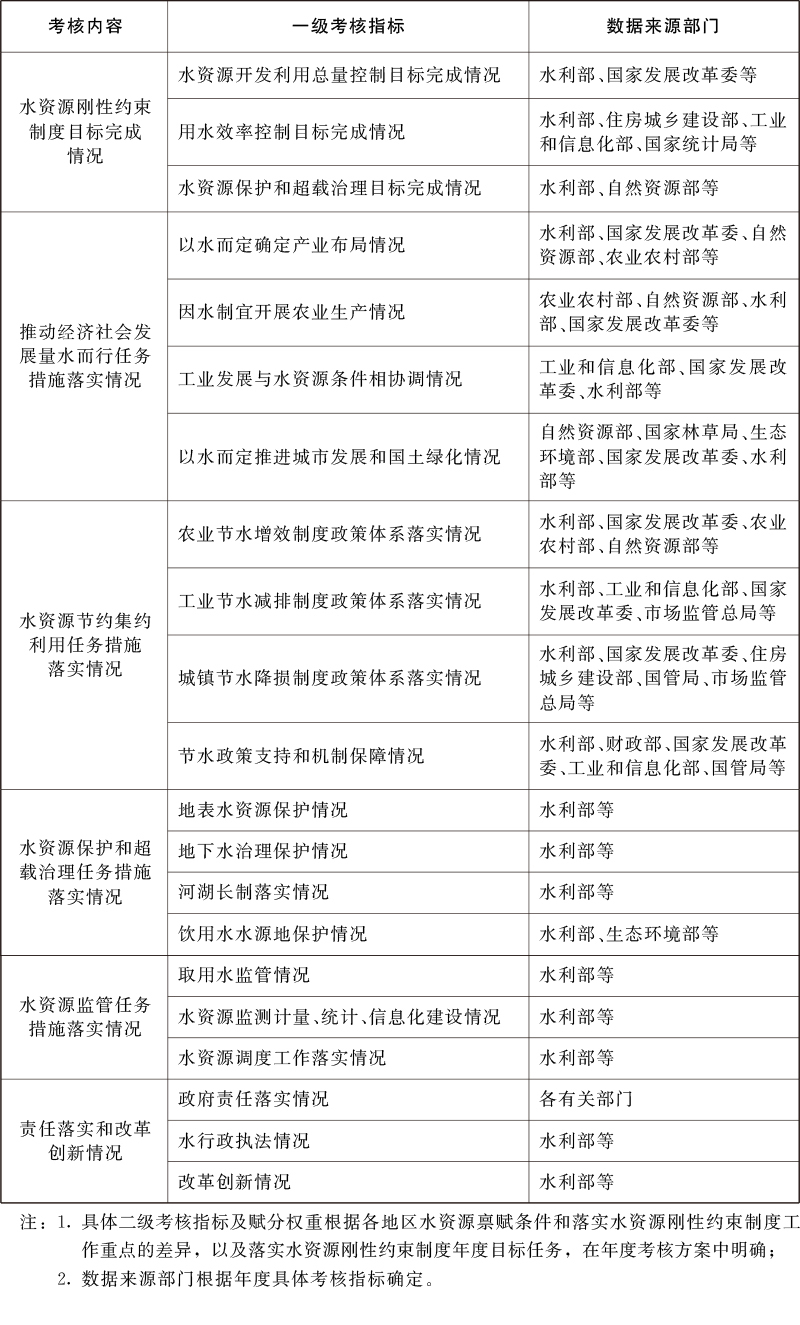
Core Viewpoint - The State Council of China has issued a new assessment method for implementing a rigid water resource constraint system, aimed at promoting efficient and sustainable water resource utilization while improving ecological environments [1][2]. Group 1: Assessment Framework - The assessment method is designed to ensure that water resource development remains within the limits of ecological carrying capacity, supporting high-quality development [3]. - The assessment applies to provincial governments and emphasizes goal-oriented and problem-oriented approaches, with a focus on scientific indicator setting and efficient execution [4]. - The assessment will be conducted annually, with a scoring system where a score of 90 and above is considered excellent, 80-89 good, 60-79 passable, and below 60 as failing [4][5]. Group 2: Implementation and Oversight - A working group composed of various ministries, including the Ministry of Water Resources and the National Development and Reform Commission, will oversee the implementation of the assessment [4][5]. - Each province is required to conduct self-assessments and submit reports to the State Council, which will then be verified by the working group [5][6]. - The results of the assessments will be used as a reference for evaluating provincial leaders and for allocating central funding [6][7]. Group 3: Accountability and Compliance - Provinces that fail to implement the rigid water resource constraint system effectively will not be rated above "passable" [4][6]. - Significant achievements in implementing the system will be recognized, while provinces with poor performance must submit corrective measures within a month of the assessment results [6][7]. - Any fraudulent activities during the assessment process will lead to automatic failure and accountability for responsible parties [7]. Group 4: Specific Assessment Indicators - The assessment will include various indicators such as total water resource utilization control, water efficiency targets, and the implementation of water-saving policies across different sectors [9][10]. - Specific indicators will be tailored based on regional water resource conditions and the focus of the rigid constraint system implementation [10].

国务院办公厅印发《落实水资源刚性约束制度考核办法》
Xin Hua She· 2025-12-31 09:14
Core Points - The State Council has issued the "Implementation Measures for the Assessment of the Rigid Water Resource Constraint System," which will take effect immediately [1] - The main objective of the measures is to promote the implementation of the rigid water resource constraint system, enhance water resource conservation and safety, and improve the ecological environment of rivers and lakes [1] - The assessment will be conducted annually and will include self-evaluation, verification scoring, comprehensive evaluation, feedback, and announcement of results [1] Assessment Criteria - The assessment will focus on the completion of the rigid water resource constraint system goals, the implementation of water resource conservation measures, and the management of water resources [1] - Results will be categorized into four levels: excellent, good, qualified, and unqualified, which will serve as an important reference for evaluating the performance of provincial governments [1] - Units and individuals achieving significant results will be considered for recognition and rewards, while those with unqualified results will be required to submit rectification measures [2]
松辽水利委员会完成流域水资源严重短缺和超载地区划定成果复核工作
Shui Li Bu Wang Zhan· 2025-12-31 00:36
Core Viewpoint - The article discusses the completion of the technical review for the delineation of areas with severe water resource shortages and over-exploitation in the Songliao River Basin, which is a crucial step in implementing a rigid water resource constraint system and achieving differentiated water resource management [1] Group 1 - The delineation of severely short and over-exploited water resource areas is an important measure to enforce water resource constraints and manage water resources differently [1] - The Songliao Water Resources Commission guided provincial water authorities to communicate with natural resource departments and conduct the delineation work based on water resource endowments, river utilization levels, and actual water consumption over the past three years [1] - The preliminary results of the delineation were formed by considering upstream and downstream, left and right banks, local water, transit water, and external water [1] Group 2 - The Songliao Water Resources Commission conducted two rounds of technical reviews and communicated with provincial authorities to finalize the technical results of the delineation [1] - The next steps involve continuing the delineation work for severely short and over-exploited water resource areas and promoting the application of the results to guide economic and social development in the basin [1]
明确“硬指标”、划定“红线”,山东15条措施推进“十五五”节水控水工作
Feng Huang Wang Cai Jing· 2025-12-16 07:24
Core Viewpoint - Shandong Province faces significant challenges in water resource distribution, heavily relying on external water sources, which constrains high-quality economic and social development [2][4]. Group 1: Water Resource Management - The Shandong government emphasizes a water-saving priority approach, aiming for sustainable economic development with limited water resources [4]. - The province has implemented various measures to enhance water-saving awareness and efficiency, achieving a GDP output of 426 yuan per cubic meter of water [6]. - By 2024, Shandong aims to reduce water consumption per unit of GDP by 21.28% and per unit of industrial added value by 19.69% compared to 2020 [6]. Group 2: Policy Implementation - The "Opinions on Implementing the Water-Saving Priority Policy" was officially issued on November 20, 2025, outlining 15 specific measures to promote comprehensive water-saving efforts [7]. - The document aligns with national laws and regulations, including the Yellow River Protection Law and the Water Conservation Law, focusing on rigid water resource constraints [7]. Group 3: Specific Goals and Measures - Shandong has set specific targets for 2030, including controlling groundwater extraction to 9.018 billion cubic meters and improving irrigation water efficiency to 0.655 [8]. - The province aims to reduce urban public water supply pipeline leakage to 7.85% and achieve a 60% reuse rate of urban reclaimed water [8]. Group 4: Institutional Mechanisms - The province plans to enhance the water-saving institutional framework, including strict water pricing standards and the promotion of water-saving technologies [10]. - Initiatives include the establishment of water budget management trials and the development of a water-saving industry worth 150 billion yuan [10]. Group 5: Future Directions - The Shandong Water Resources Department will focus on promoting the implementation of the water-saving policy, enhancing the management of the entire water resource process, and fostering a water-saving society [11]. - The province aims to strengthen the market for water rights trading and improve water resource utilization efficiency to support green and low-carbon development [11].
松辽水利委员会组织开展基于遥感的农业用水量核算和违规取用水情况调查工作
Shui Li Bu Wang Zhan· 2025-12-11 07:21
Core Viewpoint - The article discusses the challenges and initiatives related to agricultural water usage in the Lalin River basin, highlighting the implementation of a water resource constraint system and the ongoing investigation into agricultural water consumption and illegal water usage [1] Group 1: Agricultural Water Usage Investigation - The Songliao Water Resources Committee has initiated an investigation into agricultural water usage in the Lalin River basin, focusing on the tight water supply situation [1] - The investigation employs a combination of satellite remote sensing and on-site verification to assess agricultural planting areas and actual irrigation areas [1] - The total agricultural irrigation water volume for 2024 in the Lalin River basin has been calculated based on different agricultural water quotas for various regions [1] Group 2: Data Verification and Management - The investigation includes a review of water usage data reported by local authorities through a water usage statistical reporting system [1] - The committee is utilizing the achievements from water usage consolidation actions and management platforms to map irrigation water intake locations and ranges [1] - A field verification was conducted in six counties (cities, districts) including Wuchang and Shulan, with 15 to 20 sampling points selected for on-site checks [1] Group 3: Future Actions and Oversight - The Songliao Committee plans to solicit opinions from relevant provinces regarding the issues identified during the investigation and will require further verification [1] - There will be guidance and supervision to implement corrective measures, strengthen total water usage control in key river basins, and enhance supervision and management of water usage [1]