网络暴力

Search documents
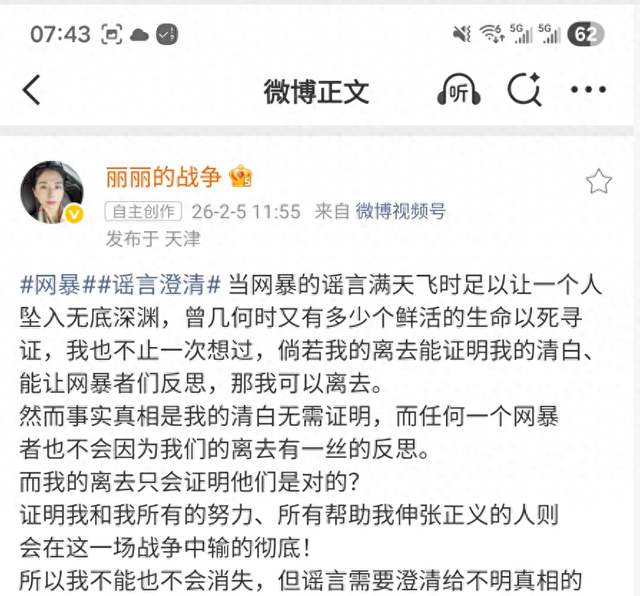
“出差遭老板性侵”当事人:起诉网暴者!
Xin Lang Cai Jing· 2026-02-06 06:35
2月5日 "我不能也不会消失 但谣言需要澄清给不明真相的人!" 澄清围绕她的六大谣言 宣布将对网暴者发起刑事自诉 视频中,她讲述网络上针对她的六大谣言。 谣言一:被侵害是自己做局,是"仙人跳"。 谣言二:被侵害后,先索要3%的股权,后要2000万,无果后才报案。 谣言三:被侵害后,在施暴者的房间洗澡。 "国内首例职场性侵工伤认定案" 当事人崔丽丽发布视频 谣言四:直播卖货,炒作流量。 谣言五:勾结西方势力。 谣言六:骗取社保,薅社保羊毛。崔丽丽表示,将刑事自诉涉嫌造谣、诽谤、侮辱她的网暴者们。 崔丽丽在后续微博中,透露了事件进展: 基于扎实的证据,我们已经锁定了第一批近50名侵权用户的真实身份信息以及涉及侵权的证据,包括 120篇博文、260个短视频,并正式向我天津当地法院提起了可能涉及造谣诽谤、侮辱罪的刑事自诉,目 前案件正在进行立案审查工作。 有结果我会第一时间给到大家。同时,第二批还有135名侵权用户的信息调取也在同步进行中。 据潮新闻报道,2025年12月底,崔丽丽在天津本地法院申请立案。前几日,她收到法院通知,证据材料 诉状都已审查完,目前已经移交给公安(刑侦)。 另外,她也补充表示,针对网暴的不同 ...

配音演员被“开盒”,两人伙同境外犯罪分子非法获取公民信息获刑
Xin Lang Cai Jing· 2026-02-05 02:44
#个人隐私信息被混合编辑后成造谣文案#【配音演员被"开盒",#两人伙同境外犯罪分子非法获取公民 信息获刑#】2023年至2024年1月,身处北京海淀的赵某与广东的成某某,通过Telegram非法获取某虚拟 偶像团体的配音演员及"粉丝"的户籍、手机号、行踪轨迹信息、健康信息等个人隐私信息,将相关信息 进行混合编辑,生成针对其个人的侮辱谩骂、造谣诽谤的违法犯罪信息文案。诱导他人实施网暴及线下 骚扰,严重危害公民权益与网络秩序,其中2名被侵害人因此罹患抑郁症。最终,赵某、成某某均获 刑。2026年2月5日,最高人民检察院发布"强化刑事检察监督 推进更高水平平安中国建设"典型案例, 公开了这起非法利用信息网络案。详情↓ ...
情绪宣泄需有度,网暴终将受严惩
Xin Lang Cai Jing· 2026-02-03 16:43
(二)公然侮辱他人或者捏造事实诽谤他人的; 近日,乳山市公安机关依法查处一起利用网络社交平台公然侮辱他人案件,及时维护了网络空间秩序和人 民群众合法权益。 基本案情: 2026年1月11日,王某利用某互联网平台,发布内容为受害人正面照片及醉酒视频等作品,并配有"男人都喜 欢免费的""卖肉的,最不值钱的那种"等文字对其进行公然侮辱,接到报警后,民警立即出警对案件展开调 查。经了解王某与受害人之间存在矛盾,为发泄私愤,王某在社交平台上发布侮辱他人的视频,根据《中华 人民共和国治安管理处罚法》第五十条的规定,乳山市公安局依法给予王某行政拘留五日的行政处罚。 法律条文: 《中华人民共和国治安管理处罚法》第五十条之规定,有下列行为之一的,处五日以下拘留或者一千元以 下罚款;情节较重的,处五日以上十日以下拘留,可以并处一千元以下罚款: (一)写恐吓信或者以其他方法威胁他人人身安全的; (三)捏造事实诬告陷害他人,企图使他人受到刑事追究或者受到治安管理处罚的; (四)对证人及其近亲属进行威胁、侮辱、殴打或者打击报复的; (五)多次发送淫秽、侮辱、恐吓等信息或者采取滋扰、纠缠、跟踪等方法,干扰他人正常生活的; (六)偷窥、偷 ...
猝死程序员妻子维权反遭网暴!千万粉丝大 V 疑似带节奏,留言区尽是攻击家属的水军
程序员的那些事· 2026-02-02 23:54
① 他们家庭内部的事,和她为亡夫维权争取工伤认定,这是两码事,不能混为一谈。 换作是这些挑七挑八的网友遭遇这种悲剧,还不知道他们又是哪样咯。 高广辉妻子遭受很多黑嘴和网暴, 小程程之前在这篇推文已经提过的 。 她在小某书不止发维权帖,还有不少追思贴,其中公开了家庭内部过往很多细节。 但是,有些人开始拿着放大镜,从中挑七挑八的,来证明"高妻并不是真爱丈夫的"之类的,或者是要"证明": 家庭生活压力才是压死高广辉的主因。( 这也就和那个 HR 波波姐不谋而合了 ) ② 在被网暴后,高妻隐藏了很多帖子。 上周我在她的留言区,看到某公号的文章截图,顺着找到了原文。在他主页看了一下,还是个大V,自称全网 矩阵超 2000 万粉丝。 文中还说"高广辉从来不体检" 记性好的读者,应该记得这篇推文:《 某大厂称"猝死程序员未按要求做体检",家属:每年都体检,但公司 不认三甲医院报告 》 这大V 在留言区回复时还称"高妻是寄生虫" 文章标题如下:《 程序员猝死背后的真话、真爱、真相》 他的文章,我不点评也不反驳,我是发现他文章留言区挺有意思的。总共 77 个留言,其中至少 54 个机器水 军留言 留言区水军的特征太明显了。 好 ...

按键伤人不见血,法律亮剑不宽容
Xin Lang Cai Jing· 2026-01-27 16:55
近日,乳山市公安机关依法查处一起利用网络社交平台公然侮辱他人案件,及时维护了网络空间秩序和人 民群众合法权益。 基本案情: (二)公然侮辱他人或者捏造事实诽谤他人的; (三)捏造事实诬告陷害他人,企图使他人受到刑事追究或者受到治安管理处罚的; (四)对证人及其近亲属进行威胁、侮辱、殴打或者打击报复的; (五)多次发送淫秽、侮辱、恐吓等信息或者采取滋扰、纠缠、跟踪等方法,干扰他人正常生活的; (六)偷窥、偷拍、窃听、散布他人隐私的。 有前款第五项规定的滋扰、纠缠、跟踪行为的,除依照前款规定给予处罚外,经公安机关负责人批准,可以 责令其一定期限内禁止接触被侵害人。对违反禁止接触规定的,处五日以上十日以下拘留,可以并处一千 元以下罚款。 2026年01月04日,周某利用某互联网平台,发布内容为受害人正脸视频,并配上"小三""破鞋"等文字进行公 然侮辱。经查明,嫌疑人周某为受害人前夫,为报复前妻,其在社交平台发布侮辱他人的视频,根据《中华人 民共和国治安管理处罚法》第五十条的规定,乳山市公安局依法给予周某行政拘留七日的予行政处罚。 法律条文: 《中华人民共和国治安管理处罚法》第五十条之规定,有下列行为之一的,处五日以 ...

演员孙涛遭网暴,抖音回应
Xin Lang Cai Jing· 2026-01-24 13:24
1月24日下午,@抖音黑板报 发布消息称,近期,网上出现"演员孙涛直播力挺闫学晶""孙涛在直播间卖杂粮""孙涛发布致歉信""孙 涛参与2026年春晚彩排"等不实信息。 经抖音求真团队核查账号情况,无证据显示孙涛曾于过往直播和视频中提及闫学晶事件。同时,根据当事人辟谣及媒体报道信 息,"直播间卖杂粮""发布致歉信""参与2026年春晚彩排"亦为不实信息。谣言源于营销号的恶意炒作,已被当事人及权威媒体多方 证伪,相关信息请以官方声明和权威报道为准。 孙涛于1月23日发布视频澄清有关情况。抖音运营团队持续严格处置,针对前述谣言推出求真卡,展示在相关热点话题和搜索结果 中,并在"抖音求真"官方账号发布辟谣视频。相关谣言均已加入数据库,站内存量视频已进行回查,下架视频超过8000条,谣言首 发账号已被封禁。平台对评论区、搜索词条等场景同步处置,清理6万余条评论。 针对孙涛遭受的网络暴力,平台自1月7日起依据相关规定对其账号启动保护机制,累计处置逾17万条负向评论、弹幕,7个违规账 号被禁止评论7到30天不等,平台将继续关注其账号状况。 据此前报道,1月23日,演员孙涛在个人社媒发布澄清视频,回应近期围绕其与闫学晶相关的 ...
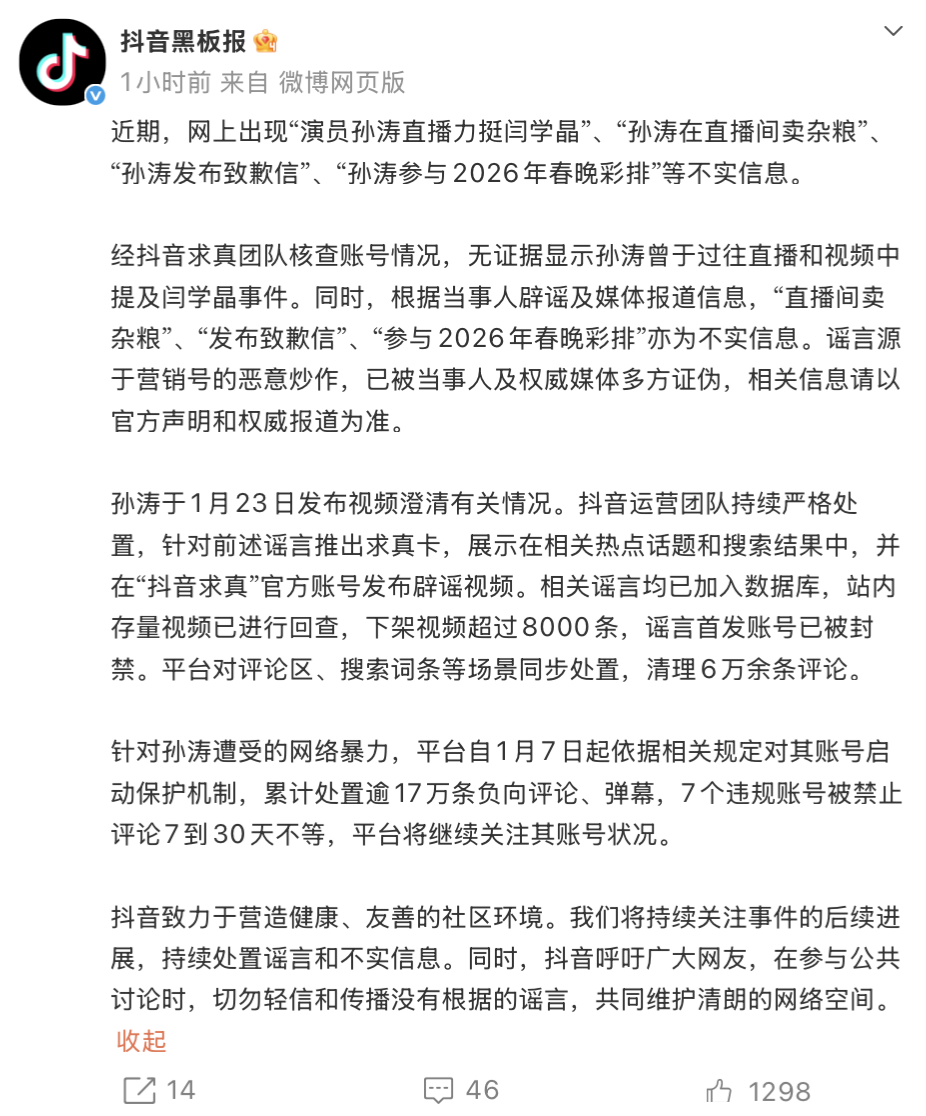
抖音辟谣四类涉孙涛不实信息,严处谣言及网络暴力行为
Yang Zi Wan Bao Wang· 2026-01-24 12:31
Core Viewpoint - Douyin has issued a statement refuting four categories of false information related to actor Sun Tao, emphasizing that these rumors are malicious fabrications by marketing accounts and have been debunked by the individual and authoritative media [1] Group 1: Rumor Refutation - Douyin's truth-seeking team found no evidence that Sun Tao mentioned the Yan Xuejing incident during his live broadcasts, and all other claims are also false [1] - The platform has launched a "Truth Card" to display in related hot topics and search results, and has published a video on the "Douyin Truth" account to clarify the rumors [1] - Over 8,000 related videos have been taken down, and the original account that spread the rumors has been banned [1] Group 2: Network Violence Response - Since January 7, Douyin has implemented a protection mechanism for Sun Tao's account, addressing over 170,000 negative comments and imposing penalties on seven violating accounts for 7 to 30 days [1] - The platform will continue to monitor the situation and take action against false information and rumors [1] Group 3: Sun Tao's Clarification - Sun Tao clarified on January 23 that during the controversy surrounding Yan Xuejing, he only discussed personal matters during his live broadcasts and did not mention the incident at all [2]
孙涛遭网暴超17万条评论被处置
Xin Lang Cai Jing· 2026-01-24 10:17
Core Viewpoint - The article discusses the spread of false rumors regarding actor Sun Tao, including claims of him supporting Yan Xuejing and participating in various events, which have been debunked by both Sun Tao and authoritative media sources [1] Group 1: Rumor Details - Recent rumors included claims that Sun Tao supported Yan Xuejing during a live stream, sold grains, issued an apology, and participated in the 2026 Spring Festival Gala rehearsal, all of which have been proven false [1] - The source of these rumors is identified as malicious marketing accounts, which have been verified and debunked by Sun Tao and media reports [1] Group 2: Platform Response - Douyin's truth-seeking team has taken action against the rumors, including launching a truth card to display in related hot topics and search results, and has removed over 8,000 videos related to the false claims [1] - The platform has also implemented protective measures for Sun Tao's account, addressing over 170,000 negative comments and banning seven accounts for violations [1] Group 3: Sun Tao's Response - Sun Tao publicly denied the rumors during a live stream on January 23, stating that he had not mentioned Yan Xuejing in his last live stream on January 2, which focused solely on his work [1] - He revealed that he had been advised to handle the situation quietly but decided to take legal action due to the persistent spread of misinformation, including fabricated apology letters [1] Group 4: Legal Actions - Sun Tao's legal team is collecting evidence to pursue legal action against the accounts spreading the rumors, having already identified those with significant engagement [1] - He has committed to focusing on his acting career and not engaging in live commerce, while also sending New Year wishes to his audience [1]
网红爱吃蛋一个月掉粉50万发文致歉
Xin Lang Cai Jing· 2026-01-24 04:12
Core Viewpoint - The internet celebrity "Love Eating Eggs" has experienced significant backlash, losing 500,000 followers in one month due to online bullying after gaining popularity from a boiled egg tutorial [1] Group 1: Background and Popularity - "Love Eating Eggs" gained 4 million followers in just nine days after the viral boiled egg tutorial [1] - The initial popularity was followed by skepticism regarding claims of consuming 40 eggs daily, leading to public criticism [1] Group 2: Response to Criticism - In a recent post, "Love Eating Eggs" apologized and acknowledged the impact of his statements, asking the public not to attack his family and fans [1] - He clarified that the mention of 40 eggs referred to a mix of egg whites, yolks, and feeding animals, but the doubts persisted [1] Group 3: Fundraising Efforts - On January 21, "Love Eating Eggs" released a video to raise funds for an eight-year-old girl suffering from heart disease, indicating a shift towards more charitable actions [1] - He expressed willingness to accept criticism and misunderstandings as long as he could help the child in need [1]
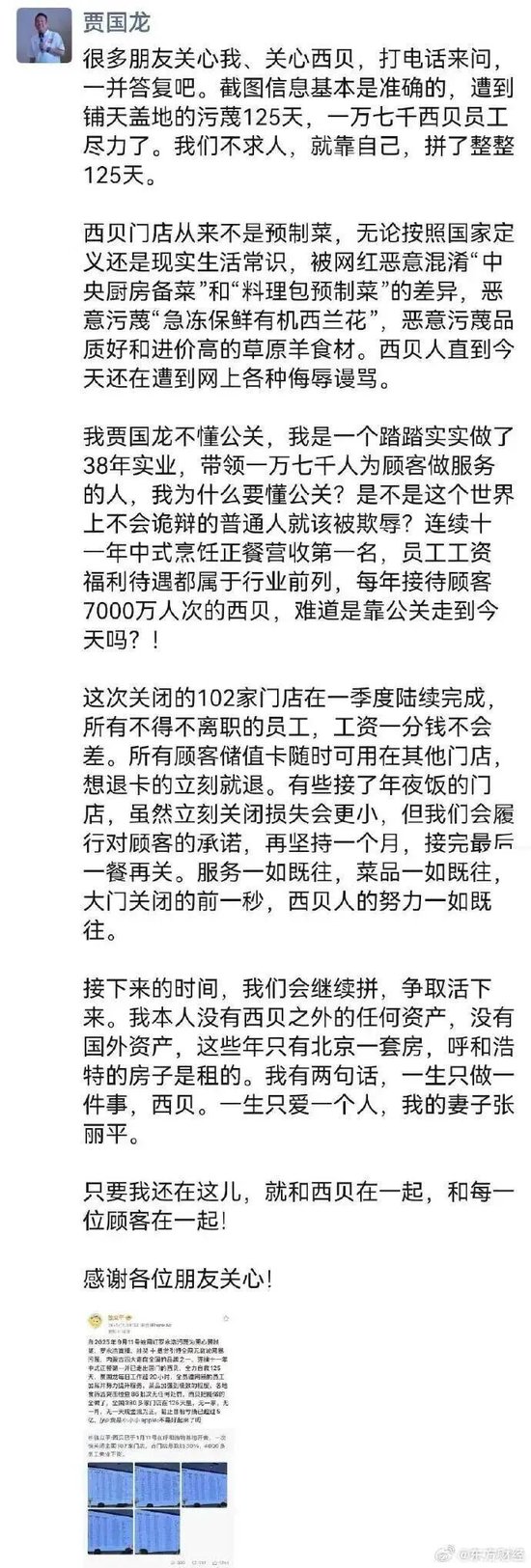
贾国龙,其实挺逗的
Xin Lang Cai Jing· 2026-01-18 03:30
来源:有趣的焦大 我们先贴一张图。然后再来说事儿。 老贾被铺天盖地的"污蔑"了125天,看着确实挺可怜的。但是被骂了125天之后,还是没整明白为啥挨 骂。 他总觉得是罗永浩恶意挑起了网友对西贝的攻击。他的羊肉没问题,他的西兰花没问题,他的卖不是预 制菜,他自己更没问题。 他以为他的失败,或者是局部失败、暂时失败,是公关失败。因为他不懂公关,因为他不会诡辩,所以 才被骂的体无完肤,才被迫关掉102家门店。 他一直很纳闷,我这么努力,这么用心搞餐饮,做实业,为什么还需要接这么多的脏水?而那些像罗永 浩一样动动嘴皮子的人,为什么总能赢,总那么得意,总那么一呼百应。 他觉得他是有良心的企业家,觉得把生意做对了,对员工好了,成为行业第一了,就一切都ok了。 他始终不明白,为什么自己这样一个道德完人、优秀企业家会遭受网暴,并且从线上蔓延到线下,从直 播间蔓延到凉菜间。他以为一直坚持,一如既往,一生只做一件事,一生只爱一个人,一家只有一套 房,就完全够了。就应该得到理解,得到尊重,得到善待,得到旌扬。 可是,他没说,西贝原有370家门店,2024年营收约55.73亿元,每年净利润约4-5亿元。原本打算2026 年上市,目标 ...