流量变现

Search documents
证券投顾机构赚翻了!这家公司去年净利大增238%,营销“烧钱”超14亿元
券商中国· 2026-03-28 03:57
Core Viewpoint - The article highlights the impressive financial performance of Jiufang Zhituo, a Hong Kong-listed securities advisory firm, reporting significant revenue and profit growth in 2025, driven by increased marketing expenditures and user acquisition strategies [1][2]. Financial Performance - Jiufang Zhituo achieved a revenue of 34.03 billion yuan in 2025, marking a 48.7% year-on-year increase, with a net profit of 9.22 billion yuan, up 238.5% from the previous year [1]. - The total order amount reached approximately 39.55 billion yuan, a 12.8% increase from 35.06 billion yuan in 2024 [3]. Marketing and User Acquisition - The company invested 14.13 billion yuan in sales and marketing, a 33.4% increase year-on-year, accounting for 41.2% of total revenue [2]. - The number of paying users surged to 289,500, a 59.5% increase from 181,500 in 2024 [3]. Other Income and Financial Support - Other income totaled 4.89 billion yuan, reflecting an 85.9% year-on-year growth, with VAT refunds contributing approximately 2.02 billion yuan [3]. - The company reported contract liabilities of 1.53 billion yuan, which will primarily be recognized as revenue in the 2026 fiscal year, providing future revenue support [3]. Refund Rate Trends - The refund rate for VIP products increased to 22.9% in 2025, up from 21.8% in 2024, indicating a rising trend over the past two years [4]. - Historical data shows significant fluctuations in refund rates, with some product series reaching as high as 30.3% and 31% in early 2024 before declining [4]. Industry Challenges and Regulatory Environment - Despite strong financial results, Jiufang Zhituo's subsidiary faced regulatory scrutiny, receiving an administrative penalty and being ordered to suspend new customer acquisitions for three months [5]. - The article notes a shift in industry competition from merely acquiring traffic to emphasizing research capabilities and compliance, suggesting that firms with strong compliance and professional skills will thrive [5].


“流量的尽头是放贷”,这话还真没骗人
程序员的那些事· 2026-02-15 02:10
Group 1 - The financial regulatory authority has recently conducted discussions with several platforms regarding their lending practices [1] - There is a growing trend among major internet platforms to engage in lending, as they have reached a saturation point in their primary business growth [3] - The lending business is perceived as highly profitable due to the platforms' access to vast user data, allowing for effective risk management and quick monetization compared to traditional e-commerce and advertising [4]

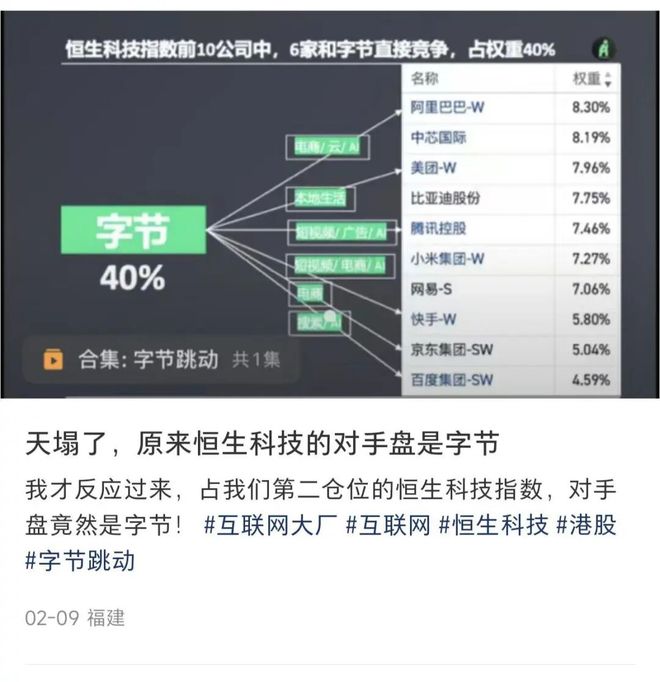
打败你(恒生科技)的不是天真,是字节
Xin Lang Cai Jing· 2026-02-13 13:02
Core Viewpoint - The article discusses the dominance of ByteDance in the tech industry, particularly in the context of the Hang Seng Tech Index, highlighting how its aggressive strategies and innovative approaches have outpaced traditional competitors like Tencent and Alibaba [1][19][22]. Group 1: Competitive Landscape - ByteDance is described as a formidable competitor that has effectively created a "red ocean" in various sectors, challenging established players without being a publicly listed company [1][19]. - Among the top 10 companies in the Hang Seng Tech Index, 6 are in direct competition with ByteDance, collectively holding a 40% weight in the index [2]. - The article emphasizes that ByteDance's approach to competition is not merely about financial strength but about its relentless drive and adaptability in the market [1][19]. Group 2: Market Disruption - ByteDance's entry into e-commerce through Douyin (TikTok) has significantly impacted Alibaba, with Douyin's GMV projected to approach 4 trillion yuan by 2025, capturing a substantial market share [6][9]. - The article argues that ByteDance's innovative model of combining content with e-commerce is more effective than Alibaba's traditional search-based approach, leading to a shift in consumer behavior [6][9]. - The dominance of ByteDance in various sectors, including short videos, news, and AI, is highlighted, indicating its broad market influence [7][9]. Group 3: Management and Leadership - The core competitive advantage of ByteDance is attributed to its founder, Zhang Yiming, whose unique management style and continuous learning mindset set the company apart from its competitors [11][12]. - Zhang's approach to management emphasizes equality, flexibility, and a focus on talent density, allowing for a more dynamic and innovative corporate culture [12][13]. - The article suggests that ByteDance's ability to maintain efficiency and cross multiple sectors is a testament to its superior management capabilities compared to other tech giants [13][19]. Group 4: Industry Implications - The article posits that the ongoing competition in the tech industry is not just between companies but also a challenge for companies to adapt and innovate continuously [22][23]. - It warns that companies in the Hang Seng Tech Index must either learn from ByteDance's strategies or risk being outpaced and potentially eliminated from the market [22][23]. - The narrative concludes that the future of the tech industry will be shaped by companies that embrace change and innovation, with ByteDance leading the charge [22][23].


罗永浩懂个屁手机,他只是懂流量!
Sou Hu Cai Jing· 2026-02-11 03:29
Core Viewpoint - The comparison between Luo Yonghao and Duan Yongping highlights the importance of both product value creation and market value realization in achieving business success [1][21]. Group 1: Understanding of Mobile Phones - Luo Yonghao believes he understands mobile phones, citing micro-innovations in the Smartisan phone's operating system as evidence [2][3]. - However, the article argues that these innovations do not encompass the entirety of understanding mobile phones, as they focus too much on superficial features rather than the broader product strategy [5][11]. - The article emphasizes that in a mature manufacturing industry like smartphones, localized innovations hold little value compared to comprehensive technological advancements [7][8]. Group 2: Business Acumen - Luo Yonghao admits to not fully understanding business, operating instead within a framework of internet celebrity and traffic monetization rather than sustainable business growth [17][18]. - The core of successful business is establishing a positive feedback loop where good products lead to consumer satisfaction, repeat purchases, and reinvestment in product development [19]. - Luo's business model is described as event-driven, relying on generating buzz and controversy to mask product weaknesses, which is unsustainable in the long run [19][20]. Group 3: Comparison with Duan Yongping - Duan Yongping's understanding of business is characterized by ecological insight, allowing him to identify effective teams and strategies in the smartphone ecosystem [21][23]. - His investments in OPPO and VIVO reflect a focus on companies that can meet specific consumer needs, demonstrating a deeper understanding of resource organization and consumer demand [23]. - The article concludes that Luo Yonghao's approach is superficial and lacks the sustainable value creation that defines successful business practices, contrasting sharply with Duan Yongping's investment philosophy [24][25].

九方智投控股(09636):事件点评:监管规范促进行业健康发展,公司转型契机已至
Soochow Securities· 2026-02-11 02:56
Investment Rating - The investment rating for the company is "Buy" (maintained) [1] Core Insights - The report highlights that regulatory norms are promoting healthy industry development, presenting a transformation opportunity for the company [1] - The company has issued a positive earnings forecast, expecting revenue of approximately 34.30 billion yuan for 2025, an increase of about 11.24 billion yuan from 2024, and an adjusted net profit between 1.0 to 1.03 billion yuan [1] - The company is undergoing a compliance review and has been ordered to suspend new customer acquisition for three months due to various regulatory violations, but this will not affect existing customer services [1] Financial Performance Summary - Total revenue (in million yuan) is projected to be 1,965 in 2023, 2,306 in 2024, 3,459 in 2025, 3,264 in 2026, and 4,645 in 2027, with a growth rate of 50.01% in 2025 [1] - The net profit attributable to shareholders (in million yuan) is expected to be 191 in 2023, 272 in 2024, 908 in 2025, 944 in 2026, and 1,418 in 2027, reflecting a significant increase of 233.53% in 2025 [1] - The earnings per share (EPS) is forecasted to be 0.46 in 2023, 0.65 in 2024, 2.18 in 2025, 2.26 in 2026, and 3.40 in 2027 [1] Industry Context - The report indicates that the current regulatory environment is pushing the securities investment consulting industry towards higher quality development, with a focus on professional capabilities and long-term investor trust [8] - The company is seen as taking proactive steps to enhance its business model, which may temporarily affect its expansion pace but is expected to lay a stronger foundation for sustainable growth [8] - The report emphasizes that firms that can complete internal governance upgrades and build a client-centered service system will gain a competitive advantage in the reshaped industry landscape [8]
揭秘资本市场违规“大V”收割套路:炒作、造假、无资质导流
Nan Fang Du Shi Bao· 2026-02-04 00:41
Core Viewpoint - The article discusses the crackdown on fraudulent stock recommendation practices by internet influencers, highlighting regulatory actions and the characteristics of these "pseudo-financial influencers" who mislead investors for profit [2][12]. Group 1: Regulatory Actions - Since late January, regulatory bodies have intensified efforts to combat the disruptive activities of internet influencers in the capital market, with the China Securities Regulatory Commission (CSRC) imposing penalties exceeding 83 million yuan on influencer Jin Yongrong for market manipulation [2][13]. - Major internet platforms, including Xueqiu, have conducted internal investigations, resulting in the banning of 22 influencers following regulatory penalties [2][14]. - The regulatory approach has shifted from mere punishment to comprehensive governance, aiming to protect small investors and maintain market stability [12][14]. Group 2: Characteristics of Fraudulent Influencers - The fraudulent influencers exhibit four main characteristics: 1. Overly speculative and market-manipulating behavior, often using tactics like "team trading" and "market reviews" to induce follow-on trading [5]. 2. Engaging in illegal securities investment consulting without proper qualifications, often using suggestive language to lure users to third-party platforms for illegal activities [7]. 3. Operating in groups to manipulate market perceptions through coordinated actions and fake accounts, creating a "traffic closed loop" [7]. 4. Spreading false information using AI or misleading narratives to distort policy interpretations and mislead investors [8]. Group 3: Profit Models of Influencers - The profit model of these influencers follows a three-step process: accumulating traffic, building trust, and illegal monetization [8]. - Influencers like Jin Yongrong utilize cross-platform strategies to attract followers, achieving over 100,000 followers and high engagement rates on various platforms [8]. - Monetization methods include charging for paid courses, membership fees, and selling trading software, with some influencers demanding significant fees for access to exclusive content [11]. Group 4: Shift in Regulatory Logic - The regulatory framework is evolving from reactive measures to proactive prevention, emphasizing the responsibility of internet platforms to manage influencer activities [14]. - The CSRC has highlighted the need for platforms to strengthen their monitoring and compliance measures, addressing the lack of qualifications among influencers who provide stock recommendations [14].
股价大幅跳水后,知名投顾公司九方智投控股启动1亿美元回购
Xin Lang Cai Jing· 2026-01-27 03:47
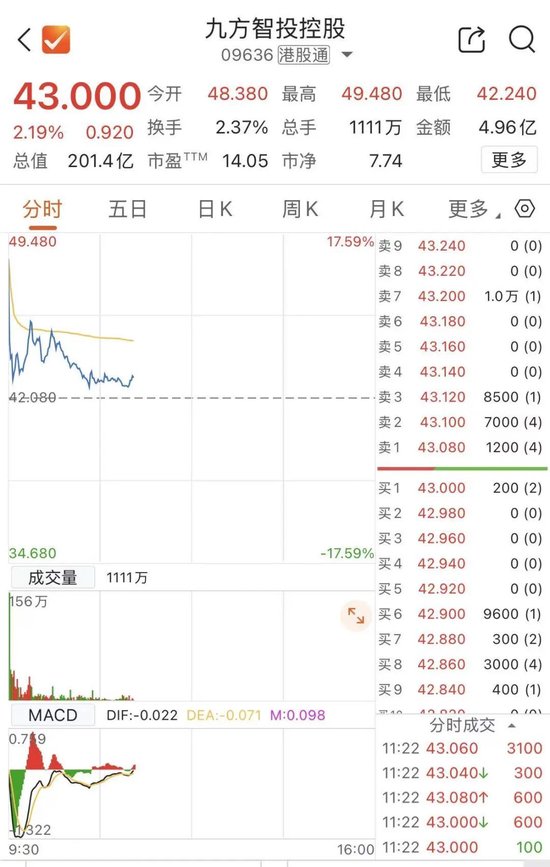
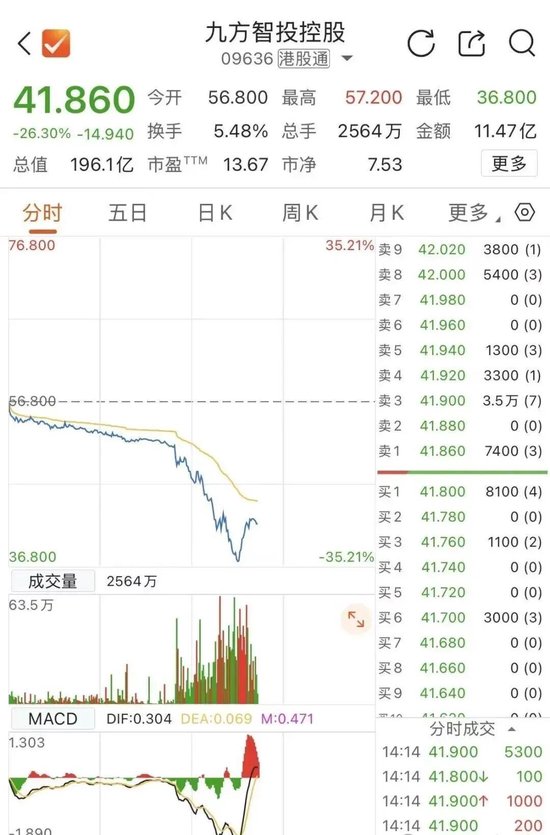
Core Viewpoint - Jiufang Zhitu Holdings experienced a significant stock price drop on January 26, leading to a rapid announcement of a share buyback plan worth up to $100 million, aiming to repurchase up to 10% of its total shares, reflecting the board's confidence in the company's future despite recent market volatility [3][12][14]. Stock Performance - On January 26, Jiufang Zhitu's stock price fell by 25.92%, closing at 42.08 HKD per share, with a market value loss of nearly 7 billion HKD [4][14]. - The stock had previously peaked at 84.05 HKD on August 27, 2025, indicating a nearly 50% decline since then [4][14]. Buyback Plan - The company announced a voluntary buyback plan to repurchase shares using existing cash reserves and cash flow, without external borrowing [3][14]. - The buyback plan allows for the repurchase of up to 44.8357 million shares, representing 10% of the total issued shares [3][12]. Financial Performance - For the first half of 2025, Jiufang Zhitu reported revenues of 2.1 billion CNY and a net profit of 865 million CNY, with a gross margin of 88.2% and a net margin of 41.2% [16]. - The company saw a 74.3% year-on-year increase in core business order amounts, with paid users rising to 102,000, a 152.7% increase [16]. Business Model and Strategy - Jiufang Zhitu positions itself as a leading player in the 2C financial information service industry, focusing on "content + traffic" for customer acquisition [14]. - The company utilizes live marketing and traffic operations to convert public traffic into private customers, supported by a network of 526 MCN accounts and 50.05 million followers [15][16]. Compliance Risks - The company faces compliance risks, highlighted by regulatory actions from the Shanghai Securities Regulatory Bureau regarding unauthorized investment advice and misleading marketing content [8][17].
九方智投“闪崩”幕后:投顾牌照风暴与监管利剑下的模式裂痕
Xin Lang Cai Jing· 2026-01-26 22:42
Core Viewpoint - The stock price of the well-known domestic investment advisory platform Jiufang Zhituo plummeted over 30% within the first hour of trading, resulting in a market value loss of nearly 10 billion yuan, triggered by rumors of a regulatory "surprise inspection" [1][2]. Group 1: Regulatory Inspection - The China Securities Regulatory Commission (CSRC) initiated "surprise on-site inspections" targeting several licensed advisory institutions, including Jiufang Zhituo, focusing on two sensitive areas: the blurred line between algorithmic recommendations and "gray area" marketing, and systemic issues in user suitability management [2][9]. - Internal sources revealed that some high-yield strategy combinations may involve hidden commission sharing with specific brokerages, raising concerns about the legitimacy of their recommendations [2][10]. Group 2: Business Model Reevaluation - Jiufang Zhituo's business model, which combines "internet traffic and advisory services," is facing a fundamental reevaluation as regulatory scrutiny tightens on marketing practices. The average annual growth rate of marketing expenses has been 45% over the past three years, while the growth rate of paying users has dropped from 68% in 2021 to 23% last year, indicating a decline in traffic benefits [3][11]. - The platform's reliance on AI-driven and quantitative models is now under scrutiny regarding algorithm transparency, with concerns that the "black box" nature of their operations could erode investor trust, especially in volatile markets [3][11]. Group 3: Industry Impact - The market anticipates that the regulatory storm will accelerate industry reshuffling, with platforms lacking solid research capabilities facing valuation changes and increased compliance costs, potentially leading to forced transformations or acquisitions [4][12]. - Traditional brokerages with comprehensive research systems and compliance experience may seize the opportunity to expand their market share in the advisory sector [4][12]. Group 4: Investor Guidance - The incident serves as a warning for investors to be cautious of "high-yield promises," as any advisory service guaranteeing profits or excessive returns should be viewed skeptically [4][12]. - Investors are advised to prioritize compliance qualifications when selecting advisory platforms, considering not only their licenses but also their historical compliance records [4][12]. - A long-term industry transition from "traffic-driven" to "compliance-driven" and "content-driven" is expected, emphasizing the importance of helping investors establish long-term asset allocation discipline [5][13].
一年爆赚上百亿,震惊业内的低调北京大厂,十几年没走过寻常路
3 6 Ke· 2026-01-22 05:28
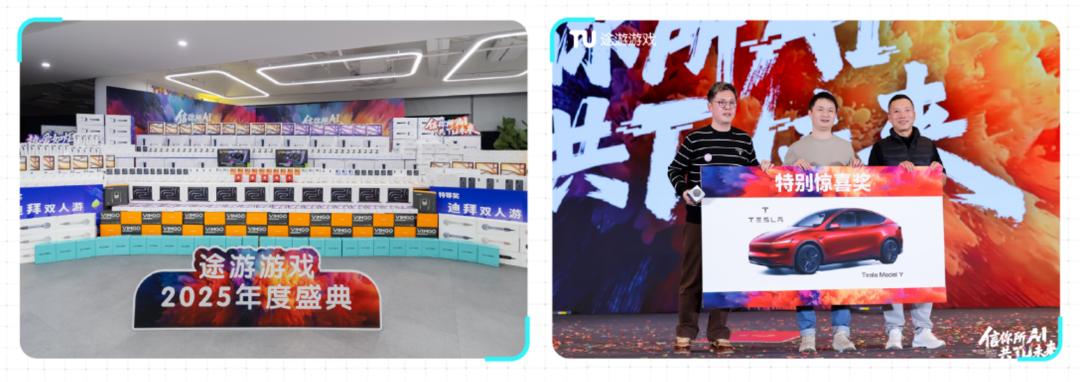
Core Viewpoint - The article highlights the impressive performance and strategic evolution of Tuyu, a traditional gaming company that has successfully navigated the competitive landscape of the gaming industry by diversifying its product offerings and leveraging innovative marketing strategies [1][7]. Group 1: Company Performance - Tuyu has shown strong revenue growth, with its game "Fishing Battle" projected to generate 900 million yuan in iOS revenue by 2025, placing it in the top 10 of revenue rankings despite fierce competition from major players like Tencent and NetEase [3][4]. - The company’s total annual revenue exceeds 10 billion yuan, driven by multiple successful titles including "Tuyu Fishing" and "Tuyu Dou Di Zhu," which collectively generate nearly 1.8 billion yuan on iOS alone [4][7]. Group 2: Strategic Evolution - Tuyu's founders, with backgrounds in major internet companies, have applied innovative internet thinking to the gaming sector, allowing the company to differentiate itself from traditional competitors [10][11]. - The company has effectively transitioned from a focus on traditional card games to mobile gaming, capitalizing on the growing popularity of mobile platforms and adopting aggressive branding strategies [11][13]. Group 3: Market Adaptation - Tuyu entered the mini-game market early, predicting its growth trajectory and adapting its product development to meet evolving user preferences, which has led to successful titles like "Next God: Light Awakening" and "Wandering Supermarket" [19][21]. - The company has successfully integrated social features into its games, enhancing user engagement and retention, which has been crucial for its success in the competitive gaming landscape [30][31]. Group 4: Long-term Vision - Tuyu demonstrates a commitment to long-term development, as evidenced by the seven-year development cycle for its SLG game "Three Kingdoms: Ice Age," reflecting the company's patience and dedication to quality [35][36]. - The company’s approach emphasizes understanding user needs and preferences, allowing it to create games that resonate with a broad audience, including previously untapped demographics [36][37].
小红书继“红猫计划”“红京计划”后,再官宣“红美计划”,卖流量是门好生意?
Sou Hu Cai Jing· 2026-01-20 16:19
Core Insights - Xiaohongshu has officially announced a strategic partnership with Meituan, launching the "Hongmei Plan," which initially focuses on Meituan's medicine delivery service, marking a significant expansion into instant retail [10][11][12] - This collaboration follows previous initiatives with Taobao Tmall and JD.com, showcasing Xiaohongshu's ongoing efforts to monetize its traffic through various e-commerce platforms [1][6][17] Group 1: Hongmei Plan Overview - The Hongmei Plan aims to integrate content-driven marketing with instant retail, leveraging Xiaohongshu's content ecosystem to meet immediate consumer needs [10][11] - Users can seamlessly transition from discovering health-related content on Xiaohongshu to purchasing products on Meituan, addressing urgent consumer demands effectively [11][12] - Initial data indicates that brands participating in the Hongmei Plan have seen an average search volume increase of 42% on Xiaohongshu, with order costs dropping over 33% compared to industry averages [11][12] Group 2: Previous Initiatives - The "Hongmao Plan" with Taobao Tmall was launched in May 2025, focusing on reducing cross-platform traffic loss and enhancing marketing conversion paths for brands [3][4] - The "Hongjing Plan" with JD.com followed in June 2025, further refining Xiaohongshu's traffic monetization strategy by allowing direct product links in user-generated content [6][8] - Both previous plans have demonstrated significant improvements in sales metrics for participating brands, validating the effectiveness of Xiaohongshu's integrated marketing approach [4][8] Group 3: Business Model and Strategy - Xiaohongshu's business model revolves around transforming its content ecosystem into a sustainable revenue source by creating a closed-loop system of "content seeding - conversion - data" [14][15] - The platform's strategy minimizes capital investment in logistics and supply chain management, focusing instead on providing traffic and data services to partners [15][12] - The ongoing partnerships with major e-commerce platforms allow Xiaohongshu to diversify its revenue streams and mitigate risks associated with reliance on a single platform [15][16] Group 4: Challenges and Future Outlook - Despite the successful implementation of these plans, Xiaohongshu faces challenges such as dependency on partner platforms for transaction control and increasing competition from other content platforms [16][18] - The platform must maintain a balance between commercial value and user experience to ensure the sustainability of its community-driven content ecosystem [16][18] - Future expansions of the Hongmei Plan into other instant retail categories could further enhance Xiaohongshu's market presence and revenue potential [13][18]