量子模拟

Search documents
【科技日报】突破量子热化难题,我国78量子比特芯片实验成果登上《自然》
Ke Ji Ri Bao· 2026-02-03 02:52
实验显示,预热化阶段系统保留初始信息、熵增受抑,结束后纠缠快速增长、信息呈体积律扩散, 经典算法无法精准描述。78比特芯片虽非当前最高比特数,却凭借创新方案、特色测控与芯片性能协 同,首次在量子模拟器上实现超越周期驱动的可调预热化研究,为量子模拟提供新范式。 该成果为人工驱动调控量子系统开辟新方向,可与时间晶体、多体局域化等热点问题结合,同时为 大规模量子模拟数值方法提供新思路。该团队表示,未来将研制百比特以上超导芯片,探索更复杂的多 体问题,力争实现"可验证的实用化量子优势",推动量子计算从基础研究迈向实用化。 1月28日,中国科学院物理研究所/北京量子信息科学研究院智能量子团队联合北京大学等国内外机 构,在78量子比特超导芯片"庄子2.0"上完成量子系统预热化调控实验,相关成果在线发表于《自然》 国际期刊,为理解与控制复杂量子动力学迈出关键一步。 量子系统热化是指能量与信息均匀分布、趋近热平衡的过程,过快热化会导致量子信息丢失,直接 制约量子计算实用化。研究发现,量子系统受外场驱动时并非立即混乱,而是存在稳定的"预热化平 台",类似冰融水时温度长期维持在0℃的阶段,该反直觉现象超出经典计算机模拟能力。团队 ...
心智观察所:为什么物理学界对量子计算的争议持续存在
Guan Cha Zhe Wang· 2026-01-27 00:40
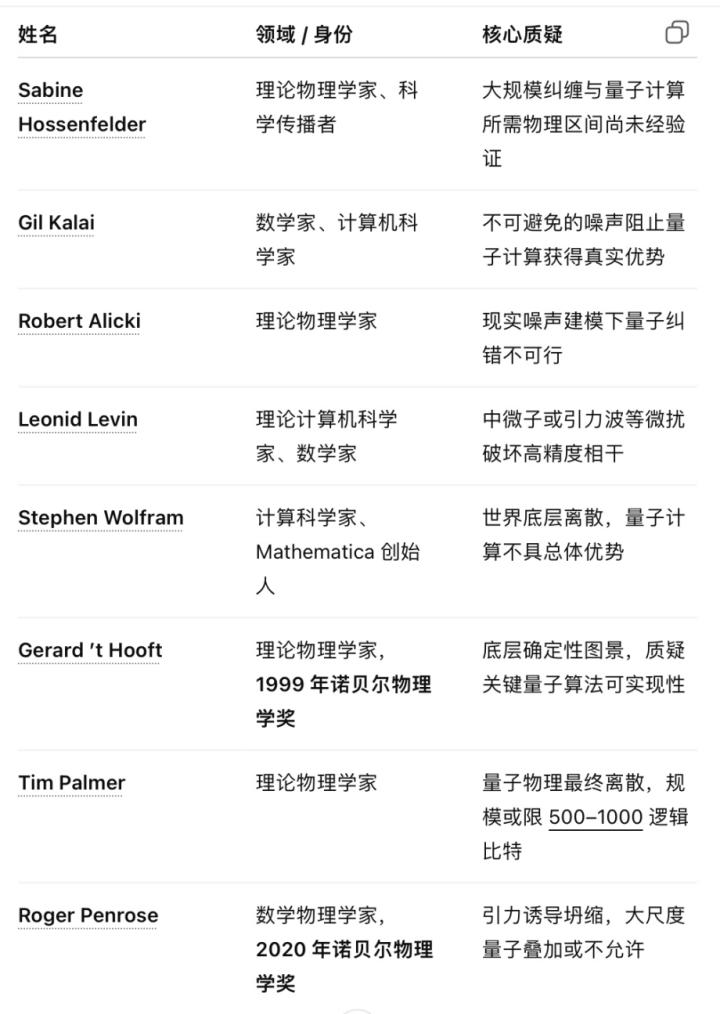
【文/观察者网专栏作者 徐令予】 《量子计算机很可能永远不会成功》一文发表后,在多家媒体的转载下引发了广泛关注。传播热度虽不 代表真理归属,但它释放了一个重要信号:量子计算正逐渐走出单一的"乐观叙事",开始进入一个更加 多元、审慎的公共视野。 在读者的反馈中,认同与质疑交织,而对我而言,后者尤显珍贵。科学从来不需要鲜花和掌声,它本质 上是在持续的质疑、修正与反思中砥砺前行。作为一项承载了世人热切期待的高精尖技术,量子计算的 演进尤其需要理性的批评与严肃的质疑。 作为《量子计算机很可能永远不会成功》的续篇,本文无意于情绪渲泄,而是旨在真诚地回应批评意 见,并对关键议题进行深度补遗。与其说这是一次"回应",不如说是将理性的质疑继续向深处推进的一 次尝试。 一、对量子计算质疑主要来自物理学专家学者 同时,有必要需要指出,视频播主本身并非缺乏专业背景的媒体从业人员。Sabine Hossenfelder 受过完 整而严格的理论物理训练,长期从事量子引力及相关基础问题研究,并在德国科研机构任职。她并非 以"科普身份"介入前沿议题,而是在转向公众传播之前,已深度参与过相关学术领域的内部讨论。 因此,对该视频更合理的评价方 ...

可扩展中性原子阵列技术获验证
Ke Ji Ri Bao· 2026-01-20 09:56
此次研究中,超表面像素尺寸小于200纳米,远低于所操控的520纳米激光波长,可在无需额外光学系统 的情况下同时生成成千上万个聚焦点。研究人员表示,这种超表面相当于在同一平面上集成了成千上万 个微型透镜,可一次性产生大规模光镊阵列。 目前最先进的量子计算机约有1000个量子比特,而美国哥伦比亚大学团队正试图将这一数字提升两个数 量级以上。他们首次将光镊与超表面技术结合,提出并验证了一种可扩展的中性原子阵列技术,为构建 超过10万个量子比特的量子计算机奠定基础。相关成果发表在新一期《自然》杂志上。 中性原子阵列是构建量子计算机的新兴平台。研究团队在实验中俘获1000个锶原子,并验证该方法可在 原理上扩展至10万个以上,这些原子未来或可作为量子比特使用。 原子在量子计算中具有天然优势,可稳定呈现量子叠加和纠缠等特性,且彼此完全一致,无需像固态量 子比特那样校准与同步。但难点在于如何实现大规模精确操控。 过去十多年,科学家通常利用空间光调制器或声光偏转器生成光镊阵列。单个光镊是一束高度聚焦的激 光,可将单个原子固定在焦点上,阵列则由许多光镊组成,但设备复杂、体积庞大,限制了阵列规模。 此外,超表面由氮化硅和二氧化钛制 ...
可扩展中性原子阵列技术获验证 为构建10万量子比特计算机奠定基础
Ke Ji Ri Bao· 2026-01-19 00:55
此外,超表面由氮化硅和二氧化钛制成,可承受超过2000瓦/平方毫米的激光强度,约为地表太阳光的 100万倍,这为大规模俘获原子提供了条件。 实验中,团队构建了多种高度均匀的二维原子阵列,还制备了一块直径3.5毫米,包含超过1亿个像素的 超表面,可生成600×600阵列,总计36万个光镊,规模比现有技术提升两个数量级。 该技术不仅有望推动大规模量子计算发展,还可应用于量子模拟和高精度光学原子钟等中性原子量子技 术。 (文章来源:科技日报) 中性原子阵列是构建量子计算机的新兴平台。研究团队在实验中俘获1000个锶原子,并验证该方法可在 原理上扩展至10万个以上,这些原子未来或可作为量子比特使用。 原子在量子计算中具有天然优势,可稳定呈现量子叠加和纠缠等特性,且彼此完全一致,无需像固态量 子比特那样校准与同步。但难点在于如何实现大规模精确操控。 过去十多年,科学家通常利用空间光调制器或声光偏转器生成光镊阵列。单个光镊是一束高度聚焦的激 光,可将单个原子固定在焦点上,阵列则由许多光镊组成,但设备复杂、体积庞大,限制了阵列规模。 此次研究中,超表面像素尺寸小于200纳米,远低于所操控的520纳米激光波长,可在无需额外光 ...
为什么物理学界对量子计算的争议持续存在
Guan Cha Zhe Wang· 2026-01-16 06:01
《量子计算机很可能永远不会成功》一文发表后,在多家媒体的转载下引发了广泛关注。传播热度虽不 代表真理归属,但它释放了一个重要信号:量子计算正逐渐走出单一的"乐观叙事",开始进入一个更加 多元、审慎的公共视野。 在读者的反馈中,认同与质疑交织,而对我而言,后者尤显珍贵。科学从来不需要鲜花和掌声,它本质 上是在持续的质疑、修正与反思中砥砺前行。作为一项承载了世人热切期待的高精尖技术,量子计算的 演进尤其需要理性的批评与严肃的质疑。 作为《量子计算机很可能永远不会成功》的续篇,本文无意于情绪渲泄,而是旨在真诚地回应批评意 见,并对关键议题进行深度补遗。与其说这是一次"回应",不如说是将理性的质疑继续向深处推进的一 次尝试。 一、对量子计算质疑主要来自物理学专家学者 读者对前文的批评比较集中在一个问题上:视频播主是否具备评价量子计算问题的资格。对此,有必要 先澄清一个容易被忽略的事实:该视频并非播主个人的原创判断,而是对既有学术争论的整理与转述。 在这一意义上,她更接近一名"二传手"——将原本分散在学术文献与专业讨论中的质疑观点,系统地呈 现给公众,而非以个人权威替代学术共识。 更重要的是,视频中所引用的质疑,并非来 ...
新方法几微秒内完成单原子清晰成像
Huan Qiu Wang Zi Xun· 2025-12-25 01:33
Core Insights - Researchers from the University of Trieste and the National Research Council's National Institute of Optics have developed a new ultra-fast, low-loss single-atom detection method that significantly enhances single-atom imaging capabilities [1][3] Group 1: Methodology and Innovation - The new method combines intense microsecond fluorescence pulses with rapid re-cooling, achieving clear single-atom imaging within a few microseconds while retaining over 99.5% of atoms in optical traps for repeated use [1][3] - Unlike traditional binary detection methods, this approach allows for the differentiation and counting of multiple atoms within a single "optical tweezer" without significant imaging blur, enabling precise in-situ measurements of atomic numbers [3] Group 2: Implications and Applications - This advancement is crucial for the scalable development of neutral atom quantum computing, enhancing the precision of next-generation atomic clocks, and facilitating complex many-body quantum simulations [3][4] - The research team successfully achieved single-atom imaging of the fermionic isotope Ytterbium-173, which has six internal ground state levels, laying the groundwork for quantum circuits based on "quantum multi-level" rather than traditional qubits, potentially improving quantum information storage and processing efficiency [3]
【科技日报】高阶非平衡拓扑相首次在量子体系中实现
Ke Ji Ri Bao· 2025-12-01 03:29
Core Insights - The research team from the University of Science and Technology of China, in collaboration with Shanxi University, has achieved a significant breakthrough by realizing and detecting higher-order non-equilibrium topological phases using the programmable superconducting quantum processor "Zuchongzhi 2" [1][2] - This achievement marks an important step in quantum simulation, particularly in exploring complex topological states, and lays the groundwork for achieving quantum advantage in quantum simulation problems [1] Group 1 - The research successfully implemented quantum simulation and detection of both balanced and non-equilibrium second-order topological phases for the first time [2] - The team proposed theoretical designs for static and Floquet quantum circuits to address the challenges of constructing higher-order topological Hamiltonians in a two-dimensional superconducting qubit array [2] - A systematic optimization scheme for the processor was established, allowing for dynamic control of qubit frequency and coupling strength, leading to the successful execution of up to 50 Floquet periods of evolution operations on a 6x6 qubit array [2] Group 2 - The experiment successfully realized four different types of non-equilibrium second-order topological phases and systematically explored their energy spectrum, dynamical behavior, and topological invariants [2] - The realization of higher-order topological phases in quantum systems presents a significant scientific challenge and offers potential pathways for topological quantum computing based on non-Abelian statistics [1]
量子科技重要突破!我国科学家首次实现→
Shang Hai Zheng Quan Bao· 2025-11-29 06:30
Core Insights - The research team from the University of Science and Technology of China, in collaboration with Shanxi University, achieved a significant breakthrough by realizing and detecting higher-order non-equilibrium topological phases using the programmable superconducting quantum processor "Zuchongzhi 2" [1] Group 1: Research Achievements - The research marks an important advancement in quantum simulation, laying the groundwork for achieving quantum advantage in quantum simulation problems [1] - The team proposed static and Floquet quantum circuit design schemes for higher-order topological phases, addressing the critical challenge of constructing higher-order balanced and non-equilibrium topological Hamiltonians in a two-dimensional superconducting qubit array [1] - A universal framework for dynamical topological measurement was developed, enhancing the understanding of complex topological states [1] Group 2: Experimental Results - Researchers established a systematic processor optimization scheme, achieving dynamic control of qubit frequency and coupling strength through precise calibration [1] - In a 6×6 qubit array, the team successfully executed up to 50 Floquet periods of evolution operations, marking the first successful realization of four different types of non-equilibrium second-order topological phases [1] - The study systematically explored the energy spectrum, dynamical behavior, and topological invariants of the identified topological phases [1]
量子模拟在探索复杂拓扑物态方向上取得重要突破
Ke Ji Ri Bao· 2025-11-29 03:02
Core Insights - The research team from the University of Science and Technology of China, including Pan Jianwei, Zhu Xiaobo, Peng Chengzhi, and Gong Ming, in collaboration with Mei Feng from Shanxi University, has achieved a significant breakthrough by realizing and detecting higher-order non-equilibrium topological phases in a quantum system using the programmable superconducting quantum processor "Zuchongzhi 2" [1] Group 1 - The achievement marks an important advancement in quantum simulation, particularly in exploring complex topological states [1] - This research lays the groundwork for utilizing superconducting quantum processors to achieve quantum advantage in quantum simulation problems [1] - The findings were published in the international academic journal "Science" on November 28 [1]
中科大×山西大学合作发表最新Science论文
生物世界· 2025-11-28 10:00
Core Insights - The article discusses a significant breakthrough in the field of quantum simulation, specifically the realization and detection of higher-order nonequilibrium topological phases (HOTPs) using a programmable superconducting quantum processor [1][5]. Group 1: Research Background - Topological phases have emerged as a crucial research direction in condensed matter physics and quantum simulation, with higher-order topological phases challenging traditional bulk-boundary correspondence [3]. - The realization of higher-order topological phases in quantum systems has been a scientific challenge, with potential implications for revealing the quantum nature of topological states and enabling topological quantum computing based on non-Abelian statistics [4]. Group 2: Experimental Achievements - The research team successfully implemented quantum simulation and detection of both balanced and nonequilibrium second-order topological phases using the "Zuchongzhi 2" superconducting quantum processor [5]. - They developed theoretical designs for static and Floquet quantum circuits to construct higher-order topological Hamiltonians in a two-dimensional superconducting qubit array, addressing key challenges in the field [5]. - The experimental setup involved a 6×6 qubit array, where the team executed up to 50 Floquet periods of evolution operations, successfully realizing four different types of nonequilibrium second-order topological phases and exploring their energy spectra, dynamical behaviors, and topological invariants [5][7].