
全球变暖

Search documents
5600万年前北极海洋加剧全球变暖谜底揭开
Ke Ji Ri Bao· 2025-09-27 08:06
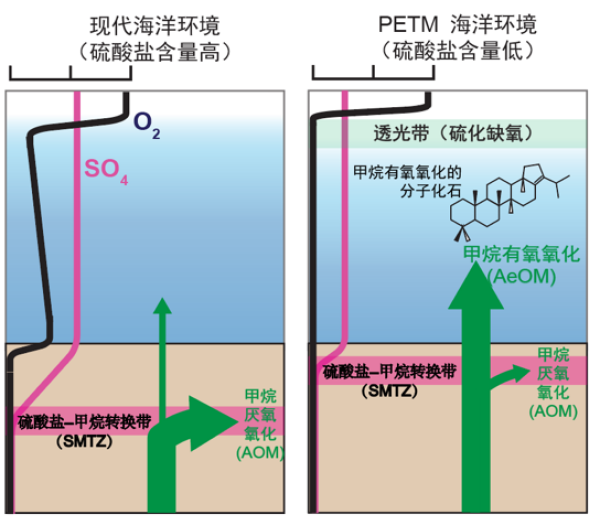
Core Insights - The research reveals that subtle changes in ocean sulfate concentrations can act as a "chemical switch" affecting methane consumption, which has significant implications for global climate change [1][2]. Group 1: Methane and Climate Change - Methane is the second-largest greenhouse gas after carbon dioxide, with a significant amount stored as hydrates on the ocean floor [1]. - In modern oceans, approximately 90% of methane is utilized by microorganisms in sediments under anoxic conditions, using sulfate as a "fuel" and producing alkaline substances that mitigate ocean acidification [1]. - During the Paleocene-Eocene Thermal Maximum (PETM) around 56 million years ago, the sulfate concentration in Arctic seawater was less than one-third of modern levels, leading to a shift in methane decomposition processes [2]. Group 2: Microbial Activity and Methane Oxidation - A lack of sulfate during the PETM resulted in the activation of oxygen-loving bacteria that rapidly "burned" methane, contrasting with the slow-burning process seen in modern oceans [2]. - The research team successfully reconstructed the methane oxidation process from 56 million years ago by detecting specific molecular traces left by ancient bacteria [2]. - The study indicates that during the PETM, the concentration of CO2 in Arctic seawater was 200-700 ppm higher than the global average, transforming the Arctic from a carbon sink to a carbon source [2]. Group 3: Geological Influences on Climate - Geological activities such as crustal movements, rock formation, continental weathering, and volcanic eruptions directly influence ocean sulfate levels, thereby affecting methane decomposition methods [3]. - The research suggests that the historical low sulfate levels in ancient oceans may have significantly impacted global carbon cycles and climate [3]. - With the rapid warming and freshening of modern Arctic waters, similar methane oxidation mechanisms could be reactivated, potentially leading to a shift from efficient methane utilization to rapid burning [3].
【科技日报】海水硫酸盐含量揭开5600万年前北极海洋加剧全球变暖谜底
Ke Ji Ri Bao· 2025-09-26 01:25
Core Insights - The research reveals that subtle changes in ocean sulfate concentrations during the Paleocene-Eocene Thermal Maximum (PETM) 56 million years ago acted as a "chemical switch" that altered methane consumption, significantly impacting global climate change [1][2] Group 1: Methane Dynamics - Methane, the second-largest greenhouse gas after carbon dioxide, is primarily stored in the ocean floor as hydrates [1] - In modern oceans, approximately 90% of methane is utilized by microorganisms in sediments under anoxic conditions, using sulfate as a "fuel" to efficiently convert methane while producing alkaline substances that mitigate ocean acidification [1][4] - During the PETM, the concentration of sulfate in Arctic seawater was less than one-third of modern levels, leading to a shift in methane oxidation pathways [2][4] Group 2: Microbial Activity - A significant increase in the activity of methane-oxidizing bacteria that prefer oxygen was observed during the PETM, indicating a transition from slow combustion to rapid burning of methane [2] - The research team successfully reconstructed the methane oxidation process from 56 million years ago by detecting specific molecular traces left by ancient bacteria [2] Group 3: Carbon Cycle Implications - The study found that CO2 levels in Arctic seawater during the PETM were 200-700 ppm higher than the global average, indicating a shift from being a carbon sink to a carbon source [4] - Geological activities such as tectonic movements and volcanic eruptions directly influence ocean sulfate levels, which in turn determine methane decomposition methods [4] Group 4: Modern Relevance - The research highlights the potential for similar methane oxidation mechanisms to be reactivated due to rapid warming and freshening of modern Arctic waters, which could lead to a shift from efficient methane utilization to rapid burning [4] - This study serves as a crucial warning regarding the potential risks of greenhouse gas emissions in the context of modern Arctic climate changes [4]

特朗普说了啥?他们都急了!
中国能源报· 2025-09-24 07:45
Core Viewpoint - The article discusses the claims made by US President Trump regarding China's wind power usage and the subsequent rebuttals from American media outlets, highlighting China's significant investments and advancements in wind energy [2][4]. Group 1: Trump's Claims - Trump stated that while China manufactures a large number of wind power generation devices, it is reluctant to use wind power domestically [4]. - He reiterated this claim during his speech at the United Nations, suggesting that China primarily exports wind power equipment rather than utilizing it [4]. Group 2: Rebuttals from Media - CNN reported that China has a substantial number of onshore and offshore wind farms, with wind power installed capacity growing at a rate much faster than that of the US. According to data from China's National Energy Administration, the installed wind power capacity in China is expected to reach approximately 520 million kilowatts by 2024, reflecting an 18% year-on-year increase [4]. - The New York Times countered Trump's assertions by stating that China possesses more wind farms and installed capacity than any other country, and is planning to build even more [4]. Group 3: Climate Change Agreements - Trump criticized the Paris Climate Agreement, claiming it was unfair to the US and suggested it required the US to pay $1 trillion [4]. - CNN clarified that the US has never committed to spending or contributing $1 trillion for the Paris Agreement. Under President Biden, the US pledged to contribute $11.4 billion annually to international climate financing, but actual spending has been lower due to insufficient congressional appropriations [4].

研究发现东南极洲腹地较沿海升温更快
Xin Hua She· 2025-09-24 02:52
研究人员介绍,长期以来,对南极洲气候变化的研究主要依赖以沿海地区为主的有人科考站数据,有关 南极洲腹地的气候变化数据相对较少。他们收集了东南极洲自20世纪90年代以来一直在持续观测的3个 无人气象站的观测数据,创建了一个跨越30年(1993年至2022年)的月平均温度数据集。 新华社北京9月24日电 一项国际研究发现,受来自南印度洋的暖空气影响,东南极洲广阔而冰冷的腹 地较其沿海地区升温更快。这表明世界上最大的冰储库可能比之前认为的更加脆弱。 日本名古屋大学等机构的研究人员近期在英国学术期刊《自然-通讯》上发表论文说,东南极洲腹地较 沿海地区升温更快,原因是南印度洋温度变化引发的暖气流增加,而当前的气候模型未能捕捉到这一变 暖过程,因此对南极洲未来升温的预测可能被低估了。 在南印度洋,海洋锋(即冷暖海水交汇处)形成了明显的温度边界。全球变暖对海水加热不均,更加剧 了这些区域的温差:更强的海洋锋导致更多的风暴活动和大气变化,从而形成"偶极子"模式,即中纬度 地区出现低压系统,而南极洲上空出现高压系统将暖空气向南拉动,并深入大陆深处。 研究人员说,该研究通过完善东南极洲这一观测上"盲点"的数据,证明了东南极洲腹地 ...
瑞典8座冰川在2024年彻底消失
人民网-国际频道 原创稿· 2025-09-23 03:31
人民网斯德哥尔摩9月22日电 (记者殷淼)瑞典塔法拉研究站负责人妮娜·基尔希纳22日表示,受全 球变暖影响,瑞典境内已有八座冰川在2024年彻底消失,成为自有高分辨率卫星影像记录以来首次确认 灭绝的冰川。 目前,瑞典还有约30座冰川面临同样的风险。不过,基尔希纳指出,2025年冬季降雪量充足,夏季 较短且气温相对较低,因此今年预计不会有冰川完全消失。但她警告说,未来仍将出现更多炎热的夏 季,必须做好冰川持续退缩甚至消亡的准备。 根据世界气象组织的数据,全球气温上升的主要原因是工业革命以来煤炭、石油和天然气等化石能 源的大量使用。冰川的消失不仅是气候变暖的直接证据,也为全球生态系统敲响了警钟。 位于瑞典北部最高峰凯布讷山(Kebnekaise)附近的瑞典塔法拉研究站,每年都会研究瑞典冰川的 卫星图像,以追踪其变化。近日,该机构研究人员通过对比年度卫星影像发现,瑞典有八座冰川已彻底 消失,其中包括瑞典最北端位于瓦德维恰卡国家公园的库努约克尔恩冰川(Cunujokeln)。据报道,这 八座冰川中最大的一个,大约相当于六个足球场的面积。 基尔希纳称,瑞典原有277座冰川,其中八座在2024年的异常高温下完全融化。她表 ...
国家公园法将施行;五年来高排放车辆淘汰近两千万辆丨碳中和周报
2 1 Shi Ji Jing Ji Bao Dao· 2025-09-22 12:24
Group 1: National Park Law Implementation - The first National Park Law in China will take effect on January 1, 2026, aiming to protect representative natural ecosystems and promote sustainable use of natural resources [2] - The law establishes a legal framework for a national park system, emphasizing strict protection and integrated management of natural resources [2] - It encourages public participation in conservation efforts and aims to foster awareness of ecological protection among the public [2] Group 2: High-Emission Vehicle Elimination - The Ministry of Ecology and Environment announced that nearly 20 million high-emission vehicles will be eliminated during the 14th Five-Year Plan period [3][4] - Significant reductions in PM2.5 concentrations are targeted, with expected decreases of 18%, 10%, and 20% in key regions by 2024 compared to 2020 levels [3] - The campaign includes comprehensive measures such as coal management and pollution source tracking, achieving notable progress in water and soil protection [4] Group 3: Carbon Market Development - As of September 18, 2025, China's carbon market has seen a cumulative transaction volume of 714 million tons and a total transaction value of approximately 49.96 billion yuan [5][6] - The establishment of a regulatory framework for carbon trading is underway, supporting China's climate change initiatives [5] - The carbon market is recognized as a key mechanism for achieving carbon peak and carbon neutrality goals [6] Group 4: Climate Change and Industry Restructuring - The year 2024 is projected to be the first year to exceed the 1.5°C temperature threshold set by the Paris Agreement, indicating a concerning trend in global warming [7][8] - Experts emphasize the need for intensified emission reduction efforts to meet climate targets and ensure sustainable development [7][8] Group 5: Renewable Energy Consumption in Inner Mongolia - Inner Mongolia has issued a notification to optimize the mechanism for renewable energy consumption, focusing on both mandatory and voluntary consumption [9] - The initiative aims to enhance green electricity consumption and promote the integration of renewable energy with industry [9] Group 6: Low-Carbon Initiatives and Events - The "Low-Carbon China Tour" and Climate Action Week series of events were launched to showcase China's efforts in energy transition and public engagement [10][11] - The events highlight the role of enterprises like Southern Power Grid in promoting green development and their participation in international climate discussions [10][11] Group 7: Clean Energy Expo in Shandong - The 2025 Shandong Clean Energy Industry Expo was held to facilitate innovation and collaboration in the clean energy sector [13][14] - The event aims to strengthen partnerships between enterprises and research institutions to support the region's energy transition [13][14] Group 8: Sustainable Strategy by Yinyu Water Zhongtian - Yinyu Water Zhongtian has set a net-zero target for 2040 and aims to achieve various sustainability goals by 2030 [15][16] - The strategy includes low-carbon construction, climate risk adaptation, and waste management initiatives to promote a circular economy [15][16]
地球储碳的“胃口”有多大?
Ke Ji Ri Bao· 2025-09-22 01:29
地球能"吞"下多少人类排放的二氧化碳?这个问题,听起来像是在问地球的"胃容量"有多大。人类 一直以为,地壳深处那些沉默的岩石构造,就像宇宙黑洞一样,能无休止地吞噬人类制造的碳排放。毕 竟,把二氧化碳"埋"进地下,听起来很靠谱,就像把垃圾塞进一个永不溢出的垃圾桶。但最新研究显 示:这个"垃圾桶"其实是有盖子的,而且,可能正在快速逼近它的极限。 奥地利国际应用系统分析研究所和英国帝国理工学院的科学家,近期在《自然》杂志发表研究揭 示,地球通过岩石构造进行地质碳封存的"实际容量"上限约为1.46万亿吨。别看这个数字庞大得像天文 单位,按照当前全球减排节奏,这个额度可能在不到180年的时间内就被用光。这意味着,如果继续 把"埋碳"当作气候危机的万能解药,可能会在未来的某一天突然发现地下的"空位"已经满了。 这一容量即便全部用尽,最多也只能让全球变暖逆转0.7℃。要知道,现在已经比工业化前升温了 1.2℃,人类正拼命想守住1.5℃的防线。换句话说,单靠"埋碳",连一半的账都还不清。 科学家也坦承,这不是最终答案。他们还没算技术突破的可能性,比如未来会不会有更高效的捕碳 机器,或者更安全的封存方式。但正因如此,人类更需要 ...
不到10天,清华大学张强团队连发两篇Nature论文
生物世界· 2025-09-19 04:04
Core Insights - Global warming is exacerbating the occurrence of wildfires, which in turn affects the global carbon cycle, ecosystems, air quality, and human health [2] - A study by Tsinghua University predicts a significant increase in wildfire-related carbon emissions and premature deaths by the end of the century [3][6] Group 1: Wildfire Emissions and Health Impact - The research developed a machine learning framework to predict global wildfire emissions and premature deaths, indicating a 23% increase in carbon emissions from 2010-2014 to 2095-2099 under a moderate emissions scenario (SSP 2-4.5) [3][6] - By 2095-2099, annual premature deaths due to wildfire smoke could reach 1.4 million, nearly six times the current level, with Africa expected to see the highest increase in wildfire-related mortality, projected to rise by 11 times [6][10] Group 2: Long-range PM2.5 Pollution - A separate study quantified the global impact of long-range PM2.5 pollution from the 2023 Canadian wildfires, revealing an increase in global average PM2.5 exposure by 0.17 µg/m³ [10][11] - North America experienced the highest increase in PM2.5 exposure at 1.08 µg/m³, while Europe saw an increase of 0.41 µg/m³ due to long-distance transport [10] - The study estimated that 354 million people in North America and Europe were exposed to PM2.5 pollution from the Canadian wildfires, leading to approximately 5,400 acute premature deaths in North America and 64,300 chronic premature deaths across North America and Europe [10][11]

国际最新研究:全球变暖威胁重要产氧海洋微生物
Zhong Guo Xin Wen Wang· 2025-09-11 02:03
Core Insights - A recent study published in the journal Nature Microbiology indicates that global warming poses a significant threat to Prochlorococcus, a crucial oxygen-producing marine microorganism, with potential population reductions of up to 51% by 2100 under moderate to high warming scenarios [1][5]. Group 1: Impact of Climate Change - Prochlorococcus, a vital cyanobacterium found in 75% of the sunlit surface oceans, contributes approximately 20% of the world's oxygen through photosynthesis [3]. - Predictions suggest that sea surface temperatures in many tropical and subtropical regions may frequently exceed 30°C by 2100, endangering marine ecosystems [3][5]. - Previous assumptions indicated that Prochlorococcus would expand its distribution with rising ocean temperatures, but these estimates were primarily based on laboratory data [3]. Group 2: Research Findings - The study analyzed a decade of data collected from ships traversing the tropical and subtropical Pacific Ocean from 2010 to 2023, revealing that the growth and division rates of Prochlorococcus are temperature-dependent [5]. - Contrary to earlier predictions, the study found that the division rate of Prochlorococcus sharply declines when sea surface temperatures exceed 28°C [5]. - Simulations indicate that under representative concentration pathways 4.5 and 8.5, Prochlorococcus productivity could decrease by 17% to 51% compared to current levels in future moderate and high warming scenarios [5][7]. Group 3: Research Limitations - The authors acknowledge that their field sampling may have missed rare heat-tolerant Prochlorococcus strains, and the ship-based data may not adequately represent some hotter tropical regions [7].
报告:五大“拯救南北极冰盖”计划,均缺乏可行性
Huan Qiu Shi Bao· 2025-09-10 22:45
此外,这些试图拯救南北极冰盖的计划,其费用之高昂也令人瞠目结舌,估计每个计划的建立和维护成 本至少为100亿美元以上,其中为冰川布设帷幕是最昂贵的,预计10年内每50英里长的帷幕将耗资800亿 美元。 报告总结说,即使这些计划能克服重大技术和经济障碍,它们也无法以足够大的规模和速度展开部署, 从而应对气候危机的紧迫性。西格特表示,"它们反过来分散了我们对需要做的事情的注意力——那就 是减少碳排放。"伦敦帝国理工学院地球科学与工程系主任蒂娜·范德弗利尔特认为:"作为在南极进行 过具有挑战性实地考察的亲历者,我想强调的是,这些建议要么在科学上存在缺陷,要么未经证实,要 么危险,要么在经济上不可行。"也有科学家表示,不应停止对"极地地球工程"的研究。芝加哥大学地 球物理科学助理教授皮特·欧文表示,"极地地球工程"不能替代减排,但这些干预措施可能会为地球健 康做出重大贡献。(陈山) 美国有线电视新闻网(CNN)9日称,随着全球变暖的概念得到公众认可,人工冷却地球南北极的想 法,即所谓"极地地球工程"也越来越受到关注,学术界启动了相关研究项目,初创企业激增,投资者蜂 拥而至。但发表在《科学前沿》杂志上的最新报告显示," ...