高铁建设

Search documents
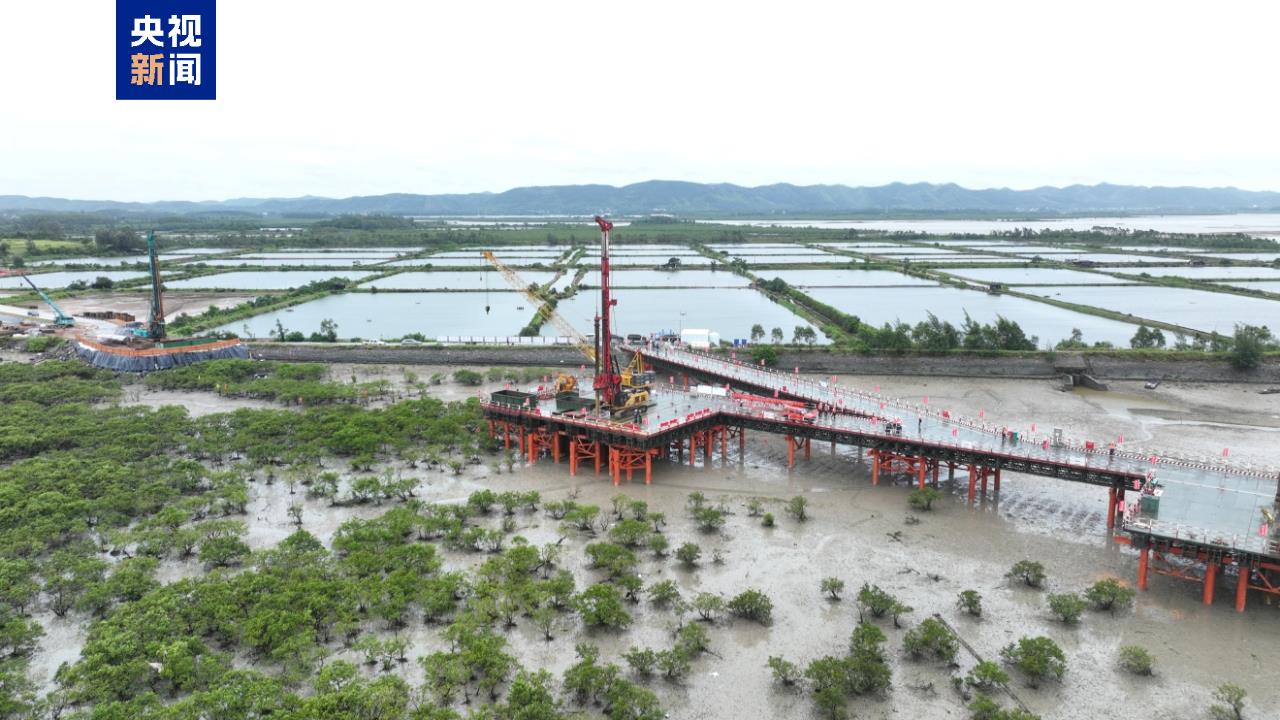
合湛高铁全线进入海上主体施工阶段 预计2028年底建成通车
Yang Shi Xin Wen Ke Hu Duan· 2025-08-25 09:16
Core Viewpoint - The construction of the Tieshan Port Cross-Sea Bridge, a key segment of the Guangxi-Hainan High-Speed Railway, has officially commenced, marking the transition to the marine construction phase of the entire railway line [1][3]. Group 1: Project Overview - The Tieshan Port Cross-Sea Bridge spans a total length of 8,473.478 meters, requiring 4,332 pile foundations and 578 piers, with 99 marine piers and 919 marine pile foundations [3]. - The Guangxi-Hainan High-Speed Railway is designed for a speed of 350 km/h, with a total length of approximately 139 kilometers, of which the Guangxi section is about 63 kilometers, and bridges account for 78% of this section [5]. Group 2: Environmental Considerations - The construction will address significant challenges such as large tidal differences, high salt mist corrosion, and strong typhoon intensity, which complicate the construction process [3]. - Efforts are being made to minimize the impact of construction on the surrounding environment and wildlife, particularly in areas with mangroves and marine life [3]. Group 3: Economic and Social Impact - The Guangxi-Hainan High-Speed Railway is positioned as a crucial inter-regional passenger transport line, enhancing the railway network layout in the region and facilitating travel for local residents [5]. - The project is expected to be completed by the end of 2028, significantly improving the railway transport capacity along the Guangdong and Guangxi coasts and promoting high-quality economic and social development in the region [5].

襄阳至荆门高铁开启运行试验
Xin Hua She· 2025-08-23 09:34
Core Viewpoint - The Xiangjing High-Speed Railway has officially commenced trial operations, marking a significant step towards its opening, which is part of China's major high-speed rail network [1] Group 1: Project Overview - The Xiangjing High-Speed Railway runs from Xiangyang to Jingmen in Hubei Province, with a total length of 116.23 kilometers and a design speed of 350 kilometers per hour [1] - The project began construction in September 2022 and started joint debugging and testing in June 2023 [1] Group 2: Testing and Validation - During the joint debugging and testing phase, a total of 1,759 test trains were operated, covering a distance of 43,300 kilometers to validate the functionality of various fixed and mobile equipment [1] - The technical performance of the railway has met national and industry standards, confirming its readiness for operation [1] Group 3: Operational Significance - The completion of the Xiangjing High-Speed Railway will create a high-speed rail loop within Hubei Province, significantly supporting the high-quality development of the Yangtze River Economic Belt [1] - It is also expected to play a crucial role in accelerating the rise of the central region of China [1]
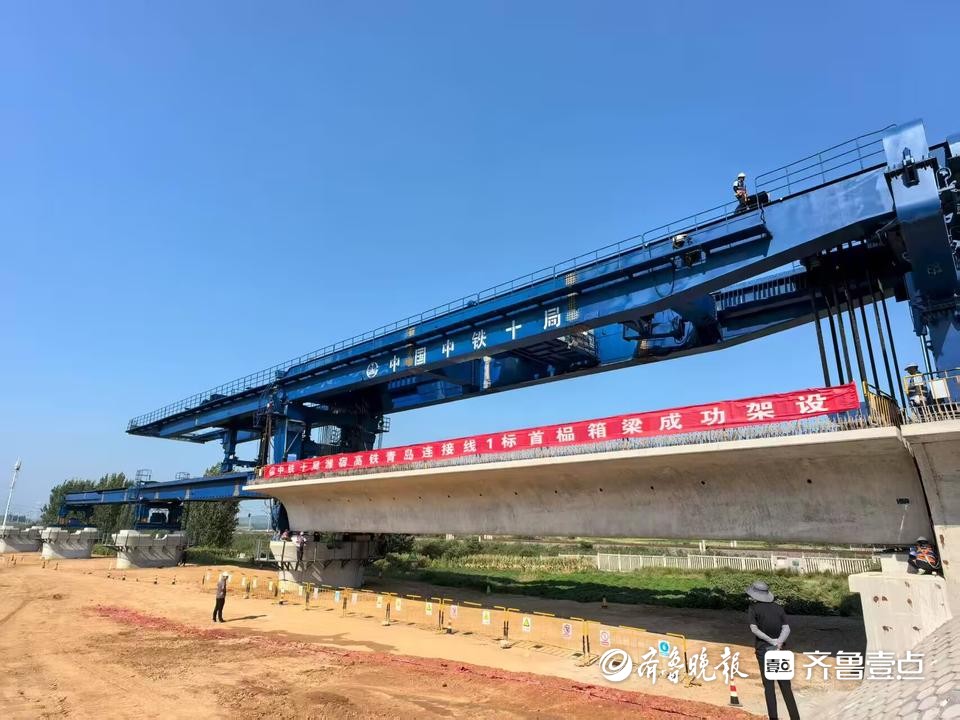
潍宿高铁至青岛连接线全面进入上部结构施工阶段
Qi Lu Wan Bao Wang· 2025-08-22 11:40
Core Viewpoint - The construction of the Weishui High-speed Railway to Qingdao connection line has entered the upper structure construction phase with all four segments starting box girder erection, indicating significant progress in the project timeline [1][3]. Group 1: Project Progress - The first box girder was erected on August 22, marking the commencement of the upper structure construction phase for the entire line [1]. - As of the end of July, the Qingdao section has completed an investment of 2 billion yuan, achieving 67% of the annual investment plan and 23% of the overall construction progress [5]. Group 2: Construction Techniques and Safety Measures - The project employs a "first piece system" and "three inspections system" to ensure the smooth erection of box girders, coordinating various forces to focus on key tasks [3]. - Digital technologies such as IoT and AI are utilized to assign unique identification numbers to each prefabricated beam, enabling digital control and streamlined operations throughout the production process [3]. - Safety measures include 3D modeling for tracking the lifting trajectory, specialized testing for 900T lifting equipment, and the installation of a collision detection radar system to monitor obstacles within a 30-meter radius [3]. Group 3: Project Overview and Future Impact - The Weishui High-speed Railway to Qingdao connection line spans 108.78 kilometers, with the Qingdao section measuring 53.5 kilometers, designed for a speed of 350 km/h [6]. - The project will connect Qingdao to the Beijing-Shanghai second line, alleviating bottlenecks in southbound transportation and enhancing the national railway's coastal corridor connectivity [6]. - Upon completion, the project is expected to significantly improve high-speed rail access to the Yangtze River Delta and Central China, while also upgrading the Qingdao hub facilities to better meet public transportation needs [6].
沪杭高铁正式获批,杭州人可以直接坐高铁去浦东机场了
第一财经· 2025-08-21 13:12
Core Viewpoint - The newly approved Shanghai-Hangzhou high-speed railway project aims to enhance connectivity between the two cities, facilitating travel and economic interaction, with a total investment of approximately 67.1 billion yuan [1][3]. Group 1: Project Overview - The Shanghai-Hangzhou high-speed railway is designed for a maximum speed of 350 km/h and spans approximately 223.8 kilometers [1]. - The project includes the construction of 9 stations, with 4 new stations and 5 existing stations being expanded or utilized [2][3]. Group 2: Economic and Social Impact - The new railway will significantly improve access for Hangzhou residents to Shanghai's Pudong Airport, enhancing travel convenience for both cities [2].
广湛高铁下周开启联调联试
Guang Zhou Ri Bao· 2025-08-21 09:22
Core Points - The Guangzhan High-Speed Railway has officially entered the joint debugging and testing phase, with the first segment from Xinxing South to Zhanjiang North set to begin testing on August 25, followed by the Guangzhou to Xinxing South segment on September 25 [1] Group 1: Project Overview - The Guangzhan High-Speed Railway has a total length of approximately 401 kilometers and a total investment of 99.8 billion yuan, making it a significant part of China's "Eight Vertical and Eight Horizontal" high-speed rail network [1] - This project is the most technically complex, longest, and largest investment railway project constructed independently by Guangdong Province [1] Group 2: Route and Connectivity - The railway line starts from Guangzhou Station and passes through cities including Foshan, Zhaoqing, Yunfu, Yangjiang, Maoming, and finally reaches Zhanjiang North Station [1] - Once completed, the railway will significantly reduce travel time between the western Guangdong region and the Guangdong-Hong Kong-Macao Greater Bay Area, cutting the travel time from Guangzhou to Zhanjiang from 3 hours to approximately 1.5 hours [1] Group 3: Importance of Joint Debugging and Testing - Joint debugging and testing is a crucial step before the railway opens, simulating operational conditions to test various systems including tracks, bridges, tunnels, power supply, communication, and disaster monitoring [1] - This phase is essential for identifying and addressing any issues, providing important technical support for the railway's operational readiness [1]
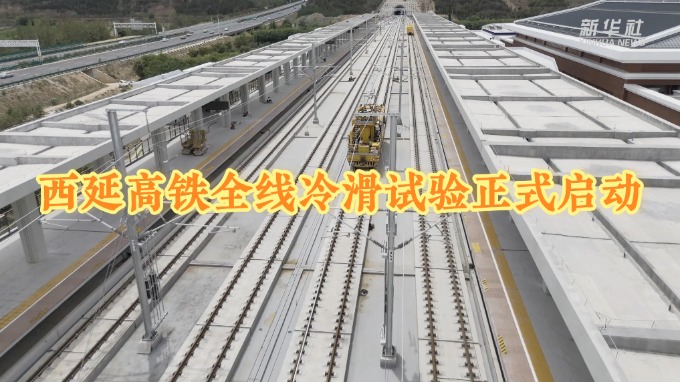
西延高铁全线冷滑试验正式启动
Xin Hua She· 2025-08-20 14:30
Core Viewpoint - The cold sliding test for the Xi'an to Yan'an high-speed railway has officially commenced, marking a significant step towards the railway's joint debugging and testing phase [1] Group 1: Project Overview - The cold sliding test began on August 18, with a train departing from the Gengzhen Line Station towards Tongchuan, covering a total of over 280 kilometers [1] - The test involves 10 stations and related connecting sections, assessing the geometric parameters of the electrified railway contact network without power [1] Group 2: Significance and Impact - The Xi'an to Yan'an high-speed railway is the first high-speed rail in the revolutionary old area of northern Shaanxi, expected to reduce travel time from 2.5 hours to approximately 1 hour [1] - The completion and operation of this railway will enhance the national high-speed railway network layout and contribute to the rural revitalization of revolutionary old areas [1]
广湛高铁完成全线铺轨
Xin Jing Bao· 2025-08-18 04:59
Core Viewpoint - The completion of the track-laying construction for the Guangzhou-Zhanjiang High-Speed Railway (广湛高铁) marks a significant milestone, laying a solid foundation for the line's operational launch [1] Group 1: Project Overview - The Guangzhou-Zhanjiang High-Speed Railway extends 401 kilometers from Guangzhou Station to Zhanjiang North Station, with a designed speed of 350 kilometers per hour [1] - The railway connects key regions including the Guangdong-Hong Kong-Macao Greater Bay Area, Hainan Free Trade Port, and the Beibu Gulf city cluster, serving as an important high-speed rail corridor [1] Group 2: Economic Impact - Once operational, the railway is expected to significantly reduce travel time between the western Guangdong region and the Guangdong-Hong Kong-Macao Greater Bay Area, playing a crucial role in promoting economic and social development in the western Guangdong area [1]
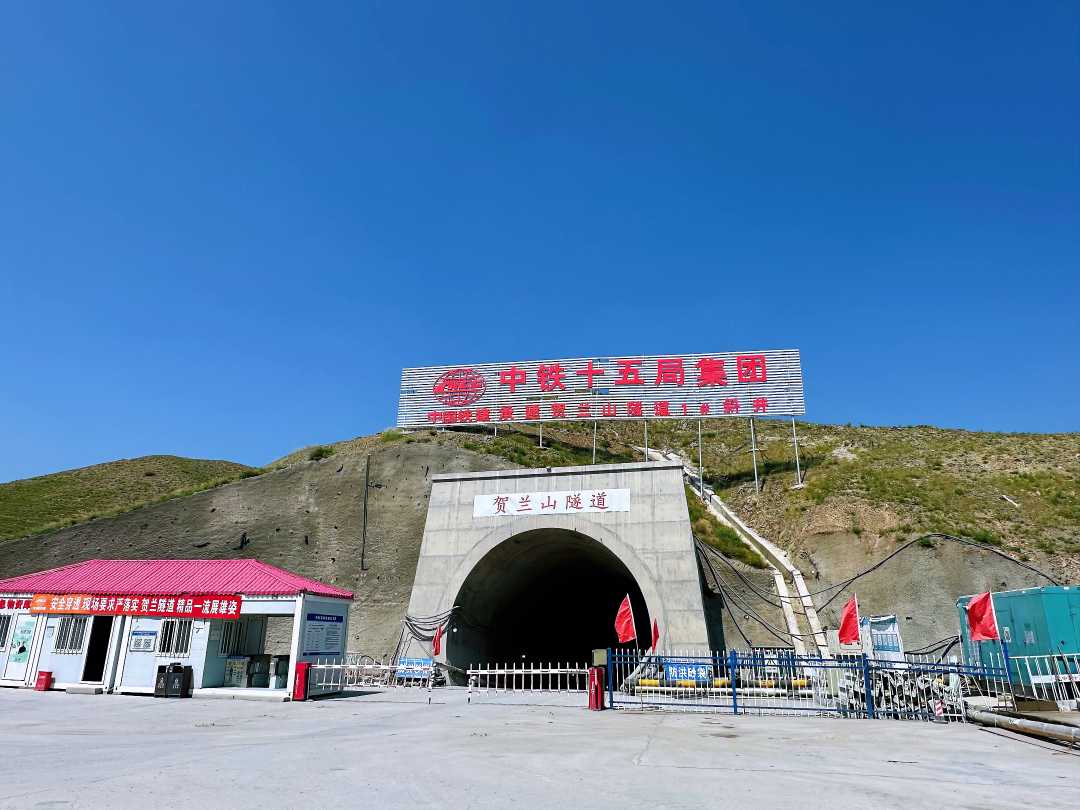
包银高铁银巴支线贺兰山隧道顺利贯通
Zhong Guo Jing Ji Wang· 2025-08-17 06:05
Core Viewpoint - The successful completion of the Helan Mountain Tunnel marks a significant milestone for the Baoyin High-speed Railway's Yinba branch, laying a solid foundation for its operational launch [1][3]. Group 1: Project Overview - The Helan Mountain Tunnel, located between Yinchuan City in Ningxia and Alashan League in Inner Mongolia, spans 8,792 meters and is the first railway tunnel to cross the Helan Mountain in China [3]. - The Yinba branch of the Baoyin High-speed Railway is a crucial part of the national "Eight Horizontal and Eight Vertical" high-speed rail network, with a total length of 111 kilometers, starting from Yinchuan City and ending at Bayannur City in Inner Mongolia [6]. Group 2: Engineering Challenges and Solutions - The tunnel's construction faced significant geological challenges, including crossing six regional faults, two fold structures, and two areas with dense joints, necessitating advanced design solutions such as pre-reinforcement and water isolation [5]. - The construction process involved comprehensive geological forecasting techniques, including geological radar and advanced drilling, to assess and mitigate risks such as soft rock deformation and surrounding rock instability [5]. Group 3: Economic and Social Impact - The completion of the project is expected to play a vital role in promoting local economic development, enhancing tourism resource utilization, and meeting passenger travel demands [6].
“成都3小时到昆明”新进展 ——渝昆高铁川滇段全线隧道贯通
Si Chuan Ri Bao· 2025-08-17 00:45
Core Points - The last tunnel of the Yukun High-speed Railway's Sichuan-Yunnan section, the Junlian Tunnel, successfully broke through on August 15, marking the completion of all 28 tunnels in this section [1] - Once completed, the Yukun High-speed Railway will enable travel from Chengdu to Kunming in approximately 3 hours [1] Group 1 - The Junlian Tunnel is located between Yibin County in Sichuan and Yanjin County in Yunnan, featuring complex geological conditions and is a key project for the Yukun High-speed Railway [1] - The tunnel measures 7,888 meters in length with a maximum depth of 635 meters, and 84% of the surrounding rock is classified as level four and five, indicating significant construction challenges [1] - Advanced technologies such as geological radar scanning and advanced horizontal drilling were utilized to predict risks associated with karst water and gas distribution, leading to substantial cost savings in construction [1] Group 2 - The maximum monthly excavation rate for the Junlian Tunnel reached 140 meters, and the tunnel was completed ahead of schedule with a focus on safety [1] - Currently, the roadbed engineering for the Sichuan-Yunnan section is 99% complete, while bridge engineering is 92% complete, with electrical and station construction progressing rapidly [1]
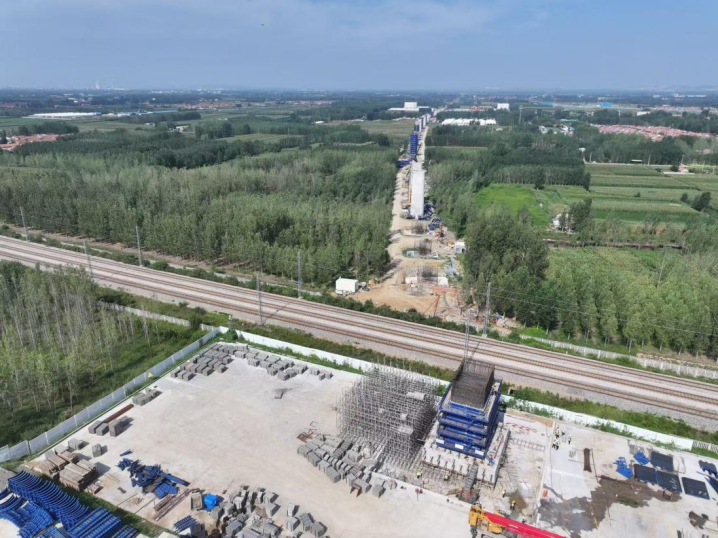
潍宿高铁取得重要进展:上跨胶新铁路转体梁主墩墩身浇筑成功
Qi Lu Wan Bao· 2025-08-16 13:28
Group 1 - The completion of the main pier body for the T-shaped turning beam of the Weishui High-speed Railway marks a critical phase in the upper structure construction, laying the foundation for subsequent turning operations [1] - The main pier of the turning bridge adopts a unique square pier design within the project segment, utilizing advanced double-line rigid wall pier technology to optimize structural shape and material distribution, ensuring sufficient strength and stability while saving materials and reducing land occupation [4] - The construction area of the Weishui High-speed Railway is the only segment adjacent to an operational line, with a minimum construction distance of only 14.2 meters, posing significant safety risks and complex construction organization [7] Group 2 - The project team implemented a three-tier quality control system during construction, ensuring "zero error" management of indicators such as rebar spacing and protective layer thickness, thereby controlling engineering quality from the source [7] - The Weishui High-speed Railway, approximately 340 kilometers long with a design speed of 350 kilometers per hour, will serve as a key rapid passenger transport corridor connecting the Beijing-Tianjin-Hebei region with the Yangtze River Delta, enhancing personnel exchanges and economic ties between the two regions [8]