
科技金融

Search documents
中信银行全资子公司信银金融资产投资获准开业
Ge Long Hui· 2025-11-23 09:28
信银金投获准开业,是本行积极响应国家号召,大力支持"科技金融"发展,做好金融"五篇大文章"的关 键举措,也是本行打造综合金融服务的关键一环。信银金投将围绕战略新兴产业、"专精特新"等重点领 域,开展市场化债转股及股权投资业务,发挥股权投资对科创企业、民营经济的支持作用,在新兴产业 和未来产业领域发挥价值发现的作用,提升本行综合经营能力和可持续发展水平。 格隆汇11月23日丨中信银行(601998.SH)公告,中信银行股份有限公司(以下简称本行),于2025年11月21 日收到《国家金融监督管理总局关于信银金融资产投资有限公司开业的批复》(金复〔2025〕666号), 国家金融监督管理总局已批准本行全资子公司信银金融资产投资有限公司(简称信银金投)开业。根据该 批复,信银金投注册资本为100亿元人民币,注册地为广东省广州市。后续信银金投将依照有关规定办 理开业手续。 ...

AIC再添新丁!信银金投、招银金投获准开业
Bei Jing Shang Bao· 2025-11-23 09:04
Core Points - CITIC Bank and China Merchants Bank announced the approval of their respective financial asset investment companies, signaling a strategic move to enhance their financial services and support technological innovation [1][2]. Group 1: CITIC Bank - CITIC Bank's wholly-owned subsidiary, Xinyin Financial Asset Investment Co., Ltd. (信银金投), received approval to commence operations with a registered capital of RMB 10 billion [1]. - The establishment of Xinyin Financial Asset Investment is part of CITIC Bank's initiative to support the development of strategic emerging industries and enhance its comprehensive operational capabilities [1]. - The company aims to engage in market-oriented debt-to-equity swaps and equity investment, focusing on supporting technology-driven enterprises and the private economy [1]. Group 2: China Merchants Bank - China Merchants Bank's wholly-owned subsidiary, Zhaoyin Financial Asset Investment Co., Ltd. (招银金投), has also been approved to operate with a registered capital of RMB 15 billion [2]. - The establishment of Zhaoyin Financial Asset Investment will enable the bank to deepen collaboration between industry and finance, enhancing its ability to serve the real economy [2]. - The company plans to conduct pilot equity investment projects to empower technological innovation and promote high-quality development [2]. Group 3: Industry Context - The approval of these financial asset investment companies expands the number of domestic joint-stock bank AICs to three, following the establishment of Xinyu Financial Asset Investment Co., Ltd. earlier this month [2]. - The regulatory environment is supportive, as evidenced by the Financial Regulatory Authority's recent notification encouraging qualified commercial banks to establish AICs [2]. - Additionally, Postal Savings Bank has announced plans to establish its own financial asset investment company with a registered capital of RMB 10 billion, indicating further growth in this sector [3].

今年来国寿资产长三角专项投资超50亿
Sou Hu Cai Jing· 2025-11-23 00:45
今年以来,国寿资产支持长三角系列资产支持专项计划密集落地,投资规模超过50亿元,为上海企业盘 活存量资产注入强劲动力。具体来看,为进一步支持上海消费基础设施建设,国寿资产通过投资百联股 份ABS项目优先级份额,盘活金山、川沙两大购物中心存量资产;通过投资张江人工智能岛ABS项目, 将国内首个"5G+AI"全场景商用示范园区的优质资产纳入配置。 截至2025年三季度末,国寿资产合并管理资产规模近7万亿元,合并管理第三方业务规模超9100亿元, 服务实体经济投资规模超4万亿元,科技金融、绿色金融、普惠金融等投资规模稳步增长。在2025年IPE 全球资管机构排名中,国寿资产位列全球第29位、中国第1位。 ...

南方财经编委陈晨星:让金融资源高效流向创新最前沿
2 1 Shi Ji Jing Ji Bao Dao· 2025-11-22 12:33
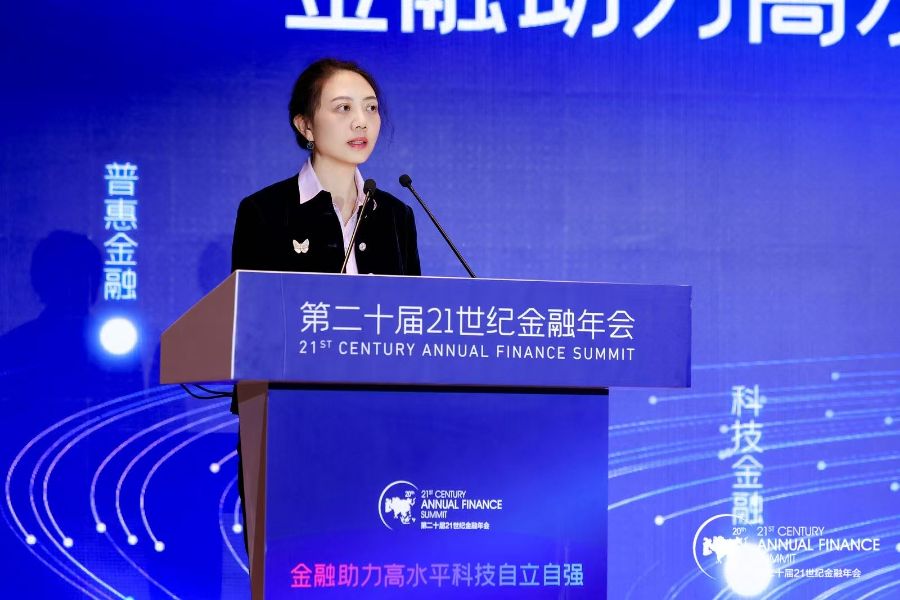
21世纪经济报道记者张欣 "一项新技术从实验室走向市场,如同一场周期长、投入大、风险高的'长征路',每个环节都离不开金融'活水'的精准滴灌。"陈 晨星称。她强调,党的二十届四中全会为经济金融工作指明方向,加快建设金融强国,关键就在于构建适配科技创新的金融服 务体系,让金融资源高效流向创新最前沿,这既是国家战略要求,也是金融业高质量发展的必然选择。 以下为发言全文—— 11月22日,为凝聚行业智慧、探寻发展新路径,由南方财经全媒体集团指导、21世纪经济报道主办的"第二十届21世纪金融年 会"在北京盛大召开。 "为高水平科技自立自强构建适配的体制机制,打造覆盖科技创新全生命周期、全产业链条的金融服务体系,让金融资源高效流 向创新最前沿。"在"主题论坛一:金融助力高水平科技自立自强"上,南方财经全媒体集团编委、21世纪经济报道执行总编辑陈 晨星如是表示。 在会上,她回顾了21世纪金融年会二十年发展历程,结合国家战略阐述了金融助力科技自立自强的重要意义,剖析当前科技金 融发展痛点,并介绍了南方财经全媒体集团的转型实践与成效,期待以此次论坛为契机,汇聚行业智慧,共同打造覆盖科技创 新全生命周期的金融服务体系,为科技自立 ...
共话穿越周期的韧性增长之道 第二十届21世纪金融年会顺利收官
2 1 Shi Ji Jing Ji Bao Dao· 2025-11-22 11:21
Core Insights - The 20th 21st Century Financial Annual Conference focused on "Reshaping Financial Resilience and Navigating Interest Rate Cycles," highlighting the need for the financial industry to adapt to low interest rates and economic fluctuations [1][2] Group 1: Financial Industry Development - The conference featured discussions on how China's financial system is building resilience against cyclical fluctuations through structural reforms and precise monetary policies [2] - Key areas of focus for financial institutions include technology finance, green finance, inclusive finance, pension finance, and digital finance, which are essential for differentiated development during interest rate cycles [2] - The shift from the old economic cycle of "real estate-finance-local government infrastructure" to a new cycle of "technology-finance-industry" was emphasized as a significant change in China's economic growth logic [2] Group 2: Insurance and Investment Opportunities - The role of green insurance in supporting climate resilience and investment was discussed, highlighting the importance of public-private partnerships in managing project risks [3] - The life insurance sector is encouraged to integrate into a people-oriented pension and health protection ecosystem, with a focus on enhancing long-term asset management capabilities [3] - Recommendations for the health protection ecosystem include reshaping the health insurance system to become a cornerstone of the national multi-level health security framework [3] Group 3: Technological Impact on Finance - A roundtable discussion on "AI and Future Finance" explored the impact of artificial intelligence on the financial industry, with insights from various industry leaders [4] - The "Financial Support for High-Level Technological Self-Reliance" sub-forum featured discussions on financial support paths for key technology breakthroughs and capital market innovations [4] Group 4: Wealth Management Trends - The "Low Interest Rate Question in Wealth Management" sub-forum addressed the transition from real estate dependency to diversified asset allocation in wealth management [5] - The release of the "2025 China Banking Industry Competitiveness Research Report" and the "2025 China Insurance Industry Competitiveness Research Report" provided valuable insights and guidance for the financial sector [5]
谁是行业年度典范?2025年21世纪金融竞争力优秀案例揭榜
2 1 Shi Ji Jing Ji Bao Dao· 2025-11-22 10:36
21世纪经济报道 记者郭聪聪 2025年正值"十四五"规划收官之年,我国金融行业沿中国特色金融发展之路稳步前行,科技金融、绿色金融、普惠金融等领域 的标准体系与基础制度持续完善,金融服务的可获得性与便利度不断提升。 为梳理行业先进实践、促进经验交流互鉴,21世纪经济报道于2025年9月正式启动 "2025年度21世纪金融竞争力优秀案例"征集活 动,旨在挖掘年度优秀样本,将标杆经验转化为行业发展动能,推动金融行业健康高质量发展。 本次案例征集活动秉持公开、公正、专业的原则,通过专家推荐与机构自主申报相结合的方式广泛收集案例,覆盖金融行业多 业态、多领域。活动启动后,得到行业内众多金融机构积极响应,最终收到超百家机构的申报材料,为后续评选工作奠定了丰 富的案例基础。为确保评选结果的专业性与权威性,组委会特别组建专家团队,围绕客观指标与主观指标开展综合评定。通过 多轮严谨审核,从海量申报案例中筛选出具备示范意义的优秀案例。 11月21日,在由南方财经全媒体集团指导、21世纪经济报道主办的"第二十届21世纪金融年会"上,"2025年度21世纪金融竞争力 优秀案例"最终名单正式揭晓。 本次评选设置综合类、服务类、产品类 ...

招商银行全资子公司招银金融投资获准开业,注册资本150亿元
Zhong Guo Ji Jin Bao· 2025-11-22 09:41
Core Viewpoint - China Merchants Bank's wholly-owned subsidiary, China Merchants Financial Investment, has been approved to commence operations with a registered capital of 15 billion RMB [1][6]. Group 1: Company Establishment - The establishment of China Merchants Financial Investment was a smooth process, taking just over six months from board approval to operational approval [4]. - The registered capital of 15 billion RMB makes it the highest initial registered capital for a financial asset investment company at its inception [6]. Group 2: Business Direction - Following its approval, China Merchants Financial Investment will focus on market-oriented debt-to-equity swap business, enhancing synergy between production and finance, and serving the real economy [7]. - The company aims to support technological innovation and promote high-quality development by engaging in equity investment pilot projects [7]. Group 3: Industry Context - The approval of China Merchants Financial Investment aligns with a broader trend where financial asset investment companies (AICs) are expanding their roles in supporting technology innovation and private enterprises [9][10]. - Recent regulatory changes have allowed AICs to broaden their equity investment pilot programs, increasing the number of commercial banks and insurance funds eligible to participate [9].
深夜宣布!又一家AIC,获准开业!
Zhong Guo Ji Jin Bao· 2025-11-22 09:39
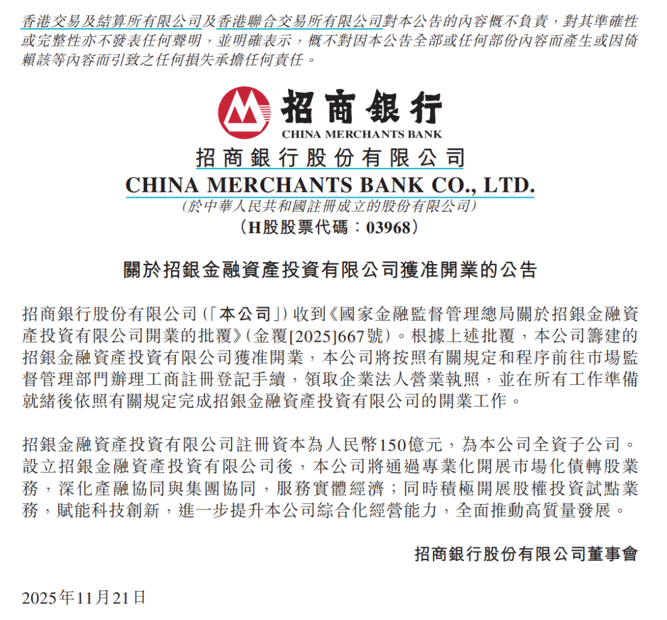
Core Viewpoint - China Merchants Bank's wholly-owned subsidiary, China Merchants Financial Investment, has been approved to commence operations with a registered capital of 15 billion RMB [1][4]. Group 1: Company Establishment - The establishment of China Merchants Financial Investment was a smooth process, taking just over six months from board approval to operational approval [4]. - The registered capital of 15 billion RMB makes it the highest initial registered capital for a financial asset investment company at its inception [4]. Group 2: Business Development Direction - After commencing operations, China Merchants Financial Investment will focus on market-oriented debt-to-equity swap business, enhancing synergy between industry and finance, and serving the real economy [5]. - The company aims to support technological innovation and improve the bank's comprehensive operational capabilities, promoting high-quality development [5]. - It will concentrate on key areas such as technological innovation, green low-carbon initiatives, and advanced manufacturing, leveraging long-term and patient capital to assist enterprises in reducing leverage and facilitating transformation [5][6]. Group 3: Industry Context - The approval of China Merchants Financial Investment aligns with a broader trend of expanding financial asset investment companies (AICs) in China, with several banks recently receiving approval to establish similar entities [7]. - Recent policies have been favorable for the development of AICs, positioning them as significant "patient capital" in the technology finance market [8].

徽商银行:创新驱动高质量发展 资产质量持续向好
Zhong Guo Jin Rong Xin Xi Wang· 2025-11-22 04:56
Core Insights - Huishang Bank has consistently prioritized development and innovation, leading to steady improvements in operational management and overall strength, with total assets reaching 2.3 trillion yuan by September 2025 [1] - The bank ranked 101st in the Global Top 1000 Banks, an improvement of 11 positions from the previous year [1] Group 1: Support for Regional Development - The bank has implemented a comprehensive plan to support the integration of the Yangtze River Delta, with infrastructure loans totaling 260 billion yuan [2] - It has provided over 24 billion yuan in funding support for enterprises in new functional areas and industrial parks within the Yangtze River Delta [2] - Huishang Bank has been a key financial supporter for major provincial projects, including significant investments in the semiconductor industry [2] Group 2: Focus on Key Industries - The bank has enhanced its financial services for the new energy vehicle industry, providing over 110 billion yuan in credit to more than 1,700 upstream and downstream clients [2] - It has invested over 100 billion yuan in local government bonds and created indices for local government and corporate credit bonds [2] Group 3: Financial Support for Small and Micro Enterprises - Huishang Bank has strengthened financial support for small and micro enterprises, with loans exceeding 170 billion yuan for inclusive small and micro businesses and over 260 billion yuan for private enterprises [2] - The bank has been recognized for its contributions to high-quality development in Anhui province, receiving awards for its financial support efforts [2] Group 4: Innovation in Financial Services - The bank has established a dedicated structure for technology finance, launching various specialized financial products aimed at supporting technological innovation [3][4] - It has developed a digital product service system that integrates technology and finance, providing over 12 billion yuan in online credit loans to more than 4,200 technology enterprises [3][4] Group 5: Commitment to Rural Development - Huishang Bank has focused on county-level economic development, with county loans accounting for over 30% of its total provincial loans [5] - The bank has signed agreements with 124 credit villages, with loans to these villages reaching 11 billion yuan [5] - It has launched over 40 financial products specifically for rural revitalization, providing more than 16 billion yuan in loans for various revitalization projects [7] Group 6: Future Outlook - As Huishang Bank approaches its 20th anniversary, it aims to become a global top 100 bank and a benchmark for systemic excellence, continuing to support the modernization of Anhui province [7]
人民日报:科创新苗引来金融活水
Ren Min Ri Bao· 2025-11-22 04:00
Core Insights - The article emphasizes the importance of financial support in fostering technological innovation and high-quality development in China, particularly in the context of the "new era" and the "14th Five-Year Plan" [1][9] - It highlights the role of various financial institutions in providing tailored financial services to technology-driven enterprises, particularly in Wuhan's East Lake New Technology Development Zone, known as "China's Optics Valley" [1][3] Financial Support for Technology Enterprises - Over 5,000 technology companies are located in Wuhan's East Lake New Technology Development Zone, supported by more than 1,000 financial institutions offering diverse financial products [1][3] - Financial institutions are increasingly focusing on innovation potential rather than traditional asset-based lending, providing significant credit support to technology firms [4][5] Case Study: Grando Intelligent Technology Co., Ltd. - Grando has evolved from a single focus on smart grid equipment to multiple sectors, including intelligent robotics, with financial backing facilitating this transition [3][5] - The company received substantial credit support during its initial high-risk phase, with banks offering unsecured loans of up to 10 million yuan [4] - Grando's revenue has seen significant growth, increasing from over 20 million yuan to more than 400 million yuan within three years [5] Collaboration and Innovation - Grando's partnership with Huazhong University of Science and Technology has led to successful product development, demonstrating the benefits of industry-academia collaboration [6][7] - The company is now focusing on acquiring patents and expanding into new technological fields, supported by financial institutions that provide loans for patent purchases [8][9] Comprehensive Financial Services - A comprehensive financial service system is being established to support technology enterprises throughout their lifecycle, with significant funding allocated for ongoing research and development [8][9] - The financial sector has issued over 650 billion yuan in intellectual property pledge loans since the "14th Five-Year Plan," indicating a growing trend in supporting innovation through financial mechanisms [9]