
Robotics

Search documents
Nvidia CEO says this is the decade of robotics and autonomous vehicles
CNBC· 2025-06-12 10:38
Group 1 - Nvidia CEO Jensen Huang predicts significant growth in autonomous vehicles (AVs) and robotics in the coming decade, emphasizing it as the "decade of AV, robotics, autonomous machines" [1] - Nvidia is a key player in the development of driverless vehicles, providing both hardware and software solutions for AVs [2] - The presence of self-driving cars is increasing in the U.S., with companies like Waymo operating robotaxi services in major cities [2] Group 2 - Chinese companies such as Baidu and Pony.ai are also actively deploying their own robotaxi fleets, indicating a competitive landscape in the AV sector [2]


NVIDIA (NVDA) Conference Transcript
2025-06-11 12:45
Summary of NVIDIA Conference Call - June 11, 2025 Company Overview - **Company**: NVIDIA (NVDA) - **Event**: Conference Call - **Date**: June 11, 2025 Key Industry Insights - **AI Growth**: AI is recognized as the fastest-growing technology in history, with global reach and significant potential for expansion in Europe, particularly in France and the EU [1][18] - **Quantum Computing**: The industry is shifting towards a hybrid model of quantum and classical computing, emphasizing the importance of GPU supercomputers for error correction and data generation [9][12][15] - **Sovereign AI**: The development of AI infrastructure in Europe is seen as crucial, with an estimated $1.5 trillion build-out expected over the coming years [17][18] Core Company Strategies - **Local Infrastructure**: NVIDIA is focusing on building AI factories and supercomputing centers for local consumption in Europe, which will support the region's heavy industry and robotics capabilities [16][17] - **Physical AI Models**: The company is developing multimodal physical AI models that can reason and execute tasks based on prompts, differentiating them from traditional LLMs [19][20] - **Gigawatt Projects**: NVIDIA is involved in multiple gigawatt projects across Europe, with a focus on regional cloud service providers and AI factories supported by government initiatives [24][26] Financial and Operational Insights - **Supply Chain Management**: NVIDIA's supply chain is robust, with the ability to forecast demand and place large orders with suppliers like TSMC and Micron, ensuring timely production of supercomputers [30][32] - **Market Demand**: The company is not limited by critical components but must forecast production accurately to meet the growing demand for AI technologies [30][33] - **Post-Training Opportunities**: NVIDIA sees significant potential in post-training processes, which involve reinforcement learning and human feedback to improve AI models [49][52] Challenges and Risks - **Geopolitical Concerns**: The company acknowledges the importance of local infrastructure due to data privacy and geopolitical issues, particularly in Europe [27][28] - **Dependency on Taiwan**: NVIDIA is actively working to reduce its dependency on Taiwan for chip manufacturing, with plans to build substantial AI supercomputer infrastructure in the United States [64][66] - **China Market**: The company has removed China from its forecasts due to export controls, resulting in a significant revenue drop, but remains optimistic about growth in other markets [70][71] Future Outlook - **AI Integration in Enterprises**: NVIDIA is focused on integrating AI into traditional enterprise IT systems, which presents a substantial market opportunity estimated in the hundreds of billions [96][98] - **Continuous Improvement**: The company emphasizes ongoing software improvements that enhance the performance of its hardware, ensuring long-term value for customers [114][115] - **Ecosystem Development**: NVIDIA is building an ecosystem around its NVLink technology, which is expected to facilitate partnerships and enhance its competitive position in the market [91][92] Conclusion NVIDIA is strategically positioned to capitalize on the rapid growth of AI and quantum computing, with a strong focus on local infrastructure development in Europe, robust supply chain management, and continuous innovation in AI technologies. The company faces challenges related to geopolitical risks and market dependencies but remains optimistic about its growth trajectory and market opportunities.
大模型能够自发形成“人类思维地图”!Nature子刊重磅研究揭示多模态大模型类脑机制
机器人圈· 2025-06-11 11:43
Core Viewpoint - The research published in "Nature Machine Intelligence" demonstrates that multimodal large language models (MLLMs) can develop human-like object concept representations, challenging the notion that these models merely mimic human language without true understanding [2][4]. Group 1: Research Findings - The study analyzed 4.7 million behavioral judgment data to construct an "concept map" of AI models, confirming that MLLMs can form object concept representations similar to humans [3][6]. - The research identified 66 core dimensions of cognition through a sparse positive definite similarity embedding method, revealing that both ChatGPT-3.5 and the multimodal Gemini model exhibit stable low-dimensional representation structures [9]. - MLLMs spontaneously formed 18 high-level object concept categories with a classification accuracy of 78.3%, approaching human accuracy of 87.1% [13]. Group 2: Methodology - The research employed a novel "behavioral cognitive probe" method, integrating computational modeling, behavioral experiments, and neuroscience to analyze AI cognition [8]. - A triplet odd-one-out task was designed to assess the similarity of object representations between AI and humans, allowing for a comparative analysis of decision-making processes [5][31]. Group 3: Cognitive Dimensions - The study provided semantic labels for the cognitive dimensions of AI models, categorizing them into dimensions related to semantic categories, perceptual features, and physical components [17][19][20]. - The findings indicated a significant correlation between MLLM representations and human brain activity patterns, particularly in areas responsible for processing faces, scenes, and bodies [23][24]. Group 4: Implications and Future Directions - The research has broad applications, including the development of neuro-aligned AI systems, exploration of neural mechanisms for concept combination and reasoning, and enhancement of brain-computer interface systems [35]. - Future work will focus on expanding to next-generation multimodal models and establishing a cognitive benchmark testing platform to objectively assess AI's semantic understanding [35][36].

Top Stock Picks for Week of June 9, 2025
Zacks Investment Research· 2025-06-10 22:11
Cybersecurity Industry Analysis - Cyber Arc is a leader in privileged access management, focusing on identity security [2] - The cybersecurity war is being fought with AI against AI in 2025, emphasizing the need to own cybersecurity companies [5] - Nation-state enterprises are heavily involved in hacking, making cybersecurity a big business [6][7] - Cyber Arc's main competitor is Crowd Strike, which specializes in dealing with nation-state threat actors [12] Cyber Arc Financials and Valuation - Cyber Arc is approaching $1.5 billion in revenue, with a projected 32% growth this year if they reach $1.3 billion [13] - Cyber Arc's market cap is $20 billion, resulting in a 13x price-to-sales ratio [13] - Cyber Arc is projecting 20% revenue growth for next year [14] - Cyber Arc's EPS is growing at approximately 25% [17] Robotics Industry Analysis - ABB, a Swiss industrial giant, will spin off its thriving robotics division next year [19] - The robotics industry is predicted to be the next multi-trillion dollar industry [25][31] - There are numerous private robotics companies vying for funding and success, with many looking to IPO [22][23] - Figure Robots is identified as a significant private player in the robotics industry [30]

5 Reasons Amazon Is Still the Alpha in Tech Stocks
Benzinga· 2025-06-10 15:47
Core Insights - Amazon.com, Inc. continues to outperform other tech stocks despite job cuts, driven by high-growth segments such as AWS cloud services, digital advertising, and Project Kuiper's satellite internet [1] - The company is leveraging investments in artificial intelligence and robotics to enhance operational efficiency and create new profit opportunities [1] Group 1: Market Position - Amazon holds an estimated 37.6% market share in U.S. e-commerce for 2025, significantly ahead of competitors like Walmart at 6.4% [4] - The company boasts a vast customer base of over 310 million active customers globally [4] Group 2: Business Diversification - Amazon's business model includes multiple high-growth segments such as cloud computing (AWS), e-commerce, subscriptions, and digital advertising [4] - The Project Kuiper division aims to deploy a low-Earth-orbit satellite constellation to provide broadband internet access to underserved communities [4] Group 3: Profitability - Amazon's operating margins increased to 11.8% in Q1 2025, up from 10.7% in the same quarter the previous year [4] - The company continues to grow in high-margin areas like AWS and advertising [4] Group 4: Innovation - Amazon invests in AI and robotics to drive efficiency and expand profit margins, including the establishment of a new agentic AI team [4] - Analysts from BofA Securities recognize Amazon as a leader in AI and robotics, which is expected to enhance profitability [4] Group 5: Analyst Sentiment - Most analysts maintain a bullish outlook on Amazon, with its stock frequently appearing on "Best Ideas" lists, indicating strong fundamentals and growth potential [4]


Our top three takeaways from Bloomberg Tech 2025 #shorts #bloombergtech #ai #robots
Bloomberg Technology· 2025-06-09 19:45
So, what are my top three takeaways. One, shocker. AI is everywhere.I know that's obvious, but it's everywhere, changing everything, and we all need to get on it and make sure we are educating ourselves about how to use it so we can compete in this world and be the best version of ourselves. Two, jobs. We talked a lot about jobs.Are there going to be more total jobs in the future, less total jobs in the future. One of my favorite moments was talking about what is going to be the it job of the future and the ...

斯坦福大学和哥伦比亚大学联合开发的以人手为灵巧操作通用接口的突破性研究——DexUMI
机器人圈· 2025-06-09 10:47
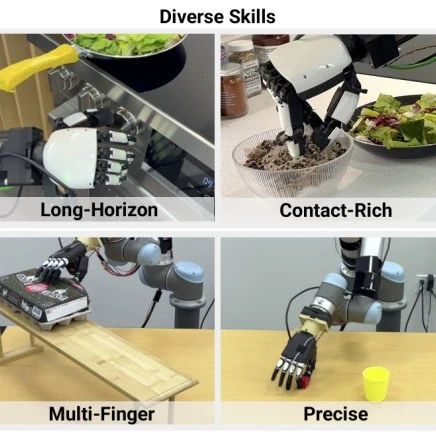
在灵巧机器人领域,一项重大突破正在改变机器人如何学习复杂的手部操作技能。来自斯坦福大学、哥伦比亚大 学、摩根大通 AI 研究院、卡内基梅隆大学和英伟达的研究团队,由 Mengda Xu 、 Han Zhang 、 Yifan Hou 、 Zhenjia Xu 、 Linxi Fan 、 Manuela Veloso 和 Shuran Song 共同合作,于 2025 年 5 月发表了题为《 DexUMI: Using Human Hand as the Universal Manipulation Interface for Dexterous Manipulation 》的研究 论文。这项研究提出了一个创新框架,允许机器人直接从人类手部动作中学习复杂的灵巧操作技能。 人类的手部展现出令人惊叹的灵巧特质,能够胜任各式各样复杂精细的任务。然而,将人类手部的这些技能迁移 至机器人身上,却始终面临着巨大的挑战。究其原因,主要是人类的手与机器人的手之间存在着显著的 " 身体差 异鸿沟 " 。研究团队由此提出了一个核心问题:究竟该如何最大程度地缩小这种 " 身体差异鸿沟 " ,让人类的手 部能够成为各类不同机器人手的通 ...
Our top three takeaways from Bloomberg Tech 2025 #shorts #bloombergtech #ai #robots
Bloomberg Television· 2025-06-09 10:37
So, what are my top three takeaways. One, shocker. AI is everywhere.I know that's obvious, but it's everywhere, changing everything, and we all need to get on it and make sure we are educating ourselves about how to use it so we can compete in this world and be the best version of ourselves. Two, jobs. We talked a lot about jobs.Are there going to be more total jobs in the future, less total jobs in the future. One of my favorite moments was talking about what is going to be the it job of the future and the ...

LP周报丨港澳资本入局,广东再设100亿AI基金
投中网· 2025-06-07 04:22
Core Viewpoint - The article highlights the increasing investment in AI and robotics industries in Guangdong, with the establishment of two major funds totaling 200 billion RMB, reflecting the urgency and strategic approach of the region in fostering these sectors [4][5]. Fund Establishments - Guangdong has launched its first AIC Artificial Intelligence Industry Fund in March, with a scale of 10 billion RMB, focusing on AI and robotics investments [4]. - A new Guangdong Intelligent Industry Fund has been initiated, also with a scale of 10 billion RMB, targeting AI, robotics, and semiconductor sectors [5]. - The Hubei Province has established a humanoid robot industry investment fund with a total investment of 5 billion RMB, aiming to enhance its capabilities in the humanoid robot sector [11]. - The Hangzhou West Lake Future Venture Capital has been set up with a capital of 2 billion RMB, focusing on early-stage investments [12]. - The Jiangsu Province has seen the establishment of a 3 billion RMB angel fund focusing on biopharmaceuticals, supported by local government and industry investors [14][15]. Investment Dynamics - Chaoxi Capital has successfully closed its second RMB fund with a first close of 700 million RMB, indicating strong support from industrial LPs [7]. - The Shenzhen AI Terminal Industry Private Equity Fund has been established with a capital of 1.44 billion RMB, aligning with Honor's strategic shift towards AI ecosystem development [17]. - The establishment of the Qihang He Wu Entrepreneurship Investment Partnership in Changzhou, focusing on synthetic biology, highlights the region's commitment to emerging technologies [18]. GP Recruitment - The Suqian New Emerging Industry Mother Fund has been set up with a scale of 2 billion RMB, seeking to recruit GP for strategic investments in various emerging industries [27]. - The Nanjing Pukou District High-Quality Development Mother Fund is also looking for GP, focusing on integrated circuits, new energy, and AI [28][29].

AIR珠江指数发布:广东综合实力居首,长三角协同性强
2 1 Shi Ji Jing Ji Bao Dao· 2025-06-07 02:06
Core Insights - Guangdong Province ranks first in the national artificial intelligence and robotics industry with a score of 92.33, leading in seven core indicators including enterprise development, market potential, and industry application [1][2][3] - The report evaluates the development levels of artificial intelligence and robotics across ten provinces and four economic zones, establishing a four-tier development structure [1][3] Industry Overview - In 2024, the core AI industry in Guangdong is projected to exceed 220 billion, with over 1,500 core AI enterprises, the highest number of "little giant" enterprises in the country [2] - The production of industrial robots in Guangdong is expected to reach 246,800 units in 2024, a 31.2% increase year-on-year, maintaining a 44% share of the national market [4] Policy and Strategic Development - Guangdong has implemented a series of policies to support AI and robotics, including the "Guangdong New Generation Artificial Intelligence Innovation Development Action Plan (2022-2025)" and other initiatives aimed at accelerating AI applications across various sectors [3][5] - The province's comprehensive strength in AI and robotics is reflected in its top rankings in research capability, enterprise development, market potential, infrastructure, industry application, and social participation [3] Regional Competitiveness - The report highlights a competitive landscape where Guangdong leads, followed by Beijing, Zhejiang, Jiangsu, and Shanghai, each with unique strengths in governance, infrastructure, and industry applications [6][7] - The Yangtze River Delta region exhibits significant collaborative advantages, while the Pearl River Delta showcases comprehensive industry chain competitiveness [7]