
总体国家安全观

Search documents
更好统筹高质量发展和高水平安全(深入学习贯彻习近平新时代中国特色社会主义思想·学习《习近平经济文选》第一卷专家谈)
Ren Min Wang· 2025-10-19 22:31
李 非 黄 婧 当今时代,发展利益和安全利益复杂交织。如何处理好发展和安全的关系,是世界各国面临的共同难 题。党的十八大以来,习近平总书记高度重视发展和安全,反复强调要统筹高质量发展和高水平安全, 许多重要论述都收入《习近平经济文选》第一卷。比如,《关于构建新发展格局》指出:"这次中央全 会对统筹发展和安全作出战略部署,对在复杂环境下更好推进我国经济社会发展具有重大指导意义"; 《中国式现代化要靠科技现代化作支撑》指出:"坚持创新引领发展,树牢抓创新就是抓发展、谋创新 就是谋未来的理念,以科技创新引领高质量发展、保障高水平安全";等等。8月29日召开的中共中央政 治局会议强调:"牢牢守住发展不能以牺牲安全为代价这条底线""更好统筹高质量发展和高水平安全"。 在以中国式现代化全面推进强国建设、民族复兴伟业的新征程上,我们要深入学习贯彻习近平总书记重 要讲话精神,坚决贯彻中共中央政治局会议部署要求,以高质量发展促进高水平安全,以高水平安全保 障高质量发展,不断续写经济快速发展和社会长期稳定两大奇迹新篇章。 更好统筹高质量发展和高水平安全具有深刻的理论逻辑、历史逻辑、实践逻辑 从"发展"到"高质量发展"的深化,从" ...
坚决贯彻习近平总书记重要指示精神 全力维护边疆稳固边境安全人民安宁
Ren Min Ri Bao· 2025-10-15 22:22
Core Viewpoint - The article emphasizes the importance of maintaining national security and social stability in border regions, particularly in Yunnan and Xinjiang, through comprehensive governance and law enforcement efforts [1][2]. Group 1: National Security and Stability - The political and legal authorities are urged to implement Xi Jinping's directives, focusing on the overall national security concept and balancing development with security [1]. - There is a strong emphasis on the need to maintain political security and social stability as fundamental requirements for governance in border areas [1][2]. - Authorities are instructed to enhance political sensitivity, detect issues early, and take legal action against hostile forces and their activities [1]. Group 2: Crime Prevention and Law Enforcement - The focus is on combating telecom and internet fraud, with a call for increased efforts against overseas fraud masterminds and domestic accomplices [2]. - There is a need to strengthen preventive measures by holding industry regulators and telecom/financial companies accountable, improving systems, and enhancing industry governance [2]. - The article highlights the importance of public awareness campaigns to improve citizens' fraud prevention capabilities [2]. Group 3: Border Control and Anti-Terrorism - The complexity of the border situation necessitates strict measures against terrorism, with a commitment to legal and normalized anti-terrorism efforts [2]. - The article calls for the establishment of a robust border control system to combat cross-border crimes and effectively address infiltration and destructive activities from "three forces" [2]. - There is an emphasis on community support and employment stability to maintain social harmony and public confidence [2].
陈文清在云南和新疆调研时表示 坚决贯彻习近平总书记重要指示精神 全力维护边疆稳固边境安全人民安宁
Xin Hua She· 2025-10-15 09:59
Group 1 - The core viewpoint emphasizes the importance of maintaining national security and social stability in border regions, particularly in Yunnan and Xinjiang, as part of the overall governance strategy [1][2] - The political and legal authorities are urged to enhance their responsibilities in safeguarding political security and social stability, with a focus on early detection and small-scale intervention in potential threats [1] - There is a strong emphasis on the need for collaboration among various departments to effectively manage ethnic and religious affairs, promoting national unity and the sinicization of religion [1] Group 2 - The focus on combating telecom and internet fraud is highlighted, with a call for increased efforts to target both domestic and foreign perpetrators, ensuring the protection of citizens' interests [2] - The complexity of the border situation necessitates stringent measures against terrorism, with a commitment to legal and systematic approaches to counter-terrorism and stability maintenance [2] - The importance of community support and employment stability is underscored, with initiatives aimed at assisting vulnerable groups and maintaining social harmony [2]
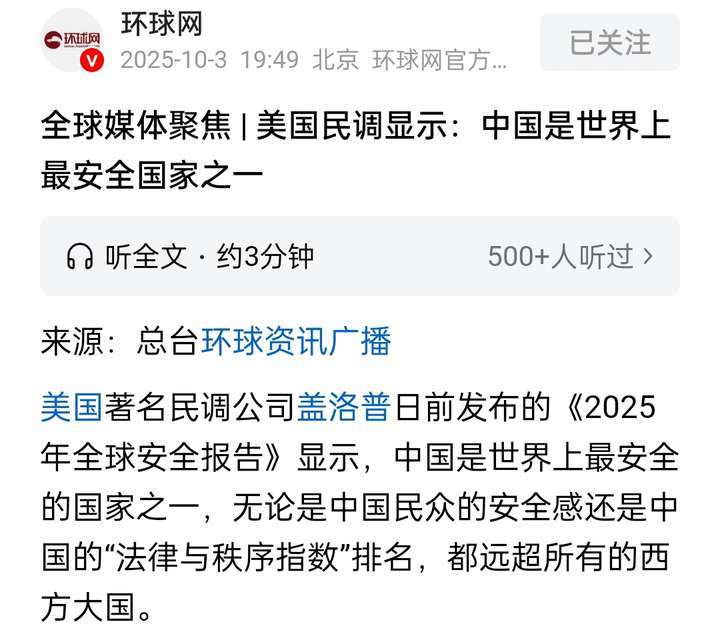
美国调查:中国是全球最安全国家之一,整体安全世界第三!西方大国无一个上榜前十
Sou Hu Cai Jing· 2025-10-06 10:25
Core Insights - The Gallup Global Safety Report 2025 ranks China as one of the safest countries in the world, placing it third overall and fourth in the Law and Order Index, based on a survey of 144 countries and over 145,000 adults [1][5][17] - Notably, no major Western countries appear in the top ten of the safety rankings, challenging the perception that Western nations are inherently safer [2][17] - The report highlights a significant gender gap in safety perceptions in Western countries, particularly in the U.S., where only 71% of adults feel safe walking alone at night, with a stark difference between male (84%) and female (58%) respondents [10][17] Summary by Categories Overall Safety Ranking - China is ranked third in overall safety and fourth in the Law and Order Index, with a score of 93, tied with Iceland and Vietnam [5][17] - The report indicates that the Asia-Pacific region is now considered the safest globally, with rising safety perceptions since 2006, contrasting with declining perceptions in North America [12][17] Law and Order Index - The Law and Order Index is based on four key questions regarding personal safety and trust in law enforcement, with China's high score reflecting strong public confidence in safety measures [5][17] - In comparison, major Western countries like Germany (ranked 24th with 86 points), the UK, and the US (both tied at 53-54 with 84 points) show significant gaps in safety perceptions [5][10] Gender Safety Perceptions - The report reveals a pronounced gender gap in safety perceptions in Western countries, with the U.S. showing a 26 percentage point difference between male and female respondents regarding safety while walking alone at night [10][17] - This gap is indicative of broader issues in addressing personal safety and gender equality in these regions [10][17] Security Governance - China's security governance model is characterized by a comprehensive approach that integrates community involvement and rapid response measures, contributing to its high safety ratings [8][14][17] - The report suggests that effective safety governance is a combination of economic development, social equity, legal frameworks, and public welfare [15][17] Global Security Dynamics - The findings of the Gallup report suggest a shift in global security dynamics, with non-Western countries, particularly in the Asia-Pacific region, demonstrating effective safety governance models that challenge the traditional Western-centric view of security [17] - The report emphasizes the need for a balanced approach to security that considers both safety and individual freedoms, as well as the roles of government and community participation [17]

贯彻实施原子能法 推动原子能事业高质量发展迈上新征程
Ren Min Ri Bao· 2025-09-29 22:11
Core Points - The National People's Congress passed the Atomic Energy Law, effective from January 15, 2026, emphasizing the importance of nuclear energy for national security and high-quality development [1][2][4] - The law aims to establish a comprehensive legal framework for the development, management, and application of atomic energy in China, enhancing governance and safety standards [2][5] - The law incorporates principles of public interest, encouraging the application of nuclear technology in various sectors while ensuring public communication and involvement [3][5] Summary by Sections Importance of the Atomic Energy Law - The law reflects the implementation of Xi Jinping's rule of law thought and aims to clarify national policies and management systems for atomic energy development [2] - It integrates nuclear safety into the overall national security framework, promoting a balanced approach to development and safety [2] Development and Management Framework - The law summarizes the experiences gained in China's atomic energy sector, establishing a management system that includes responsibilities for various government departments [4][5] - It outlines specific management systems for spent fuel storage, transportation, and disposal, as well as for nuclear technology applications [5] Legal Responsibilities and Public Engagement - The law defines the legal responsibilities and obligations of government entities, enterprises, and personnel involved in atomic energy activities [5] - It emphasizes the importance of public awareness and engagement in atomic energy development, mandating communication on significant issues affecting public interests [3][5] High-Quality Development Goals - The law aims to drive high-quality development in the nuclear industry by promoting innovation, sustainability, and the application of nuclear technology across various sectors [6][7] - It encourages international cooperation in peaceful nuclear energy use and supports China's participation in global nuclear governance [3][7]
镇江高新区党工委理论学习中心组召开学习会
Zhen Jiang Ri Bao· 2025-09-24 23:30
Core Viewpoint - The meeting emphasized the importance of deepening the study of party history and strengthening ideological foundations to support the development of the high-tech zone and national defense education [1] Group 1 - The meeting took place at the Wei Gang Anti-Japanese War Memorial, where participants paid tribute to the victory monument and revisited the history of the Wei Gang battle [1] - Attendees studied Xi Jinping's important speech commemorating the 80th anniversary of the victory in the Chinese People's Anti-Japanese War and the World Anti-Fascist War [1] - The meeting called for a robust national defense education system that encourages public participation and long-term commitment, aiming to lay a solid foundation for regional development and national defense [1] Group 2 - The meeting highlighted the need to implement a comprehensive national security concept and advance safety measures across various fields to strengthen security [1] - There was a focus on enhancing awareness of potential challenges and ensuring effective execution of responsibilities to support the high-tech zone's development [1]
展军训风采 护国家安全
Nan Jing Ri Bao· 2025-09-22 02:19
Group 1 - Nanjing University of Aeronautics and Astronautics organized a practical study activity themed "National Security" for new students, emphasizing campus safety education through an interactive experience [1] - The safety education experience center covers nearly 1,000 square meters and features modern display designs, immersing students in various safety scenarios including national security, confidentiality, fire safety, and laboratory safety [1] - The initiative aims to enhance the sense of responsibility and mission among young people regarding national security, integrating national security education with national defense education [1][2] Group 2 - Nanjing Xiaozhuang College conducted a two-day orientation program focusing on "Big Safety" education, featuring four thematic lectures on political security, national defense security, campus safety, and mental health [2] - The military research office director provided an in-depth analysis of the new characteristics and challenges facing national security in the current global context, receiving positive feedback from students [2] - Various schools in Nanjing have innovated educational formats, such as theme class meetings and knowledge quizzes, to actively engage students in national security education [3] Group 3 - Schools have organized activities like the "Grand Parade" theme to educate students about the significance of national security and historical military parades, planting the seeds of national security awareness [3] - The integration of national security education into daily activities has led to a deeper understanding of the overall national security concept among youth, encouraging them to contribute to national security efforts [3]
刚设立的黄岩岛国家级自然保护区有什么特殊意义?
Huan Qiu Shi Bao· 2025-09-18 10:39
Core Points - The establishment of the Huangyan Island National Nature Reserve marks a significant step in China's efforts to enhance ecological protection in the South China Sea, reflecting its commitment to marine ecological civilization and governance [1][2] - The reserve's unique geographical environment and biodiversity highlight its exceptional value, indicating a systematic approach to marine scientific research and environmental monitoring [1] - This initiative aligns with international marine governance principles, showcasing China's role as a responsible stakeholder in global marine environmental protection [2][3] Group 1 - The Huangyan Island National Nature Reserve is a milestone in China's ecological civilization construction, emphasizing the importance of marine ecosystem protection [1] - The reserve's establishment is a direct response to the obligations outlined in the United Nations Convention on the Law of the Sea, reinforcing China's commitment to international marine environmental standards [2] - The reserve is expected to facilitate international cooperation in marine environmental protection, potentially involving scientists and institutions from various countries [2] Group 2 - The creation of the reserve provides a positive narrative in the international discourse surrounding the South China Sea, countering negative perceptions and accusations against China [3][4] - China's proactive measures in establishing the reserve demonstrate its role as a maintainer of peace and stability in the South China Sea, as well as a leader in marine ecological civilization [4] - The reserve's establishment is part of a broader strategy to enhance regional cooperation and uphold the Declaration on the Conduct of Parties in the South China Sea [4]
【安全】2025年金融网络安全宣传手册
招商银行App· 2025-09-16 07:05
Core Viewpoint - The article emphasizes the importance of cybersecurity and the need for public awareness and education regarding online safety, particularly in the context of financial information protection and the prevention of various types of online fraud [10][22]. Group 1: Cybersecurity Principles - Xi Jinping's important thoughts on building a cyber power are outlined, emphasizing the integration of cybersecurity and information technology development [2][4]. - The "Four Persistences" in cybersecurity work are highlighted, focusing on the need for cybersecurity to serve the people and the importance of education and technology integration [10][11]. Group 2: Legal Framework - The "Cybersecurity Law of the People's Republic of China" is introduced as the foundational legal framework for managing cybersecurity, effective since June 1, 2017 [13]. - The "Data Security Law" and the "Personal Information Protection Law" are also discussed, establishing guidelines for data handling and personal information protection, effective from September 1, 2021, and November 1, 2021, respectively [17][18]. Group 3: Financial Information Security - Personal financial information is defined, including identity, asset, account, credit, and transaction information [22]. - Recommendations for protecting personal financial information include not sharing sensitive information and being cautious with online transactions [23][25]. Group 4: Fraud Prevention - Various types of online fraud are detailed, including investment scams, loan fraud, and impersonation scams, with specific case studies illustrating how these scams operate [27][31][36]. - Safety tips are provided to help individuals recognize and avoid scams, emphasizing the importance of skepticism towards unsolicited offers and requests for personal information [30][33][38]. Group 5: Anti-Fraud Tools - The article lists several anti-fraud tools and resources, such as the National Anti-Fraud Center APP and various reporting hotlines, aimed at enhancing public awareness and response to potential fraud [43][44][45].

滚动更新|中央政法委:正在起草新一轮法治中国建设规划
2 1 Shi Ji Jing Ji Bao Dao· 2025-09-12 03:23
Core Viewpoint - The central government is drafting a new round of legal construction planning to enhance the rule of law in China, which is seen as a crucial guarantee for modernization and economic vitality [1][3]. Group 1: Legal Environment and Reforms - The legal environment is being improved to foster a business-friendly atmosphere, with a focus on equal protection for various business entities and addressing enforcement issues [2][3]. - The judicial system is undergoing reforms, including the implementation of a lifelong responsibility system for case quality and accountability for wrongful cases, which aims to enhance judicial efficiency and public trust [2][3]. Group 2: Legislative Achievements - During the "14th Five-Year Plan" period, significant legislative progress has been made, including the enactment of 36 new laws and amendments to 63 existing laws, contributing to a robust legal framework [4]. - The current effective legal framework includes 306 laws, 600 administrative and supervisory regulations, and over 14,000 local regulations, reflecting a dynamic and evolving legal system [4]. Group 3: Dispute Resolution and Mediation - Nationwide, over 79 million disputes have been mediated by people's mediation organizations, achieving a success rate of over 95%, indicating effective conflict resolution mechanisms [5]. - The number of mediation committees and mediators has significantly increased, enhancing the capacity to address common disputes in various sectors [5]. Group 4: Judicial Statistics - National courts have received a total of 189.74 million cases during the "14th Five-Year Plan" period, showcasing the high demand for judicial services [6][7]. - The courts have adjudicated 5.23 million criminal cases, reinforcing the commitment to combat serious crimes and enhance public safety [8]. Group 5: Economic and Market Support - The legal framework supports the promotion of the private economy and fair competition, with measures in place to protect various forms of ownership and stimulate market vitality [8]. - Intellectual property cases have been adjudicated to the tune of 2.34 million, fostering an environment conducive to innovation and creativity [8].