电动自行车新国标

Search documents
25km/h限速,围住3.8亿电驴大军
Di Yi Cai Jing· 2025-10-13 09:45
Core Viewpoint - The introduction of the new mandatory national standard for electric bicycles on September 1, 2023, aims to address safety concerns, but the practice of modifying speed limits remains prevalent in the market, posing ongoing challenges for regulation [1][6]. Group 1: New National Standard - The new national standard mandates a maximum speed of 25 km/h for electric bicycles, with automatic power cut-off for exceeding this limit [1][6]. - The standard includes anti-tampering requirements for battery packs, controllers, and speed limiters to enhance safety [5][8]. Group 2: Market Practices - Many retailers continue to offer services to modify electric bicycles to exceed the 25 km/h limit, often for free, with some modifications allowing speeds up to 100 km/h [3][4]. - The practice of modifying speed limits has become an industry "unwritten rule," driven by consumer demand for faster bicycles [4][5]. Group 3: Safety Concerns - The methods used to bypass speed limits, such as removing limiters or upgrading batteries, pose significant safety risks, including potential accidents and fire hazards [4][5]. - The increase in traffic accidents involving electric bicycles has been alarming, with a reported annual growth rate of 5.85% in fatalities from 2019 to 2023 [7]. Group 4: Market Dynamics - The transition to the new standard has led to a significant increase in the cost of electric bicycles, with some products nearly doubling in price due to enhanced safety materials and components [9][10]. - The "trade-in for new" policy has seen substantial growth, with a reported 113.5% month-on-month increase in sales through this method in the first half of 2023 [10]. Group 5: Future Outlook - Despite current challenges, the electric bicycle market is expected to grow, with estimates suggesting a potential increase in ownership from 4.6 billion to 5.1 billion units [11]. - The new standard is anticipated to accelerate technological upgrades and industry consolidation, pushing the market towards higher quality products [11].



电动车知名品牌,全资子公司突然停产
Shen Zhen Shang Bao· 2025-10-01 12:58
Core Viewpoint - Aima Technology Group announced the suspension of production at its subsidiary Guangdong Aima Vehicle Technology due to strategic adjustments, with production capacity being transferred to its other subsidiaries in Guangxi and Chongqing [1][2]. Group 1: Company Operations - Guangdong Aima was established in August 2011 with a registered capital of 100 million yuan, primarily engaged in the production and sales of motor vehicles, bicycles, electric bicycles, and motors [1]. - As of June 30, 2025, Guangdong Aima had total assets of 710.18 million yuan, total liabilities of 461.11 million yuan, and net assets of 249.07 million yuan [1]. - In the first half of 2025, Guangdong Aima reported operating revenue of 1.27 billion yuan and a net profit of 98.38 million yuan [1]. Group 2: Strategic Adjustments - The decision to suspend production at Guangdong Aima is influenced by the establishment of new production bases in Guangxi and Chongqing, which are set to be operational in 2024 and 2025, respectively [2]. - The new production bases offer significant improvements in site, technology, equipment, and design capacity compared to the original base [2]. - The implementation of the new national standard for electric bicycles (GB17761-2024) has created a limited order quantity for old standard electric bicycles, contributing to the decision to suspend production [2]. Group 3: Financial Performance - Aima Technology achieved operating revenue of 13.03 billion yuan in the first half of 2025, a year-on-year increase of 23.04%, and a net profit of 1.21 billion yuan, up 27.56% year-on-year [3]. - The growth was partially driven by the "trade-in" policy and increased industry concentration [3]. - The company faces challenges from competitors like Ninebot and NIU, which have shown higher revenue growth and profitability in the electric two-wheeler market [3].

骑“电鸡”穿隧道被罚:深圳电单车车主,正在为规则补课
Hu Xiu· 2025-09-26 10:04
Core Points - The article discusses the increasing enforcement of electric bicycle regulations in Shenzhen, highlighting the experiences of various riders who are adapting to new rules and facing penalties for violations [1][9][10] Group 1: Regulatory Changes - The new national standard for electric bicycles (GB 17761—2024) was implemented on September 1, 2023, leading to stricter enforcement of traffic rules for electric bicycles in Shenzhen [9][60] - The number of electric bicycles in Shenzhen has reached 6.5 million, prompting authorities to enhance monitoring and enforcement using electronic surveillance and drones [9][10] Group 2: Rider Experiences - Many riders, like Xiao Zhong, are unaware of the specific regulations and face fines, such as a 2000 yuan penalty for riding in restricted areas [1][5] - Riders are increasingly receiving notifications about violations through electronic monitoring, leading to a learning curve regarding the rules [10][12][19] Group 3: Enforcement and Compliance - Enforcement actions have intensified, with riders reporting penalties for common infractions like riding on motor vehicle lanes or not wearing helmets [11][24] - Some riders express a desire for better education on traffic rules, indicating a gap in knowledge about specific regulations [33][35] Group 4: Market Dynamics - The transition to the new national standard has created challenges for electric bicycle retailers, as many do not stock compliant models, leading to a potential market gap [61][62] - There are reports of tactics used by buyers to circumvent regulations, such as temporarily reducing the weight of bicycles to meet standards for registration [66][70]
小牛电动车三年多亏超5亿 非法改装电动自行车现象尚存、巨头猛追下智能化光环有所褪色
Xin Lang Zheng Quan· 2025-09-25 09:41
Core Viewpoint - The electric bicycle industry is experiencing rapid growth in the first half of 2025, driven by the end of the transition period for new national standards and a nationwide trade-in subsidy policy, with a significant increase in sales volume and market concentration among leading companies [1][17]. Industry Overview - In the first half of 2025, the national sales volume of electric two-wheelers reached 32.325 million units, a year-on-year increase of 29.5% [1]. - The performance of listed companies in the electric bicycle sector has been strong, with six representative companies achieving double growth in performance [1]. Company Performance - Niu Technologies reported a revenue increase of 34.1% year-on-year to 1.938 billion yuan in the first half of 2025, but still recorded a net loss of 32.96 million yuan, making it the only listed company in the industry with a loss [1][2]. - Niu's sales figures have fluctuated since 2021, with sales of 1.038 million units in 2021, dropping to 0.83 million in 2022, and 0.7098 million in 2023, before a slight recovery in 2024 [2][5]. Financial Challenges - Niu Technologies has accumulated losses exceeding 500 million yuan over three years, with net losses of 49 million yuan in 2022, 272 million yuan in 2023, 193 million yuan in 2024, and 33 million yuan in the first half of 2025 [2][7]. - The company's stock price has been volatile, dropping from an initial public offering price of $9 to $4.31 as of September 19, 2025, indicating a significant decline in market confidence [10]. Market Dynamics - Niu Technologies faces increasing competition from traditional giants like Yadea and Aima, which have adopted similar smart features, diminishing Niu's competitive edge in the market [17][18]. - The implementation of the new national standard for electric bicycles on September 1, 2025, aims to tighten safety controls and curb illegal modifications, posing a challenge for Niu to balance user demands with compliance [17]. Consumer Behavior - There is a growing trend of illegal modifications among Niu users, with reports of significant speed increases post-modification, raising safety concerns and regulatory scrutiny [12][14][15].
最严新国标落地,3.8亿小电驴用户告别“速度与激情”
3 6 Ke· 2025-09-24 08:36
Core Viewpoint - The implementation of the new national standard for electric bicycles (GB17761-2024) starting September 1, 2024, introduces strict speed limit regulations, requiring automatic power cut-off for speeds exceeding 25 km/h, marking a significant shift in the industry towards safety and regulation compliance [1][2]. Group 1: Speed Limitation and Price Increase - The new standard has led to a surge in prices for existing models, with reports of price increases ranging from 200 to 1000 yuan for older models as dealers clear inventory before the new regulations take full effect [2][3]. - The new regulations not only impose speed limits but also introduce additional requirements, such as limiting the total plastic weight of electric bicycles to no more than 5.5% of the total vehicle weight, which may further increase production costs [2][3]. - The design of new electric bicycles is expected to shift towards single-rider configurations, potentially reducing carrying capacity and altering consumer expectations [2][3]. Group 2: Impact on Delivery Riders - The electric bicycle market has approximately 380 million units in circulation, with a significant portion used by delivery riders, whose income is closely tied to speed and efficiency [5][6]. - The new speed regulations may hinder delivery riders' ability to meet tight deadlines, as many rely on modified bicycles that can exceed the new speed limits [5][6]. - The rise in traffic accidents involving delivery riders, particularly those caused by speeding, highlights the urgent need for regulatory compliance and safety measures in the industry [5][6]. Group 3: Market Dynamics and Industry Restructuring - The transition to the new standard is expected to lead to a market reshuffle, with a notable decline in sales projected for 2024, estimated at 49.5 million units, a decrease of 11.6% year-on-year [9][10]. - Major brands have reported significant sales declines in 2024, with Yadea's sales dropping by 21.18% to 13.02 million units, indicating the challenges faced by the industry during this transition [10]. - Despite the downturn, many leading companies have shown strong performance in the first half of the year, with double-digit revenue growth, suggesting a potential recovery as the market adapts to the new regulations [11][12]. Group 4: Future Outlook and Industry Evolution - The new standard is anticipated to drive the electric bicycle industry towards higher safety standards and technological advancements, with an emphasis on smart features and higher price points [11][12]. - The shift from speed to safety represents a broader transformation in urban mobility and management, indicating a future where electric bicycles are integrated into a more regulated and safer transportation ecosystem [12].
首批“新国标”电动自行车已来济,一旦强制改装就报废
Qi Lu Wan Bao Wang· 2025-09-19 10:19
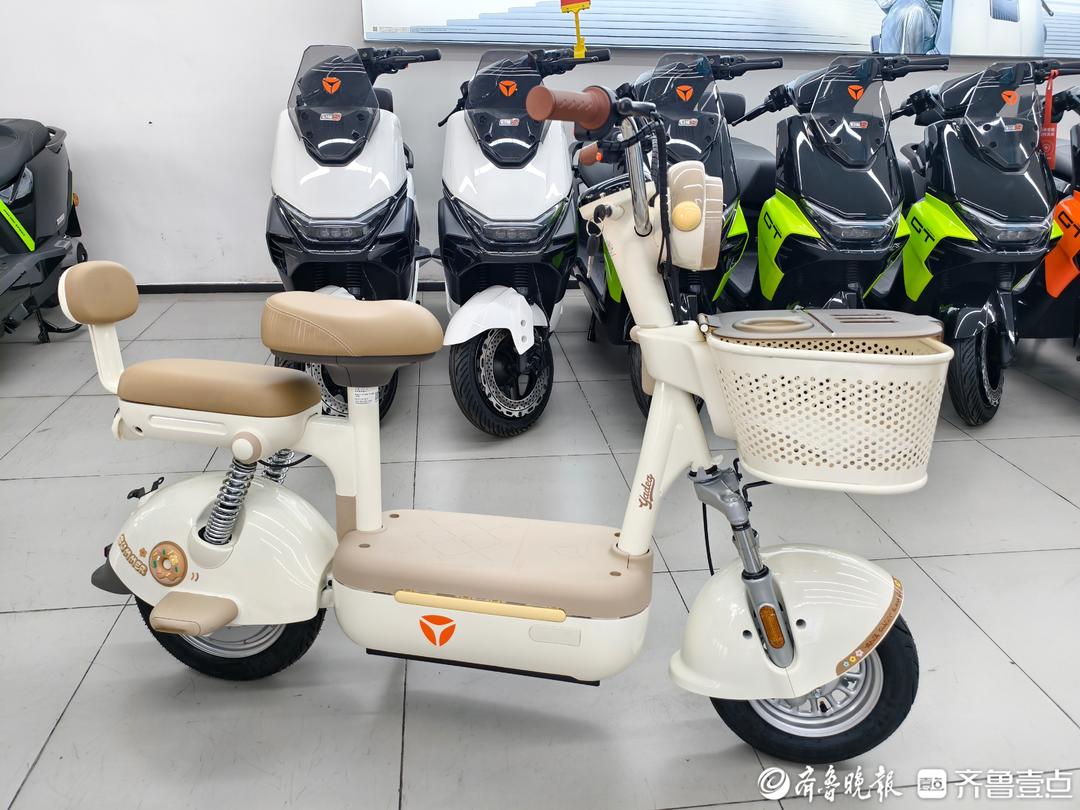
Core Viewpoint - The implementation of the new national standard for electric bicycles, effective from September 1, has led to limited availability of compliant models in the market, with existing models still being sold due to a transition period until November 30, 2023 [1][6]. Group 1: New National Standard Implementation - The new national standard for electric bicycles restricts the total plastic usage to no more than 5.5% of the vehicle's weight, promoting the use of aluminum-magnesium alloy for parts like fenders and baskets, enhancing safety and durability [2][4]. - The new models feature improved braking sensitivity and a mandatory installation of a non-removable Beidou positioning system for theft prevention and tracking [4][6]. - The theoretical range of the new models is between 50-60 kilometers, with a price increase of 600-800 yuan compared to older models, priced at 3199 yuan [6]. Group 2: Market Response and Sales Dynamics - Currently, the availability of new standard electric bicycles is limited, with many stores only having one or two models in stock, while older models continue to sell well due to their speed advantages [5][8]. - The transition period allows for the sale of older models until November 30, 2023, to prevent resource wastage, with a significant increase in inquiries for older models noted [6][8]. Group 3: Industry Challenges and Recommendations - The demand for speed among delivery personnel raises concerns about safety, as many prefer to use modified vehicles that exceed the new speed limits [9][11]. - Experts suggest that while the new standard aims to enhance safety, the unique needs of industries like delivery services should be considered, advocating for a balance between regulatory compliance and operational requirements [11][12].
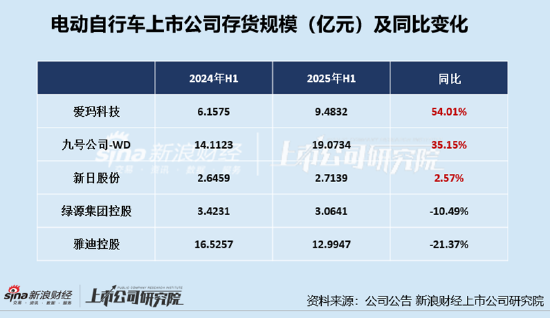
12月1日起停售旧国标电动自行车爱玛科技存货规模同比+54%、存货占比提升、存货周转效率下降
Xin Lang Cai Jing· 2025-09-19 09:09
Core Viewpoint - The new national standard for electric bicycles (GB 17761-2024) will be implemented starting September 1, 2024, introducing significant changes aimed at enhancing safety and performance in the industry [1][2]. Group 1: New National Standard Details - The maximum design speed for electric bicycles is set to not exceed 25 km/h, with power output ceasing if this limit is surpassed [1]. - The weight limit for lead-acid versions has been increased from 55 kg to 63 kg to improve overall safety and range [1]. - The use of plastic components in the bicycle's body is restricted to a maximum of 5.5% of the total weight, and fire resistance requirements for non-metal materials have been heightened [1]. - Modifications to the bicycles are prohibited, with new anti-tampering design requirements introduced [1]. - Chargers are not allowed to be designed for onboard use, addressing potential safety hazards [1]. - Electric bicycles used for commercial activities must be equipped with a Beidou positioning system [1]. Group 2: Industry Impact and Company Performance - Starting September 1, 2025, all newly produced electric bicycles must comply with the new standards, while a three-month sales transition period is granted for vehicles produced under the old standards [2]. - Major brands like Yadea, Aima, and Ninebot are initiating extensive inventory clearance actions, including trade-in subsidies for older models [2]. - As of mid-2025, Aima Technology reported a significant inventory increase, with a year-on-year growth of 54% in inventory scale [2]. - Ninebot has the highest inventory-to-total-assets ratio at 9.72% as of mid-2025, indicating a relatively high level of inventory compared to its total assets [2]. - Ninebot also recorded the lowest inventory turnover efficiency, with an average turnover period of 41.26 days, the longest among the selected companies [2]. - Aima Technology's inventory includes 500 million yuan in raw materials and 448 million yuan in finished goods, raising concerns about potential unsold products, particularly those adhering to the old standards [2].
电动自行车为什么要限速25公里?
Zhong Guo Xin Wen Wang· 2025-09-19 08:59
Core Viewpoint - The implementation of the new national standard for electric bicycles (GB 17761—2024) has led to significant changes in the market, including a surge in prices for old standard models and a shift in consumer preferences towards these models due to restrictions imposed by the new regulations [1][2][5]. Group 1: Market Changes - The new national standard has triggered a price increase for old standard electric bicycles, with some stores reporting price hikes of 100-300 yuan [2][4]. - Consumers are showing a preference for old standard models, as they are perceived to be more appealing and faster, with many opting to purchase these before the new regulations take full effect [5][6]. Group 2: New Standard Regulations - The new standard imposes a maximum speed limit of 25 km/h for electric bicycles, which has raised concerns among consumers who find this speed too slow for commuting [5][11]. - The new regulations also limit the use of plastic materials in bicycle construction and require the installation of a Beidou module for commercial use, which is expected to increase the cost of new models by approximately 500-600 yuan [7][12]. Group 3: Consumer Behavior - Many consumers are seeking to modify their electric bicycles to exceed the new speed limit, with some models capable of reaching speeds of 30-55 km/h after modification [9][11]. - The reluctance of sales staff to discuss speed modifications indicates a shift in the market dynamics as the new regulations come into play [9][12]. Group 4: Safety Considerations - The new speed limit is aimed at enhancing safety, as higher speeds can lead to longer braking distances and increased accident risks [11][12]. - The regulations also include measures to prevent illegal modifications, such as improved technical standards for components like batteries and speed limiters [12].
12月1日起停售旧国标电动自行车 爱玛科技存货规模同比+54%、存货占比提升、存货周转效率下降
Xin Lang Zheng Quan· 2025-09-19 08:56
出品:新浪财经上市公司研究院 作者:木 9月1日起,电动自行车新国标《电动自行车安全技术规范》(GB 17761—2024)正式实施。电动自行 车新国标GB17761-2024主要修改的内容包括: (1)最高设计车速不得超过25km/h,超过25km/h时停止动力输出; (2) 车身使用的塑料件,不能超过总重的5.5%,整车非金属材料的阻燃性要求提高; 其次,从存货占比角度看,2025年上半年,电动自行车行业存货占全部资产的比重相对较为适中,其中 九号公司存货占总资产的比重最高,2025年H1存货占总资产比重为9.72%。动态来看,仅爱玛科技一家 存货占比有所提升,由2024年H1的2.87%提升至2025年H1的3.75%。 (4) 明确禁止预留改装接口,并新增多项防篡改设计要求,杜绝非法改装行为; (5) 明确规定充电器不得设计为车载形式,有效规避车载充电引发的潜在安全隐患; | | 存货占总资产的比重及同比变动 | | | --- | --- | --- | | | 2024年H1 | 2025年H1 | | 九号公司-WD | 10.88% | 9.72% | | 爱玛科技 ◎ | 2.87% | 3 ...
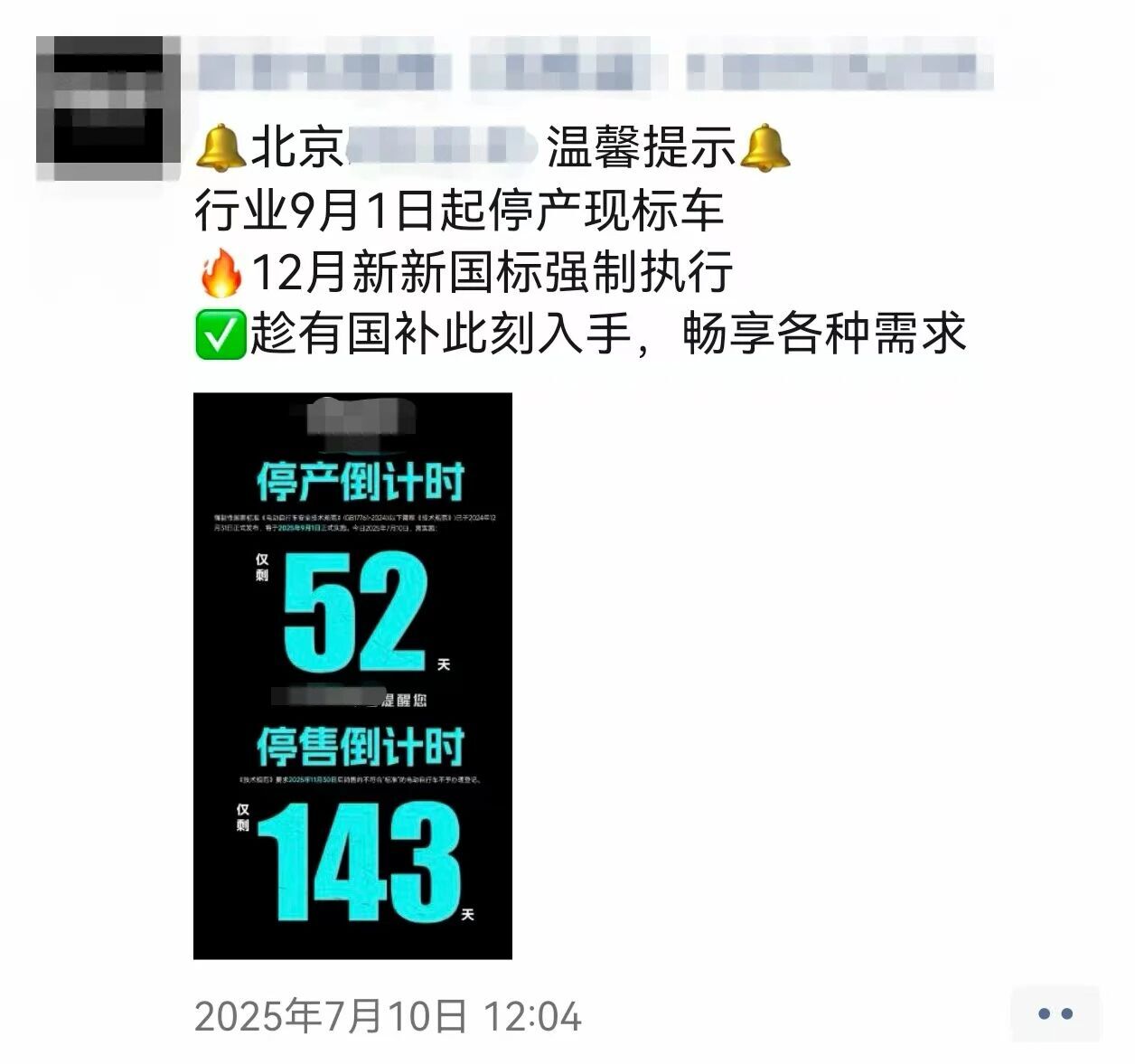
电动自行车新国标落地 消费者买旧不买新?
Zhong Guo Xin Wen Wang· 2025-09-17 14:35
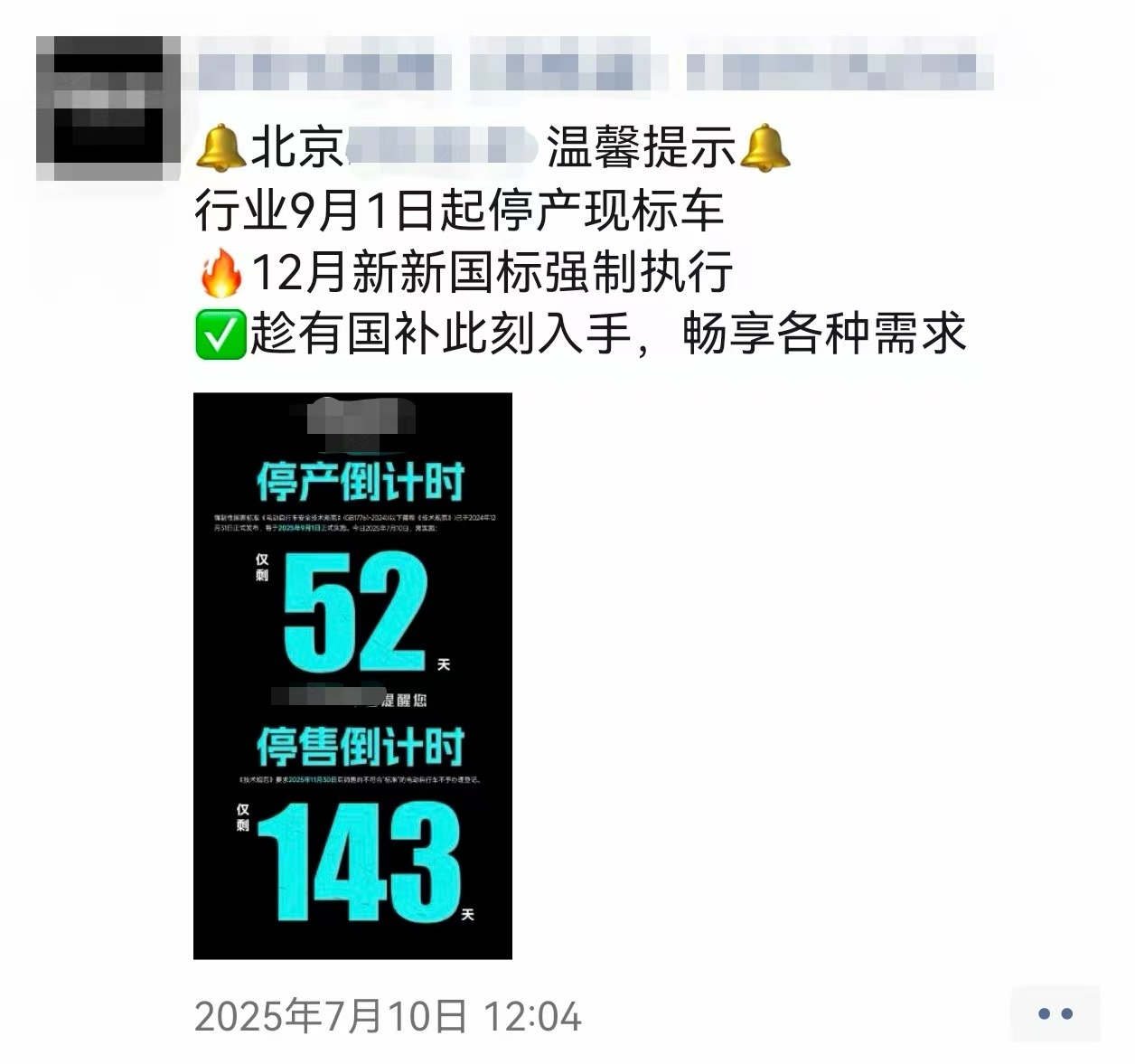
"旧车不会降价,只会涨,大家更希望买旧国标车。"一位电动车门店销售人员告诉记者,目前新国标车型尚未到货,店里销售的还都是旧国标电动车,已有 部分门店涨价100-200元,市中心门店最高可能会涨300多元。 八月中旬,李倩(化名)来到电动自行车门店办理上牌,遭遇了"人山人海":"那天是周一,店里的人却特别多,上牌的系统都挤瘫痪了,大家都赶着在新国标 落地前买车。" 9月1日起,由工业和信息化部等五部门联合修订的强制性国家标准《电动自行车安全技术规范》(GB 17761—2024)正式实施。9月1日至11月30日为过渡期。 "最严"新国标落地,电动自行车市场出现了哪些变化? 旧国标电动自行车出现涨价潮 中国新闻网《民生调查局》记者在走访中发现,早在七月,就已有商家制作旧国标电动自行车停产倒计时的海报,推销旧国标车。而随着新国标落地,旧国 标电动车价格也应声而涨。 电动自行车商家制作的旧国标电动自行车停产倒计时海报。 根据新国标,在2025年8月31日及之前,企业既可以按照旧标准生产,也可以按照新标准生产;2025年9月1日以后,所有新生产的电动自行车都必须符合新 标准要求。同时,为保证符合旧标准电动自行车的充分消 ...