GDP Growth

Search documents
ECB's Guindos on Inflation, Euro Rate, Fiscal Policy
Bloomberg Television· 2025-07-01 07:37
Economic Outlook & Uncertainty - Trade negotiations are a relevant factor influencing the European economy, with predictions varying based on different outcomes [1] - High levels of uncertainty persist due to geopolitical risks and the unknown final outcome of trade negotiations [4][5] - The Euro area's growth rate is expected to be below 1% in 2025 and slightly above that in 2026, with risks tilted to the downside [9] - Investment is flat, and consumption is not recovering, indicating a weak economic situation [9][10] Monetary Policy - The ECB has reduced interest rates eight times, from 4% to 2%, and is in a good place to deal with the future [3] - Further interest rate cuts are unlikely to significantly improve the economy, and the focus should be on certainty in trade and fiscal policies [10][11] - The evolution of inflation is expected to be positive, with the possibility of undershooting the target being limited [6][7] - The ECB does not target any concrete level for the exchange rate but monitors its level and evolution, considering its impact on inflation [16] Inflation & Exchange Rate - The ECB is confident that inflation will reach 2%, with favorable factors including the exchange rate and the evolution of energy prices [17][18][19] - An exchange rate of 1.17 or even 1.20 is considered acceptable, but overshooting beyond that would be more complicated [14] Fiscal Policy & Market Risks - Increased defensive spending is supported, but fiscal sustainability is needed, as markets may not continue to overlook fiscal policy [21][22] - Concerns exist about a market event linked to perceived unsustainable fiscal policy, which could lead to higher yields and impact valuations [23][24]

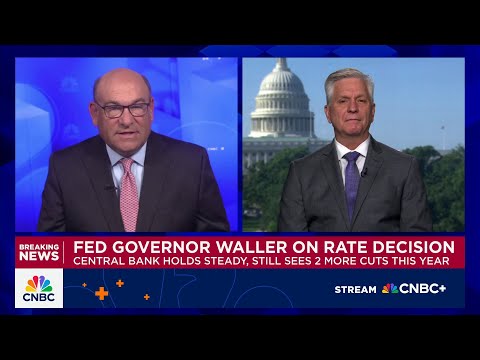
Watch CNBC's full interview with Federal Reserve Governor Christopher Waller
CNBC Television· 2025-06-20 13:21
I'm pleased to uh bring in uh Fed Governor Christopher Waller. Uh he is um joining us this morning from Washington. Good morning, Governor Waller. Good morning, Steve.Thanks for having me on. Uh thank thanks for joining us. Um I just want to begin um big debate and you can see it in the outlook for rates at the at at uh from the uh summer of economic projections.Where do you stand in this debate right now over how much concern we all should have over coming potential inflation from tariffs. Steve, you know, ...
'The bull trend is under way,' says BMO's Brian Belski
CNBC Television· 2025-06-17 17:03
Market Trends & Investment Strategies - Nvidia shares are up 50% from their April low, outperforming other Mag 7 stocks [1] - The market bull trend is considered underway, but short-term concerns exist due to falling company guidance [2] - Selective stock picking within the Mag 7 is advised, with overweight stances in Microsoft and Amazon maintained, and adding to Apple expected [3][4] - Professional investors showed pessimism, but the market is near a new high, suggesting a time to be less fearful [4][5] Macroeconomic Factors & Policy Impacts - Potential transformational changes in tax policy, such as expensing capital expenditure on software, could monetize the AI trade beyond the MAG 7 [6] - Expected tariff rates are decreasing, which could lead to more guidance from companies and increased optimism from professional investors [6][7] - Uncertainty remains regarding the full impact of Trump's tariffs and immigration policies on various industries [8][9] - Despite concerns, GDP growth is at 38%, averaging 25% for the first and second quarters [10] Currency & International Markets - The US dollar has lost 10% of its value since President Trump took office, which can be seen as beneficial for multinationals or as a sign of declining faith in American exceptionalism [12] - International investors, particularly in Europe, have been overweight in European stocks, but there's a growing reluctance to buy US stocks [17][19] - The dollar's weakness is beginning to slow down, with a trend towards solidification [16] - The consensus at the beginning of the year was that the dollar was overvalued, predating recent political events [21]




摩根大通:美国_2025 年中期经济展望
摩根· 2025-06-16 03:16
Our 2025 year-ahead outlook built off two propositions: momentum in the business cycle at the turn of the year was solid, and policy risks were bidirectional. In the subsequent six months that solid momentum has continued, with steady growth in jobs and spending. And as we have gotten more clarity on policy it has been a mixed bag, as expected, but we think tilting in a less growth-friendly way. Most notably, tar- iffs and trade policy have been the biggest driver of our fore- cast revisions. The stagflatio ...

高盛:印度第一季度 GDP 增长超预期;创纪录的公共资本支出推动投资强劲增长
Goldman Sachs· 2025-06-04 01:50
Investment Rating - The report indicates a positive outlook for India's economy, with an upward revision of the GDP growth forecast for CY25 to 6.6% year-over-year, reflecting strong investment growth driven by public capital expenditure [6][11]. Core Insights - India's real GDP growth surged to 7.4% year-over-year in Q1 CY25, up from 6.4% in Q4 CY24, surpassing consensus expectations [3][6]. - The growth in real Gross Value Added (GVA) was recorded at 6.8% year-over-year in Q1 CY25, an increase from 6.5% in the previous quarter [2][6]. - Strong investment growth was noted, particularly in public capital expenditure, which exceeded revised estimates by 0.1% of GDP for FY25 [6][7]. - The agricultural sector showed growth of 5.4% year-over-year, while manufacturing and services sectors also demonstrated robust performance [6][7]. - Despite a contraction in private consumption expenditure growth, fixed investment growth rose sharply to 9.4% year-over-year, aided by back-loaded public capex [6][7]. Summary by Sections Economic Growth - Real GDP growth in Q1 CY25 was 7.4% year-over-year, with a sequential increase of 2.1% [2][3]. - Nominal GDP growth reached 10.8% year-over-year, up from 10.3% in Q4 CY24 [2][5]. Sector Performance - The agricultural sector grew by 5.4% year-over-year, while manufacturing growth hit a three-quarter high of 4.8% [6][7]. - Services growth remained strong at 7.3% year-over-year, primarily driven by financial services and real estate [6][7]. Investment Trends - Central government public capex in March increased by 68% year-over-year, significantly contributing to GDP growth [6][7]. - The report anticipates continued strong rural consumption, although policy uncertainty may dampen future investment growth [6][7].
摩根士丹利:中国政府的刺激措施如何缓解关税冲击
摩根· 2025-05-06 02:28
Investment Rating - The report does not explicitly state an investment rating for the industry but indicates a cautious outlook due to tariff impacts and economic conditions [1][2]. Core Insights - The report anticipates a slowdown in China's GDP growth by over 1 percentage point in 2Q 2025 due to high tariffs, with a gradual recovery expected in the second half of the year [2][22]. - Tariffs are currently at prohibitive levels, with expectations for gradual de-escalation through negotiations, although they are projected to remain elevated [3][4]. - The Chinese government is expected to implement a stimulus package of Rmb1-1.5 trillion to support the economy amid these challenges [2][22]. Summary by Sections Tariff Assumptions - Current US-China tariffs are viewed as excessively high, with a terminal effective US tariff rate projected at 45% [4]. - The report suggests that if tariffs remain at current levels, there could be a 0.5 percentage point downside to the GDP growth forecast for 2025 [5][15]. Economic Stimulus - The Politburo meeting indicated a focus on faster rollout of a Rmb2 trillion stimulus, but the approach remains reactive rather than proactive [16][19]. - The report highlights a shift in policy towards consumption over time, although investment remains the primary focus for immediate economic support [18][19]. Growth Projections - The report predicts a significant deceleration in GDP growth to below 4.5% in 2Q 2025, down from 5.4% in 1Q 2025, primarily due to tariff impacts and policy responses [21][22]. - For 2H 2025, growth is expected to slow further, with real GDP growth projected at 3.7% year-over-year [22].
摩根士丹利:亚洲经济观点:急剧同步放缓
摩根· 2025-04-21 03:00
Investment Rating - The report indicates a downward revision in growth projections for Asia, with a specific focus on the impact of tariffs and related uncertainties on the economic outlook [3][29]. Core Insights - Asia's GDP growth is expected to slow sharply from 4.8% in 4Q24 to 3.6% in 4Q25, reflecting a decrease of 120 basis points [5][29]. - The weighted average tariff on Asia has increased significantly from 4.8% in January 2025 to 43.8%, contributing to a decline in trade and corporate confidence [1][13]. - The report emphasizes that uncertainty surrounding tariffs is likely to persist, affecting business cycles and investment decisions across the region [7][28]. Summary by Sections Economic Growth Projections - The report forecasts a significant slowdown in Asia's GDP growth, with specific country projections indicating declines, such as China from 5.4% to 3.7% and Hong Kong from 2.4% to 1.2% [5][29]. - The overall GDP growth estimate for Asia is lowered to 4% for 2025, down from 4.4% previously [29]. Tariff Impact - The report highlights that the escalation of tariffs raises recession risks and has already negatively impacted the business cycle, leading to a wait-and-see approach among corporations [8][31]. - The likelihood of reaching trade deals varies by country, with economies like India, Japan, and Korea being more likely to secure agreements compared to China and Vietnam [10][9]. Monetary and Fiscal Policy Outlook - The report anticipates more monetary easing across Asia, with specific measures expected from central banks in response to the economic slowdown [46][49]. - In China, a significant fiscal easing package is expected, while other Asian economies may face constraints due to rising public debt levels [56][57]. Sectoral Analysis - Trade-oriented economies such as Korea, Taiwan, and Malaysia are projected to experience sharper slowdowns due to their exposure to tariff impacts [31][32]. - India is viewed as relatively better positioned due to supportive policy measures, although its growth forecast has also been adjusted downward [33][44].

事关货币政策,政府工作报告最新定调!
21世纪经济报道· 2025-03-05 15:21
Group 1 - The core viewpoint of the article emphasizes the government's commitment to a moderately loose monetary policy for 2025, aiming to align monetary supply growth with economic growth and price level expectations [2][3] - The report sets a GDP growth target of around 5% and a CPI growth target of about 2%, indicating a more pragmatic approach to monetary growth goals compared to the previous year's targets [3][4] - The focus on structural monetary policy tools is highlighted, with an emphasis on supporting the real estate and stock markets, as well as promoting financing for technology innovation and small enterprises [6][7] Group 2 - The report indicates a significant reduction in the average interest rates for new corporate loans and personal housing loans, suggesting a favorable environment for borrowing [4] - The government plans to utilize various monetary tools flexibly to ensure sufficient liquidity in the market, especially in light of a projected fiscal deficit of approximately 14 trillion yuan [7] - The article notes the importance of maintaining a balanced level of interest and exchange rates, while also addressing external pressures on the currency [8]