大数据

Search documents
天下秀跌2.07%,成交额1.93亿元,主力资金净流出2027.98万元
Xin Lang Cai Jing· 2025-10-24 02:43
Core Viewpoint - The stock of Tianxiaxiu has experienced fluctuations, with a recent decline of 2.07% and a year-to-date increase of 9.42%, indicating volatility in its market performance [1]. Group 1: Stock Performance - As of October 24, Tianxiaxiu's stock price is 5.68 CNY per share, with a total market capitalization of 10.268 billion CNY [1]. - The stock has seen a net outflow of 20.28 million CNY from main funds, with significant selling pressure observed [1]. - Year-to-date, the stock has risen by 9.42%, but it has declined by 3.40% over the last five trading days [1]. Group 2: Financial Performance - For the first half of 2025, Tianxiaxiu reported a revenue of 1.844 billion CNY, a year-on-year decrease of 8.01%, and a net profit of 36.38 million CNY, down 19.28% compared to the previous year [2]. - Cumulative cash dividends since the company's A-share listing amount to 216 million CNY, with 61.64 million CNY distributed over the last three years [3]. Group 3: Shareholder Information - As of June 30, 2025, the number of shareholders is 103,900, a decrease of 6.39% from the previous period, while the average circulating shares per person increased by 6.83% to 17,395 shares [2]. - The top ten circulating shareholders include Hong Kong Central Clearing Limited, which holds 14.0075 million shares, an increase of 288,200 shares from the previous period [3].

达梦数据涨2.05%,成交额8944.46万元,主力资金净流入655.89万元
Xin Lang Cai Jing· 2025-10-24 02:26
Core Viewpoint - Dameng Data's stock price has shown a positive trend with a year-to-date increase of 4.78% and a recent 5-day increase of 5.49% [1] Company Overview - Wuhan Dameng Database Co., Ltd. is a leading domestic database product developer, established on November 13, 2000, and listed on June 12, 2024 [2] - The company provides various database software and related technical services to large and medium-sized enterprises, government agencies, and institutions, aiming to become a top-tier global provider of full-stack data products and solutions [2] - The revenue composition includes software product licensing (92.15%), operation and maintenance services (4.85%), data and industry solutions (1.82%), database integrated machine sales (0.84%), and training and others (0.34%) [2] Financial Performance - For the first half of 2025, Dameng Data achieved operating revenue of 523 million yuan, a year-on-year increase of 48.65%, and a net profit attributable to shareholders of 205 million yuan, a year-on-year increase of 98.36% [2] - Cumulative cash dividends since the A-share listing amount to 190 million yuan [3] Shareholder Information - As of June 30, 2025, the number of shareholders increased by 24.57% to 7,737, with an average of 9,452 circulating shares per person, up 286.26% [2] - Notable changes in institutional holdings include the entry of Nuoan Growth Mixed A as the tenth largest circulating shareholder, increasing its holdings by 472,000 shares [3]
香江控股跌2.18%,成交额1.03亿元,主力资金净流出118.84万元
Xin Lang Cai Jing· 2025-10-24 02:09
Core Viewpoint - Xiangjiang Holdings experienced a stock price decline of 2.18% on October 24, with a current price of 2.24 CNY per share and a total market capitalization of 7.321 billion CNY [1] Financial Performance - For the first half of 2025, Xiangjiang Holdings reported a revenue of 736 million CNY, a year-on-year decrease of 61.52%, and a net profit attributable to shareholders of -19.8462 million CNY, a decline of 147.19% [2] - The company has seen a stock price increase of 17.34% year-to-date, with a 2.75% increase over the last five trading days, a 22.22% decrease over the last 20 days, and a 26.55% increase over the last 60 days [1] Shareholder Information - As of June 30, 2025, the number of shareholders decreased by 5.61% to 53,900, with an average of 60,641 circulating shares per shareholder, an increase of 5.94% [2] - The company has distributed a total of 3.262 billion CNY in dividends since its A-share listing, with 1.245 billion CNY distributed in the last three years [3] Major Shareholders - As of June 30, 2025, Hong Kong Central Clearing Limited is the fourth-largest circulating shareholder, holding 56.6868 million shares, a decrease of 24.4146 million shares from the previous period [3] - The Southern CSI Real Estate ETF Linked A (004642) is the ninth-largest circulating shareholder, holding 16.6925 million shares as a new shareholder [3] Business Overview - Xiangjiang Holdings is primarily engaged in urban industrial development, trade circulation, and home market operations, with revenue composition of 52.81% from trade circulation, 31.56% from the sale of residential properties, shops, and office buildings, and 15.63% from other sources [1]

启明星辰10月23日获融资买入2093.75万元,融资余额7.64亿元
Xin Lang Cai Jing· 2025-10-24 01:48
Core Viewpoint - On October 23, 2023, Qiming Star's stock rose by 1.92% with a trading volume of 217 million yuan, indicating a mixed sentiment in the market regarding the company's performance and financing activities [1]. Financing Summary - On the same day, Qiming Star had a financing buy-in amount of 20.94 million yuan and a financing repayment of 25.02 million yuan, resulting in a net financing outflow of 4.08 million yuan [1]. - As of October 23, the total financing and securities lending balance for Qiming Star was 774 million yuan, with the financing balance at 764 million yuan, accounting for 5.35% of the circulating market value, which is below the 40th percentile level over the past year, indicating a low financing level [1]. - In terms of securities lending, Qiming Star repaid 5,700 shares and sold 2,100 shares on October 23, with a selling amount of 32,300 yuan, while the securities lending balance was 9.37 million yuan, exceeding the 90th percentile level over the past year, indicating a high level of securities lending [1]. Business Performance Summary - As of June 30, 2023, Qiming Star had 95,200 shareholders, an increase of 5.45% from the previous period, with an average of 7,615 circulating shares per person, a decrease of 5.17% [2]. - For the first half of 2023, Qiming Star reported an operating income of 1.133 billion yuan, a year-on-year decrease of 28.03%, while the net profit attributable to the parent company was -93.35 million yuan, showing a year-on-year increase of 48.78% [2]. Dividend and Shareholding Summary - Since its A-share listing, Qiming Star has distributed a total of 886 million yuan in dividends, with 518 million yuan distributed over the past three years [3]. - As of June 30, 2023, the top ten circulating shareholders included Hong Kong Central Clearing Limited as the second-largest shareholder with 20.82 million shares, a decrease of 17.13 million shares from the previous period, while Southern CSI 500 ETF increased its holdings by 1.28 million shares to 10.81 million shares [3].

新国都10月23日获融资买入2128.88万元,融资余额11.49亿元
Xin Lang Cai Jing· 2025-10-24 01:45
Group 1: Company Overview - Shenzhen Xinguodu Co., Ltd. is located in Nanshan District, Shenzhen, Guangdong Province, and was established on July 31, 2001, with its listing date on October 19, 2010 [2] - The company specializes in the electronic payment industry, providing payment acquisition services and selling and leasing electronic payment terminals, primarily financial POS machines [2] - The revenue composition includes 61.85% from acquisition and value-added services, 35.24% from electronic payment products, and smaller contributions from audit services, technical services, and others [2] Group 2: Financial Performance - For the first half of 2025, the company achieved operating revenue of 1.527 billion yuan, a year-on-year decrease of 3.17%, and a net profit attributable to shareholders of 275 million yuan, down 38.61% year-on-year [2] - Cumulative cash dividends since the A-share listing amount to 1.341 billion yuan, with 890 million yuan distributed in the last three years [3] Group 3: Shareholder Information - As of June 30, 2025, the number of shareholders increased to 83,400, up 77.74% from the previous period, while the average circulating shares per person decreased by 43.72% to 5,207 shares [2] - The top ten circulating shareholders include Hong Kong Central Clearing Limited, which holds 3.7633 million shares, a decrease of 2.6324 million shares from the previous period, and Southern CSI 1000 ETF, which is a new shareholder with 3.6473 million shares [3] Group 4: Market Activity - On October 23, the company's stock fell by 0.71% with a trading volume of 189 million yuan, and the financing buy-in amount was 21.2888 million yuan, while the financing repayment was 26.9716 million yuan, resulting in a net financing buy-in of -5.6828 million yuan [1] - The total balance of margin trading as of October 23 is 1.151 billion yuan, with the financing balance at 1.149 billion yuan, accounting for 7.61% of the circulating market value, indicating a high level compared to the past year [1]

东方国信10月23日获融资买入1717.20万元,融资余额8.67亿元
Xin Lang Cai Jing· 2025-10-24 01:45
Core Insights - On October 23, Dongfang Guoxin's stock rose by 0.29% with a trading volume of 247 million yuan, indicating a stable market interest in the company [1] - The company reported a net financing outflow of 464.39 million yuan on the same day, with a total financing and margin balance of 870 million yuan, suggesting a high level of trading activity [1] - For the first half of 2025, Dongfang Guoxin's revenue decreased by 8.37% year-on-year to 941 million yuan, and the net profit attributable to shareholders was a loss of 79.17 million yuan, reflecting financial challenges [2] Financing and Margin Data - On October 23, the financing buy amount was 17.17 million yuan, while the financing repayment was 21.82 million yuan, leading to a net financing buy of -4.64 million yuan [1] - The current financing balance of 867 million yuan accounts for 7.37% of the market capitalization, which is above the 60th percentile of the past year, indicating a relatively high level of leverage [1] - The margin trading data shows a short selling of 2,200 shares and a repayment of 10,600 shares, with a margin balance of 2.86 million yuan, also above the 70th percentile of the past year [1] Shareholder and Institutional Holdings - As of June 30, 2025, the number of shareholders decreased by 4.37% to 85,700, while the average number of circulating shares per person increased by 4.57% to 10,573 shares [2] - The company has cumulatively distributed 156 million yuan in dividends since its A-share listing, with no dividends paid in the last three years [3] - Among the top ten circulating shareholders, Hong Kong Central Clearing Limited increased its holdings by 3.95 million shares to 13.63 million shares, indicating growing institutional interest [3]

【人民日报】2025中国计算机大会开幕
Ren Min Ri Bao· 2025-10-24 01:24
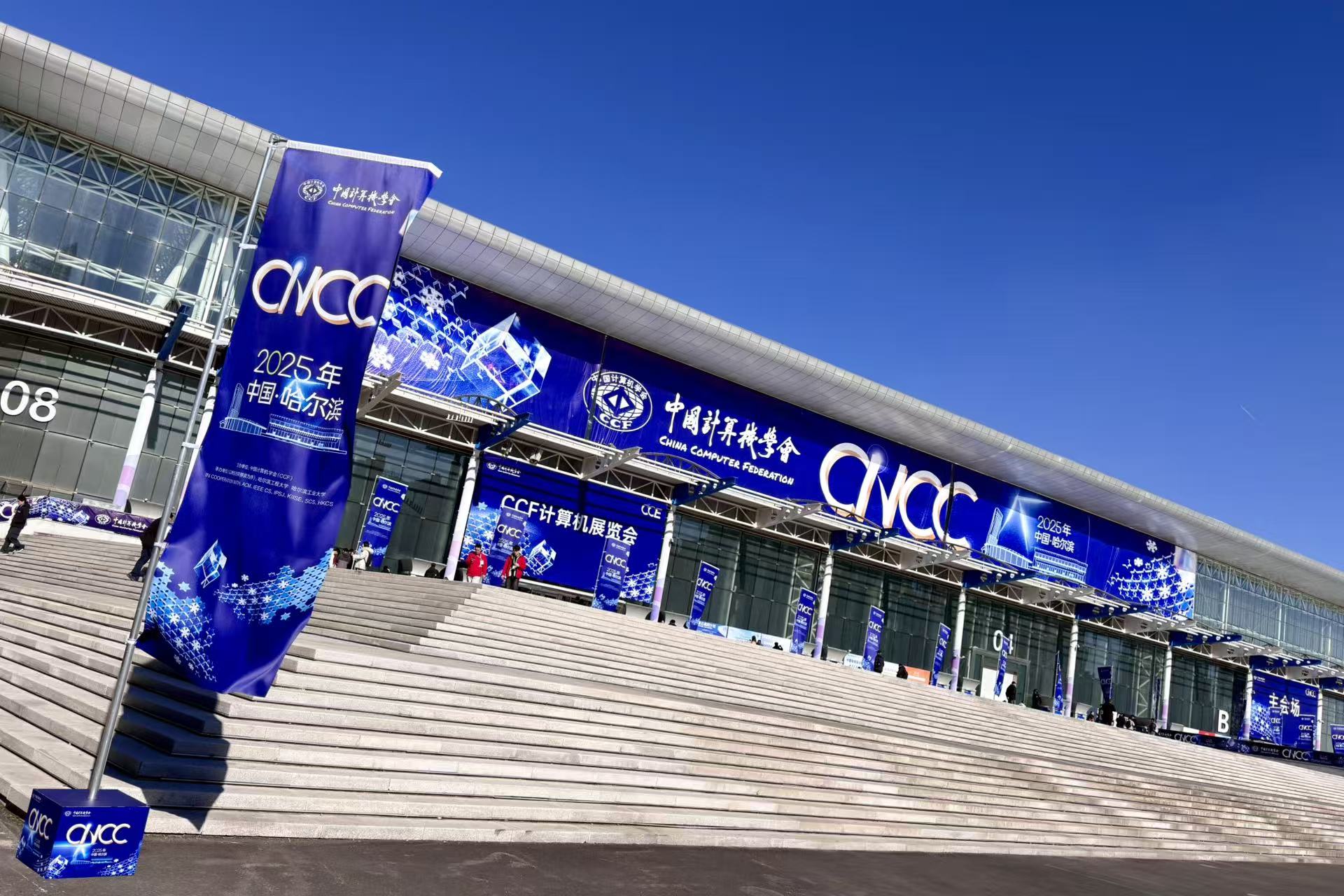
Core Viewpoint - The 2025 China Computer Conference opened in Harbin, Heilongjiang Province, focusing on the theme "Digital Intelligence Empowerment, Infinite Possibilities" to explore advancements and future trends in digital intelligence technology [1] Group 1: Conference Overview - The conference is organized by the China Computer Society and hosted by Harbin Engineering University and Harbin Institute of Technology [1] - It aims to promote the deep integration of computing technology with economic and social development [1] Group 2: Topics and Sessions - The conference features over 150 specialized forums covering nine thematic areas, including foundational models of artificial intelligence, machine learning theory and mechanisms, data management and governance for AI, reinforcement learning, and reasoning [1] - Key areas of focus include artificial intelligence, big data, and cloud computing, which are currently trending topics in the industry [1]
2025中国计算机大会开幕
Ren Min Ri Bao· 2025-10-23 21:57
Core Insights - The 2025 China Computer Conference opened in Harbin, Heilongjiang Province, focusing on the theme "Digital Intelligence Empowerment, Infinite Possibilities" [1] - The conference aims to explore cutting-edge advancements and future trends in digital intelligence technology, promoting deep integration of computing technology with economic and social development [1] Industry Overview - The conference features over 150 specialized forums covering nine thematic areas, including foundational models of artificial intelligence, machine learning theories and mechanisms, data management and governance for AI, reinforcement learning, and reasoning [1] - Key topics of interest include artificial intelligence, big data, and cloud computing, which are currently hot areas in the technology sector [1]
“数智赋能、无限可能”——从第22届中国计算机大会看人工智能与经济社会深度融合
Xin Hua She· 2025-10-23 15:59
Core Insights - The 22nd China Computer Conference (CNCC2025) opened in Harbin, Heilongjiang Province, focusing on the integration of digital intelligence technology with economic and social development [1][3] Group 1: Artificial Intelligence Trends - The development of artificial intelligence is transitioning from computational intelligence and perceptual intelligence to cognitive intelligence, with future extensions towards behavioral and emotional intelligence, ultimately aiming for generalized strong intelligence [3] - The "Knowledge Forest" concept proposed by a research team has successfully organized fragmented knowledge and has been applied in civil engineering and test question generation [3] Group 2: Virtual Reality and AI Integration - The integration of artificial intelligence with virtual reality is expected to enhance production and daily life, with applications in manufacturing, healthcare, and education [3] - Virtual reality technology, which combines high-performance computing and graphics, can save significant time and costs in various fields, such as automotive destructive testing and medical simulations [3] Group 3: Industry Applications and Cost Savings - Huawei is exploring AI applications across multiple sectors, optimizing device interaction in consumer areas and improving quality, safety, and efficiency in industrial applications [4] - AI-enabled optimizations in steel production have resulted in annual cost savings of millions, with additional value generated in the rolling process [4] Group 4: Future Challenges and Collaborations - The next two to three decades will see accelerated movement towards an intelligent society, facing challenges in machine cognition and efficient creative intelligence [4] - Collaboration between hardware, software, and the industrial chain is crucial to address opportunities and challenges in AI development [4] - The rapid advancement of large models, particularly after the emergence of ChatGPT, is pushing AI capabilities closer to or beyond human levels in language and vision, while hardware challenges remain [4]

京北方20251023
2025-10-23 15:20
Summary of the Conference Call for Jingwei Technology Company Overview - **Company**: Jingwei Technology - **Industry**: AI and Financial Technology Solutions Key Points Financial Performance - In Q3 2025, Jingwei Technology achieved revenue of 1.252 billion yuan, a year-on-year increase of 5.01% [3] - The software and IT solutions segment generated revenue of 855 million yuan, up 9.9% year-on-year, contributing to 68.32% of total revenue [3] - The smart customer service and consumer finance precision marketing product line generated 248 million yuan in revenue, growing by 11.21% [2][3] - The company’s net profit increased by nearly 18% year-on-year, indicating a significant acceleration in growth [2][5] Profitability and Margins - The gross margin for the software and IT solutions business improved both year-on-year and quarter-on-quarter, particularly in AI and big data product lines [2][5] - Cost control measures and operational improvements contributed to the increase in overall gross margin [5] - The expected net profit margin is projected to stabilize between 8% and 12% in a steady industry environment [16] R&D and Innovation - The company is increasing its patents and software copyrights in blockchain and AI, with significant results in R&D transformation [2][6] - A wholly-owned subsidiary in Hong Kong was established to enhance R&D capabilities in AI and blockchain-driven fintech solutions and to expand overseas market operations [2][10] Globalization Strategy - The global strategy involves leveraging existing client relationships and collaborating with local financial institutions to meet diverse IT needs [11][12] - The Hong Kong subsidiary is a key step in the internationalization strategy, with agreements signed with several overseas institutions [10][11] Future Development Plans - The company plans to continue investing in cutting-edge technologies such as AI, big data, blockchain, privacy computing, and quantum technology [7][8] - Focus areas include banking transformation, product marketing, service efficiency enhancement, and risk control [7][8] AI and Big Data Applications - AI is being applied in marketing and customer service systems within the banking sector, enhancing operational efficiency and customer analysis [20][21] - The company has seen over 50% revenue growth in AI and big data product lines, exceeding expectations by 20% [14] - Successful pilot projects with major banks have accelerated the adoption of AI applications across the industry [14][17] Challenges and Responses - AI applications face challenges such as gaps between foundational model capabilities and professional handling of business needs [20][21] - The company addresses these challenges by selecting appropriate models, targeted data governance, and utilizing a combination of tools for optimal results [21] Market Outlook - The future of AI in banking is expected to see explosive growth, with an increase in application scenarios and personnel demand [22][23] - Jingwei Technology positions itself as a crucial player in the AI industry chain, focusing on delivering effective solutions and maintaining strong partnerships with upstream providers [24] Long-term Vision - The company aims to leverage its competitive edge in the IT sector and expand its customer base and product offerings, ensuring sustained performance and market recognition [25]