产业链垂直整合

Search documents
敏华控股(01999):关注内外销积极的边际变化
Huafu Securities· 2026-01-23 11:10
Investment Rating - The report assigns a "Buy" rating for the company, Minhua Holdings [3][57]. Core Insights - Minhua Holdings is the global leader in functional sofas, with a strong presence in both domestic and international markets. The company has successfully transitioned from a traditional export-oriented business to a model that balances export manufacturing with domestic brand sales [5][8]. - Recent financial performance shows a mixed trend, with a projected revenue decline of 8.2% in FY2025, but a slight recovery in net profit expected in FY2026 [5][15]. - The company is experiencing positive changes in its business operations, particularly in e-commerce sales, which have rebounded by 13.6% in FY26H1, reversing previous declines [28][39]. Financial Data and Valuation - Revenue projections for FY2024 to FY2028 are as follows: - FY2024: 18,411 million HKD - FY2025: 16,903 million HKD (down 8%) - FY2026: 16,392 million HKD (down 3%) - FY2027: 16,757 million HKD (up 2%) - FY2028: 17,424 million HKD (up 4%) [5][54]. - Net profit projections are: - FY2024: 2,302 million HKD - FY2025: 2,063 million HKD (down 10%) - FY2026: 2,067 million HKD (up 0.2%) - FY2027: 2,120 million HKD (up 2.5%) - FY2028: 2,208 million HKD (up 4.1%) [5][54]. - The company maintains a dividend payout ratio of around 50%, with a projected dividend yield of approximately 5.7% based on FY26 earnings [57]. Business Operations - The company has a balanced revenue structure with approximately 59% from domestic sales and 41% from international sales as of FY26H1 [6][17]. - The domestic sales model primarily focuses on the Zhihua brand, with a significant portion of revenue coming from sofas and mattresses [8][17]. - The company is pursuing strategic acquisitions, such as the planned acquisition of Gainline Recline Intermediate Corp, to enhance its business layout and operational synergies [39][41]. Profitability and Margin Analysis - The company has demonstrated resilience in profitability, with a net profit margin of 12.2% in FY2025, slightly below the previous year's 12.5% [43][54]. - Despite a decrease in average selling prices, the gross margin has improved, indicating strong cost control capabilities [43][54]. Investment Recommendations - The report suggests that Minhua Holdings, as a leader in the functional sofa market, is well-positioned for growth, particularly with its manufacturing advantages and recovery in online sales [57]. - The projected earnings for FY2026 to FY2028 indicate a gradual recovery in net profit, with expected growth rates of 0.2%, 2.5%, and 4.1% respectively [54][57].
兆驰股份(002429) - 投资者关系活动记录表(2026-001)
2026-01-19 15:36
Group 1: Company Overview and Industry Position - The company’s subsidiary, Fengxing Online, is positioned as a digital entertainment creation and distribution platform, leveraging a leading distribution network with over 400,000 influencers on Douyin and Kuaishou, establishing a significant competitive advantage [1][2]. - Fengxing Online has created an end-to-end commercial closed loop, integrating the "creation-distribution-consumption" process, making it one of the few AI application entities capable of achieving commercialization in the market [2]. Group 2: Content Creation and Distribution - The platform has attracted 15,000 creators, achieving over 2,000 daily active users and accumulating more than 10,000 scripts, thus fostering a diverse content supply ecosystem [2]. - Key business areas include short-to-long and long-to-short adaptations, AI comics, and AI novels, with the first two leading the industry. Several works have achieved over 10 million exposures through the distribution network, becoming new growth engines [2]. Group 3: Technological Advancements - The Orange Star Dream Factory utilizes eight intelligent collaborative technologies, allowing for rapid content production, with single episodes of comics taking only minutes from conception to completion, significantly enhancing production efficiency [3]. - The system supports creators by managing IP, audio, and material resources, enabling them to focus on creativity rather than operational complexities [3]. Group 4: Strategic Partnerships - Fengxing Online has established a deep collaboration with Alibaba Cloud, focusing on co-research and ecosystem creation based on AI content creation technologies [4]. Group 5: Optical Communication Business Development - The optical communication business is identified as the third growth curve, focusing on vertical integration of the supply chain, technological upgrades, and global market expansion [5][6]. - The company is enhancing its supply chain control and cost competitiveness through vertical integration of optical chips, devices, and modules, with PCB production line investments initiated in late 2025 [5]. Group 6: Global Market Strategy - The company aims to establish partnerships with mainstream clients in the domestic market while expanding into international markets through product validation and long-term collaborations [6]. - The strategy includes leveraging existing relationships with international clients to enhance competitiveness in the global market [6]. Group 7: Smart Terminal Business Strategy - The smart terminal business is undergoing a global upgrade, focusing on localized supply capabilities to ensure delivery efficiency and adapt to changing trade environments [7][8]. - The company plans to replicate its domestic manufacturing experience and supply chain integration capabilities in overseas bases to improve efficiency and cost-effectiveness [8].

从“中国心”奖项看理想汽车(LI.US/2015.HK):核心技术自研如何撑起中国车企的全球竞争力
Ge Long Hui A P P· 2026-01-19 01:49
Core Insights - The Chinese electric vehicle (EV) industry is transitioning from a focus on range and battery capacity to a phase emphasizing core technology advancements, with a market penetration rate reaching 46.1% and over 10 million units sold in the first nine months of 2025, reflecting a year-on-year growth of over 30% [1] - The "China Heart" 2026 Annual Power Day highlighted the success of Li Auto's self-developed high-voltage SiC electric drive system, which won the "Top Ten New Energy Vehicle Power Systems" award, showcasing the company's strategic shift from market follower to technology leader [1][2] - Li Auto's full-stack self-research strategy has led to significant breakthroughs in electric drive technology, emphasizing the importance of understanding underlying technologies rather than merely integrating existing components [3] Technical Autonomy and System Innovation - Li Auto's high-voltage SiC electric drive system represents a departure from traditional practices by achieving full-chain self-research from silicon carbide power chips to the complete electric drive system [2] - The innovative hexagonal cell structure in chip design reduces conduction resistance, enhancing overall system efficiency, while the new internal window structure in power module design minimizes footprint and optimizes hidden friction [2][3] User Experience and Value Creation - The successful conversion of advanced technology into user-perceived value is evident in the Li Auto i8, which boasts an industry-leading electric drive efficiency of 93.08% and a CLTC range of 720 kilometers, significantly reducing charging frequency for users [5][6] - Innovations such as a 97.8 kWh battery enabling 500 kilometers of range with just 10 minutes of charging and specialized lubricants for low temperatures enhance user experience and address real-world driving concerns [6][7] Ecosystem Building and Industry Leadership - Li Auto's commitment to fostering an innovative ecosystem is demonstrated through partnerships with academic institutions and investments in research funds, promoting long-term foundational research in smart vehicles and AI [8] - The company's collaborative approach with local suppliers not only enhances its own technology but also drives the growth of the domestic supply chain, exemplifying a model where leading companies uplift the entire industry [9][10] Conclusion - The recognition of Li Auto's high-voltage SiC electric drive system signifies a broader awakening of technological confidence within the Chinese automotive industry, emphasizing the necessity for companies to master core technologies to compete globally [11] - The future evaluation of automotive value may shift towards the extent of self-developed core technologies and their impact on the supply chain, calling for more Chinese companies to anchor their strategies in technology for accelerated growth in the global EV market [12]

战略转型与产业链布局:全球贵金属新材料巨头业务调整与国际化扩张经验借鉴
Sou Hu Cai Jing· 2026-01-07 06:46
Core Insights - The article discusses the dual flow of globalization in the precious metals new materials sector, with international companies entering the Chinese market while Chinese companies seek global opportunities and face challenges [1] - It emphasizes the need for Chinese precious metals companies to move beyond a single trade mindset and build a global circular system for resources, materials, and recycling [1] Business Layout - Focus on core segments of the precious metals value chain and develop a diversified collaborative growth model [2] Industry Chain Integration - Companies like Umicore and Heraeus are enhancing their global presence and refining their industry chain layout, serving as models for domestic companies [1] - The full industry chain loop includes upstream resource control, midstream material manufacturing, and downstream battery recycling [3] Strategic Focus - Leading companies are increasingly focusing on core business areas and shedding non-core assets to enhance competitiveness [11] - Umicore has exited certain projects to concentrate on cash-generating core businesses [11] Technological Collaboration - Companies are leveraging technological synergies to drive innovation, such as Umicore's extension of catalytic coating technology from automotive catalysts to fuel cell applications [13] Capital Operations - Strategic investments are crucial for acquiring key technologies and driving product commercialization [14] - Heraeus is investing millions in Chinese companies to quickly access critical technologies [14] Regional Cooperation - Joint ventures, such as the one between Tanaka Precious Metals and Chengdu Guangming Pait, enhance resource control capabilities and establish a recycling network [15] Market Strategy in China - Global leaders are intensifying their investments in the Chinese market through production bases and R&D centers [17] - Companies like Heraeus are expanding their production capabilities in China to meet high-end industry demands [18] Global Resource Assurance - Leading companies are building global recycling networks to enhance resource security in the Chinese market [19] Local Management - Companies are establishing localized management structures to improve regional market capabilities, such as the upgrade of the Shanghai Songjiang factory by Johnson Matthey [21] Future Outlook - The industry is poised for transformation driven by green initiatives and technological innovation, with hydrogen, battery materials, and circular economy sectors expected to be key growth areas [22]
从“中国甜”到“中国营养”:莱茵生物易主背后的产业进化逻辑
Sou Hu Cai Jing· 2026-01-04 02:44
Core Viewpoint - The control of Rhein Biotech (002166.SZ), known as the "first stock of plant extraction," will be transferred to Guangzhou Defu Nutrition, led by the well-known investment institution Defu Capital, alongside a strategic acquisition of 80% of Beijing Jinkangpu, a company specializing in food nutrition fortifiers [2][3]. Group 1: Company Overview - Rhein Biotech is a leading player in the global plant extraction industry, with over 20 years of experience in natural sweeteners, holding a significant market share in stevia and monk fruit extracts [3]. - The company has recently achieved a major milestone with its synthetic biology technology, which is expected to generate over 1 billion yuan in annual output once its first domestic production line reaches full capacity [3]. Group 2: Financial Performance - Despite revenue growth, Rhein Biotech's net profit attributable to shareholders decreased by 30.73% year-on-year in the third quarter of 2025, highlighting the industry's challenges of intensified competition and price pressure [3]. Group 3: Strategic Moves - The acquisition by Defu Capital is not merely a financial investment but aims to vertically integrate the industry chain by acquiring control and injecting assets to fill Rhein Biotech's downstream gaps [4]. - The injected asset, Beijing Jinkangpu, is a leader in the food nutrition fortifier sector, providing a strategic intent to create an industry closed loop, allowing Rhein Biotech's upstream natural extracts to supply high-value nutrition fortifiers and end products [4]. Group 4: Future Outlook - Post-acquisition, Rhein Biotech's development path is clear, with short-term synergies expected to enhance profitability and risk resilience [5]. - In the medium to long term, the company will transition from a single plant extract supplier to a comprehensive platform covering "natural raw materials—core ingredients—end formulations," expanding into broader health and nutrition sectors [5]. - The success of this integration will determine whether Rhein Biotech can navigate through cycles and secure a more significant position in the global health industry [5].


明冠新材:公司尚未开展有关“高纯石英、锂云母”矿的矿产开采及提纯业务
Mei Ri Jing Ji Xin Wen· 2025-12-31 09:52
Core Viewpoint - The company is currently not engaged in the mining and purification of high-purity quartz and lithium mica, despite recent recruitment activities related to quartz mining in Mali County, which raised questions about vertical integration in securing upstream raw materials [1] Group 1 - Investors have noted the company's recent recruitment for positions related to quartz mining and purification processes [1] - The company is expanding its production of aluminum-plastic films and photovoltaic materials [1] - There is speculation that the recruitment is part of a strategy to secure key upstream raw materials [1] Group 2 - The company confirmed on the investor interaction platform that it has not yet started any mining or purification business for high-purity quartz and lithium mica [1]

TCL华星收购福建LED芯片公司80%股权
WitsView睿智显示· 2025-12-27 03:25
Core Viewpoint - TCL Technology announced that its subsidiary TCL Huaxing Optoelectronics successfully acquired 80% equity and related debt of Fujian Zhaoyuan Optoelectronics Co., Ltd. for 490 million yuan, making it a controlling subsidiary [1][4]. Group 1: Acquisition Details - The acquisition includes Fujian Zhaoyuan Optoelectronics' total debt of 1.759 billion yuan, with a principal of 1.64 billion yuan and additional interest and penalties of 143 million yuan [4]. - The acquisition price of 490 million yuan was set during the formal listing at the Fujian Provincial Property Exchange Center [4]. Group 2: Company Background - Fujian Zhaoyuan Optoelectronics was established in March 2011 with a registered capital of 1.437 billion yuan, focusing on the R&D, production, and sales of LED epitaxial wafers and chips [5]. - The total investment for the LED industry base construction project is 3.177 billion yuan, divided into two phases, with the first phase costing 1 billion yuan to establish a production line of 100,000 pieces/month [5]. Group 3: Strategic Intent - The acquisition aims to enable TCL Huaxing to independently control the design and manufacturing of LED chips, creating a vertically integrated supply chain from LED chips to display modules [5][6]. - TCL Huaxing has been deepening its layout in the semiconductor display field, establishing a diversified product matrix and extensive customer network, which lays a solid foundation for steady business development [5]. Group 4: Industry Positioning - LED chips are critical materials for display and lighting technologies, directly affecting the quality, energy efficiency, and reliability of end products [6]. - Zhaoyuan Optoelectronics has achieved industry-leading levels in high-value areas such as backlighting, Mini LED direct display, and automotive lighting, although its product structure has led to lower gross margins [6].

TCL科技(000100.SZ):竞买摘牌福建兆元光电80%股权及相关债权项目
Ge Long Hui A P P· 2025-12-26 13:21
Core Viewpoint - TCL Technology has successfully acquired 80% equity of Fujian Zhaoyuan Optoelectronics Co., Ltd. and related debts for a total price of 490 million yuan, aiming to enhance its capabilities in the LED chip sector and achieve vertical integration in the supply chain [1][2][3] Group 1 - The Fujian Provincial Electronic Information Group officially listed the 80% equity of Fujian Zhaoyuan Optoelectronics Co., Ltd. for transfer, along with debts totaling 1.759 billion yuan, with a listing price of 49 million yuan [1] - TCL Huaxing, a subsidiary of TCL Technology, has been a leader in the semiconductor display industry for over a decade and has been authorized to participate in the bidding for the equity and debt of the target company [2] - The acquisition aims to enable TCL Huaxing to independently control the design and manufacturing of LED chips, thereby creating a vertically integrated supply chain from LED chips to display modules [3] Group 2 - TCL Huaxing has established a diversified product matrix and extensive channel network in the LED sector, supported by continuous R&D investment and market expansion [3] - The performance of LED chips is critical as it directly affects the quality, energy efficiency, and reliability of end display products, making it a core material in display and lighting technology [3] - The strategic move into the LED chip business is part of the company's long-term development plan to break through supply barriers and enhance the integrated value of the industry chain [3]
控盘怡园酒业,能解1919之困吗?一场“以进为退”的资本冒险
Xin Lang Cai Jing· 2025-12-18 05:09
Core Viewpoint - The transaction represents a classic "production + channel" capital story, with its outcome heavily dependent on execution capability and resource matching [3][24]. Group 1: Acquisition Details - Yang Lingjiang, founder of 1919 Group, acquired 73.63% of Hong Kong-listed Yiyuan Wine Industry, becoming its controlling shareholder [4][17]. - The acquisition was made in Yang's personal capacity, possibly for tax optimization, risk isolation, and decision-making flexibility [4][17]. - Yiyuan Wine Industry, a significant brand in China's wine market, covers the entire production to distribution chain and aims to balance high-end and mass-market products [17]. Group 2: Yiyuan Wine Industry's Financial Performance - Yiyuan's revenue increased by 14.2% year-on-year to 18.9 million RMB, while the gross profit margin dropped by 15.7 percentage points to 67.2%, indicating a trade-off between price and volume [5][18]. - The company experienced a 22.4% increase in total sales volume, driven by a shift towards high-end product sales [5][18]. - Despite revenue growth, the underlying profitability remains weak, raising concerns about the sustainability of this growth model [5][18]. Group 3: 1919 Group's Challenges - Founded in 2010, 1919 Group once thrived but faced severe losses since 2016, accumulating a total loss of 756 million RMB from 2019 to 2022 [6][19]. - The company adopted aggressive strategies like forced inventory purchases and large-scale store closures, exacerbating cash flow issues and leading to franchisee disputes [6][19]. - By June 2025, 1919 began defaulting on online order payments, extending payment cycles from 15 days to several months, causing financial strain on franchisees [6][19]. Group 4: Strategic Integration and Future Prospects - Yang's acquisition of Yiyuan is viewed as a strategic vertical integration, aiming to connect production and distribution through 1919's extensive retail network of approximately 3,000 stores [9][21]. - The integration is expected to enhance sales and market share for Yiyuan's high-end product line, creating a synergistic effect [9][21]. - The acquisition also serves as a critical step in Yang's long-term capital strategy, potentially allowing for future capital operations and industry consolidation [9][21]. Group 5: Policy and Market Opportunities - Following the acquisition, 1919 Group reduced its debt from a peak of 92% to below 20%, creating room for future capital strategies [11][23]. - The capital operation aligns with local policies supporting mergers and acquisitions, providing potential advantages for future endeavors [11][23]. - The Chinese wine industry is shifting towards a consumer-oriented approach, with young consumers favoring white and sparkling wines, presenting opportunities for Yiyuan and 1919 [11][23].
2.4亿落子滕州!江苏这家上市公司重仓山东
Sou Hu Cai Jing· 2025-12-16 03:08
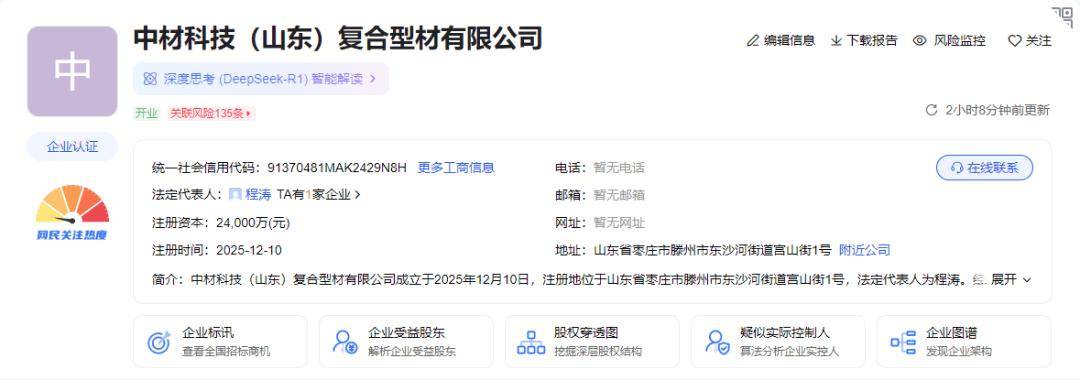
Group 1 - The core point of the article is that China National Materials Technology (中材科技) has established a new subsidiary in Tengzhou, Shandong, with a registered capital of 240 million yuan, focusing on the manufacturing and sales of high-performance fibers and composite materials [1][3] - The new subsidiary, China National Materials Technology (Shandong) Composite Materials Co., Ltd., is the third subsidiary of the company in Shandong, following the establishment of Taishan Glass Fiber Co., Ltd. and China National Materials Lithium Film Co., Ltd., which is 48.39% owned by the company [1][3] - The three subsidiaries in Shandong achieve vertical integration across the supply chain, covering "raw materials—materials—components" [1] Group 2 - China National Materials Technology is headquartered in Nanjing, Jiangsu Province, and was established in December 2001, with its IPO in November 2006 [3] - The company's main business includes three leading industries: glass fiber and products, wind turbine blades, and lithium battery separators, along with research, manufacturing, and sales of high-pressure composite gas cylinders and other composite materials [3] - The primary products of the company are wind turbine blades, glass fibers and their products, and lithium battery separators [3]