人与自然生命共同体

Search documents
福建首次以“活动周”方式参加世博会
Zhong Guo Chan Ye Jing Ji Xin Xi Wang· 2025-05-25 22:23
Group 1 - The "Fujian Activity Week" will take place from May 30 to June 1, 2025, at the China Pavilion during the Osaka World Expo [1] - This marks the first time Fujian Province participates in the expo with a dedicated "Fujian Activity Week" [1] - The theme for the activity week is "Fresh Fujian, Innovative Land," featuring an opening ceremony, exhibitions, economic and trade matching events, and specific activity days for Fuzhou and Xiamen [1] Group 2 - The Osaka World Expo will be held from April 13 to October 13, 2025, at the Kansai Osaka Expo Park, with the China Pavilion focusing on "Building a Community of Life Between Man and Nature - The Future Society of Green Development" [1] - The opening ceremony of the Fujian Activity Week will include a China (Fujian) - Japan economic and trade matching meeting and project signing ceremony [1] - The activity week will showcase Fujian's economic, cultural, and ecological advantages, as well as the results of friendly exchanges and cooperation with Japan [1][2] Group 3 - Fuzhou and Xiamen will host city-themed activity days during the "Fujian Activity Week," focusing on ecological governance, marine economy, and cultural heritage protection [2] - The event aims to enhance friendship and exchanges between Fujian and Japan, as well as with countries worldwide, promoting cooperation in culture, tourism, and trade [2]
大阪世博会中国馆成热门
Jing Ji Ri Bao· 2025-05-16 21:53
Core Insights - The China Pavilion at the Osaka Expo has received over 200,000 visitors in its first month, averaging about 7,000 visitors per day, making it one of the most popular pavilions at the expo [1][2] Group 1: Pavilion Highlights - The theme of the China Pavilion is "Building a Community of Life Between Man and Nature - The Future Society of Green Development," featuring multiple unique exhibition areas [1] - The pavilion's design resembles a scroll of Chinese literature, showcasing both ancient civilization and modern technology [1] - A significant exhibit is a large circular screen displaying multimedia images themed around the "Twenty-Four Solar Terms," illustrating the harmony between humans and nature [1][2] Group 2: Visitor Experience - The pavilion has implemented a humanized flow mechanism to prioritize the entry of special groups, including the elderly, children, and disabled individuals, supported by around 60 volunteers [2][3] - Visitors have expressed admiration for the cultural connections between China and Japan, noting similarities in seasonal changes and traditional aesthetics [2] - The pavilion features a replica of the 4-meter tall bronze tree from the Sanxingdui site, which has impressed many visitors and reshaped their understanding of Chinese bronze artifacts [2][3] Group 3: Cultural Significance - The pavilion aims to convey the warmth of Chinese culture and its respect for vulnerable groups, as highlighted by the experiences of international visitors [3] - The "Moon Soil" exhibit, showcasing samples from China's Chang'e missions, has drawn significant interest, with visitors expressing amazement at China's achievements in space exploration [3] - An AI-generated mural titled "Co-creating Peach Blossom Land" allows visitors to contribute to a collective artwork, emphasizing the theme of global cooperation [3][4]
自然观|望仙谷的“仙气”何来
Zhong Guo Zi Ran Zi Yuan Bao· 2025-04-30 03:30
Core Viewpoint - The article highlights the transformation of Wangxiangu, a former mining area in Jiangxi Province, into a thriving eco-tourism destination, showcasing the successful integration of ecological restoration and rural revitalization efforts [1][2][3]. Group 1: Ecological Restoration and Development - Wangxiangu has undergone significant ecological restoration, shifting from a resource-extraction model to an eco-prioritized development approach, emphasizing the concept that "green mountains and clear waters are as valuable as mountains of gold and silver" [2][3]. - The local government has attracted 2.6 billion yuan in social capital for the unified planning and ecological restoration of over 600 hectares of land surrounding Wangxiangu, aiming to enhance natural resources and promote eco-industrialization [2]. Group 2: Tourism and Economic Impact - Wangxiangu has become a popular national AAAA-level tourist attraction, receiving over 2 million visitors in 2023 and generating tourism revenue exceeding 1 billion yuan [3]. - The "scenic area + farmers" cooperation model has created tens of thousands of job opportunities, encouraging many villagers to return and engage in specialty farming, handicrafts, and hospitality businesses, thus increasing local income [3]. Group 3: Cultural Heritage and Community Engagement - The development strategy incorporates both natural and artificial restoration methods, preserving local cultural heritage while enhancing the natural landscape, thereby creating a unique cultural experience for visitors [2]. - The project emphasizes the importance of respecting nature, preserving culture, and benefiting the local community, aligning with the broader concept of a "community of life between humans and nature" [3].
大阪世博会中国馆惊艳亮相
人民网-国际频道 原创稿· 2025-04-14 02:02
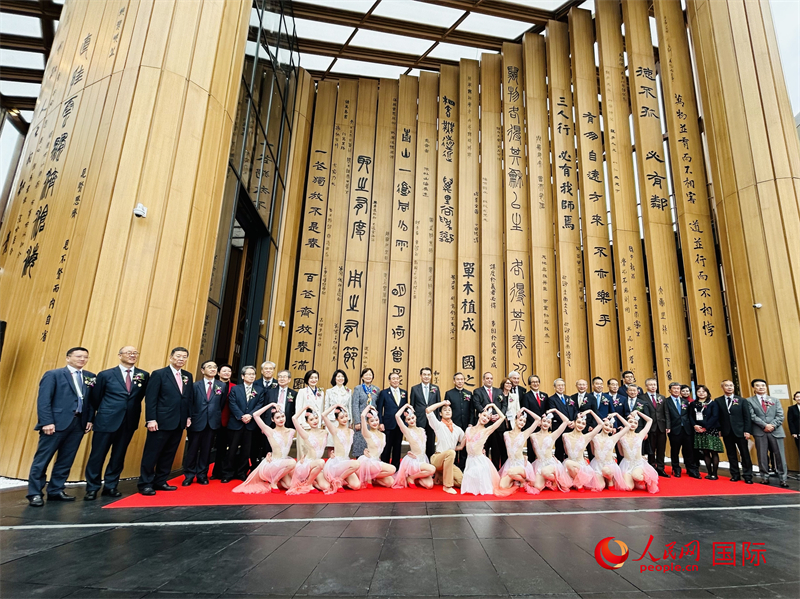
Core Viewpoint - The opening ceremony of the China Pavilion at the 2025 Osaka World Expo took place on April 13, 2025, showcasing China's cultural heritage and modern achievements to promote international cooperation and understanding [1][4][17]. Group 1: Event Overview - The China Pavilion's opening ceremony was attended by approximately 300 guests, including representatives from the Japanese government, business, and cultural sectors, as well as Chinese enterprises [1][4]. - The Expo is scheduled to run from April 13 to October 13, 2025, with the theme "Envisioning a Vibrant Future Society" [17]. Group 2: Key Speakers and Their Messages - Ren Hongbin, President of the China Council for the Promotion of International Trade, emphasized the Chinese government's support for the Expo and the importance of showcasing China's vibrant and open image [4]. - Dimitri Kerkentzes, Secretary-General of the Bureau International des Expositions, highlighted the architectural achievements of the China Pavilion in previous expos and the opportunity for visitors to experience China's rich culture and technological innovations [6]. - Wu Jianghao, the Chinese Ambassador to Japan, described the pavilion's design as a representation of traditional Chinese culture and future aspirations, aligning with the Expo's theme [8]. - Masakazu Tokura, President of the Japan Association for the 2025 World Expo, expressed the significance of Japan-China relations and the potential for innovation and cooperation through the Expo [10]. - Yoshimura Hirofumi, Governor of Osaka Prefecture, noted the 45th anniversary of friendship between Osaka and Shanghai, aiming to deepen local exchanges through the Expo [12]. Group 3: Pavilion Features and Themes - The China Pavilion covers an area of approximately 3,500 square meters, making it one of the largest foreign pavilions at the Expo [17]. - The pavilion's theme is "Building a Community of Life Between Man and Nature - A Future Society of Green Development," featuring exhibits that showcase China's ecological wisdom and green development philosophy [20]. - Notable exhibits include lunar soil samples collected by China's Chang'e 5 and 6 missions, a deep-sea exploration submersible, a next-generation humanoid robot, and a multimedia display themed around the 24 solar terms [20].

大阪世博会中国馆亮相
Bei Jing Shang Bao· 2025-04-10 16:13
Group 1 - The 2025 World Expo in Osaka, Japan, will take place from April 13 to October 13, featuring the China Pavilion as one of the largest and most representative exhibits [1] - The China Pavilion will cover an area of approximately 3,500 square meters, focusing on the theme of "Building a Community of Life Between Humans and Nature - The Future Society of Green Development" [2] - The pavilion will showcase traditional ecological wisdom from 5,000 years of Chinese civilization and highlight achievements in green development, with interactive installations and digital technologies enhancing visitor experience [2] Group 2 - The exhibition will include significant displays such as lunar soil samples brought back by the Chang'e 5 and Chang'e 6 missions, allowing for a unique comparison of lunar soil from the moon's front and back sides [2] - The Expo site, located on the artificial island Yumeshima in Osaka, spans approximately 155 hectares and will feature participation from 158 countries and regions, along with 7 international organizations [3] - The overall theme of the Expo is "Imagining a Revitalized Future Society," with a ticket sales target of 23 million to support operational costs, of which 8.7 million tickets have been sold as of early this month [3]