
绿色发展理念

Search documents
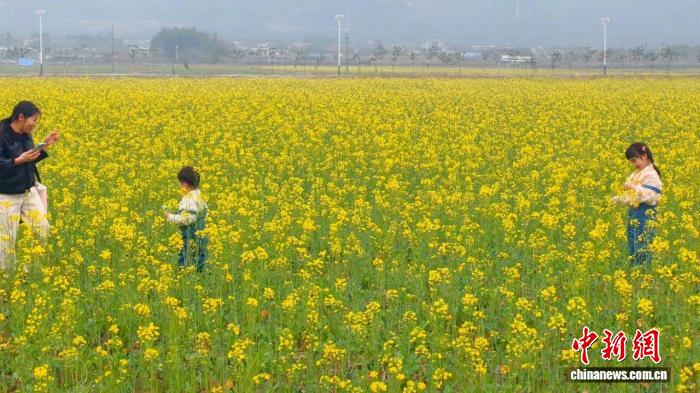
(新春走基层)广东太和镇:绿肥还田 生态效益双丰收
Zhong Guo Xin Wen Wang· 2026-02-27 14:08
Core Viewpoint - The article highlights the ecological and agricultural benefits of using green manure in Taihe Town, Guangdong, showcasing a sustainable agricultural model that enhances soil fertility and reduces costs while promoting green development [1][4]. Agricultural Practices - Taihe Town has implemented a green manure strategy by planting 2,000 acres of purple vetch and creating a 1,000-acre canola flower sea, forming a 3,000-acre "green manure matrix" [3]. - Purple vetch, through symbiosis with nitrogen-fixing bacteria, can add 10 to 30 kilograms of nitrogen fertilizer per acre to the soil, while canola roots help activate deep soil nutrients [3]. Crop Production Plans - For the current year, Taihe Town plans to cultivate 9,582 acres of food crops, including 7,344 acres of rice, 2,026 acres of tubers, and 212 acres of corn, alongside 3,012 acres of peanuts and 10,709 acres of various vegetables [4]. - The integration of green manure and full mechanization is expected to reduce rice cultivation costs to 780 yuan per acre, enhancing efficiency and lowering expenses [4]. Sustainable Development - The practice of returning green manure to the soil not only improves soil quality but also reduces pollution, contributing to long-term ecological sustainability [4]. - The transformation of the flower sea into nutrient-rich soil exemplifies the shift from aesthetic appeal to agricultural productivity, reinforcing the commitment to green agriculture [4].

2026云南春晚——彰显创新创造活力 展现云南蓬勃气象
Xin Lang Cai Jing· 2026-02-17 20:42
Core Viewpoint - The 2026 Yunnan Spring Festival Gala showcases the integration of culture, art, and technology, highlighting the vibrant spirit of modern Yunnan and promoting cultural heritage through innovative artistic expressions [1][4]. Group 1: Cultural Integration - The gala theme "Cultural Tides Surge in Colorful Yunnan" emphasizes the active transmission of ethnic culture, blending ancient Dian civilization, intangible cultural heritage, and ethnic customs into a cohesive presentation [1][2]. - The multimedia dance "He Bo Suo·Spring Fusion," led by young artist Yang Wu, utilizes cinematic techniques to create a dialogue between ancient artifacts and modern art, exemplifying the innovative use of cultural heritage [1][2]. Group 2: Artistic Presentation - The gala features a variety of performances that reflect Yunnan's ethnic diversity, including the dance "Chang Lian·Da Guan," which merges the poetic essence of China's longest couplet with Yunnan's ethnic dance [2][4]. - The event breaks traditional stage boundaries by using Yunnan's natural landscapes as a backdrop, creating a visually stunning and emotionally resonant experience for the audience [2][3]. Group 3: Technological Innovation - The gala employs a "multi-stage + world heritage site + virtual-real combination" model, showcasing Yunnan's breathtaking scenery through advanced technologies like AI, AR, and CG, resulting in high-definition visual experiences [2][3]. - The integration of AI in performances, such as featuring representative animals of Yunnan, illustrates the artistic expression of ecological civilization and green development [3][4]. Group 4: Community and Cultural Exchange - The gala promotes cultural unity and understanding among different ethnic groups, featuring performances that resonate with both domestic and international audiences [4]. - The program includes a mix of local humor and cross-cultural collaborations, showcasing the inclusive and open spirit of Yunnan's cultural landscape [4].
基于aβγδ经济动力结构模型的中国经济改革历程分析
Jing Ji Guan Cha Bao· 2026-02-16 15:34
Core Insights - The article introduces the aβγδ economic dynamic structure model, which integrates various dimensions of economic reform in China, emphasizing the need for a comprehensive analytical framework to understand the structural transformations and collaborative logic behind the reforms [1][2]. Group 1: Economic Dynamic Structure Model - The aβγδ model posits that sustainable socio-economic development results from the organic combination and dynamic evolution of four driving forces: a (production factors), β (operational mechanisms), γ (innovation systems), and δ (systemic synergy) [2]. - Successful transformation is characterized by the sequential evolution of dominant forces (a→β→γ) and the continuous support of δ coupling throughout the process [2]. Group 2: Stages of China's Economic Reform - **First Stage: Reform Initiation and Exploration (1978-early 1990s)** - The focus was on activating a dynamics by restructuring the dual link of production factors, releasing suppressed foundational vitality, with δ coupling primarily based on "mutual adaptability" [3][5]. - **Second Stage: Market Economy System Construction (early 1990s-early 2010s)** - This stage established the β framework and empowered a upgrades, with key developments including: - a dynamics: The core is the capacity for output proliferation through the combination of production factors and their relationships [4]. - β dynamics: This refers to the ability to maintain stable and efficient resource allocation through market and governance mechanisms [4]. - γ dynamics: It represents the evolutionary capacity to break path dependence and achieve qualitative leaps through diverse innovation entities [4]. - δ dynamics: This involves the synergy of the three dynamics, ensuring stability, continuity, and efficiency in the reform process [4][9]. - **Third Stage: High-Quality Development (2010s-present)** - The focus shifted to innovation-driven growth, addressing challenges of traditional growth models, with δ coupling emphasizing "systemic and contradiction transformation" [7]. Group 3: Theoretical Insights and Policy Implications - The study highlights the importance of systematic thinking and structural awareness in promoting sustainable economic development, advocating for a precise understanding of dominant dynamics (currently γ) while reinforcing a foundations and improving β environments [8]. - The sequential evolution of dynamic structures reflects the internal logic of addressing survival, development, and future challenges, while δ coupling serves as a stabilizer and amplifier for successful reforms [9].
将生态文明教育全面融入教育体系
Zhong Guo Huan Jing Bao· 2026-02-12 05:47
Core Viewpoint - The integration of ecological civilization education into the education system is essential for fostering a sustainable mindset among citizens, ensuring that the concept of "lucid waters and lush mountains are invaluable assets" is deeply rooted in society [1] Group 1: Education Stages - In early childhood education, children can learn about the value of life and the wonders of nature through guided observations of ants and bees [2] - In primary education, ecological education can be incorporated into various subjects, such as moral education, science, and art, to instill a love for nature [2] - Secondary education should focus on deeper ecological principles through subjects like biology and geography, while also connecting ecological protection to national development [2] - Higher education should emphasize theoretical depth and practical innovation, offering specialized courses in ecology and sustainable development to cultivate professionals who understand and advocate for environmental protection [2] Group 2: Campus Practices - Schools are actively creating "ecological campuses" by utilizing solar energy and promoting waste sorting to instill low-carbon habits in students [3] - Various ecological and environmental activities, such as Earth Day campaigns and tree planting events, engage students in hands-on experiences that highlight the importance of environmental responsibility [3] - Collaborations with environmental organizations and research institutions provide students with opportunities to interact with experts and witness ecological practices firsthand, reinforcing the internalization of green concepts [3] Group 3: Teacher's Role - Teachers play a crucial role in guiding ecological education, and their own understanding of ecological civilization must be enhanced through training and collaborative activities [4] - The education system should foster an ecological culture within schools, promoting environmental knowledge through various communication platforms [4] - When environmental stewardship becomes a habitual action among students and a shared goal among faculty, schools can effectively embody the principles of ecological civilization [4]
十堰号召党员干部带头严格执行烟花爆竹禁(限)放规定
Xin Lang Cai Jing· 2026-02-11 04:16
Core Viewpoint - The initiative by the Shiyan Municipal Organization Department aims to enforce the ban on fireworks during the Spring Festival to ensure public safety and promote a green, civilized holiday atmosphere [1] Group 1: Policy Implementation - The initiative calls for all party members and officials to strictly adhere to the regulations regarding the ban on fireworks, ensuring no storage, ignition, or transportation of fireworks in prohibited areas [1] - The campaign emphasizes the importance of embodying the green development concept and establishing a positive image for party members and officials [1] Group 2: Public Engagement - Party members and officials are encouraged to take on the responsibility of policy promotion, educating friends, neighbors, and service recipients about the safety hazards and environmental impacts of fireworks [1] - There is a focus on fostering a strong community awareness where everyone understands and actively follows the regulations regarding fireworks [1] Group 3: Responsibility and Action - The initiative stresses the need for a sense of responsibility and proactive engagement in discouraging and stopping any violations of the fireworks ban [1]
外交部:中国是全球湿地保护修复事业的重要参与者、贡献者和引领者
Xin Hua She· 2026-02-02 16:49
Core Viewpoint - The article emphasizes China's significant role in global wetland protection and restoration, highlighting its achievements and commitment to ecological sustainability [1][2]. Group 1: Wetland Protection Achievements - China ranks first in Asia and fourth globally in wetland area, with the highest number of international wetland cities [1]. - Since the 18th National Congress of the Communist Party, China has made historic achievements in wetland protection and restoration under the guidance of Xi Jinping's ecological civilization thought [1]. Group 2: International Cooperation and Recognition - As a party to the Ramsar Convention, China is a key participant and contributor to global wetland protection efforts, having established the "International Mangrove Center" with 20 member countries [2]. - China has received global honors such as the "Earth Guardian Award" and "World Biosphere Reserve," reflecting international recognition of its green development practices [2]. Group 3: Future Commitment - China aims to continue its path of harmonious coexistence between humans and nature, supporting global ecological governance and promoting the construction of a global community of life [2].
绿色发展理念引领生态文明建设深刻变革(深入学习贯彻习近平新时代中国特色社会主义思想·学习《习近平生态文明文选》第一卷专家谈)
Ren Min Ri Bao· 2026-01-30 07:53
Core Viewpoint - The first volume of "Xi Jinping's Ecological Civilization Selected Works" comprehensively reflects the rich connotation, scientific system, and original contributions of Xi Jinping's ecological civilization thought, providing authoritative material for understanding its theoretical value and strategic significance [1][2] Group 1: Green Development Concept - The green development concept is a crucial part of Xi Jinping's ecological civilization thought, emphasizing the need for a profound transformation in development perspectives to achieve sustainable development in the context of China's modernization [3][4] - Xi Jinping's ecological civilization thought advocates for a harmonious relationship between humans and nature, rejecting the traditional view that economic growth and environmental protection are mutually exclusive [4][5] - The concept of green development encompasses revolutionary changes in production, lifestyle, and values, aiming to respect, adapt to, and protect nature while promoting sustainable economic activities [5][6] Group 2: Achievements in Ecological Civilization - Under Xi Jinping's leadership, China has achieved remarkable ecological and green development milestones, establishing a clean and sustainable power supply system, with renewable energy expected to account for 56% of total installed capacity by 2024 [8] - The implementation of green development principles has led to significant improvements in air quality, with PM2.5 levels in major cities decreasing by over one-third from 2015 to 2024, and forest coverage exceeding 25% [8] - The green development approach has resulted in a complete industrial chain for new energy vehicles, with production and sales projected to exceed 16 million units by 2025, transforming the global automotive industry [8] Group 3: Global Contributions and Influence - China's green development practices have garnered international recognition, providing a model for other developing countries facing the dual challenge of economic growth and environmental protection [11][12] - The country's commitment to green development has led to collaborative projects in over 100 countries, enhancing global energy transition and improving living standards in developing regions [12] - China's experience in green development serves as a valuable reference for other nations, promoting sustainable development paths that align with their unique circumstances and requirements [11][12]
绿色发展理念引领生态文明建设深刻变革
Ren Min Ri Bao· 2026-01-30 03:25
Core Viewpoint - The articles collectively emphasize the significance of Xi Jinping's ecological civilization thought, highlighting its role in guiding China's green development and ecological progress, which is essential for achieving sustainable modernization and addressing global ecological challenges [1][2][3]. Group 1: Green Development Concept - The green development concept is a crucial component of Xi Jinping's ecological civilization thought, advocating for a transformation in production and lifestyle that respects and protects nature [2][4]. - It emphasizes the need for a profound change in development perspectives to overcome challenges in achieving high-quality development, particularly in a country with a large population like China [3][4]. - The concept promotes a harmonious relationship between humans and nature, rejecting the traditional view that economic growth and environmental protection are mutually exclusive [4][5]. Group 2: Achievements in Ecological Civilization - Under Xi Jinping's leadership, China has made significant strides in ecological civilization, achieving remarkable results in green development and environmental protection [7][8]. - The country has established the world's largest clean power supply system, with renewable energy capacity projected to reach 56% of total power generation by 2024, significantly increasing renewable energy output [8]. - From 2015 to 2024, the average PM2.5 concentration in cities has decreased by over one-third, and forest coverage is expected to exceed 25% [8]. Group 3: Global Contributions and Influence - China is positioned as a key contributor to global ecological civilization, advocating for a collaborative approach to environmental issues and promoting sustainable development practices [10][11]. - The green development model established by China serves as a reference for other developing countries facing similar challenges of balancing economic growth and environmental protection [11][12]. - China's advancements in renewable energy technologies, such as wind and solar power, are enhancing global sustainability and providing affordable solutions for energy transition in various countries [12].
光大银行鄂尔多斯分行:支持绿色制造赋能实体经济 用专业服务彰显担当
Zhong Guo Jin Rong Xin Xi Wang· 2026-01-27 01:36
Core Viewpoint - The Everbright Bank Ordos Branch is actively implementing the national "dual carbon" strategy and green development concept, integrating financial services with national strategy and regional economic development to empower local enterprises for high-quality growth [1] Group 1: Financial Support Initiatives - The branch has provided 80 million yuan in credit support to a green manufacturing demonstration enterprise, helping to solidify the foundation for its green manufacturing development [1] - The branch is facilitating the import of 150 million yuan in credit certificates for a group company involved in importing petroleum gas, addressing various challenges in the import process through a professional team [1] Group 2: Commitment to Political Responsibility - The branch prioritizes political construction and utilizes diverse financial tools such as credit support and international settlement to precisely meet the development needs of enterprises [1] - The bank aims to inject financial vitality into green manufacturing enterprises and build service bridges for foreign trade logistics companies, contributing to the high-quality economic and social development of Ordos City [1]


省级“绿色认证”!我市绿色生态城区+1
Xin Lang Cai Jing· 2026-01-25 23:27
Core Viewpoint - The article emphasizes the balance between ecological protection and economic development in Jiaxing, highlighting the implementation of the green ecological urban area in the Maqiao Street as a model for sustainable development [1]. Group 1: Green Ecological Urban Area - The Maqiao Street green ecological urban area is recognized as Jiaxing's third green ecological project, aiming to enhance economic value through ecological initiatives [1]. - The concept of "green ecological urban area" encompasses comprehensive and multi-layered green development principles, focusing on resource conservation and environmental friendliness across various sectors [1]. - Key features include energy consumption monitoring systems in buildings, distributed sewage treatment facilities, and a high percentage of green building certifications for new constructions [1]. Group 2: Community and Economic Development - The Maqiao Street area has transformed public spaces along the Loxihe River, enhancing the quality of life for residents and fostering a sense of community [2]. - The region hosts over 3,000 enterprises, with 263 being large-scale industrial companies, contributing to economic growth while generating recyclable resources [2]. - Plans are underway to establish a recycling resource center, with phases for storage, transfer, and processing to enhance local resource utilization and value [2]. Group 3: Sustainable Growth and Cultural Integration - Economic growth in Maqiao Street is designed to provide funding and technical support for ecological protection, with a focus on scientific spatial planning [3]. - The area promotes collective economic projects among villages, shifting from dependency on external support to self-sustaining initiatives [3]. - Cultural heritage is integrated into development, with projects aimed at revitalizing traditional crafts and creating community spaces that reflect local history [3].