人民币汇率市场化

Search documents
“8·11”汇改十周年: 市场化始终是最亮底色
Sou Hu Cai Jing· 2025-08-10 16:28
Core Viewpoint - The article discusses the evolution of China's exchange rate system since the 1994 reform, emphasizing the importance of market-driven mechanisms and the gradual move towards a more market-oriented exchange rate for the Renminbi (RMB) [1][2][12]. Summary by Sections Exchange Rate Reform History - The 1994 exchange rate reform established a managed floating exchange rate system, transitioning from a dual exchange rate system to a unified market-based rate [2][3]. - The initial phase of the reform faced significant challenges, including capital outflows and a decline in foreign reserves, leading to a depreciation of the RMB [2][3]. - By 2017, the introduction of a counter-cyclical adjustment factor improved the exchange rate mechanism, allowing for a more accurate reflection of economic fundamentals [2][3]. Market Dynamics and Currency Valuation - Since the 1994 reform, China's foreign exchange reserves have increased significantly, reaching $32,407 billion by March 2025, with a net increase driven primarily by trading activities [4]. - The RMB has appreciated against both bilateral and multilateral currencies, with a nominal effective exchange rate (NEER) increase of 64.2% since 1994 [4]. - The International Monetary Fund (IMF) has identified the RMB as one of the currencies that is stronger than its fundamental equilibrium exchange rate level [8]. Current Exchange Rate Challenges - The article highlights the ongoing challenges in achieving a balanced exchange rate, noting that market perceptions can lead to significant deviations from economic fundamentals [9][10]. - Recent trends indicate a potential undervaluation of the RMB despite a growing trade surplus, suggesting a complex interplay between domestic economic conditions and external pressures [7][12]. - The central bank has emphasized the need for stability in the RMB exchange rate, particularly in response to market fluctuations and external economic conditions [12][13]. Future Outlook - The article concludes that while significant progress has been made towards a market-oriented exchange rate, further efforts are needed to overcome the "fear of floating" and fully realize a market-driven exchange rate system [1][13].
国家外汇局李斌:我国外汇市场韧性不断提升 应对外部冲击能力增强
news flash· 2025-07-22 08:04
Core Viewpoint - The resilience of China's foreign exchange market is continuously improving, enhancing its ability to respond to external shocks [1] Macro Level Summary - The market-oriented formation mechanism of the RMB exchange rate is being continuously improved, leading to increased exchange rate flexibility that can timely release external pressures and promote supply-demand balance [1] Micro Level Summary - Awareness of exchange rate risk neutrality among enterprises is steadily increasing, with RMB cross-border transactions growing steadily. In the first half of the year, the proportion of enterprises' foreign exchange hedging and the proportion of RMB cross-border receipts and payments under goods trade both reached around 30%, marking historical highs. This reduction in foreign exchange risk exposure helps maintain rational trading in the market [1] Policy Level Summary - The foreign exchange market has accumulated rich experience in counter-cyclical regulation and has a wealth of policy tools in reserve. The effectiveness of foreign exchange regulation is steadily improving, and the ability to prevent and mitigate external shock risks is continuously enhanced. There is confidence and capability to maintain the stable operation of the foreign exchange market [1]
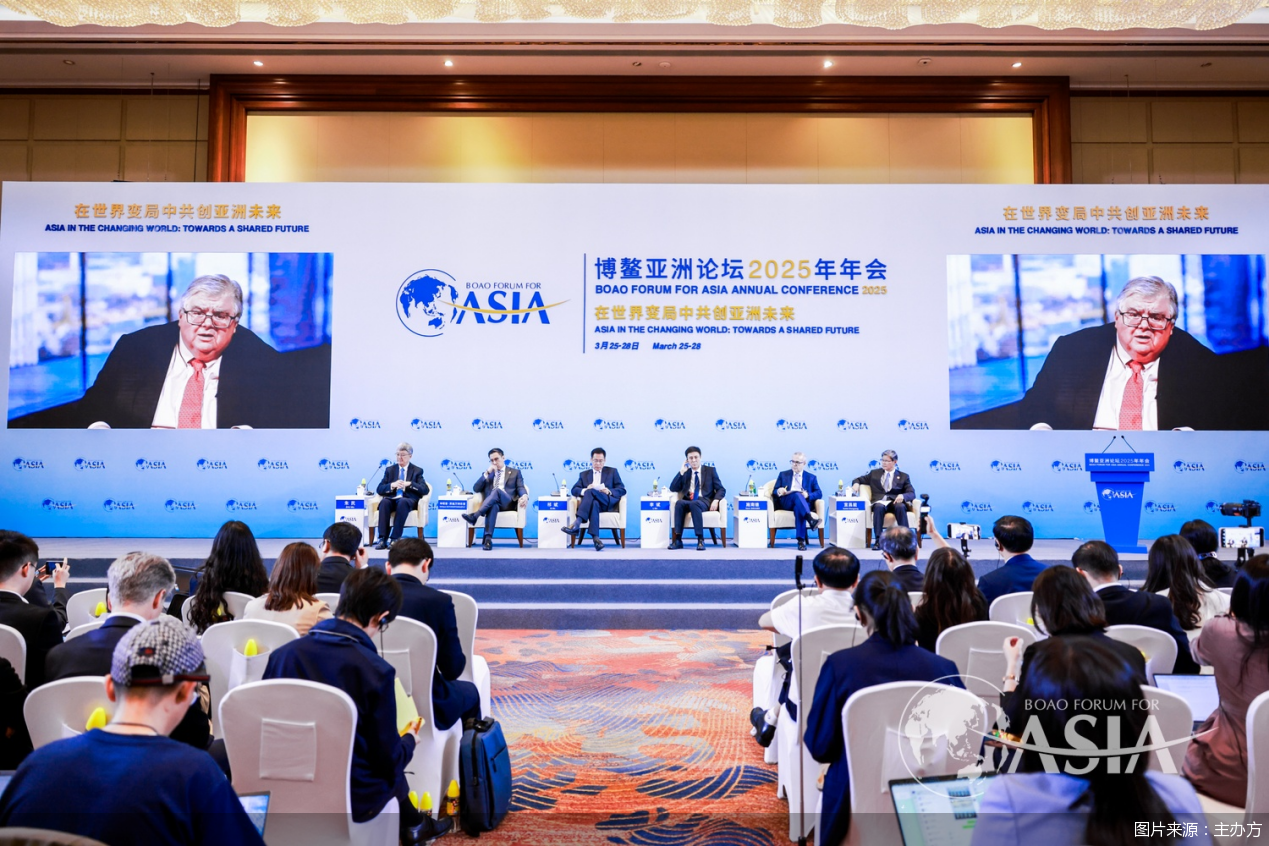
2025博鳌亚洲论坛|货币、汇率如何应对不确定
Bei Jing Shang Bao· 2025-03-27 14:54
Core Viewpoint - The Boao Forum for Asia 2025 highlighted the challenges of global economic uncertainty and the importance of monetary and financial stability in navigating these complexities [1] Group 1: Monetary Policy and Economic Stability - The People's Bank of China (PBOC) emphasizes a clear stance on maintaining a moderately accommodative monetary policy, with sufficient room for adjustments such as reserve requirement ratio (RRR) cuts and interest rate reductions based on economic conditions [3][9] - The PBOC is shifting focus from quantity-based targets to price-based adjustments in monetary policy, indicating a more flexible approach to managing liquidity [4] - The PBOC has resumed net injections through Medium-term Lending Facility (MLF) operations, marking a significant policy shift after an eight-month hiatus [4] Group 2: Structural Optimization of Monetary Policy - The PBOC is utilizing various structural monetary policy tools to support capital market stability and enhance funding for technological innovation, including the introduction of a bond market technology board [4] - Since 2020, China has independently implemented monetary policies in response to global economic conditions, contrasting with the aggressive rate hikes by the Federal Reserve [4][5] Group 3: Currency Stability and Exchange Rate Management - The Chinese yuan has demonstrated resilience amid global capital flow volatility, acting as a stabilizing force for the macroeconomy [5] - The PBOC has enhanced the market-oriented formation mechanism of the yuan's exchange rate, allowing for greater flexibility while maintaining stability [6] - The foreign exchange management authority is focused on preventing excessive fluctuations in the yuan's exchange rate and has implemented measures to improve risk management for enterprises [6][7] Group 4: Regional Economic Cooperation - Strengthening regional economic cooperation is seen as essential for enhancing economic resilience and addressing external risks, with initiatives like currency swap agreements with ASEAN countries [8] - The PBOC and foreign exchange management authority stress the importance of policy communication and coordination to stabilize expectations in an uncertain environment [8][9] Group 5: Future Outlook - The PBOC plans to continue its accommodative monetary policy while utilizing various tools to ensure ample market liquidity and reduce financing costs [9] - The foreign exchange management authority is reforming its system to enhance convenience and security for trade, benefiting thousands of enterprises [9]