
分子育种

Search documents
水果越来越甜了吗(身边的创新)
Ren Min Ri Bao· 2025-10-14 22:09
Core Insights - The sweetness of fruits has significantly increased over the past few decades, with examples such as watermelons now averaging a sugar content of 12, compared to 9 two decades ago [1][2]. Group 1: Factors Contributing to Increased Sweetness - The development of superior fruit varieties through hybridization and modern breeding techniques has been a key factor in enhancing sweetness [2]. - Advances in agricultural technology, including molecular marker-assisted breeding, have improved the efficiency and precision of fruit breeding [2]. - Understanding the molecular mechanisms of sugar accumulation in fruits like tomatoes and strawberries allows for better regulation of sugar content [2][3]. Group 2: Cultivation Practices - Specific cultivation practices, such as grafting "Su Cui No. 1" pear onto rootstocks and planting pollinator varieties, help maintain high sugar characteristics [2]. - Optimal harvesting time is crucial for flavor and texture, with the best period identified as 105 to 110 days post-bloom [3]. Group 3: Quality Considerations - A balance of sweetness and acidity is essential for flavor complexity, with high-quality fruits often having a slight acidity to enhance the sweetness [4]. - Aroma compounds play a significant role in the overall flavor experience, and breeding efforts are increasingly focused on enhancing fruit aroma alongside sweetness [4]. - The quality of fruits is also assessed based on texture, disease resistance, storage capability, and nutritional content, with a growing emphasis on vitamins and antioxidants [4].
首个空山牛专用育种芯片发布 育种有芯 产业发展更有牛劲
Si Chuan Ri Bao· 2025-09-17 03:38
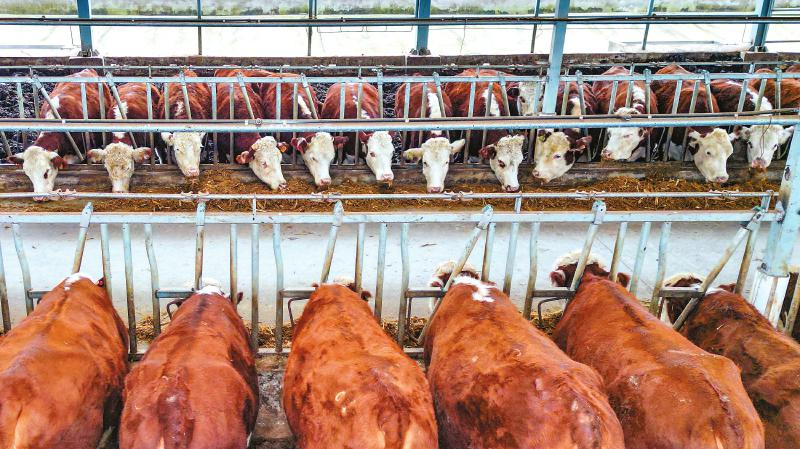
R&D Timeline - The joint research team initiated the development of the "Kongshan Cattle 1" breeding chip in October 2023, with the first batch expected to be completed by May 2025 [2][4] Development Goals - By 2027, the plan includes establishing 100 beef cattle characteristic towns, creating 1,000 demonstration villages for cow breeding, supporting 25,000 breeding households, increasing the cow stock by 160,000, and achieving a self-sufficiency rate of over 80% for breeding sources [2][5] Industry Achievements - Two beef cattle breeding farms have been established, with 209 large-scale farms and 1,296 moderately sized farms developed, alongside 53 key beef cattle development towns and 17 provincial standardized breeding farms [3][6] - The "Kongshan Cattle 1" breeding chip is the first of its kind in China and was recognized as a local breed by the National Animal Genetic Resources Committee in 2024 [3][5] Cost Reduction and Efficiency - The breeding chip is expected to reduce breeding costs by approximately 40% and shorten the breeding cycle by 10 to 15 years, providing a scientific basis for breeding direction [4][5] Industry Chain Development - The region has established a comprehensive industry chain encompassing breeding, slaughtering, processing, and marketing, with two large beef cattle trading markets and a specialized slaughterhouse capable of processing 30,000 cattle annually [7][8] - The local market has seen the successful cultivation of national standard grade 4 snowflake beef, with research on feed formulas achieving significant results [8]

扬大团队发现控制垩白的关键基因
Xin Hua Ri Bao· 2025-07-29 21:26
Core Insights - A breakthrough study by a research team at Yangzhou University has identified a key gene, Chalk9, that controls the formation of chalkiness in rice, which is crucial for both yield and quality [1][2] - The presence of chalkiness, characterized by opaque spots on rice grains, significantly affects the market value of rice, with a 1% reduction in chalkiness leading to a price increase of 0.8% to 1.2% [1] - The research provides a new molecular breeding paradigm to address the conflict between high yield and quality in rice production [1] Group 1: Research Findings - The research team constructed a core indica rice germplasm resource library and utilized whole-genome association analysis to pinpoint the Chalk9 gene [1] - Chalk9 encodes an E3 ubiquitin ligase that regulates the protein stability of the OsEBP89 transcription factor, ensuring synchronized synthesis of starch and protein [1] - A significant discovery was made in the promoter region of the Chalk9 gene, where a 64-base pair insertion/deletion variant was found, leading to a version of the gene (Chalk9-L) that reduces chalkiness without affecting yield [1] Group 2: Implications for Rice Breeding - Approximately 30% of globally cultivated indica rice varieties lack the beneficial Chalk9-L allele, indicating a substantial opportunity for molecular breeding to enhance rice quality [2] - The findings not only provide new insights into the molecular basis of rice quality formation but also offer directly usable genetic resources for future breeding efforts [2] - The potential to improve both yield and quality in rice through the application of this research is significant, presenting a promising avenue for agricultural advancements [2]
我国科学家发现调控水稻抽穗期的关键基因
Ke Ji Ri Bao· 2025-06-20 07:12
Core Insights - The research team led by academician Wan Jianmin has identified a new gene, ELD1, that specifically regulates the heading date of rice under long-day conditions, which is crucial for breeding high-yield, high-quality, and widely adaptable rice varieties [1][2] - The study reveals that the ELD1 gene can significantly promote heading without causing obvious agronomic defects, indicating its potential for molecular breeding applications [2] Group 1: Gene Discovery and Mechanism - The ELD1 gene regulates the mRNA splicing of the core biological clock gene OsCCA1, affecting the heading date of rice [1] - The research indicates that shorter light exposure leads to faster heading and earlier maturity in rice [1] - ELD1 interacts with OsNKAP protein and multiple core mRNA splicing factors, influencing the splicing of thousands of genes across the genome [1] Group 2: Implications for Breeding - The study provides a new mechanism for understanding how light signals regulate the heading date of rice, which is significant for molecular breeding [2] - The team utilized base editing technology to create targeted mutations in key amino acids of ELD1, resulting in new early-heading germplasm for high-quality rice varieties such as Ningjing 7 and Ningjing 4 [2] - This research offers important genetic resources and theoretical support for addressing the late maturity issues in hybrid rice breeding [2]
华智生物将向巴基斯坦输出分子育种技术
Xin Hua Cai Jing· 2025-05-08 14:48
Group 1 - Huazhi Biotechnology Co., Ltd. is collaborating with Pakistan to transfer molecular breeding technology, aiming to establish a national-level molecular breeding joint laboratory in Pakistan [1][3] - A memorandum of understanding was signed among Huazhi Biotechnology, Beijing Jiaolong Technology Co., Ltd., and Hassan Trading Company for comprehensive cooperation in the field of molecular-assisted breeding [1] - The cooperation will involve sharing germplasm resource databases and utilizing Huazhi's "genotype-phenotype" big data platform to aggregate superior genes [1] Group 2 - The collaboration is expected to enhance Pakistan's agricultural system, enabling the cultivation of "future seeds" that are resilient to climate change, thereby significantly increasing food production and farmers' income [1][2] - Huazhi Biotechnology aims to help Pakistan overcome breeding bottlenecks through technology sharing and promote the international application of China's seed industry "chip" technology [2] - Huazhi Biotechnology is a national-level molecular breeding platform guided by the Ministry of Agriculture and Rural Affairs, established in collaboration with leading seed companies [3]
新项目探寻作物“滋味基因密码”
Ke Ji Ri Bao· 2025-04-02 00:59
Core Viewpoint - The project "Molecular Mechanism of Flavor Quality Traits Formation in Specialty Horticultural Crops" has been launched in Changsha, Hunan, aiming to enhance the flavor quality of key horticultural crops through molecular breeding techniques [1][2]. Group 1: Project Overview - The project is led by Hunan Agricultural University in collaboration with several institutions, focusing on the molecular mechanisms behind flavor quality traits in specialty horticultural crops [1]. - The project targets three main crops: tea trees, chili peppers, and citrus, with four sub-topics designed to explore common flavor traits [2]. Group 2: Research Objectives - The aim is to clarify the genetic basis of flavor traits in tea trees, chili peppers, and citrus, and to construct a molecular regulatory network for flavor substance metabolism [2]. - The project will also investigate the mechanisms of flavor quality formation in response to adverse conditions [2]. Group 3: Technological Development - The team plans to develop a stable high-throughput breeding "chip" specifically for flavor quality, creating an efficient breeding technology system [2]. - A roadmap for improving the flavor quality of specialty horticultural germplasm will be established [2]. Group 4: Institutional Support - Hunan Agricultural University is committed to building an integrated innovation platform that combines production, education, research, and application to support the project's high-quality implementation [2].