
医用耗材集采

Search documents
耗材集采年末密集落子,市场影响几何?
2 1 Shi Ji Jing Ji Bao Dao· 2025-12-11 10:21
Core Viewpoint - The recent medical consumables procurement policies from the Beijing-Tianjin-Hebei "3+N" alliance and Yichun, Jiangxi, signify a strategic shift towards systematic and demand-driven procurement, focusing on both high-frequency and high-value items to optimize costs and promote domestic alternatives [2][3]. Group 1: Policy Implementation - The Beijing-Tianjin-Hebei alliance issued four notifications within three days, covering essential consumables such as indwelling needles and hard brain (spinal) membrane patches, while Jiangxi Yichun announced its first batch of volume-based price linkage procurement [1]. - The procurement strategy emphasizes a layered approach based on clinical needs, aligning with the 2025 policy direction of "one product, one policy" for precise procurement [2]. Group 2: Market Dynamics - The procurement policies are reshaping the market landscape, with domestic companies gaining a competitive edge in low-value consumables, achieving over 85% localization, while high-end products like hard brain (spinal) membrane patches are expected to see a market penetration increase to over 50% due to these initiatives [7]. - The shift from a "price war" to a "value war" is evident, as the focus moves towards quality and cost-effectiveness rather than merely low pricing [3][4]. Group 3: Quality Control and Innovation - Enhanced quality control measures are being implemented, with requirements for quality inspection reports and a focus on clinical applicability and safety in the evaluation process [5]. - The procurement strategies are also fostering innovation, as the sixth national procurement batch reserves market space for innovative products, encouraging a balance between basic and innovative offerings [8]. Group 4: Economic Impact - The price linkage mechanism is projected to save over 2 billion yuan annually for the medical insurance fund, with the potential for further savings through regional collaboration [9]. - Hospitals benefit directly from cost reductions and improved cash flow due to stable order volumes and expedited reimbursement processes, allowing for reinvestment in clinical services [9].
第六批耗材国采启幕:锚点价机制重塑百亿市场竞争格局
2 1 Shi Ji Jing Ji Bao Dao· 2025-11-10 06:24
Core Insights - The sixth batch of high-value medical consumables centralized procurement has officially commenced, focusing on drug-coated balloons and urological intervention consumables, which are critical clinical needs [1][2] - The new procurement rules aim to reshape the market landscape, promote domestic substitution, and drive high-quality industry development [1][4] Procurement Details - The procurement covers drug-coated balloons for coronary and peripheral vascular use, and urological intervention consumables have been narrowed down to six essential categories, emphasizing basic needs and strong demand [2] - The procurement volume ratio has been adjusted from 80%-90% to 80%, with new clauses allowing for volume adjustments based on clinical demand, ensuring market supply stability while reserving space for innovative products [2][3] - The introduction of the "anchor price" mechanism aims to mitigate vicious price competition, shifting the focus from low-price selection to reasonable pricing [3][4] Market Impact - The drug-coated balloon market is experiencing rapid growth, with a market size of 4.5 billion yuan in 2023, a year-on-year increase of 22.7%, and expected to exceed 12 billion yuan by 2025 [4] - The urological intervention market, previously dominated by imports, is now presented with opportunities for domestic companies to capture market share, potentially increasing the domestic substitution rate to over 60% [5] Industry Transformation - The centralized procurement process is both a challenge and a catalyst for transformation, pushing companies to focus on technological innovation and high-end product development [6] - The ongoing procurement initiative reflects the government's commitment to regularizing and institutionalizing centralized procurement, emphasizing quality, innovation, and price control [6][7] - The integration of procurement policies with medical insurance is expected to lower patient costs while fostering a sustainable environment for industry innovation [6][7]
26省泌尿耗材集采再推进 国产企业加速布局
2 1 Shi Ji Jing Ji Bao Dao· 2025-10-15 10:35
Core Insights - The centralized procurement of urological medical consumables in China is advancing, with a new initiative led by Chongqing covering 26 provinces, indicating a shift towards domestic product substitution and market restructuring [1][6]. Group 1: Market Dynamics - The market for urological consumables has been historically dominated by imported brands like Boston Scientific and Cook, particularly in high-end products such as alloy stents [1]. - The ongoing centralized procurement aims to stabilize prices and reduce excessive competition by shifting the focus from "low-price selection" to "reasonable price selection" [1][2]. - The urological device market is projected to grow significantly, with the global market expected to reach $65.9 billion by 2032, up from $40.8 billion in 2024, highlighting substantial growth potential [7]. Group 2: Procurement Initiatives - The new procurement initiative will categorize stents based on material and features, allowing for competitive bidding among manufacturers [6]. - Previous regional procurement efforts, such as those in Fujian and Hebei, have already demonstrated significant price reductions for urological consumables [2][3]. - The sixth batch of national procurement will include drug-coated balloons and urological intervention products, indicating a comprehensive approach to cost control and quality assurance [4]. Group 3: Domestic Companies' Positioning - Domestic companies like Weili Medical, Huitai Medical, and Ruibang Medical are increasingly gaining market share through innovation and product diversification in the urological sector [7][8]. - Huitai Medical reported a 135.05% year-on-year revenue increase in its non-vascular intervention products, emphasizing the growing importance of the urological segment [7]. - Weili Medical's urological product revenue reached 216 million yuan in 2024, marking a 6.22% increase, showcasing the rising domestic brand influence [8].
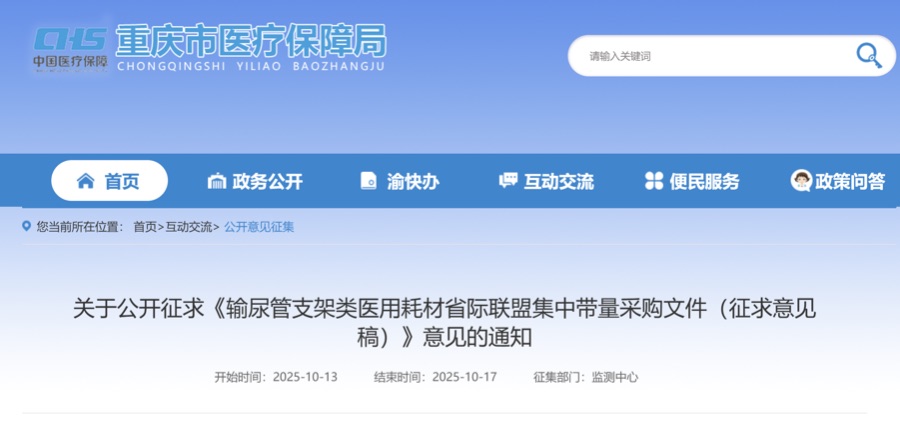
26省泌尿耗材集采再推进,国产企业加速布局
2 1 Shi Ji Jing Ji Bao Dao· 2025-10-15 10:25
Core Viewpoint - The centralized procurement of urological medical consumables in China is entering a new phase, with a focus on reasonable pricing and the promotion of domestic products, which may lead to significant market changes and opportunities for local manufacturers [3][8][10]. Group 1: Centralized Procurement Initiatives - The Chongqing Medical Security Bureau has initiated a public consultation for the centralized procurement of ureteral stents, covering 26 provinces including Chongqing, Tianjin, and Hebei [3][4]. - The procurement process is part of a broader trend towards institutionalized centralized purchasing of medical consumables in China, aiming to stabilize market expectations and reduce excessive competition [3][6]. - The procurement will categorize products based on material and features, with a focus on ensuring fair competition and preventing price wars [7][8]. Group 2: Market Dynamics and Trends - The urological medical consumables market is expected to undergo structural adjustments, with a shift from imported brands to domestic alternatives, particularly in high-end products like alloy stents [3][10]. - The global urology device market is projected to grow from $40.8 billion in 2024 to $65.9 billion by 2032, indicating significant market potential for domestic companies [9]. - Domestic companies such as Weili Medical, Huitai Medical, and Ruibang Medical are increasingly gaining market share through innovation and product development, with notable revenue growth reported [10][11]. Group 3: Impact on Domestic Companies - Huitai Medical reported a 135.05% year-on-year increase in revenue from non-vascular interventional products, highlighting the growing demand for domestic urological products [10][11]. - Weili Medical's urological product revenue reached 216 million yuan in 2024, marking a 6.22% increase, indicating a strong performance in the domestic market [10][11]. - Ruibang Medical has achieved significant technological advancements, with 42 product registration certificates and 12 CE certifications, showcasing its competitive edge in high-value consumables [11][12].

联盟耗材集采“玩法”升级:5类耗材纳入,国产品牌能否翻身?
2 1 Shi Ji Jing Ji Bao Dao· 2025-09-22 09:00
Core Viewpoint - The recent centralized procurement initiative for medical consumables, including sutures, led by a coalition of 23 provinces and the Xinjiang Production and Construction Corps, aims to reduce prices and increase market competition, potentially benefiting domestic manufacturers and challenging foreign brands' market dominance [1][8]. Group 1: Procurement Details - The procurement alliance consists of 23 provinces and the Xinjiang Production and Construction Corps, focusing on five categories of medical consumables, including sutures and syringes, with a procurement cycle of three years [1]. - The total procurement volume for sutures is set at 60.688 million units, with the annual market size for sutures exceeding 8 billion yuan, where foreign brands currently hold over 75% market share [2][8]. Group 2: Price Adjustments - The maximum effective bid prices for several products have been increased, such as absorbable sutures rising from 98.44 yuan to 126.53 yuan, and non-absorbable sutures from 50.91 yuan to 73.25 yuan, providing better profit protection for companies [2]. - The procurement rules have been refined to encourage competitive pricing, with a focus on ensuring that the selected companies maintain a balanced structure, allowing both mainstream and domestic brands to participate [4]. Group 3: Market Impact - The centralized procurement is expected to significantly reduce prices, with previous rounds showing an average price drop of 62.21% for high-value consumables, potentially saving over 1 billion yuan for the participating provinces [3]. - Domestic brands are anticipated to leverage price advantages to capture market share from foreign brands, which have historically dominated the market due to their technological edge and established presence [4][8]. Group 4: Challenges for Companies - As procurement rules become more complex, companies face increased pressure to enhance their bidding capabilities, with some smaller firms struggling to navigate the new regulations [5][6]. - Companies must improve their policy interpretation skills, optimize pricing strategies, and ensure product quality and supply stability to succeed in the competitive procurement environment [6]. Group 5: Future Opportunities - The adjustments in pricing coefficients for various products indicate a focus on profitability, with many coefficients showing an upward trend, which could influence companies' pricing strategies [7]. - The scale of this procurement initiative, covering 23 provinces and involving billions in procurement volume, presents a significant opportunity for domestic brands to break into the market and challenge foreign dominance [7].
惠泰医疗股价微跌0.45%,总经理拟减持不超过2%股份
Sou Hu Cai Jing· 2025-08-13 13:04
Group 1 - The core viewpoint of the news is that Huatai Medical's stock price has experienced a slight decline, and the company is undergoing a significant share reduction by its vice chairman and general manager due to personal financial needs [1] - As of August 13, 2025, Huatai Medical's stock price is reported at 296.93 yuan, down 0.45% from the previous trading day, with a trading volume of 4.09 billion yuan and a turnover rate of 0.99% [1] - Huatai Medical operates in the medical device sector, focusing on the research, production, and sales of cardiac electrophysiology and interventional medical devices, making it a key player in the domestic market [1] Group 2 - The vice chairman and general manager, Cheng Zhenghui, plans to reduce his holdings by up to 2% of the total share capital, amounting to 282.03 million shares, with the reduction period set from September 3 to December 2, 2025 [1] - Recent developments in the medical consumables procurement process are ongoing, affecting high-value consumables such as inferior vena cava filters and ablation electrodes, which may alter the competitive landscape of the industry [1] - On August 13, 2025, Huatai Medical saw a net inflow of 743,900 yuan in main funds, with a cumulative net inflow of 11.39 million yuan over the past five days [2]

耗材集采密集来袭,双联盟搅动千亿市场格局
2 1 Shi Ji Jing Ji Bao Dao· 2025-08-13 10:12
Core Insights - The recent centralized procurement of medical consumables in China marks a significant shift from fragmented pricing to collaborative purchasing, impacting market dynamics and competition among companies [1][5][11] Group 1: Low-Value Consumables Procurement - On August 11, a procurement alliance involving 24 provinces initiated centralized purchasing for low-value medical consumables, including sutures and syringes, with an estimated procurement scale exceeding 100 billion yuan [2][4] - The procurement volume for syringes alone is projected to exceed 6.5 billion yuan, while vacuum blood collection tubes and related needles are expected to reach around 3 billion yuan [2] - This procurement strategy aims to enhance cost control among companies, potentially increasing industry concentration from 30% to over 60% [5][6] Group 2: High-Value Consumables Procurement - Concurrently, a procurement initiative for high-value consumables, focusing on vena cava filters and ablation electrodes, was launched by 22 provinces, covering over 1 billion people [7][10] - The market for microwave ablation is projected to grow from 3.87 billion yuan in 2023 to 5.07 billion yuan in 2024, indicating significant opportunities for domestic brands to capture market share [9][10] - The procurement rules emphasize quality over price, requiring companies to justify pricing and avoid below-cost bids, which could benefit domestic manufacturers in the vena cava filter market [11] Group 3: Market Dynamics and Implications - The centralized procurement is expected to accelerate the consolidation of the low-value consumables market, pushing out less competitive small and medium-sized enterprises [5][6] - The procurement process is designed to balance competition among leading firms while providing opportunities for smaller companies, ensuring a more equitable market landscape [4][11] - Overall, the shift towards centralized procurement signifies a transition from cost reduction to quality enhancement in the medical consumables sector, benefiting both the industry and patients [11]

深圳首创“密网支架”省级集采!均价由11万元降至6万元
Nan Fang Du Shi Bao· 2025-06-25 13:56
Core Points - The procurement of "flow-directed mesh stents" led by the Shenzhen Medical Insurance Bureau resulted in an average price reduction of 42.82%, with the highest reduction reaching 63.16% [1] - The average price of the stents decreased from approximately 110,000 yuan to about 60,000 yuan, significantly alleviating the financial burden on patients and allowing more patients to access better treatment [1] - The innovative procurement model involved a "post-reporting" method, ensuring that selected products better meet clinical needs and quality standards, while also providing new products ample time to enter the market [2] Group 1 - The procurement process was supported by the provincial medical insurance bureau and aimed to share the price reduction benefits across public medical institutions in Guangdong Province, potentially reducing patient medical expenses by 119 million yuan annually [1] - The procurement cycle was shortened by 50% through a collaborative approach that considered clinical demand, market share, and expert advice, stabilizing enterprise expectations [1] - Since its establishment, the Shenzhen Medical Insurance Bureau has implemented various measures to reduce patient costs, totaling 17.109 billion yuan [2]

陕西留置针和泡沫敷料集采开锣 持续加速行业国产化率
2 1 Shi Ji Jing Ji Bao Dao· 2025-06-04 10:09
Core Insights - The ongoing centralized procurement of low-value medical consumables, such as indwelling needles and foam dressings, aims to enhance market penetration and domestic production rates, allowing domestic companies to gain a larger market share through innovation and cost control [1][2] Group 1: Procurement Mechanism - The procurement method for indwelling needles is based on "volume-linked" pricing, which considers the purchasing entity's usage needs and market price levels to determine selected products and procurement volumes [1] - The centralized procurement mechanism aims to standardize the quality and pricing of low-value medical consumables, addressing issues of quality inconsistency and price disparities in the market [2][7] Group 2: Economic Impact - The centralized procurement has significantly reduced costs for patients and medical institutions, with examples showing that the cost of hip joint replacement surgery dropped from approximately 80,000 yuan to 30,000 yuan post-procurement [3] - The implementation of centralized procurement has led to increased surgical volumes in hospitals, with one hospital reporting an increase from 4,500 to 6,700 surgeries annually, resulting in a 12% increase in physician income [3] Group 3: Market Dynamics - The market is witnessing a shift in commercial rules, with reduced profit margins for manufacturers and the exit of many intermediaries, prompting companies to adopt stricter cost control and efficiency measures [5] - The competitive landscape is evolving, with foreign companies actively participating in the market and leveraging centralized procurement as an opportunity for innovation and market expansion [6][7] Group 4: Innovation and Development - Companies are expected to increase R&D investments to introduce new products and technologies that meet market and clinical demands, with a focus on diversifying and differentiating their offerings [6] - The export of low-value medical consumables is on the rise, contributing to the long-term stable development of the industry, with leading companies like Weigao Group and Blue Sail Medical leveraging scale, innovation, and brand advantages [6]

医用耗材集采深化进行时:企业加速转型,外拓市场寻新机
2 1 Shi Ji Jing Ji Bao Dao· 2025-05-14 05:07
Group 1 - The article highlights the ongoing deepening of medical consumables procurement across various regions in China, with both high-value and low-value consumables being involved in the collection process [1][3] - Specific procurement initiatives have been launched in multiple cities in Fujian province, including Xiamen and Ningde, focusing on various medical consumables such as blood pressure sensors and intravenous nutrition bags [1] - National-level procurement projects are expected to continue advancing, with plans for collective procurement of items like aortic stents and cerebrospinal fluid shunt systems anticipated to start in 2025 [3] Group 2 - Companies are adjusting their strategies in response to the normalization of procurement, with opportunities for domestic medical device manufacturers to upgrade and innovate [2] - Leading companies have achieved growth despite the challenging environment, with Weigao Orthopedics reporting a nearly fourfold increase in revenue from related product lines after expanding its hospital coverage [4] - Guichuang Tongqiao has successfully participated in multiple procurement rounds, securing top rankings for its products, indicating a successful adaptation to the procurement landscape [4] Group 3 - Some companies are accelerating their international expansion, with Guichuang Tongqiao focusing on overseas markets and achieving regulatory approvals for numerous products [5] - Other firms, like Spring Medical, are pivoting away from traditional markets, opting for innovative fields such as dental 3D printing and surgical robotics, which are not yet subject to procurement policies [7] - The trend of "going out" is becoming common among companies, with Lanfan Medical increasing its overseas revenue share to 40% and expanding its global footprint through acquisitions [7] Group 4 - A strategy of targeting lower-tier markets is being adopted by some companies, shifting focus to county hospitals and private medical institutions to avoid competition in top-tier hospitals [8] - Industry consolidation is expected, with predictions of smaller companies being acquired by larger players, which could enhance overall competitiveness and optimize industry structure [8] - The evolving landscape of procurement is reshaping the industry, necessitating that both leading and non-winning companies choose suitable development paths, with innovation, market penetration, international expansion, and industry consolidation being key strategic directions [8]