
向量数据库

Search documents
万字长文!RAG实战全解析:一年探索之路
自动驾驶之心· 2025-08-07 09:52
Core Viewpoint - The article discusses the Retrieval Augmented Generation (RAG) method, which combines retrieval-based models and generative models to enhance the quality and relevance of generated text. It addresses issues such as hallucination, knowledge timeliness, and long text processing in large models [1]. Group 1: Background and Challenges - RAG was proposed by Meta in 2020 to enable language models to access external information beyond their internal knowledge [1]. - RAG faces three main challenges: retrieval quality, enhancement process, and generation quality [2]. Group 2: Challenges in Retrieval Quality - Semantic ambiguity can arise from vector representations, leading to irrelevant results [5]. - User input has become more complex, transitioning from keywords to natural dialogue, which complicates retrieval [5]. - Document segmentation methods can affect the matching degree between document blocks and user queries [5]. - Extracting and representing multimodal content (e.g., tables, charts) poses significant challenges [5]. - Integrating context from retrieved paragraphs into the current generation task is crucial for coherence [5]. - Redundancy and repetition in retrieved content can lead to duplicated information in generated outputs [5]. - Determining the importance of multiple retrieved paragraphs for the generation task is challenging [5]. - Over-reliance on retrieval content can exacerbate hallucination issues [5]. - Irrelevance of generated answers to the query is a concern [5]. - Toxicity or bias in generated answers is another issue [5]. Group 3: Overall Architecture - The product architecture consists of four layers, including model layer, offline understanding layer, online Q&A layer, and scenario layer [7]. - The RAG framework is divided into three main components: query understanding, retrieval model, and generation model [10]. Group 4: Query Understanding - The query understanding module aims to improve retrieval by interpreting user queries and generating structured queries [14]. - Intent recognition helps select relevant modules based on user queries [15]. - Query rewriting utilizes LLM to rephrase user queries for better retrieval [16]. - Query expansion breaks complex questions into simpler sub-questions for more effective retrieval [22]. Group 5: Retrieval Model - The retrieval model's effectiveness depends on the accuracy of embedding models [33]. - Document loaders facilitate loading document data from various sources [38]. - Text converters prepare documents for retrieval by segmenting them into smaller, semantically meaningful chunks [39]. - Document embedding models create vector representations of text to enable semantic searches [45]. - Vector databases support efficient storage and search of embedded data [47]. Group 6: Generation Model - The generation model utilizes retrieved information to generate coherent responses to user queries [60]. - Different strategies for prompt assembly are employed to enhance response generation [62][63]. Group 7: Attribution Generation - Attribution in RAG is crucial for aligning generated content with reference information, ensuring accuracy [73]. - Dynamic computation methods can enhance the generation process by matching generated text with reference sources [76]. Group 8: Evaluation - The article emphasizes the importance of defining metrics and evaluation methods for assessing RAG system performance [79]. - Various evaluation frameworks, such as RGB and RAGAS, are introduced to benchmark RAG systems [81]. Group 9: Conclusion - The article summarizes key modules in RAG practice and highlights the need for continuous research and development to refine these technologies [82].

数据治理对人工智能的成功至关重要
3 6 Ke· 2025-07-21 03:09
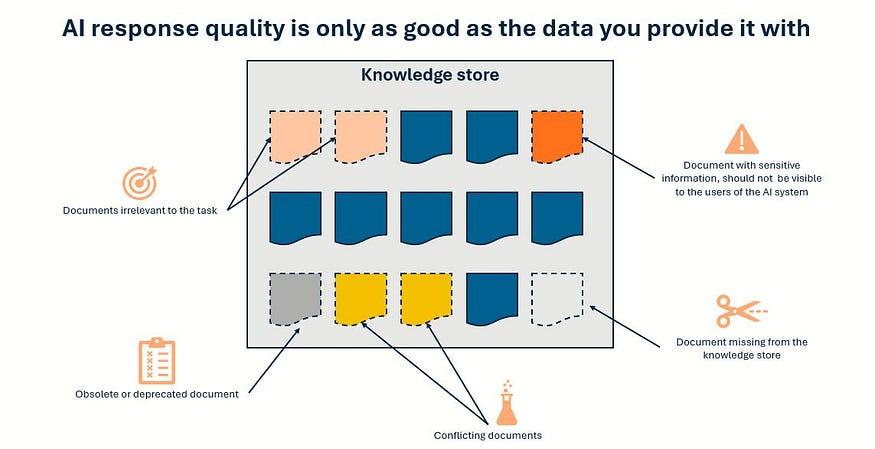
Group 1 - The emergence of large language models (LLMs) has prompted various industries to explore their potential for business transformation, leading to the development of numerous AI-enhancing technologies [1] - AI systems require access to company data, which has led to the creation of Retrieval-Augmented Generation (RAG) architecture, essential for enhancing AI capabilities in specific use cases [2][5] - A well-structured knowledge base is crucial for effective AI responses, as poor quality or irrelevant documents can significantly hinder performance [5][6] Group 2 - Data governance roles are evolving to support AI system governance and the management of unstructured data, ensuring the protection and accuracy of company data [6] - Traditional data governance has focused on structured data, but the rise of Generative AI (GenAI) is expanding this focus to include unstructured data, which is vital for building scalable AI systems [6] - Collaboration between business leaders, AI technology teams, and data teams is essential for creating secure and effective AI systems that can transform business operations [6]
现在做原生AI产品,产品经理会面临至少下面5个问题
3 6 Ke· 2025-06-30 00:53
Core Insights - The article discusses the challenges faced by product managers in developing AI products, highlighting three main limitations that need to be addressed for successful product positioning [1] Group 1: Types of AI Product Technologies - AI products can be categorized into two types based on their technology implementation: API-based and deployed AI models. Native AI products can utilize both, but they require a fundamental redesign of the product's interaction framework [2][4] - Native AI products must leverage a vector database for data management, which necessitates a shift from traditional relational databases to non-relational structures [4][5] Group 2: Product Development Challenges - The development of native AI products requires breaking through existing product design frameworks, allowing for AI-driven interactions rather than fixed functionality [3][6] - A significant challenge is the need for resource allocation from management to support new product lines, as many AI projects fail due to insufficient backing or unrealistic expectations [6][7] Group 3: Team Dynamics and Learning - There is a notable learning curve for teams, with over 60% of product managers reportedly lacking experience with advanced AI models, which can hinder development efforts [7] - The culture within large tech companies often promotes a competitive environment that encourages continuous learning and adaptation, which is crucial for the successful development of AI products [8]
对话Zilliz产品负责人郭人通:向量数据库将成为承接AI上下半场的“桥梁”
Zhong Guo Jing Ying Bao· 2025-04-24 07:48
随着近年来企业数字化转型的深入,海量非结构化数据的处理与价值挖掘成为企业竞争的关键。据 Gartner测算,从2019年到2024年,包括各类文本、图片、视频、音频在内的非结构化数据容量增加了2 倍。企业花费大量成本长期存放这些数据,却常未能带来满意的附加价值。 而在生成式AI出现后,企业数据的灵活管理与价值释放,正在进一步变得便捷。如何借助AI将其转化 为可落地的应用,也成为企业能否赢得AI时代主动权的关键命题。 在近日举办的亚马逊云科技出海大会上,作为开源向量数据库Milvus的缔造者的Zilliz合伙人与产品负责 人郭人通向《中国经营报》记者表示,Zilliz正在通过亚马逊云科技提供的全球基础设施和生成式AI能 力,为各类企业构建多样化、高可用、合规且可扩展的向量数据库解决方案,助力企业高效应对AI时 代的挑战。 "如果把人工智能的发展分为上、下半场,上半场主要是利用大规模数据训练AI能力;而下半场,则是 AI能力反过来深入行业,产生海量关键数据。企业更需关注如何挖掘数据价值,实现AI应用快速落 地。"郭人通表示。 构建AI数据新基建:向量数据库的全球化演进 在郭人通看来,承接上、下半场趋势的"桥梁", ...

中国数据库行业分析报告:AI加速,颠覆创新
墨天轮· 2025-03-07 07:58
Investment Rating - The report does not explicitly state an investment rating for the database industry. Core Insights - The Chinese distributed transaction database software market is projected to reach $1.5 billion in the first half of 2024, reflecting an 18.5% year-on-year growth, with public cloud market share at 61.2% [4][38] - OceanBase and GoldenDB are gaining traction in the market, with OceanBase scoring over 700 points and GoldenDB showing significant improvements in its latest version [7][10] - The integration of large language models (LLMs) with database technologies is highlighted as a key trend, showcasing practical applications and collaborations [5][19] Summary by Sections 1. February Database Rankings Interpretation - OceanBase leads the rankings with a score of 753.90, followed by PolarDB at 632.21 and GaussDB at 630.44 [8][9][11] - GoldenDB and Kingbase also show strong performances, with scores of 621.23 and 611.62 respectively, indicating their growing market presence [10][11] 2. Database Industry News and Dynamics - The report notes the release of Oracle's Exadata X11M, which boasts over a 55% performance improvement compared to its predecessor [43][44] - The market is increasingly competitive, with major players like Alibaba Cloud, Tencent, and Huawei dominating the landscape [38][40] 3. LLM + Database - The report discusses the synergy between LLMs and databases, emphasizing the role of vector databases as optimal partners for LLM applications [5][19] 4. Typical Cases of Chinese Database Products - The report highlights significant procurement activities in January 2025, with domestic databases winning contracts exceeding 100 million yuan, particularly in the finance and government sectors [23][24][27] - Notable projects include the procurement of GoldenDB by Guangfa Bank for approximately 34.89 million yuan and various projects involving OceanBase [23][24][27]