
国有资产证券化

Search documents
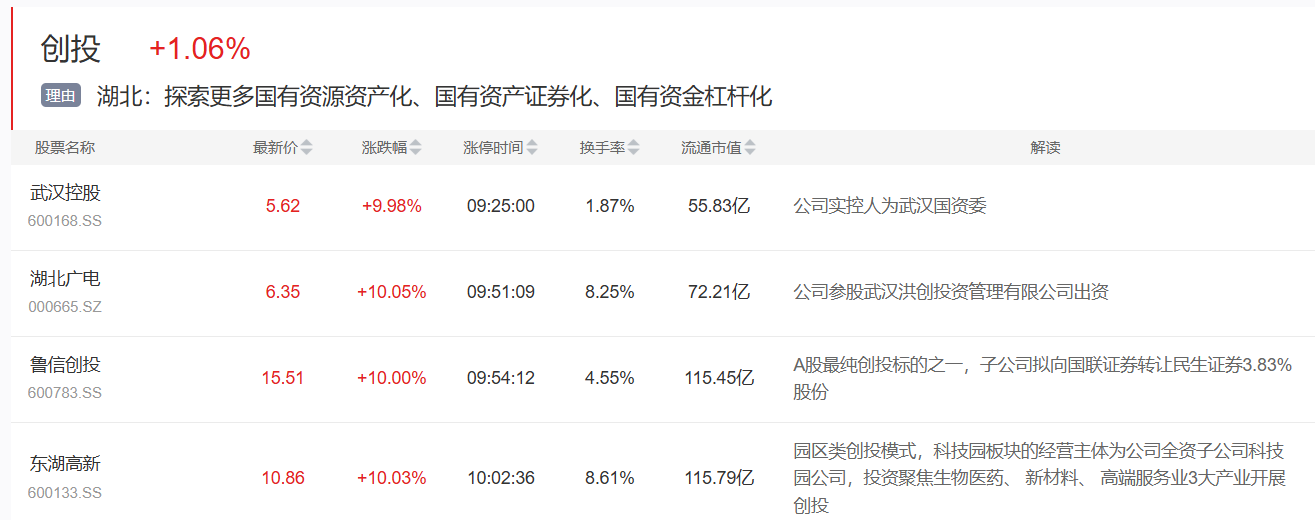
【大涨解读】国企改革:湖北打响“三资改革”又一枪,地方国资证券化比例提升空间仍大,机构预计央国企并购重组在“十五五”还有新进展
Xuan Gu Bao· 2025-10-21 02:46
Market Overview - On October 21, several stocks in Hubei, including Hubei Broadcasting, Huilv Ecology, Donghu Gaoxin, and others, experienced a collective surge, with many reaching their daily limit [1] - Notable increases were also observed in investment companies such as Luxin Venture Capital and China High-Tech [1] Event: Deepening State-Owned Asset Management Reform in Hubei - Hubei is focusing on the principles of assetization, securitization, and leveraging of state-owned resources, aiming to deepen the management reform of state-owned "three assets" [3] - As of the end of September, the total amount of state-owned "three assets" in Wuhan exceeded 6 trillion yuan, with 206.15 billion yuan of assets revitalized and 111.05 billion yuan in revitalization income achieved [3] Institutional Insights - The dividend retention effect of central enterprises is significant, with the proportion of local state-owned enterprises' securitization having greater potential for increase [4] - It is expected that mergers and acquisitions among central state-owned enterprises will progress during the 14th Five-Year Plan, driven by various factors including optimization of traditional businesses and exploration of new sectors [4] - The emergence of "state-owned + industry" acquisition models is noted, with an increase in local state-owned enterprises partnering with industrial capital to enter the A-share market [4] - In Xinjiang, state-owned enterprises are both beneficiaries of regional development and participants in business restructuring, with significant potential for asset integration and management optimization [4]


千金药业收购2家子公司股权 加速旗下资源整合
Zheng Quan Ri Bao Wang· 2025-09-14 08:49
Group 1 - Zhuzhou Qianjin Pharmaceutical Co., Ltd. received approval from the China Securities Regulatory Commission to acquire 28.92% of Hunan Qianjin Xiangjiang Pharmaceutical Co., Ltd. and 68.00% of Hunan Qianjin Xieli Pharmaceutical Co., Ltd. through a combination of share issuance and cash payment [1] - The transaction aims to enhance the control of Zhuzhou Guotou over the listed company, increasing its shareholding from 28.76% to 34.94%, which supports stable governance and control of the listed company [1] - The effects of policies such as the "Eight Articles for the Sci-Tech Innovation Board" and "Six Articles for Mergers and Acquisitions" are becoming evident, with 27 merger and reorganization projects accepted and 15 approved by the review committee since 2025, surpassing last year's total [1] Group 2 - The Shanghai Stock Exchange is focused on improving the efficiency of reorganization reviews, with several innovative and exemplary merger and reorganization cases being implemented, such as the mergers involving Silyus and Sanyou Medical [2] - Notable cases include the acquisition of Chiplink Integrated by Chiplink Yuezhou, the largest merger project in A-shares involving China Shipbuilding and China Shipbuilding Heavy Industry, and cross-industry mergers by Songfa Co. and cross-border mergers by Zhizheng Co. [2]

ST联合: 国旅文化投资集团股份有限公司收购报告书摘要
Zheng Quan Zhi Xing· 2025-08-25 17:14
Core Viewpoint - The acquisition of 51% of Jiangxi Runtian Industrial Co., Ltd. by Guotour Cultural Investment Group Co., Ltd. aims to enhance the company's competitiveness in the tourism consumption sector and improve its financial performance through the integration of quality assets in the packaged drinking water industry [10][11]. Group 1: Acquisition Details - The acquisition involves issuing shares and cash payments, with 70% of the payment in shares and 30% in cash [10]. - The acquisition is subject to approval from the shareholders' meeting, the Shanghai Stock Exchange, and the China Securities Regulatory Commission [10][12]. - The acquisition is expected to be completed after obtaining the necessary approvals, which may have uncertain timelines [10][12]. Group 2: Financial Overview of Jiangxi Maitong - Jiangxi Maitong's total assets as of December 31, 2024, are projected to be approximately 1.1 billion yuan, with owner equity of about 1.02 billion yuan [3]. - The company has reported a net profit of approximately 32.98 million yuan for 2024, with a net asset return rate of 3.22% [3][4]. - The asset-liability ratio is low at 6.75%, indicating a strong financial position [4]. Group 3: Financial Overview of Jiangxi Tourism Group - Jiangxi Tourism Group's total assets are projected to reach approximately 157.11 billion yuan by December 31, 2024, with owner equity of about 2.15 billion yuan [6]. - The company has reported a net loss of approximately 514.43 million yuan for 2024, with a negative net asset return rate of -23.88% [6]. - The asset-liability ratio stands at 86.29%, indicating a high level of debt [6]. Group 4: Strategic Objectives of the Acquisition - The acquisition aims to enhance the company's product ecosystem and improve its market competitiveness by integrating Runtian's quality assets [10][11]. - It is expected to significantly improve the company's profitability and investment value, maximizing shareholder interests [11]. - The transaction aligns with national and provincial government initiatives for state-owned enterprise reform and asset securitization [11]. Group 5: Stakeholder Information - Jiangxi Maitong is primarily controlled by Jiangxi Jianyin Tourism Industry Development Investment Center, with a 97.09% stake [2]. - Jiangxi Tourism Group is fully owned by Jiangxi Longtian Tourism Group, which is also controlled by the Jiangxi Provincial State-owned Assets Supervision and Administration Commission [3][6]. - Nanchang Jianglv Asset Management Co., Ltd. is another stakeholder, with a 90% stake held by Jiangxi Longtian Tourism Group [7].

湖北给国企土地上户口 六项试点任务盘活存量土地
Chang Jiang Shang Bao· 2025-07-02 23:43
Core Viewpoint - The Hubei Provincial Natural Resources Department has issued a plan to revitalize idle and inefficient land resources to enhance the efficiency of state-owned assets, focusing on the goals of asset capitalization, asset securitization, and leveraging state funds [1][6]. Group 1: Land Resource Management - The plan emphasizes a comprehensive inventory of state-owned enterprises' land assets, including ownership, area, purpose, location, and current utilization, to create a dynamic management system [2][6]. - Historical issues related to land rights will be addressed, allowing state-owned enterprises to apply for land use rights based on current conditions, thus resolving the "land without certificate" problem [2][3]. Group 2: Industrial Land Utilization - The plan allows for the expansion of industrial land use without increasing land price payments, promoting multi-functional industrial buildings and supporting the development of existing industrial land for increased production capacity [3][4]. - State-owned enterprises are encouraged to redevelop existing land through various methods, including self-initiated projects and government-led land reallocation [3]. Group 3: Asset Securitization - The plan supports the issuance of Real Estate Investment Trusts (REITs) to convert heavy assets into publicly tradable financial products, enhancing liquidity and value realization of land assets [4][5]. - Approximately 500,000 acres of land in Hubei are estimated to be eligible for revitalization, potentially supporting a financing scale of nearly 200 billion yuan through securitization [4]. Group 4: Financial Leverage - The activation of land capital is expected to leverage greater social capital through multiplier effects, facilitating the transformation of resources into assets and then into capital [5][6]. - The plan aims to create a systematic mechanism for resource confirmation, asset visibility, and capital flow, which is seen as a significant innovation with broader implications beyond the region [6].