基于自然的解决方案(NbS)

Search documents
人海和谐 共生共荣
Zhong Guo Zi Ran Zi Yuan Bao· 2025-06-12 06:29
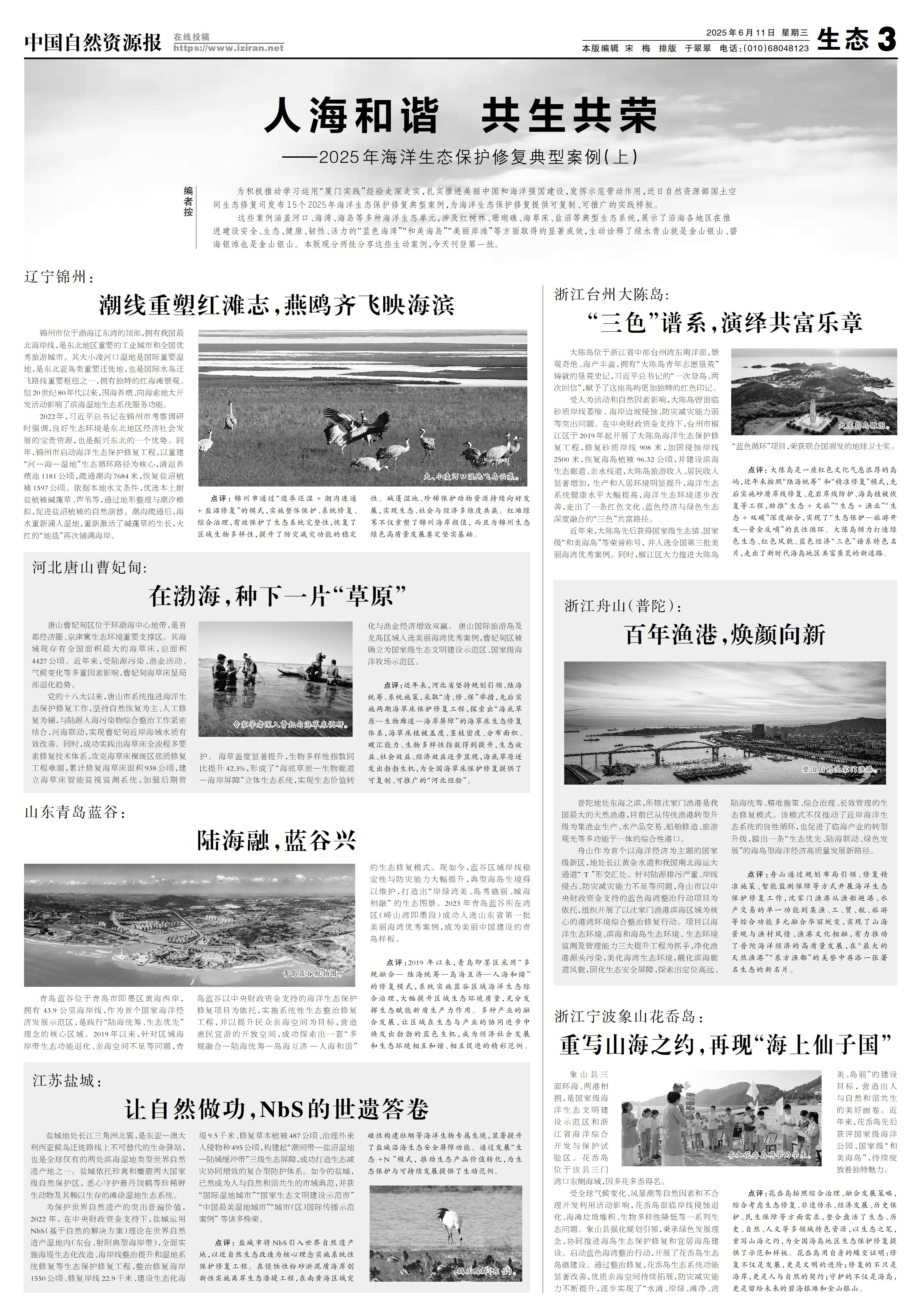
Group 1 - The article emphasizes the promotion of marine ecological protection and restoration through 15 typical cases released by the Ministry of Natural Resources, showcasing replicable practices for building a beautiful China and a strong marine nation [1] - The cases cover various marine ecological units such as estuaries, bays, and islands, highlighting significant achievements in creating safe, ecological, healthy, resilient, and vibrant coastal areas [1] Group 2 - Jinzhou City has initiated a marine ecological protection and restoration project focusing on rebuilding the "river-sea-wetland" ecological cycle, which includes the removal of 1,181 hectares of aquaculture ponds and the restoration of 1,597 hectares of salt marsh vegetation [9][10] - The project has effectively protected ecosystem integrity, restored regional biodiversity, and enhanced disaster prevention capabilities, leading to a multi-dimensional win in ecological, social, and economic aspects [10] Group 3 - Tangshan Caofeidian has the largest seagrass bed in China, covering 4,427 hectares, but has faced degradation due to pollution and climate change [13] - The city has implemented a comprehensive marine ecological protection and restoration strategy, achieving a restoration of 938 hectares of seagrass bed and a 42.3% increase in biodiversity index [14] Group 4 - Qingdao Blue Valley, as the first national marine economic development demonstration zone, has implemented a systematic ecological restoration project since 2019, significantly improving coastal stability and disaster prevention capabilities [17][18] - The area has been recognized as an excellent case for beautiful bays in Shandong Province, showcasing a harmonious relationship between ecological and economic development [18] Group 5 - Yancheng, a world natural heritage site, has implemented nature-based solutions (NbS) for ecological restoration, including the rehabilitation of 1,550 hectares of coastline and the construction of a three-tier ecological barrier [19][20] - The city has received multiple honors for its ecological achievements, demonstrating a successful model for sustainable development [20] Group 6 - Dachen Island has undergone significant ecological restoration since 2019, including the repair of 908 meters of sandy coastline and the restoration of 96.32 hectares of island vegetation, leading to increased tourism and improved living conditions [24][25] - The island has been recognized for its integration of red culture, blue economy, and green ecology, creating a model for sustainable development [25] Group 7 - Zhoushan, with its largest natural fishing port, has transformed into a multifunctional port through comprehensive environmental restoration efforts, addressing pollution and enhancing disaster prevention capabilities [27][28] - The port's transformation has led to a high-quality development path for the marine economy, integrating ecological priorities with industrial upgrades [28] Group 8 - Xiangshan Huai'ao Island has faced ecological challenges but has implemented a blue bay restoration action plan, significantly improving its ecological functions and enhancing disaster prevention capabilities [32][33] - The island has received national recognition for its ecological achievements, serving as a model for ecological protection and restoration in coastal areas [33]

2025年海洋生态保护修复典型案例发布
Yang Shi Wang· 2025-06-08 09:07
Core Viewpoint - The Ministry of Natural Resources of China has released 15 typical cases of marine ecological protection and restoration, showcasing various marine ecological units and systems, providing replicable and promotable practical models for marine ecological protection and restoration [1][2][3] Group 1: Marine Ecological Restoration Cases - Liaoning Province's Jinzhou City employs a model of "retirement of aquaculture to restore wetlands + tidal channel connectivity + salt marsh restoration," achieving comprehensive protection and systematic restoration [1] - Hebei Province's Tangshan City, home to the largest seagrass bed in China, has developed a three-dimensional ecological system that integrates "seagrass meadows + biological corridors + coastal barriers," enhancing ecological value and fisheries economic benefits [1] - Qingdao Blue Valley, as the first national marine economic development demonstration zone, implements comprehensive marine ecological governance, forming a model of "multi-plan integration - land-sea coordination - island-sea mutual assistance - human-sea harmony" [1] - Jiangsu Province's Yancheng City introduces "Nature-based Solutions (NbS)" in a world natural heritage site, conducting near-natural ecological transformation, providing a model for ecological protection and sustainable development [1] - Zhejiang Province's Taizhou City on Dachen Island achieves a virtuous cycle of "ecological protection + tourism development + funding feedback" through land-sea coordination and precise restoration [1] Group 2: Additional Marine Ecological Restoration Initiatives - Zhejiang Province's Zhoushan City, as the first national-level new area themed on marine economy, implements measures such as pollution interception and shoreline restoration, creating a harmonious "Eastern Fishing Capital" [2] - Ningbo City on Huajia Island promotes both ecological restoration and livable island construction, setting an example for national island regions [2] - Pingtan Comprehensive Experimental Zone in Fujian combines ecological restoration with disaster prevention and cultural tourism development, establishing a multi-dimensional restoration pattern [2] - Putian City in Fujian, as a cultural origin of Mazu and a key node of the ancient Maritime Silk Road, utilizes systematic restoration and cultural integration to promote ecological civilization [2] - Zhuhai City in Guangdong adopts a "public welfare + tourism" model to attract social capital, exploring new paths for the protection and utilization of uninhabited islands [2] - Guangzhou City in Guangdong innovatively integrates mangrove ecological function enhancement with ecological landscape belt construction, exploring a marine ecological restoration model in highly urbanized areas [2] - Zhanjiang City in Guangdong balances livelihoods and ecology, exploring a coupling model of mangrove planting and ecological aquaculture, providing a practical example for "retirement of ponds to restore forests" [2] Group 3: Western Region Marine Ecological Restoration - Fangchenggang City in Guangxi, as an important gateway of the western land-sea new passage, enhances biodiversity through mangrove ecosystem restoration, showcasing China's marine ecological protection and restoration concepts [3] - Beihai City in Guangxi, home to the highest latitude coral reef group in China, employs legislation, technology empowerment, continuous restoration, and public participation to improve coral reef ecosystem quality and stability [3] - Lingshui County in Hainan enhances ecological environment quality and disaster prevention capabilities through comprehensive governance above and below the shore, continuously transforming lagoon ecological advantages into economic development advantages [3]
从雪山到实验室:贝泰妮用ESG实践擘画生物多样性保护的“中国方案”
Xin Lang Cai Jing· 2025-05-22 00:21
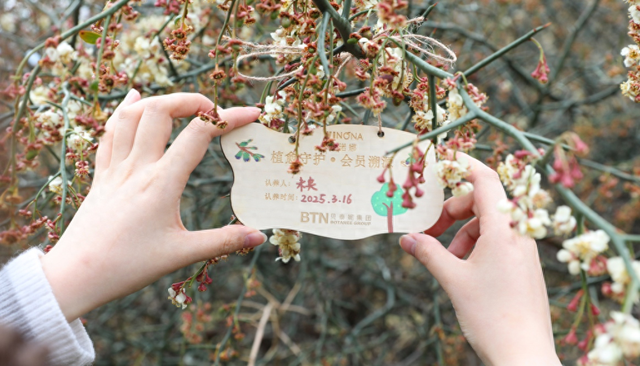
Core Viewpoint - The article emphasizes the importance of biodiversity and sustainable development, highlighting how companies like Betaini are integrating ESG principles into their strategies to promote ecological balance while achieving economic growth [1][15]. Group 1: Company Overview - Betaini is a health industry group focused on skin health, rooted in Yunnan, China, and is exploring harmonious coexistence with nature through sustainable practices [1]. - The company utilizes the unique properties of the Qingci fruit, which has over 70% unsaturated fatty acids, in developing skincare products, showcasing the potential for ecological protection and economic development to coexist [4][5]. Group 2: Research and Development - Betaini has established a plant extraction laboratory that has screened over 6,500 medicinal plants from Yunnan, leading to the development of numerous functional cosmetic ingredients [5][7]. - The company has actively participated in setting national and group standards, including 13 group standards related to the efficacy of Qingci fruit oil [7]. Group 3: Biodiversity and Sustainability Initiatives - Betaini's initiatives align with the United Nations' definition of nature-based solutions (NbS), focusing on the sustainable use and restoration of ecosystems [5]. - The company has implemented a multi-dimensional protection plan in the Haba Snow Mountain area, which includes training for forest protection and community involvement in biodiversity conservation [16][20]. Group 4: Industry Context - The global economic contribution of natural systems is approximately $125 trillion, with sustainable use of biodiversity being a crucial component [9]. - The Chinese regulatory framework is evolving, with new guidelines emphasizing the importance of biodiversity and ecosystem protection as strategic priorities for companies [15]. Group 5: Future Directions - Betaini aims to continue its commitment to sustainable development by integrating ESG principles deeply into its strategy, thereby enhancing its core competitiveness while contributing to global biodiversity governance [15][24].