守牢底线

Search documents
明年经济工作怎么干,记住“八个坚持”
Xin Hua She· 2025-12-11 12:04
Core Viewpoint - The Central Economic Work Conference has outlined eight key tasks for economic work in 2026, focusing on domestic demand, innovation, reform, openness, coordinated development, green transformation, improving people's livelihoods, and risk management [1] Group 1: Domestic Demand and Market Development - Emphasis on maintaining domestic demand as the primary driver and building a strong domestic market [1] Group 2: Innovation and New Momentum - Focus on innovation-driven strategies to cultivate and strengthen new growth drivers [1] Group 3: Reform and High-Quality Development - Commitment to reform efforts aimed at enhancing the vitality and momentum for high-quality development [1] Group 4: Openness and Cooperation - Advocacy for sustained openness to promote win-win cooperation across multiple fields [1] Group 5: Coordinated Development - Promotion of coordinated development to facilitate urban-rural integration and regional collaboration [1] Group 6: Green Transformation - Leadership in "dual carbon" initiatives to drive comprehensive green transformation [1] Group 7: Livelihood Improvement - Prioritization of people's livelihoods with efforts to address practical issues for the populace [1] Group 8: Risk Management - Focus on maintaining bottom lines and actively managing risks in key areas [1]

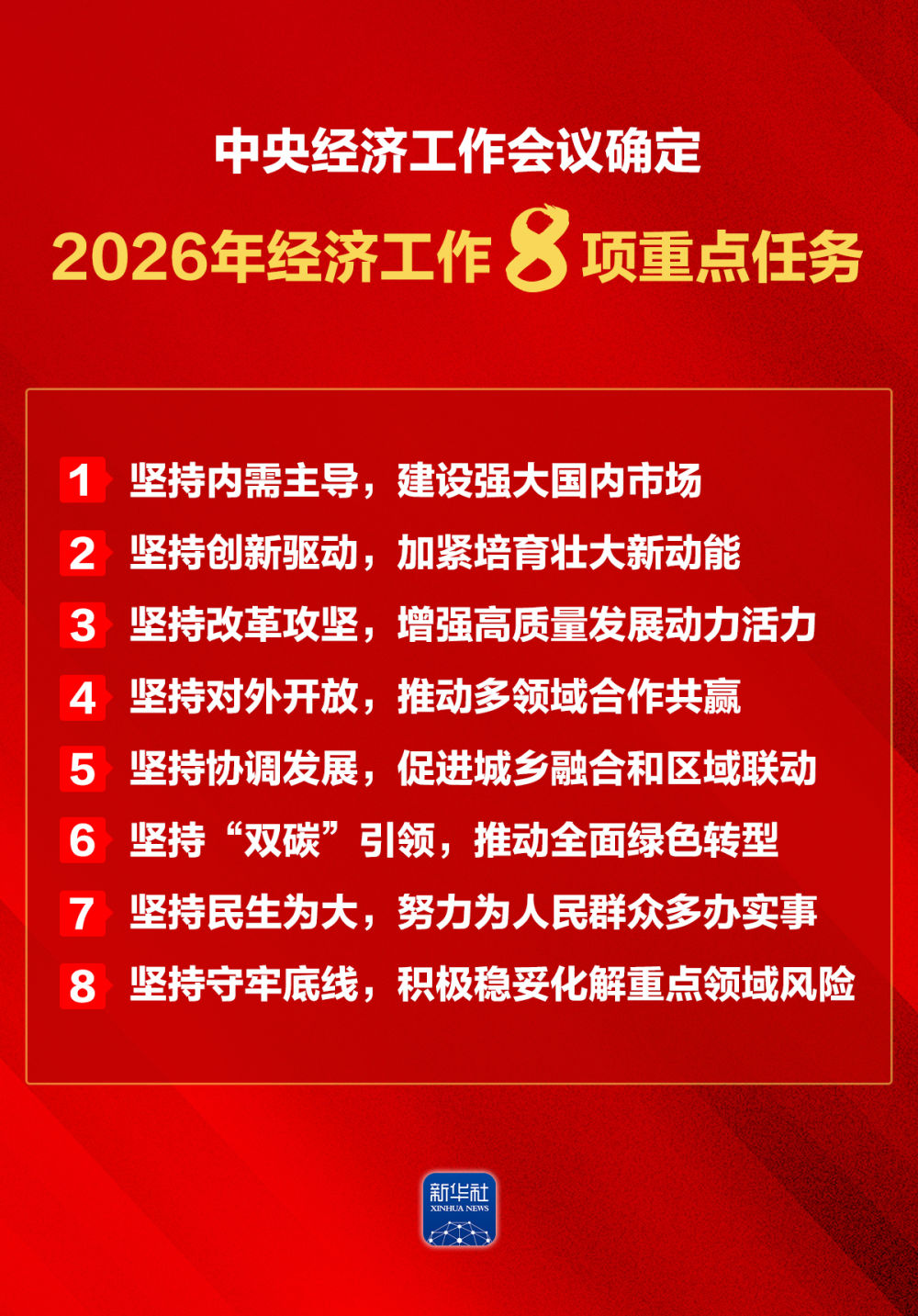
中央经济工作会议:确定明年八大重点任务
2 1 Shi Ji Jing Ji Bao Dao· 2025-12-11 11:21
Core Viewpoint - The Central Economic Work Conference held on December 10-11 in Beijing outlined key tasks for economic work in the coming year, emphasizing a focus on domestic demand, innovation, reform, openness, coordinated development, green transformation, people's livelihood, and risk management [1] Group 1: Economic Focus Areas - Emphasis on domestic demand as the main driver to build a strong domestic market [1] - Innovation-driven approach to accelerate the cultivation and growth of new economic drivers [1] - Commitment to reform efforts to enhance the vitality and momentum for high-quality development [1] Group 2: External Relations and Development - Focus on promoting cooperation and win-win outcomes in multiple fields through openness [1] - Coordination in development to promote urban-rural integration and regional linkage [1] Group 3: Sustainability and Social Welfare - Leadership in "dual carbon" initiatives to promote comprehensive green transformation [1] - Prioritization of people's livelihood with efforts to address practical issues for the populace [1] Group 4: Risk Management - Commitment to maintaining a bottom line by actively and prudently addressing risks in key areas [1]
华夏时评:以“积极宽松”政策锚定“八个坚持”
Hua Xia Shi Bao· 2025-12-11 11:16
Core Viewpoint - The central economic work conference held on December 10-11, 2023, emphasized the importance of utilizing fiscal and monetary policies effectively to achieve the goals set for 2026, marking the beginning of the "15th Five-Year Plan" [2][4]. Group 1: Economic Policy Direction - The conference reiterated the implementation of a more proactive fiscal policy and moderately loose monetary policy, aiming to enhance macroeconomic governance effectiveness [2][4]. - The "Eight Persistences" were highlighted as key strategies for economic work in 2026, focusing on domestic demand, innovation, reform, openness, coordinated development, carbon neutrality, people's livelihood, and risk management [3][4]. Group 2: Implementation Strategies - Fiscal and monetary policies are expected to work in tandem to support the "Eight Persistences," with fiscal funds directed towards infrastructure and innovation, while monetary policy aims to provide low-cost funding to high-tech enterprises [4][5]. - Specific measures include fiscal support for necessary reforms, maintaining a stable financial environment, and promoting regional balance and rural revitalization through targeted fiscal transfers [5][6]. Group 3: Long-term Goals - The success of China's economic development in 2026 will not solely be measured by GDP growth but also by the integration of macro policy resources with the strategic layout of the "Eight Persistences" [6]. - The proactive policies are seen as essential for navigating complex challenges and ensuring a strong start to the "15th Five-Year Plan" [6].