
居民人均可支配收入

Search documents
西藏2025年地区生产总值同比增长7%
Zhong Guo Xin Wen Wang· 2026-01-27 00:59
值得一提的是,2025年,西藏农村居民人均可支配收入达到全国平均水平的94.8%,比例较上年提高1.5 个百分点,与全国平均水平差距进一步缩小。西藏城乡居民收入比由上年的2.57下降至2.54,城乡收入 差距进一步缩小。 西藏自治区官方26日举行新闻发布会介绍,根据地区生产总值统一核算结果,2025年全区实现生产总值 3031.89亿元(人民币,下同),按不变价格计算,同比增长7%。西藏地区生产总值首次突破3000亿元大 关。 资讯编辑:刘佳惠 021-26093916 资讯监督:乐卫扬 021-26093827 资讯投诉:陈跃进 021-26093100 西藏自治区统计局局长田广华解读称,西藏地区生产总值跨越第一个千亿级台阶用了50年时间,跨越第 二个千亿级台阶用了6年时间,仅用了4年时间就再上一个千亿级台阶。2025年西藏全区经济运行呈现总 体平稳、稳中有进的良好态势。 免责声明:Mysteel发布的原创及转载内容,仅供客户参考,不作为决策建议。原创内容版权归Mysteel所有,转载需取得Mysteel书面授 权,且Mysteel保留对任何侵权行为和有悖原创内容原意的引用行为进行追究的权利。转载内容来源于 ...
GDP超3.37万亿元 同比增长5.3%
Xin Lang Cai Jing· 2026-01-26 16:55
1月26日,重庆市2025年"经济报表"出炉。总体来看,2025年全市各项政策协同发力,生产供给支撑稳 固,就业形势总体平稳,经济发展态势向新向好,社会大局和谐稳定。 2025年全市实现地区生产总值33757.93亿元 同比增长5.3% 其中,第一产业实现增加值2124.14亿元 同比增长3.7% 第二产业实现增加值11787.74亿元 同比增长4.0% 第三产业实现增加值19846.05亿元 同比增长6.2% 农 业 全年全市粮食产量1112.5万吨 比上年增长1.1% 蔬菜产量2526.5万吨 增长3.7% 全年全市猪肉产量157.7万吨 比上年增长3.6% 工 业 全年全市汽车产量278.77万辆 比上年增长9.7% 其中,新能源汽车129.61万辆 增长36.0% 服务业 全年全市服务业增加值 同比增长6.2% 1~11月,全市规模以上 服务业企业实现营业收入 6320.66亿元 同比增长9.7% 消 费 全年全市实现社会消费品 零售总额1.67万亿元 比上年增长3.1% 投 资 全年全市规模以上工业增加值 比上年增长5.9% 比上年增长4.7% 上游新闻-重庆晨报记者 郭发祥 全年全市固定资产投资 ...
2025年湖南全年居民人均可支配收入39545元
Xin Lang Cai Jing· 2026-01-26 15:53
1月26日上午,省政府新闻办举行2025年度全省经济社会发展情况新闻发布会。发布会上,国家统计局 湖南调查总队党组成员、副总队长龙立珍提到,2025年,湖南全年居民人均可支配收入39545元,比上 年增加1866元,增长5.0%。城镇居民人均可支配收入53369元,比上年增加2126元,增长4.1%;农村居 民人均可支配收入23501元,比上年增加1297元,增长5.8%。城乡居民人均可支配收入比为2.27,比上 年下降0.04,城乡居民收入相对差距进一步缩小。 ...
2025年全省经济运行总体平稳
Xin Lang Cai Jing· 2026-01-25 18:14
Economic Overview - In 2025, the overall economic operation of Liaoning Province is stable, with a GDP of 33,182.9 billion yuan, representing a 3.7% increase from the previous year [1] - The primary industry added value is 2,763.0 billion yuan, growing by 3.4%; the secondary industry added value is 11,027.6 billion yuan, growing by 0.7%; and the tertiary industry added value is 19,392.4 billion yuan, growing by 5.2% [1] Agricultural Performance - The primary industry saw a 3.4% increase in added value, with significant growth in planting, leading to a record grain output of 25,778 million tons, an increase of 3.1% [1] Retail and Consumption - The total retail sales of consumer goods reached 10,371.3 billion yuan, a 1.4% increase from the previous year, with urban retail sales at 9,004.3 billion yuan (up 1.5%) and rural retail sales at 1,366.9 billion yuan (up 1.0%) [1] - Retail sales of basic living goods grew rapidly, with grain and oil, and food retail sales increasing by 10.9%, and daily necessities retail sales growing by 8.2% [2] - There was a significant increase in the consumption of upgraded goods, with wearable smart devices sales increasing by 1,470%, computer and related products sales growing by 200%, and smartphone sales increasing by 110% [2] Income Growth - The per capita disposable income of residents reached 41,703 yuan, a 4.7% increase from the previous year, with urban residents earning 50,057 yuan (up 4.3%) and rural residents earning 23,942 yuan (up 5.3%) [2]
北京2025年全市地区生产总值5.2万亿元 增长5.4%
Xin Lang Cai Jing· 2026-01-25 01:47
Core Viewpoint - Beijing's GDP is projected to reach 5.2 trillion yuan by 2025, with a growth rate of 5.4%, which is 0.4 percentage points higher than the national average [1] Economic Indicators - General public budget revenue is expected to grow by 4.8% [1] - The urban survey unemployment rate is targeted at 4.1% [1] - Residents' per capita disposable income is projected to increase by 4.4% in real terms [1] Consumer and Production Metrics - Consumer prices are expected to remain stable overall [1] - Multiple indicators such as per capita GDP, overall labor productivity, and energy, water, and carbon emissions per ten thousand yuan of GDP are expected to maintain optimal levels among provincial regions in the country [1]
速读2026年北京市政府工作报告| 2025年北京市地区生产总值5.2万亿元
Bei Jing Shang Bao· 2026-01-25 01:20
Core Insights - The report highlights that Beijing's GDP reached 5.2 trillion yuan, with a growth rate of 5.4%, surpassing the national average by 0.4 percentage points [1] - Public budget revenue increased by 4.8%, while the urban unemployment rate stands at 4.1% [1] - The real disposable income per capita for residents grew by 4.4%, indicating stable overall consumer prices [1] - Multiple indicators, including per capita GDP, labor productivity, and energy and water consumption per unit of GDP, remain at the highest level among provincial regions in the country [1]
2025年陕西居民人均可支配收入同比增长5.6%
Shan Xi Ri Bao· 2026-01-25 00:18
Core Insights - In 2025, the per capita disposable income of residents in Shaanxi is projected to be 35,790 yuan, representing a nominal growth of 5.6% year-on-year, and a real growth of 5.3% after adjusting for price factors [1] - The growth rate of per capita disposable income in Shaanxi exceeds the national average by 0.6 percentage points [1] Income Growth - All four income sources have shown comprehensive growth: - Per capita wage income is expected to reach 19,420 yuan, an increase of 1,044 yuan or 5.7%, accounting for 54.3% of disposable income [2] - Per capita operating net income is projected at 4,553 yuan, up by 220 yuan or 5.1%, making up 12.7% of disposable income [2] - Per capita transfer net income is anticipated to be 9,719 yuan, increasing by 569 yuan or 6.2%, representing 27.2% of disposable income [2] - Per capita property net income is expected to be 2,097 yuan, rising by 52 yuan or 2.5%, which constitutes 5.9% of disposable income [2] Urban-Rural Income Disparity - The income growth rate for rural residents in Shaanxi is 1.2 percentage points higher than that of urban residents, with the urban-rural income ratio at 2.54, a decrease of 0.03 from the previous year [2] Consumption Expenditure - Per capita living consumption expenditure in Shaanxi is projected to be 24,409 yuan, reflecting a year-on-year growth of 5.2% [2] - Urban residents are expected to have a per capita living consumption expenditure of 29,807 yuan, growing by 4.4%, while rural residents are projected to spend 17,692 yuan, an increase of 5.7% [2] - Per capita service consumption expenditure is anticipated to be 11,559 yuan, with a growth of 6.2%, accounting for 47.4% of total consumption expenditure [2]
31省份去年人均可支配收入公布,7省市超过5万元
Sou Hu Cai Jing· 2026-01-23 04:45
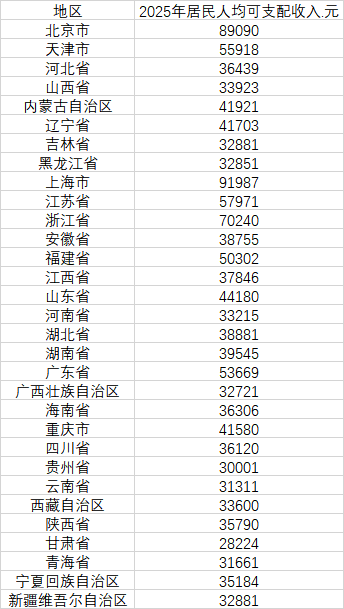
国家统计局网站公布了31个省份2025年居民人均可支配收入情况。数据显示,去年7个省份居民人均可 支配收入超过了5万元。 居民可支配收入是指居民能够自由支配的收入,是居民可用于最终消费支出和储蓄的总和。可支配收入 既包括现金收入,也包括实物收入。按照收入来源,可支配收入包含四项,分别为工资性收入、经营净 收入、财产净收入和转移净收入。居民人均可支配收入是居民可支配收入除以常住人口数后得到的平均 数。这一指标可以用来衡量居民的生活水平和购买力,为制定保障和改善民生的政策提供重要参考。 国家统计局1月19日公布的数据显示,2025年,全国居民人均可支配收入43377元,比上年名义增长 5.0%;扣除价格因素,实际增长5.0%。分城乡看,城镇居民人均可支配收入56502元,比上年名义增长 4.3%,扣除价格因素,实际增长4.2%;农村居民人均可支配收入24456元,比上年名义增长5.8%,扣除 价格因素,实际增长6.0%。 分省份来看,去年有7个省份居民人均可支配收入超过5万元,包括上海、北京、浙江、江苏、天津、广 东和福建。其中,上海2025年全市居民人均可支配收入突破9万元大关,达到91987元,位居第一。 北 ...

2025年河北GDP公布!
Xin Lang Cai Jing· 2026-01-23 00:20
Core Insights - The core viewpoint of the news is the economic performance of Hebei Province in 2025, highlighting growth in GDP, employment, and income levels across different sectors and demographics [1]. Economic Performance - The total GDP of Hebei Province for 2025 reached 49,305.2 billion yuan, reflecting a year-on-year growth of 5.6% at constant prices [1]. - The primary industry contributed 4,514.5 billion yuan with a growth rate of 3.4% [1]. - The secondary industry added 17,622.4 billion yuan, growing by 5.4% [1]. - The tertiary industry saw an increase of 27,168.3 billion yuan, with a growth rate of 6.1% [1]. Employment and Income - The province created 900,000 new urban jobs, achieving 104.6% of the annual target [1]. - The per capita disposable income for residents reached 36,439 yuan, marking a 5.1% increase from the previous year [1]. - Urban residents had a per capita disposable income of 47,544 yuan, growing by 4.2%, while rural residents saw an increase to 23,319 yuan, up by 5.9% [1]. - The income gap between urban and rural residents narrowed, with the income ratio at 2.04, a decrease of 0.03 from the previous year [1]. Consumption Expenditure - The per capita consumption expenditure for residents was 25,464 yuan, reflecting a 5.0% increase year-on-year [1]. - Urban residents had a per capita consumption expenditure of 30,522 yuan, growing by 4.1%, while rural residents' expenditure reached 19,488 yuan, increasing by 5.8% [1].

2025年福建居民人均可支配收入公布
Sou Hu Cai Jing· 2026-01-22 04:54
据抽样调查,2025年福建居民人均可支配收入50302元,比上年名义增长5.1%,扣除价格因素实际增长 5.1%。 从收入来源看,福建居民人均工资性收入比上年名义增长5.5%、经营净收入增长4.3%、财产净收入增 长3.3%、转移净收入增长6.2%。 来源:福建调查 按常住地分,城镇居民人均可支配收入61437元,比上年名义增长4.5%,扣除价格因素实际增长4.4%; 农村居民人均可支配收入30162元,比上年名义增长5.7%,扣除价格因素实际增长6.0%。 ...