市场定价

Search documents
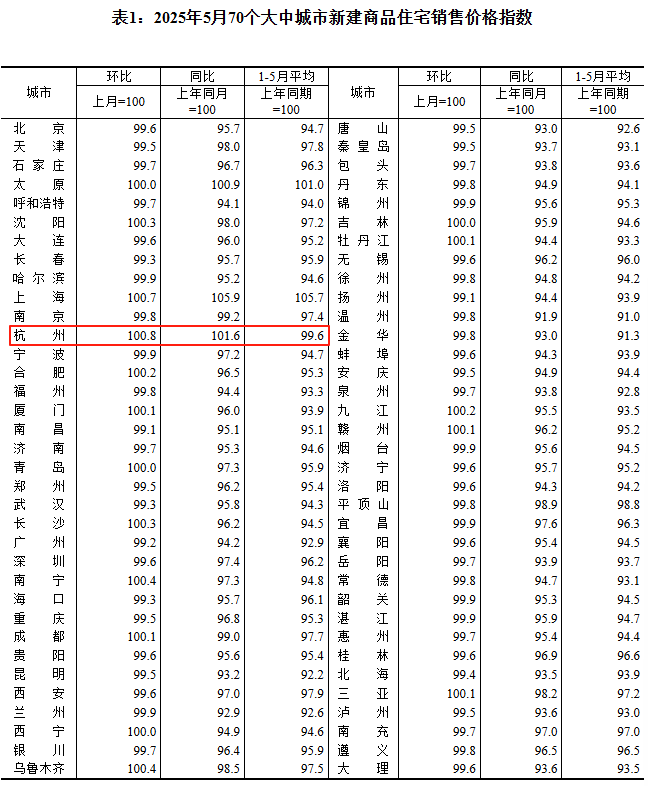
杭州新房和二手房价指数超越多个一线城市,位居全国前列|老蒋侃房
Sou Hu Cai Jing· 2025-06-16 12:01
Core Insights - Hangzhou's new home prices have shown a significant increase, with a month-on-month rise of 0.8% in May, surpassing Shanghai for the first time in several months [1][3] - Despite the recent increase, the average new home price in Hangzhou for the first five months of the year has decreased by 0.4% year-on-year, indicating a more complex market situation compared to other major cities [1][5] Price Trends - The new home price in Hangzhou has reversed from a decline of 0.1% in February to an increase of 0.8% in May, highlighting a substantial market turnaround [1][4] - The introduction of multiple new projects without price caps has contributed to the price increase, with some properties seeing significant price hikes compared to previous limits [4][5] Market Dynamics - The current price changes in Hangzhou reflect a transition from a price-controlled market to one driven by market pricing, rather than a fundamental recovery in the market [3][4] - The second-hand housing market in Hangzhou has not mirrored the new home price increases, with a month-on-month decline of 0.4% and a year-on-year drop of 1.3% in May, indicating ongoing market stabilization efforts [4][5] Future Outlook - The upcoming release of high-quality residential projects is expected to further elevate the average market price in Hangzhou, suggesting that the upward trend in new home prices may continue in the coming months [4][5] - The second-hand market is likely to face challenges due to the superior quality and amenities of new homes, making it harder for second-hand prices to stabilize [5]

欧洲央行管委卡扎克斯:没有必要急于降息。市场对下次会议的定价比较合适。
news flash· 2025-05-16 05:15
Core Viewpoint - The European Central Bank (ECB) Governing Council member Kazaks stated that there is no need to rush into interest rate cuts, indicating that the market's pricing for the next meeting is appropriate [1] Group 1 - Kazaks emphasized the importance of a measured approach to monetary policy, suggesting that current economic conditions do not necessitate immediate rate reductions [1] - The statement reflects a broader sentiment within the ECB regarding the stability of the eurozone economy and the need for careful consideration before making policy changes [1]
读研报 | 如何理解当下的行情扩散?
中泰证券资管· 2025-03-18 09:28
Core Viewpoint - The recent market dynamics indicate a shift from a technology-dominated landscape to a more diversified performance across various sectors, including consumer goods, retail, textiles, agriculture, and light manufacturing, suggesting discussions around "market diffusion" or "high-low rotation" are increasing [1] Group 1: Calendar Effect - The calendar effect is a common explanation for the market's behavior, with reports indicating that March to April serves as a transition period where market styles shift from clear trends to a more balanced performance across various styles [2] - Specifically, from early February to early March, small-cap and high-beta sectors tend to outperform, while larger, low-valuation stocks struggle [2] - As the market moves into late April, with earnings reports being disclosed, the focus will shift towards high-performing stocks with strong earnings certainty [2] Group 2: Incremental Capital Changes - Reports suggest that the "high-low rotation" phenomenon is partly driven by incremental capital changes, with consumer-focused and dividend-style funds showing signs of increasing allocations to consumer sectors [3] - Additionally, there are indications of portfolio adjustments among dividend-style funds, while low-risk capital is being allocated to low-positioned cyclical large-cap growth stocks due to favorable cost-benefit considerations [3] - However, there is no significant evidence of technology growth funds switching out of their positions [3] Group 3: Market Pricing Dynamics - Changes in market pricing are also being observed, with reports noting that credit growth is weak, and consumer activity is seasonally declining post-holiday [3] - The stock market appears to be pricing in optimistic data while underpricing negative data, possibly due to prior pricing of pessimistic data and expectations of new growth cycles driven by policies and emerging industries like AI [3] Group 4: Global Perspective - Some analysts suggest that the changes in the A-share market should be viewed in a global context, indicating a shift in global investor focus from the U.S. and information technology to other sectors [4] - The rising correlation between the CSI 300 and European markets suggests that global investors are seeking new opportunities beyond traditional tech narratives [4] Group 5: Market Sentiment - The diverse explanations for market behavior reflect a warming market sentiment, indicating that the market is no longer dominated by a single sector, which may lead to more investment opportunities [5] - This environment is favorable for investors skilled in identifying alpha, providing a platform for previously held insights to materialize [5]