情绪稳定

Search documents
喜欢把家里打扫得很干净的人,不简单
洞见· 2025-06-18 09:58
Core Viewpoint - The article emphasizes the importance of maintaining order and cleanliness in one's environment as a reflection of inner strength, optimism, and emotional stability, suggesting that these qualities are essential for navigating life's challenges [10][25][39]. Group 1: Optimism and Resilience - Individuals who keep their homes tidy often possess a resilient attitude, choosing to create order amidst chaos as a form of silent optimism [12][14]. - The act of cleaning and organizing is portrayed as a proactive approach to life, allowing individuals to maintain a sense of control and hope for the future [22][23]. - Historical examples, such as the life of Guo Youguang, illustrate how maintaining a clean and organized space can foster a disciplined mindset, even in difficult circumstances [18][21]. Group 2: Self-Discipline and Inner Order - The concept of "慎独" (self-discipline in solitude) is highlighted, indicating that true self-management is demonstrated when individuals maintain order without external supervision [26][29]. - The article references Liu Wencan, who exemplified this principle by keeping his workspace meticulously organized despite external chaos, showcasing the power of self-discipline [30][34]. - The ability to maintain order in solitude reflects a person's true character and strength, enabling them to resist distractions and stay focused on their path [36][37]. Group 3: Emotional Stability and Impact on Others - A clean and organized home is linked to emotional stability, providing a calming environment that helps individuals manage their emotions effectively [40][41]. - The story of Wang Shulan illustrates how maintaining a tidy home can create a sense of security and comfort for family members, even in challenging times [45][51]. - The article concludes that the act of keeping a clean space is not merely about aesthetics but serves as a powerful message of resilience and hope for loved ones [53][56].


情绪稳定,是投资最重要的能力
3 6 Ke· 2025-05-08 01:56
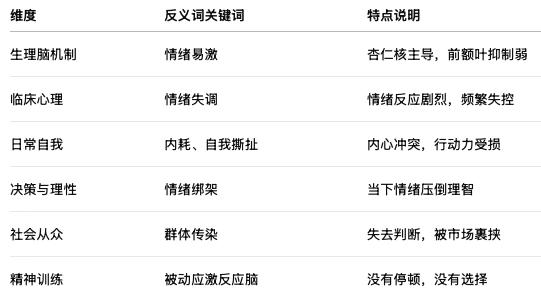
Group 1 - The core idea emphasizes the importance of emotional stability in investment, as highlighted by Warren Buffett, who believes that temperament is more crucial than intelligence in making sound investment decisions [1][9] - Emotional stability helps investors remain rational during market fluctuations, avoiding decisions driven by fear or greed [1][4] - The article discusses various aspects of emotional stability, including biological mechanisms, psychological resilience, and the impact of social contagion on decision-making [2][3][4] Group 2 - The concept of probability thinking is introduced, stressing that good decisions can lead to bad outcomes due to randomness, and vice versa, thus focusing on the decision-making process rather than just the results [8] - The article highlights that discipline and emotional control are more important than high intelligence in successful investing, as stated by both Buffett and Charlie Munger [9] - It also addresses behavioral traps and cognitive biases that can hinder rational decision-making, suggesting that awareness and training can help investors manage these psychological weaknesses [10] Group 3 - The importance of filtering information to focus on significant signals rather than noise is discussed, particularly in the context of the overwhelming information available in the digital age [13][14] - Long-term thinking is presented as a powerful strategy to mitigate short-term emotional disturbances, with an emphasis on the benefits of patience and compounding [15] - Risk management strategies are recommended, such as maintaining sufficient cash reserves to avoid forced selling during market volatility [16] Group 4 - The article outlines ten principles for achieving emotional stability, including practicing mindfulness, keeping an emotional diary, and simplifying daily decisions to reduce mental fatigue [29][33][34] - It emphasizes the need for positive cognitive restructuring to combat negative self-talk and encourages viewing challenges through a long-term lens [45][46] - The conclusion suggests that emotional fluctuations are natural and can be harnessed positively, advocating for a balanced approach to emotions in decision-making [49]
巴菲特泼冷水:投资成功不靠聪明脑瓜,靠啥?
Sou Hu Cai Jing· 2025-05-03 15:38
Group 1 - The core message emphasizes that emotional stability is more important for investment success than high intelligence, as highlighted by Warren Buffett's insights [1][3] - A study shows that investors with an IQ above 140 have a 15% lower long-term return compared to those with an IQ of 120, primarily due to overconfidence [3] - Buffett's approach during market downturns, such as the 2020 pandemic, illustrates his ability to remain calm and make informed decisions based on intrinsic value rather than panic [3] Group 2 - Emotional stability is characterized by the ability to withstand market fluctuations, as demonstrated by Buffett's long-term holding of Coca-Cola despite multiple downturns [3] - Buffett dedicates significant time to reading financial reports and news, focusing 70% of his energy on understanding potential mistakes, which is crucial for maintaining emotional stability [3] - Practical tips for ordinary investors to cultivate emotional stability include setting a cooling-off period before making purchases, limiting the frequency of account checks, and employing contrarian thinking [4]