数字财政

Search documents
博思软件:公司多年来聚焦资产全生命周期精细化管理与运营
Zheng Quan Ri Bao Wang· 2025-10-24 09:39
Core Insights - The company has focused on asset lifecycle management and operations, developing a series of asset management products suitable for digital finance development [1] Group 1: Company Initiatives - The company has implemented targeted asset revitalization practices in four provinces: Fujian, Jiangsu, Heilongjiang, and Inner Mongolia [1] - In Jiangsu, the company constructed a digital regulatory platform for dynamic asset monitoring and data management [1] - In Heilongjiang, the company established a platform for revitalizing state-owned asset resources to address the issue of inefficient and idle asset disposal [1] - In Fujian, the company built a management platform for state-owned assets to promote the coordinated allocation of operational assets [1] Group 2: Impact on Financial Management - These projects leverage technology to help local governments accurately assess their asset base and enhance the management of funds, assets, and resources [1] - The initiatives aim to improve the efficiency of fiscal fund allocation and usage flexibility, providing digital support for local fiscal debt management and sustainable development [1]

股票行情快报:中科江南(301153)8月26日主力资金净卖出706.68万元
Sou Hu Cai Jing· 2025-08-26 13:20
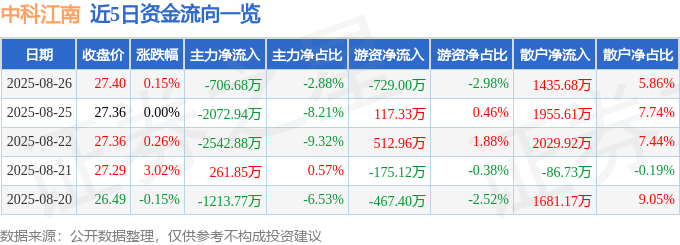
Core Viewpoint - Zhongke Jiangnan (301153) has shown a slight increase in stock price, but the financial performance indicates significant challenges, with a notable decline in revenue and profit margins [1][3]. Financial Performance - As of Q1 2025, Zhongke Jiangnan reported a main revenue of 86.54 million yuan, a year-on-year decrease of 34.2% [3]. - The net profit attributable to shareholders was -45.74 million yuan, reflecting a year-on-year decline of 235.94% [3]. - The company’s gross profit margin stands at 47.22%, which is above the industry average of 44.78% [3]. Market Activity - On August 26, 2025, Zhongke Jiangnan's stock closed at 27.4 yuan, with a slight increase of 0.15% [1]. - The trading volume was 89,300 hands, with a total transaction value of 245 million yuan [1]. - The net outflow of main funds was 7.07 million yuan, accounting for 2.88% of the total transaction value [1][2]. Industry Comparison - Zhongke Jiangnan's total market value is 9.668 billion yuan, which is below the industry average of 14.674 billion yuan [3]. - The company ranks 73rd out of 194 in terms of total market value within the software development industry [3]. - The price-to-earnings ratio (P/E) is -52.85, significantly lower than the industry average of 117.55 [3].

山西阳泉市财政局:数据驱动促改革 数智赋能提效能
Zhong Guo Fa Zhan Wang· 2025-07-10 02:35
Core Viewpoint - The construction of digital finance is essential for adapting to the development of the digital economy and society, and is a key path for achieving high-quality fiscal development [1] Group 1: Digital Transformation in Finance - The Yangquan Municipal Finance Bureau is implementing a smart solution that covers the entire chain of fiscal management, transitioning from "experience-based decision-making" to "data-driven decision-making" [1] - The integration of fiscal business into a unified platform ensures data traceability and supports precise budget preparation, enhancing overall fiscal coordination capabilities [2] - A collaborative system is being established that combines internal data governance with external data empowerment, creating a new mechanism for fiscal governance driven by big data [2] Group 2: Revenue Management - The innovation of a fiscal big data analysis system aims to deeply explore revenue growth potential by coordinating 19 departments for a new tax management framework [3] - A dynamic information ledger is established for data sharing, with a focus on identifying revenue collection issues through multi-source data comparison [3] Group 3: Expenditure Management - The use of information technology and a unified budget management system is being explored to implement zero-based budgeting, enhancing collaboration among multiple departments [4] - The focus is on monitoring general expenditures and ensuring efficient use of fiscal resources through real-time tracking and analysis of budget items [4] Group 4: Risk Control - A dual-layer comparison mechanism is being developed to monitor budget unit fund payments, enhancing the identification of potential misuse of fiscal funds [5] - The system employs advanced technology for risk scanning, transitioning from manual checks to intelligent audits, particularly focusing on sensitive expenditure categories [5] Group 5: Decision-Making Support - A visual and expandable intelligent analysis platform is being created to transform fiscal economic indicators into dynamic visual elements, aiding in scientific decision-making [6] - The development of an AI model for intelligent table processing aims to automate data handling, improving efficiency and accuracy in fiscal operations [6] - Future plans include expanding data integration and applying AI innovations to build a comprehensive data application system for fiscal management [6]
五问“车路云一体化”:如何解锁自动驾驶“规模商用”密码?
3 6 Ke· 2025-07-03 06:31
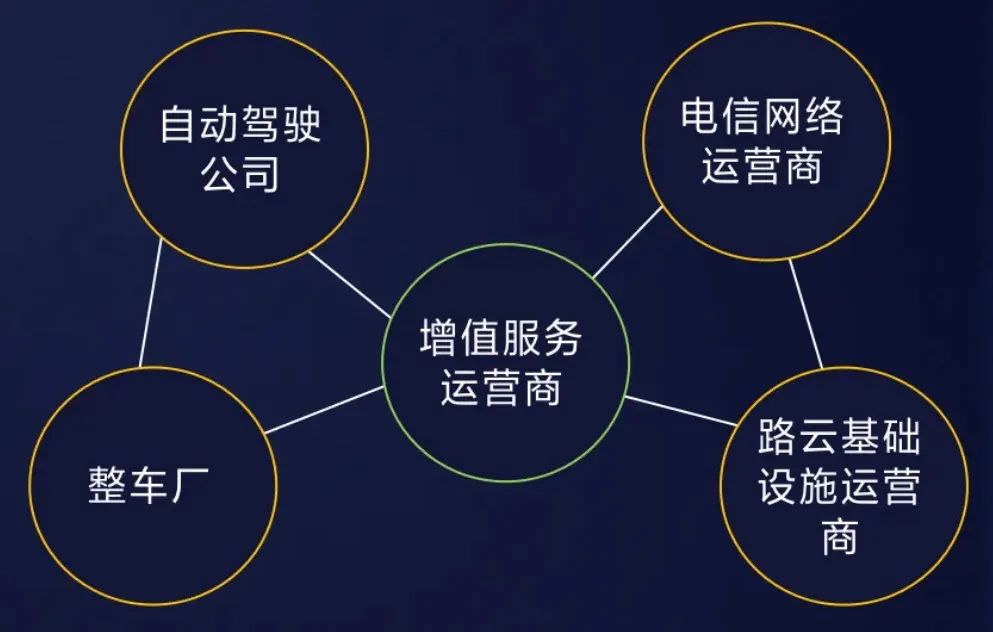
Core Viewpoint - The article discusses the ongoing debate between "single vehicle intelligence" and "vehicle-road-cloud integration" in the context of autonomous driving technology, highlighting the rapid transformation of transportation systems and the emerging opportunities in smart traffic [1][2]. Group 1: Relationship Between Technologies - "Single vehicle intelligence" and "vehicle-road collaboration" are not mutually exclusive but rather complementary approaches to achieving autonomous driving [2][4]. - Single vehicle intelligence relies on the vehicle's own sensors and algorithms, while vehicle-road collaboration aims to enhance traffic system intelligence by integrating external information [3][4]. Group 2: Role of Vehicle-Road-Cloud Integration - Vehicle-road-cloud integration is essential for achieving both vehicle intelligence and broader traffic system automation, facilitating a shift from "terminal autonomy" to "global collaboration" in smart transportation [4][14]. - This integration provides a regulatory framework for autonomous driving, ensuring compliance and safety through comprehensive monitoring of vehicle operations [7][14]. Group 3: Challenges and Opportunities in Autonomous Driving - The automotive industry is transitioning from electric vehicles to smart vehicles, with a focus on integrating advanced driver-assistance systems (ADAS) into personal vehicles [5][6]. - Current ADAS features are often marketed ambiguously, leading to potential risks and misunderstandings regarding their capabilities [5][6]. Group 4: New Regulatory Paradigms - A new regulatory framework is necessary to address the unique challenges posed by autonomous driving, focusing on data transparency, social trust, risk control, responsibility assignment, and overall safety [9][10][11][12][13]. - Vehicle-road-cloud integration can enhance regulatory oversight by monitoring real-time vehicle data and ensuring compliance with traffic regulations [14][15]. Group 5: Economic Implications of Driving Commoditization - The concept of "driving commoditization" emerges as a new business model where driving services are provided by autonomous systems, shifting responsibility from human drivers to the system operators [16][17]. - This model can create significant economic benefits for local governments through the monetization of urban data and infrastructure [17][20]. Group 6: Industry Development Strategies - To activate the potential of vehicle-road-cloud integration, the industry must shift from a technology-driven mindset to a value-driven approach, focusing on creating and capturing value through innovative services [20][22]. - Developing "killer applications" like Robotaxi can drive the scale economy of vehicle-road-cloud integration, facilitating broader adoption of autonomous driving technologies [23][24][26].