
数据要素价值

Search documents
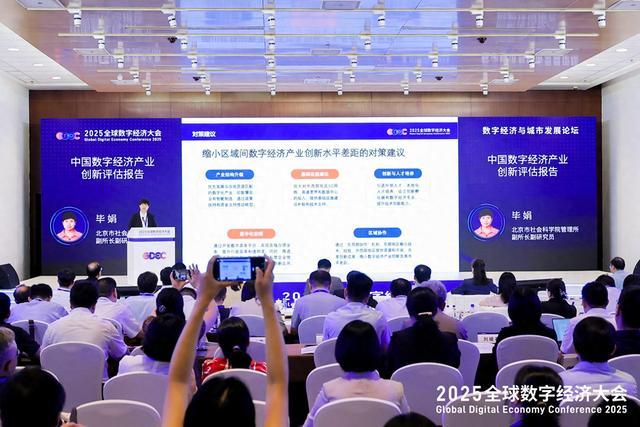
数字经济产业创新评估报告发布,北京居全国首位
Xin Lang Cai Jing· 2025-07-04 10:24
Core Insights - The "Digital Economy and Urban Development Forum" highlighted the regional patterns of innovation in China's digital economy, with Beijing ranking first in innovation index due to its concentration of technology resources and innovative enterprises [1][3]. Group 1: Digital Economy Assessment - The report focuses on five dimensions: digital industrialization, industrial digitalization, digital governance, data factor value, and digital infrastructure, establishing a three-tier evaluation index system [1][3]. - The assessment results categorize regions into four tiers: first tier (Beijing, Guangdong) shows significant advantages; second tier (Shandong, Sichuan) demonstrates steady development; third tier (Hunan, Shaanxi) has room for improvement; fourth tier (Inner Mongolia, Gansu) requires continuous effort [3][4]. Group 2: Regional Comparison - The Pearl River Delta leads in digital economy innovation index, benefiting from developed manufacturing and foreign trade, with innovation clusters in Shenzhen and Guangzhou [4]. - The Yangtze River Delta has a strong economic foundation, talent concentration, and high integration of digital economy industrial chains [4]. - The Beijing-Tianjin-Hebei region has rich research resources in Beijing but faces uneven regional development, necessitating enhanced collaboration and industrial layout [4]. Group 3: Recommendations for Improvement - The report suggests increasing investment in 5G networks, high-speed broadband, and data centers in central and western regions to strengthen infrastructure [5]. - It emphasizes the need for talent cultivation and enhancing technological innovation capabilities in underdeveloped areas of the digital economy [5]. - Development of digital governance platforms is recommended to improve administrative efficiency and transparency, promoting data openness and shared innovation applications [5].

政企联动:半岛港湾集团重新定义企业“新质生产力”
Sou Hu Cai Jing· 2025-06-13 12:01
Core Viewpoint - The Peninsula Harbor Group is transforming the model of government-enterprise cooperation through digital empowerment and ecological co-construction, aiming to break down traditional barriers and inject new momentum into regional economic development [1][3]. Group 1: Digital Transformation and Innovation - The group has developed a trade information platform and a big data center that integrates multi-channel and high-dimensional data assets, creating a digital foundation that covers the entire industrial chain [3]. - The system visualizes the economic value and social benefits of local platform companies and provides precise data support for government industrial planning and corporate strategic decision-making through intelligent analysis models [3]. - Technologies such as blockchain ensure the authenticity and immutability of supply chain financial data, while AI algorithms enable precise matching of financial resources based on enterprise growth models [3]. Group 2: Reshaping Government-Enterprise Cooperation - The Peninsula Harbor Group integrates blockchain, big data analysis, and artificial intelligence to launch a new e-commerce supply chain ecosystem platform, offering comprehensive financial service solutions across the industrial chain [3]. - The platform achieves the integration of logistics, capital flow, and information flow, providing intelligent risk control and capital operation support for e-commerce platforms, while also creating new dimensions for credit assessment based on industrial data for financial institutions [3]. - This "technology + scenario + finance" closed-loop model facilitates the transformation of the e-commerce industry from "scale expansion" to "value cultivation" and promotes the upgrade of government-enterprise cooperation from "project-based" to "ecological" [3]. Group 3: Future Directions - The group's exploration fundamentally reshapes the logic of government-enterprise cooperation, emphasizing that collaboration should leverage digital tools for value reconstruction rather than merely resource aggregation [5]. - By converting operational data into quantifiable financial assets, the group enhances the financing capabilities of enterprises and strengthens the resilience of local economies, shifting cooperation from a "task-oriented" to a "value-symbiotic" approach [5]. - Moving forward, the Peninsula Harbor Group aims to deepen digital cooperation with government and enterprise partners, exploring diverse collaboration scenarios to write a new chapter in government-enterprise cooperation from "coordination" to "win-win" [5].

数字经济拓展消费新业态
Jing Ji Ri Bao· 2025-06-12 22:06
Group 1 - The rapid development of the handmade nail industry in Donghai is closely related to various digital platforms emerging in the digital economy era, which integrate production, circulation, service, and consumption [1] - Digital platforms provide extensive online sales channels for the Donghai handmade nail industry, significantly enhancing interaction between producers and consumers, and allowing for precise identification of consumer personalization needs [1] - The Donghai handmade nail industry exemplifies the deep integration of the real economy and digital economy, offering replicable experiences for the transformation of county economies [1] Group 2 - The expansion of new business formats in the digital economy results from the integration of infrastructure, technology, factors, industries, and markets [2] - Digital infrastructure, including digital platforms, data resources, and computing power facilities, is fundamental for the development of new business formats, reducing innovation costs and ensuring stable service [2] - Market integration breaks down barriers between different industries, regions, and online and offline markets, creating a unified, interconnected, and dynamically evolving market space [2] Group 3 - Artificial intelligence and the activation of data factor value are key pathways for future innovation in new digital economy business formats [3] - Although China has a vast amount of data, the market system for data factors is still imperfect, and improvements in data sharing and governance are needed [3] - Promoting the open sharing of data resources across departments, regions, and industries can reconstruct industrial development concepts and stimulate new business formats for high-quality industrial development [3]
国家数据局发布《数字中国建设2025年行动方案》 八大行动全力释放数据要素价值 新质生产力得以不断壮大
Zheng Quan Ri Bao· 2025-05-18 16:15
Core Viewpoint - The "Digital China Construction 2025 Action Plan" aims to significantly advance the digital economy and enhance the quality and efficiency of digital development by the end of 2025, with specific targets set for various sectors [1][2]. Group 1: Action Plan Objectives - By the end of 2025, the core industry value added of the digital economy is expected to exceed 10% of GDP, with a computing power scale surpassing 300 EFLOPS [1]. - The plan emphasizes the importance of digital governance, digital culture, and ecological civilization, aiming for substantial improvements in these areas [1]. - The action plan outlines eight major initiatives, including the development of AI applications and high-quality data sets, as well as advancements in smart manufacturing and intelligent terminals [1][2]. Group 2: Industry Insights - Experts express confidence in AI's potential to drive the digital industry, highlighting sectors like smart manufacturing, intelligent connected new energy vehicles, and finance as ripe for AI applications [2]. - The balance between data sharing and privacy protection is identified as a critical challenge, necessitating robust legal frameworks and advancements in privacy technologies [2]. - The action plan aligns with China's strategic goals for high-quality economic development and the cultivation of new growth drivers, focusing on enhancing data quality and usability [2][3].
点“数”成金 企业“数据流”变“资金流”
Jin Rong Shi Bao· 2025-04-10 05:53
Core Viewpoint - The rapid development of the digital economy has positioned data as a crucial production factor and valuable resource, leading to innovative financing methods such as data intellectual property pledge financing [1][2][5] Group 1: Data Asset Financing - The first data intellectual property pledge financing in the Guangdong region was successfully executed, allowing the Zhanjiang Public Transport Group to secure a loan of 10 million yuan using its "Smart Bus Intelligent Dispatch Management System Data" as collateral [1][4] - The People's Bank of China (PBOC) in Zhanjiang has been actively guiding financial institutions to recognize and leverage the value of data assets, resulting in the first data asset pledge financing in the region back in June 2024 [2][5] - Data intellectual property pledge financing is characterized by clearer legal ownership, more mature valuation and pricing, and higher market acceptance compared to traditional data asset pledge financing [2][3] Group 2: Knowledge and Policy Promotion - The PBOC in Zhanjiang has organized multiple government-bank-enterprise matchmaking meetings to promote knowledge of intellectual property pledge financing policies, aiming to tailor financing solutions for individual enterprises [3][5] - A comprehensive service system has been established to cover data value extraction, assessment, and financial product development, focusing on local enterprises with intellectual property advantages [3] Group 3: Impact on Urban Development - The successful implementation of data intellectual property pledge financing not only validates the financial value of data intellectual property but also provides a replicable innovative path for enterprises in Zhanjiang to unlock data value [5] - This initiative is expected to accelerate the digital and intelligent transformation of urban transportation, contributing to the development of smart transportation and smart city clusters in Zhanjiang [5]
