相对强弱指数(RSI)

Search documents
金价自两周高点回落 两大因素缓解下行压力
Jin Tou Wang· 2025-08-27 06:14
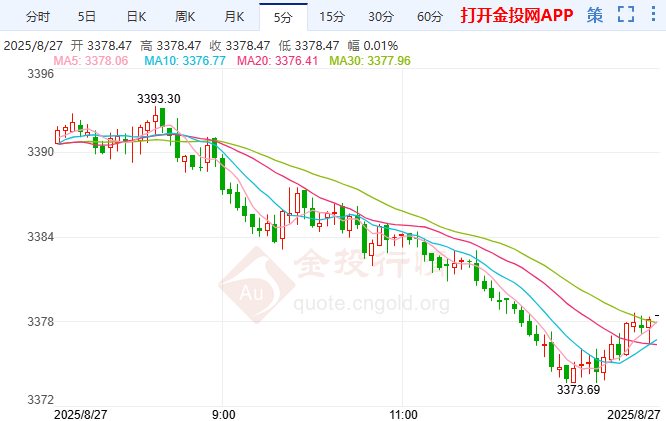
Group 1 - The US dollar index rebounded, putting pressure on gold prices, which fell from a two-week high to around $3378 per ounce, although concerns over the independence of the Federal Reserve and new US tariff threats may alleviate downward pressure on gold prices [1] - The US Department of Commerce reported that July durable goods orders fell by 2.8% month-on-month, better than the expected decline of 3.8%, with a year-on-year increase of 3.5%, influenced by Boeing's order volatility and the fading "front-loading" effect from previous tariff policies [3] - The US Department of Homeland Security announced a 50% tariff on all Indian goods starting August 27, which has significantly impacted the Indian stock market, with the MSCI India index underperforming the MSCI Emerging Markets index for four consecutive months [3] Group 2 - Technical analysis indicates that gold prices have short-term resistance at the $3400 per ounce level, with a potential static resistance at $3440 per ounce if this level is breached [4][5] - Sellers need to break below the convergence of the 21-day and 50-day moving averages around $3350 per ounce to regain control, while the next solid support level is at the 100-day moving average of $3328 per ounce [5] - Gold prices have not closed below the 100-day moving average since December 31, 2024, indicating a persistent bullish trend [5]

鲍威尔今晚“放大招”?美元多头力量强劲
Jin Tou Wang· 2025-08-22 10:59
Group 1 - The core focus of the news revolves around the upcoming speech by Federal Reserve Chairman Jerome Powell at the Jackson Hole meeting, which is expected to significantly influence the dollar's performance [1] - The U.S. dollar index is currently strong, hovering near a two-week high, with key resistance levels at 99.320 and 99.838, while support levels are at 98.317 and potentially 97.80 [1] - Market expectations are mixed regarding Powell's stance on interest rate cuts, with most institutions anticipating a neutral position without clear signals, despite concerns about a dovish tone [1] Group 2 - The August PMI data from S&P Global indicates strong momentum in both U.S. manufacturing and services, with the manufacturing PMI rising to 53.3, significantly above expectations, while the services PMI remains robust at 55.4 [2] - However, initial jobless claims in the U.S. increased by 235,000, surpassing expectations, indicating a cooling labor market, with continuing claims rising to 1.972 million [2] - The dollar index experienced fluctuations, reaching an 11-day high, supported by favorable economic data and a cooling expectation for interest rate cuts from the Federal Reserve [2] Group 3 - Technical indicators for the dollar index show strong upward momentum, with the RSI indicating that bullish forces remain strong despite a slight pullback [3] - The MACD indicator suggests that bearish momentum has weakened, indicating a shift towards bullish dominance [3] - Key support and resistance levels for the dollar index are identified, with short-term support at 98.317 and potential resistance levels at 98.950, 99.177, and 99.838 [3]
FPG财盛国际:黄金突然“大变脸”的原因在这!接下来如何交易
Sou Hu Cai Jing· 2025-08-08 02:01
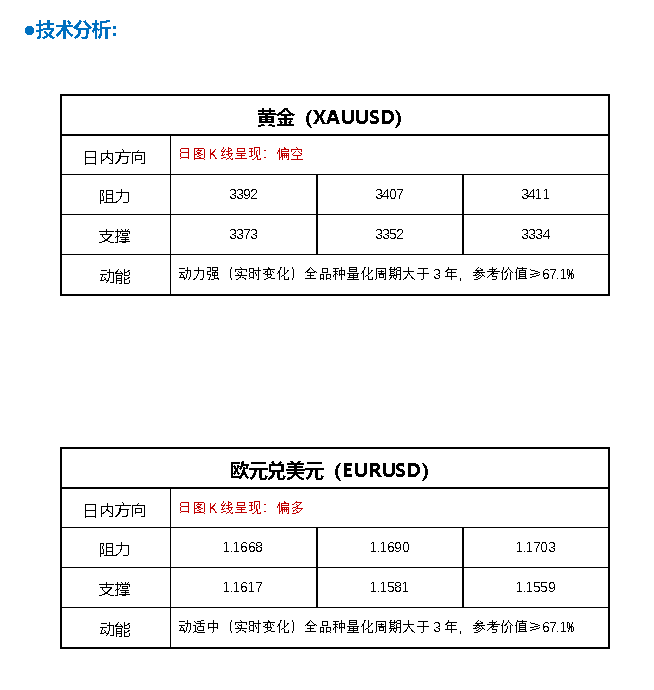
Group 1 - The latest employment data from the US indicates a weakening labor market, leading to a strong increase in gold prices as investors increase dovish bets ahead of the Federal Reserve's expected easing cycle in September [1] - The US Department of Labor reported that the number of continuing unemployment claims rose by 38,000 to 1.97 million, indicating increased difficulty for unemployed individuals to find new jobs. Initial jobless claims also rose to 226,000, exceeding economists' expectations [1] - According to Prime Market Terminal data, traders anticipate a 95% probability of a 25 basis point rate cut at the Federal Reserve's September meeting [1] Group 2 - On August 1, gold prices surged by 2%, rising from approximately $3,281 per ounce to $3,363 per ounce, and have since fluctuated between $3,350 and $3,397 per ounce, with buyers struggling to break through the $3,400 per ounce level [2] - To maintain a bullish outlook, buyers need to rise above $3,400 per ounce, which would clear the path for gold to challenge the June 16 high of $3,452 per ounce, followed by the historical high of $3,500 per ounce. Conversely, if gold prices fall below the convergence area of the 50-day and 20-day simple moving averages (around $3,350 to $3,346 per ounce), a decline towards the 100-day moving average of $3,275 per ounce is expected [3] Group 3 - Current resistance levels for gold are at $3,392, $3,407, and $3,447, while support levels are at $3,373, $3,352, and $3,334. The momentum is strong, with a reference value greater than 67.1% [4]
杰富瑞揭示美股博弈新分水岭 多空将决战5500点?
智通财经网· 2025-04-24 11:01
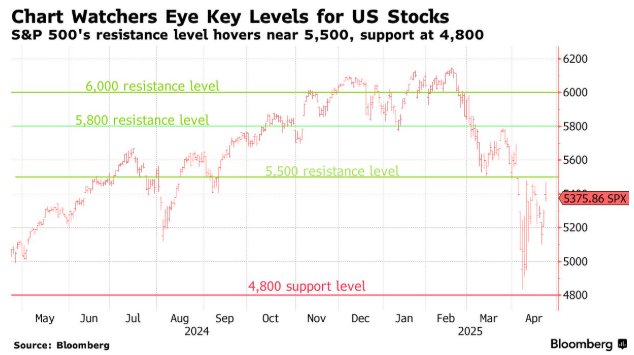
Core Viewpoint - The recent volatility in the U.S. stock market is primarily driven by President Trump's inconsistent stance on tariffs, leaving many investors uncertain [1] Group 1: Market Analysis - The S&P 500 index must break the 5500 level to recover half of the 19% decline since February's historical high [1] - The index has rebounded to 5376 points after nearly falling into a bear market below 5000 points, with a need for just over a 2% increase to surpass 5500 [2] - A breakthrough at 5500 could shift trading strategies from "selling on highs" to "buying on lows" [2] Group 2: Resistance and Support Levels - The likelihood of breaking resistance increases with the number of tests; a successful breach could lead to a rebound towards 5800 to 6000 points [4] - For traders assessing potential downside, 4800 points is a critical observation level, which is over 3.5% lower than the April low [5] - There is speculation that the market could test lower levels, potentially reaching 4500 points, with some analysts suggesting a deeper test down to 4300 points [5] Group 3: Market Breadth Indicators - The percentage of S&P 500 stocks trading above their 200-day moving average has improved to 31%, up from less than 20% in early April, indicating a more sustainable trend [6] - Market participants are looking for this percentage to approach 50% to confirm bullish sentiment [7] - The Relative Strength Index (RSI) dropped below 30 in early April, indicating overselling, but has not yet reached overbought levels during the subsequent rebound [7]