
美印贸易协议

Search documents
突然暴跌,紧急“救市”!这国央行出手
券商中国· 2025-12-02 15:14
Core Viewpoint - The Indian Rupee has faced significant depreciation, hitting a historic low against the US Dollar, prompting the Reserve Bank of India (RBI) to intervene in the market to stabilize the currency [1][2][4]. Group 1: Currency Depreciation - The Indian Rupee fell below the psychological level of 90 against the US Dollar, reaching a low of 90.058, marking a nearly 5% depreciation for the year, making it the worst-performing currency in Asia [2][4]. - As of October 2023, foreign investors have withdrawn over $17 billion from the Indian stock market, exacerbating the downward pressure on the Rupee [5]. Group 2: Economic Factors - Key reasons for the Rupee's decline include low foreign investment inflows, record trade deficits, and uncertainties surrounding the US-India trade agreement [6][7]. - India's trade deficit surged to $32.15 billion in October, the highest in 13 months, primarily due to a 28.5% drop in exports to the US from May to October [6]. Group 3: RBI's Intervention - The RBI's intervention aims to prevent further depreciation of the Rupee, with analysts expecting the central bank to actively set a ceiling for the USD/INR exchange rate [4][6]. - Despite short-term interventions, analysts suggest that the Rupee may still face further depreciation due to underlying economic pressures, including an expanding current account deficit projected to reach 1.4% of GDP this fiscal year [4][6]. Group 4: Future Outlook - The RBI Governor indicated that a 3% to 3.5% annual depreciation of the Rupee is normal, focusing on curbing excessive volatility rather than maintaining a specific exchange rate [7]. - The International Monetary Fund (IMF) forecasts that if the US-India trade agreement remains delayed, India's GDP growth may slow down, with exports expected to decline by 5.8% in the fiscal year 2026 [7].


Vatee万腾:卢比汇率连日窄幅波动,为何迟迟难走出区间?
Sou Hu Cai Jing· 2025-11-11 09:25
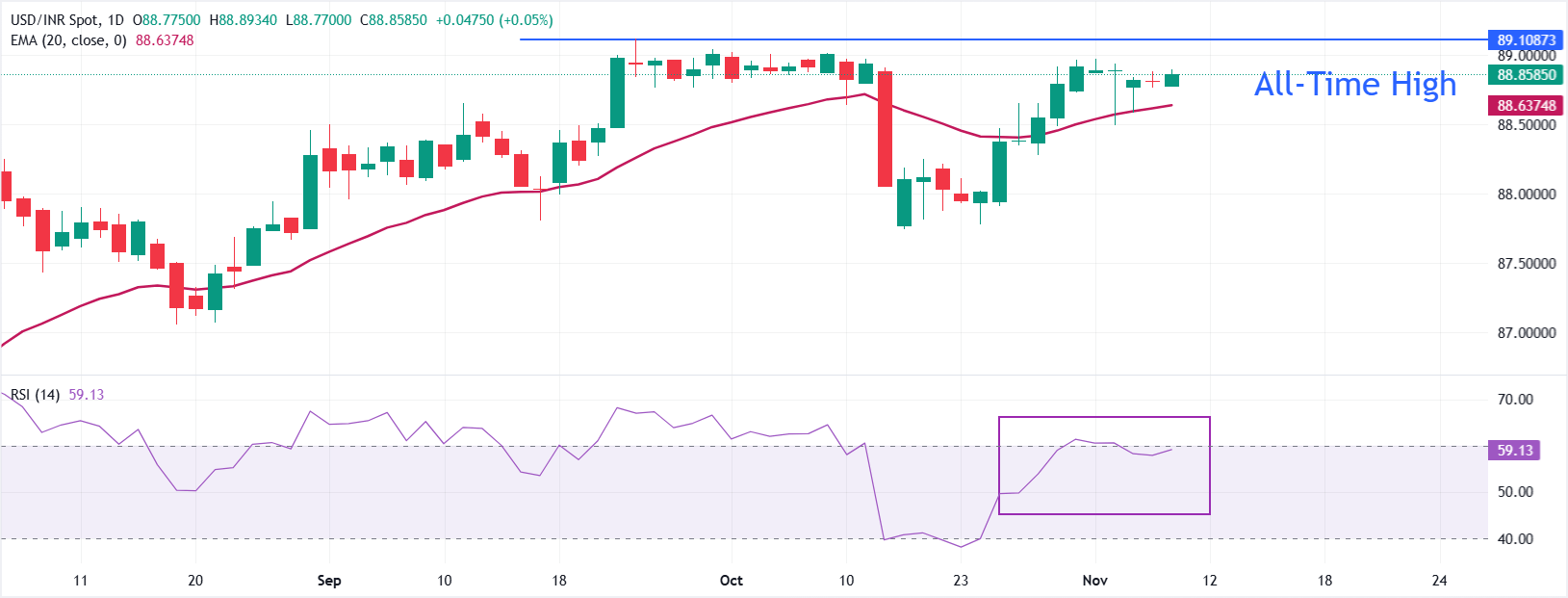
Group 1 - The Indian Rupee remains stable against the US Dollar, fluctuating around 88.85, with market activity being relatively subdued as investors await progress in US-India trade negotiations [1] - US and Indian negotiators have expressed optimism, indicating that discussions are nearing completion, although the lack of a formal agreement keeps market sentiment cautious [1] - Foreign institutional investors have shown reduced enthusiasm for the Indian stock market, with net sales of approximately 41.14 billion Rupees, reflecting short-term confidence issues [1] Group 2 - The US Dollar Index is stable around 99.65, with limited overall volatility following the Senate's approval of a temporary funding bill, which alleviates some market uncertainty [2] - The market anticipates the release of delayed economic data as US government operations resume, which may lead to significant fluctuations in the Dollar [2] - There is a 62.4% probability that the Federal Reserve will lower interest rates in December, indicating a general expectation for a more accommodative monetary policy [2] Group 3 - From a technical analysis perspective, the USD/INR exchange rate is currently above the short-term moving average, with key indicators suggesting a potential breakout from the recent trading range [4] - Important resistance is noted at the historical high of 89.12, while downward support is focused on the August low of 87.07 [4]
印度赚美国的钱买普京的油?美印贸易协议渺茫
Hu Xiu· 2025-08-19 06:30
Core Viewpoint - The U.S.-India trade agreement appears distant as the Trump administration criticizes India's significant purchase of Russian oil, linking it to the deterioration of U.S.-India trade relations [1][6]. Group 1: U.S.-India Trade Relations - Navarro's article highlights that India's large oil lobbying groups are driving the significant purchase of Russian oil, accusing India of acting as a global clearinghouse for Russian oil [2]. - The Trump administration has threatened to impose a 25% tariff on Indian imports due to India's oil purchases, raising the total tariff rate on Indian goods to 50% [6][7]. - The potential for a trade agreement between the U.S. and India remains bleak, as Navarro emphasizes that India must act like a strategic partner to receive such treatment [8]. Group 2: India's Oil Imports - Before the Russia-Ukraine conflict, India relied heavily on oil from the Middle East, with Russian oil accounting for a negligible portion of its imports. However, as of now, Russian oil constitutes approximately 37% of India's total oil imports [3][4]. - India defends its right to purchase the cheapest oil available, asserting that additional tariffs from the U.S. would be unfair and unreasonable [3]. - The Biden administration has previously shown tacit approval for India's discounted purchases of Russian oil, arguing that it helps to limit Putin's revenue while preventing a spike in global oil prices [4][5]. Group 3: Trade Negotiation Status - The planned visit of the U.S. trade delegation to India for further negotiations has been canceled, raising concerns about the timeline for reaching a trade agreement before Modi's planned discussions in the fall [11]. - There has been no consensus between the U.S. and India on agricultural products and the issue of importing Russian oil during trade talks [10].