外资流入

Search documents
负债行为跟踪:当内外资共振,结构特征如何?
ZHONGTAI SECURITIES· 2026-03-29 10:22
1. Report Industry Investment Rating No relevant content found. 2. Core Viewpoints of the Report - This week, sentiment indicators such as the VIX index continue to indicate a decline in global risk appetite, but the decline of the A - share market has narrowed, reflecting that the negative impact of external factors on the A - share market has weakened. Leverage funds' activity has dropped to a low level, ETF funds have continued to flow in, and foreign capital is optimistic about Chinese assets, even siphoning funds from other markets [2]. 3. Summary by Directory 3.1 Two - margin trading - The proportion of two - margin trading volume to A - share trading volume has dropped from 9.2% to 9.0%, reaching the average level of the past three years, close to the end of June 2025. The two - margin balance has generally decreased from 2.63 trillion to 2.62 trillion, falling on Monday and Tuesday and then rebounding slightly [2]. - Index component two - margin trading has seen continuous net outflows; most industries have de - leveraged, with national defense and military industry, agriculture, forestry, animal husbandry and fishery, commerce and retail, media, and automobile having relatively large de - leveraging amplitudes, while industries such as coal, comprehensive, and public utilities have increased leverage [3]. - Stocks with a market value of over 3 billion have de - leveraged, and small - cap stocks have a relatively large de - leveraging amplitude [3]. - Popular stocks de - leveraged on Monday and Tuesday and increased leverage from Wednesday to Friday [3]. 3.2 ETF funds - CSI 300, SSE Composite Index, ChiNext, Science and Technology Innovation 50, and CSI 1000 ETFs have seen net inflows this week, while SSE 50 and CSI 500 ETFs have had small net outflows. Except for the CSI 500 ETF, other representative ETFs had a large amount of funds bottom - fishing when they had a large decline on Monday [4]. 3.3 Foreign capital - This week, foreign capital has continued to flow into the Chinese market, which can be cross - verified from several perspectives: the trading volume proportion of northbound funds has increased from 13.2% to 13.3% on a month - on - month basis; the median weekly increase or decrease of northbound active stocks is - 0.1%, and the average is 0.5%, outperforming the entire A - share market; from March 18th to March 25th, foreign capital has flowed out of the Japanese, South Korean, and US markets and into the Chinese market [5].
调查|3000亿港元中东资本涌入香港?
证券时报· 2026-03-18 13:55
Core Viewpoint - The influx of capital from the Middle East into Hong Kong is significant but the reported figure of 300 billion HKD may be exaggerated, with actual inflows being difficult to quantify accurately [1][3][4]. Group 1: Capital Inflow Trends - Following the outbreak of conflict in the Middle East, there has been a notable increase in foreign capital inflow into the Hong Kong market, with the average daily trading volume on the Hong Kong Stock Exchange rising to approximately 341.5 billion HKD, an increase of about 99.7 billion HKD compared to the week before the conflict [3]. - Analysts suggest that while some of this increased trading volume may include Middle Eastern funds, it is challenging to determine the exact source of these funds in the short term [3][4]. - Financial institutions in Hong Kong have observed a significant uptick in inquiries from Middle Eastern clients regarding investments in Hong Kong, with some reporting a more than 50% increase in such queries [4][10]. Group 2: Investment Preferences - Middle Eastern capital is primarily interested in high-dividend blue-chip stocks and core technology assets, focusing on long-term cash flow, growth dividends, and valuation recovery [10][12]. - Notable Middle Eastern sovereign wealth funds, such as the Abu Dhabi Investment Authority and Qatar Investment Authority, have been actively participating in Hong Kong IPOs, with their stake in cornerstone investments increasing from less than 20% in early 2024 to 38-39% by early 2026 [6][7]. Group 3: Market Dynamics and Valuation - The Hong Kong market is perceived as a "valuation pit," especially after the decline of the Hang Seng Technology Index, which has been viewed as significantly undervalued despite steady revenue and profit growth among its constituent companies [13][14]. - The geopolitical instability in the Middle East has led to a reassessment of risk, with Hong Kong emerging as a safer investment destination compared to Dubai, which has lost some of its appeal as a stable haven [12][14]. - The ongoing capital flow from the Middle East may lead to a revaluation of core assets in the Hong Kong market, as foreign capital increasingly favors these investments [14].


国泰海通|策略:外资逆势流入A股与港股
国泰海通证券研究· 2026-03-11 14:03
Market Overview - The market transaction activity has increased, but the marginal profit effect has decreased. The average daily trading volume for the entire A-share market rose to 2.6 trillion, with an average daily limit-up count of 70.8 stocks and a limit-up rate of 74.0% [1] - The proportion of stocks that increased in value has dropped to 22.5%, and the median weekly return for all A-shares decreased to -3.4% [1] Fund Flow Analysis - Foreign capital inflow was recorded at 1.14 billion USD, with northbound trading accounting for 28.7% of total trading volume [2] - The issuance scale of equity public funds increased to 2.65 billion, indicating a rise in overall stock positions [2] - Financing capital saw a slight outflow, with net selling amounting to 18.04 billion, representing 9.2% of total trading volume [2] Industry Allocation - Significant inflows were observed in the oil and petrochemical sectors, with financing capital net inflow of 2.59 billion and ETF inflow of 14.37 billion [3] - The top sectors for foreign capital inflow included non-ferrous metals (+0.541 billion USD) and banks (+0.143 billion USD), while machinery and home appliances saw outflows [3] Hong Kong and Global Fund Flow - Southbound capital experienced a net outflow of 8.09 billion, marking a significant decline since 2022 [4] - Global foreign capital showed marginal inflows into Japan (+3.38 billion USD) and China (+2.95 billion USD), while the US saw outflows [4]

投资者微观行为洞察手册·2月第3期:节后融资资金显著回流
GUOTAI HAITONG SECURITIES· 2026-03-03 05:50
Market Overview - Market trading activity has increased, with the average daily trading volume rising to 2.4 trillion yuan, and the proportion of stocks rising by 75.5%[5] - The median weekly return for all A-shares has increased to 2.3%[5] Fund Flows - Foreign capital inflow reached 5.6 billion USD as of February 25, with northbound trading accounting for 37.4% of total trading volume[5] - Public equity fund issuance has decreased to 880 million yuan, indicating a decline in overall stock positions[5] - ETF funds experienced a significant outflow of 32.34 billion yuan, with passive trading volume decreasing to 6.0%[5] Investor Behavior - The private equity confidence index increased by 0.5% compared to January, although positions have marginally decreased[5] - Retail investor activity has shown a slight increase, indicating growing market participation[5] Sector Performance - The electronics sector saw a net inflow of 15.8 billion yuan, while the non-ferrous metals sector attracted 8.8 billion yuan[5] - The basic chemical sector experienced a net outflow of 2.94 billion yuan, indicating a shift in investor sentiment[5] Global Market Trends - Southbound capital inflow has slowed, with net purchases dropping to 26.92 billion yuan, representing the 75th percentile since 2022[5] - Global foreign capital has marginally flowed into the US and South Korean markets, with inflows of 5.18 billion USD and 4.22 billion USD respectively[5]
南方基金:人民币持续升值,中国资产值得高看一手?
Sou Hu Cai Jing· 2026-02-27 03:38
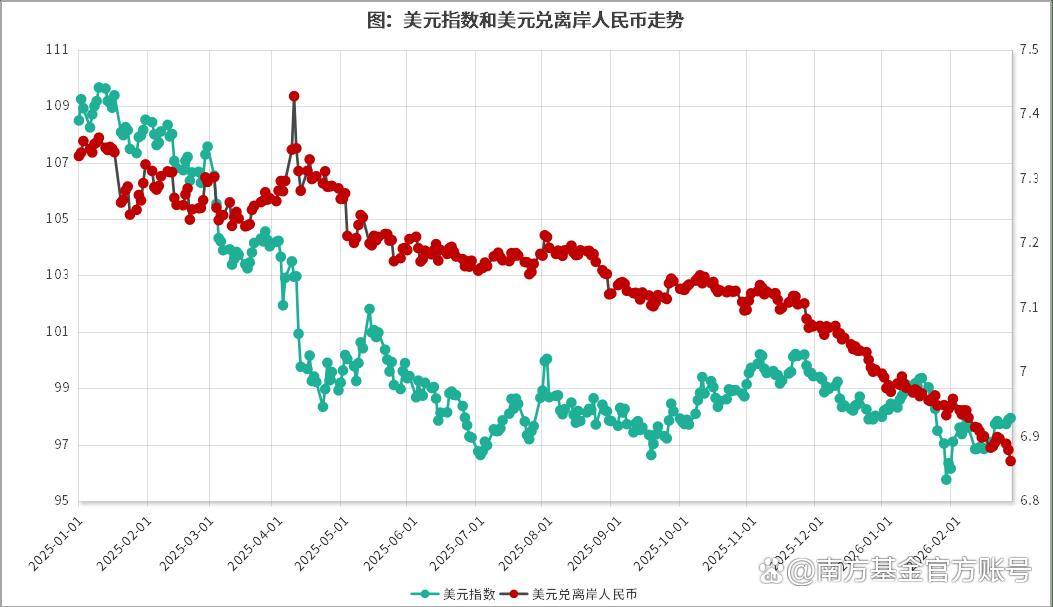
Group 1 - The recent appreciation of the RMB is driven by both internal and external factors, including a weakening dollar and strong trade surplus [2][3] - The U.S. dollar is under pressure due to a potential 75 basis point rate cut by the Federal Reserve and ongoing investigations into its chairman, impacting the dollar's credibility [2] - China's trade surplus exceeded $1.076 trillion in 2025, with a significant increase in corporate currency settlement around the Lunar New Year, contributing to the RMB's strength [3] Group 2 - The appreciation of the RMB is expected to positively influence the A-share market, with a focus on sectors like real estate and advanced manufacturing benefiting from improved market sentiment [4] - Industries with high dollar-denominated debt, such as motorcycles and photovoltaic equipment, will experience reduced debt burdens and enhanced profitability due to currency gains [5] - Sectors reliant on imported materials, like electronic chemicals and steel, will see improved profit margins as the RMB's purchasing power increases [6] Group 3 - The RMB's appreciation reflects the resilience of the Chinese economy, strong foreign trade capabilities, and restored market confidence [7] - Structural opportunities are emphasized, suggesting a focus on technology growth, price expectations, cost improvements, and foreign investment preferences rather than speculative trading [9]
人民币狂飙5600点!美元没跌,人民币却独自升值,谁在疯狂买入?
Sou Hu Cai Jing· 2026-02-27 02:32
Core Viewpoint - The offshore RMB exchange rate has strengthened significantly, reaching around 6.8 against the US dollar, with a cumulative increase of over 5600 basis points in the past 10 months, indicating a deliberate and sustained trend rather than a random fluctuation [1][3]. Group 1: RMB Strength and Market Dynamics - The RMB has steadily appreciated over the past 10 months without significant volatility, accumulating a total increase of 5600 basis points, driven by underlying market forces [3][5]. - The strengthening of the RMB is independent of the US dollar's performance, which has remained stable without signs of decline or significant upward movement [3][5]. - The recent surge in the bank's foreign exchange settlement surplus reached nearly $100 billion in December 2025, marking a historical peak, with January 2026 maintaining a high surplus of around $90 billion [7][8]. Group 2: Foreign Capital Inflow - The substantial foreign exchange surplus indicates that foreign capital is actively converting large amounts of US dollars into RMB, contributing to the currency's appreciation [8][10]. - In January 2026, a record surplus of $26 billion in securities investment further highlights foreign investors' ambitions in the RMB market, showcasing a shift in capital flow towards A-shares [10][12]. - The influx of foreign capital into the A-share market reflects a significant change in investor behavior, moving from passive observation to active participation with substantial investments [12][14]. Group 3: Market Conditions in Shanghai vs. Hong Kong - In Shanghai, the slowdown in new stock issuance has created a scarcity of quality assets, leading to increased valuations in the technology sector due to heightened liquidity [14][16]. - Conversely, Hong Kong has experienced a dramatic increase in IPO fundraising, reaching ten times the amount from the previous year, indicating a revitalization of its financial engine but also leading to liquidity challenges [16][17]. - The current IPO landscape in Hong Kong reveals a significant transformation in its industrial structure, with a notable focus on technology and high-end manufacturing, moving away from traditional financial and real estate sectors [19][21]. Group 4: Investment Sentiment and Market Outlook - The rapid development of the AI industry provides long-term growth prospects, while some assets have returned to reasonable valuation levels after experiencing a bubble [21][23]. - The evolving market dynamics suggest that the fundamentals will play a crucial role in determining whether foreign capital remains committed or withdraws, emphasizing the importance of identifying quality assets amidst market fluctuations [23][25]. - The RMB's stability at the 6.8 level reinforces expectations that RMB assets will become more valuable, further attracting foreign investment and signaling a new market cycle [25][27].
投资者微观行为洞察手册·2月第2期:外资延续流入,公募新发积极
GUOTAI HAITONG SECURITIES· 2026-02-24 10:05
Market Pricing Status: Trading Activity Slightly Decreased, Profitability Increased - The trading turnover rate has decreased, with the average daily trading volume for the entire A-share market dropping to 2.1 trillion yuan, and the average number of daily limit-up stocks decreasing to 60.8 [8][12] - The proportion of stocks that increased in value rose to 47.6%, while the median weekly return for A-share stocks increased to -0.1% [12][15] - The trading concentration in both primary and secondary industries has declined, with six industries having turnover rates in the historical top 90% [12][19] A-Share Liquidity Tracking: Foreign Capital Slightly Inflows, ETF Capital Slightly Outflows - Foreign capital inflow amounted to approximately 3.67 million USD, with the northbound trading volume accounting for 34.6% of total trading [29][46] - The new issuance scale of equity funds increased to 43.63 billion yuan, indicating a rise in overall stock positions of public funds [29][31] - ETF funds experienced a net outflow of 44.18 billion yuan, with the proportion of passive trading decreasing to 6.6% [29][25] A-Share Industry Allocation Tracking: Divergence in Movements of Foreign Capital, ETF Capital, and Financing Capital - Foreign capital saw net inflows in the non-ferrous metals (+39.1 million USD) and banking (+21.4 million USD) sectors [29][43] - Financing capital showed net inflows in the media (+2.88 billion yuan) and environmental protection (+0.24 billion yuan) sectors, while there were significant outflows in power equipment (-6.5 billion yuan) and non-bank financials (-4.56 billion yuan) [29][19] - The ETF sector experienced widespread outflows, particularly in electronics (-11.47 billion yuan) and power equipment (-4.94 billion yuan) [29][19] Hong Kong Stock and Global Liquidity Tracking: Slowing Inflows from Southbound Funds, Marginal Inflows of Global Foreign Capital into Developed Markets - Southbound fund inflows decreased to 27.8 billion yuan, representing the 76th percentile since 2022 [29][4] - The Hang Seng Index fell by 0.6%, while global markets showed mixed performance, with South Korea leading with a 5.5% increase [29][4] - Global foreign capital saw marginal inflows into developed markets, particularly in the US (+8.13 billion USD), Japan (+3.9 billion USD), and the UK (+2.11 billion USD) [29][4]
新年汇率狂飙!离岸人民币创近三年新高,这波升值风暴谁在发力
Sou Hu Cai Jing· 2026-02-19 03:23
Core Viewpoint - The offshore RMB against the USD has surged, breaking the key level of 6.89 and reaching a nearly three-year high, marking a strong start to the year with over 1% appreciation since the beginning of 2026, reflecting robust economic fundamentals and market dynamics [1][7]. External Factors - The primary external driver for the RMB's appreciation is the weakening of the USD, influenced by rising expectations of interest rate cuts by the Federal Reserve, which has led to a decline in the USD index and created upward pressure on non-USD currencies like the RMB [3]. - The US economic data has underperformed, prompting market expectations for a shift to a rate-cutting cycle, thereby diminishing the USD's strength and allowing for greater appreciation potential for the RMB [3]. Internal Support - China's strong economic resilience and impressive foreign trade performance have provided solid support for the RMB's appreciation, with the country's goods trade surplus surpassing $1 trillion in 2025, driven by exports in sectors like new energy vehicles and lithium batteries [3]. - The peak period for foreign trade enterprises to settle accounts before the Spring Festival has led to increased demand for RMB, as companies convert USD for year-end bonuses and wages, further boosting the RMB's value [3]. Foreign Investment - Continuous inflow of foreign capital into China has also contributed to the RMB's rise, as the attractiveness of RMB-denominated assets increases with the steady recovery of the Chinese economy [4]. - Improved Sino-US trade relations and a favorable external environment have bolstered market confidence in the Chinese economy, encouraging international investors to hold RMB assets [4]. Central Bank Policy - The People's Bank of China's prudent regulation has been crucial in maintaining a stable RMB exchange rate, allowing for a reasonable appreciation without excessive intervention, thus ensuring a healthy market-driven rise [6]. - The current appreciation of the RMB is seen as a rational increase supported by economic fundamentals and market supply-demand dynamics [6]. Impact on Consumers and Businesses - The appreciation of the RMB benefits consumers by making overseas purchases cheaper, thus enhancing the purchasing power for travel, education, and imported goods [6]. - While export-oriented businesses may face challenges due to a stronger RMB, the government is expected to implement policies to support these firms in maintaining their market positions [7]. - Overall, the RMB's rise is viewed as a positive signal for both the economy and consumer confidence, indicating a robust outlook for the future [9].
人民币对美元近期走强与未来前景|宏观经济
清华金融评论· 2026-02-17 13:19
Core Viewpoint - The article discusses the projected trends of the RMB against the USD, indicating a weak start in 2025 followed by a strengthening phase, with expectations of surpassing the 7.0 mark by year-end and continuing strong into early 2026. Key drivers include a weakening USD, strong economic fundamentals in China, policy guidance, and corporate behaviors [1][3]. Summary by Sections RMB to USD Exchange Rate Trends for 2025 and Early 2026 - The RMB is expected to experience three phases in 2025: a pressure period from January to April, a rebound from April to July, and a strengthening phase from July to December. The onshore RMB fell to 7.35 and the offshore RMB dropped below 7.4 during the pressure period. The rebound saw the RMB rise to 7.16 due to easing trade tensions and a 9% drop in the USD index. By year-end, the RMB surpassed the 7.0 mark, with early 2026 seeing both onshore and offshore RMB break 6.9, marking a new high since April 2023. The RMB appreciated approximately 4% against the USD over the year, while it depreciated 3.5% against a basket of currencies [2][3][5]. Key Factors Driving RMB Strength Against USD - The weakening of the USD is a primary factor, with the Federal Reserve cutting rates three times in late 2025, totaling 75 basis points, leading to a 9.7% decline in the USD index. China's economic fundamentals remain robust, with a record trade surplus of $1.19 trillion in 2025, driving corporate demand for currency exchange. Additionally, foreign capital inflow into A-shares exceeded 150 billion yuan. Policy measures from the central bank, including adjustments to the midpoint rate, have also supported the RMB's appreciation. Corporate behaviors, such as increased willingness to exchange currency due to RMB appreciation, have created a positive feedback loop [4][5]. Future Outlook for RMB to USD Exchange Rate - In the short term, a moderate appreciation of the RMB is anticipated, with many institutions predicting it could reach 6.8 in 2026. Supporting factors include the continuation of the Fed's rate cuts and strong performance in China's economy, particularly in technology and exports. However, potential risks include a rebound in US inflation, escalating geopolitical conflicts, and pressures on Chinese exports. Despite these challenges, the actual effective exchange rate remains low, which may mitigate some impacts. In the long term, a dual-directional fluctuation is expected, with the central bank aiming to maintain a stable exchange rate at a reasonable level. Companies are advised to focus on their core businesses and utilize hedging tools to manage risks [6][7][8].

离岸汇率冲破6.90!外资疯狂涌入,人民币要开启“狂飙”模式?
Sou Hu Cai Jing· 2026-02-12 18:53
Core Viewpoint - The recent strengthening of the Renminbi (RMB) is influenced by both internal and external factors, with significant movements in the offshore market and a notable increase in foreign capital inflow [2][4][6]. Group 1: Currency Movements - The offshore RMB against the USD broke the 6.90 mark, reaching a high of 6.9060, while the onshore rate peaked at 6.9112, marking the first time in three years that the offshore rate surpassed 6.92 [2] - The CFETS RMB exchange rate index rose by 1.35, while the BIS currency basket index increased by 1.38, indicating a general strengthening of the RMB [8] Group 2: Foreign Capital Inflow - There has been a continuous net inflow of foreign capital through the northbound trading channel, with significant purchases of RMB-denominated bonds, indicating a growing international confidence in the RMB [6][12] - In January, China's foreign exchange reserves reached $3.3991 trillion, an increase of $41.2 billion, marking the highest level since December 2015 [4][17] Group 3: Economic Fundamentals - China's trade surplus remains robust, with the country maintaining the largest volume of goods trade globally, which supports the stability of the RMB [4][12] - The expectation of a decline in the Federal Reserve's interest rates and the narrowing of the interest rate differential between China and the US are attracting capital inflows into RMB assets [12] Group 4: Market Sentiment and Predictions - Market sentiment has shifted towards a view of "range fluctuations" for the RMB, with predictions suggesting a trading range of 6.90 to 7.00 in 2026, contingent on breaking the critical point of 6.90 [19] - Analysts caution that while the current conditions are favorable, the strength of the RMB may wane after seasonal factors dissipate, and future movements will depend on external variables [8][12]