
财政刺激计划

Search documents
统计局:加拿大经济萎缩0.2%后反弹!自由党计划“刺激经济”!但德勤警告:今年陷衰退
Sou Hu Cai Jing· 2025-05-01 10:21
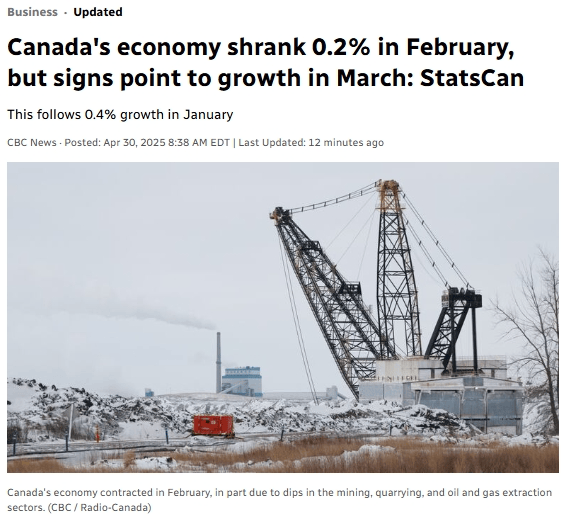
Group 1 - In February, 12 out of 20 industries in Canada experienced a decline, while the manufacturing sector grew by 0.6% [1] - The financial and insurance sectors have seen a continuous increase for three months, with a growth rate of 0.7% in February, partially offsetting the overall economic downturn [1] - The winter storms in central, eastern Canada, and British Columbia have negatively impacted the economy, particularly affecting the transportation and warehousing sector, which declined by 1.1% [4] Group 2 - Economists suggest that the unexpected decline in February is likely due to severe weather rather than tariff uncertainties, with significant impacts on mining, oil and gas, transportation, and real estate sectors [6] - The manufacturing sector is highlighted as a "bright spot," with a 0.6% growth in February, driven mainly by durable goods manufacturing, particularly machinery, which grew by 5.9% [7] - Deloitte's economic outlook predicts that the Canadian economy will enter a recession in the second quarter of this year, with a projected GDP growth rate of -1.1% for Q2 and -0.9% for Q3 [11][12] Group 3 - The Bank of Canada indicates that the era of low interest rates may be coming to an end, with a forecasted benchmark interest rate of 2.25% by the end of 2025, which is still higher than most of the 2010s [14] - The unemployment rate is expected to exceed 7% this year, with a projected loss of 75,000 jobs in the next two quarters, particularly in export-sensitive sectors like manufacturing, steel, and aluminum [14] - The current trade threats could lead to a permanent reduction of about 3% in Canada's real GDP by 2030 if exceptions in the USMCA are removed, highlighting the urgency to address long-term economic issues [17]

经济学家:欧洲央行将不得不肩负起提振经济的重担
news flash· 2025-04-23 10:19
Core Viewpoint - Economists suggest that the European Central Bank (ECB) will need to take on the responsibility of boosting economic activity in the Eurozone due to ongoing trade tensions and economic challenges [1] Economic Indicators - The April PMI data indicates a further easing of price pressures, which supported the ECB's recent interest rate cut [1] - The combination of low price pressures and weakened economic activity suggests that the ECB may implement additional rate cuts in the future [1] Trade and Fiscal Policy - If current trade conflicts do not resolve, the ECB will be tasked with addressing economic issues within the Eurozone [1] - Germany's announced fiscal stimulus plan and increased defense spending efforts in Europe are expected to take time before significantly impacting economic activity [1]