货币霸权

Search documents
美国逼全球接盘美债,中国却拿稳定币反打美元!胜负已初现
Sou Hu Cai Jing· 2025-06-27 00:58
Group 1 - The global economic landscape is undergoing a profound transformation, with the competition between China and the United States in the stablecoin sector representing a struggle for dominance in the future international monetary system [2] - Stablecoins, which are cryptocurrencies pegged to fiat currencies or specific assets, are becoming a new battleground for both countries, reflecting their differing strategic intentions [2] - The U.S. government aims to expand the potential buyer base for U.S. Treasury bonds by issuing stablecoins, thereby reducing reliance on foreign central banks [5] Group 2 - The U.S. Senate passed the GENIUS Act, which mandates that for every dollar stablecoin issued, an equivalent value of U.S. Treasury bonds must be purchased, potentially injecting $2 trillion into the Treasury market if the stablecoin market reaches $2 trillion [5] - China's central bank is actively promoting the internationalization of the digital yuan to gain a foothold in the stablecoin arena, viewing stablecoins as a tool for enhancing national monetary power [7] - Hong Kong has been designated as a testing ground for the digital yuan, with the passage of the Stablecoin Ordinance, positioning it as a "stablecoin regulatory special zone" [9] Group 3 - The value of currencies, including the U.S. dollar and the Chinese yuan, ultimately depends on credit backing, with recent surges in Bitcoin prices reflecting a loss of confidence in the dollar [10] - China's strategy for developing stablecoins is not solely focused on addressing fiscal challenges but aims to establish a new global monetary order [11] - The competition between U.S. and Chinese stablecoins signifies a significant shift in the global monetary landscape, leading to the emergence of a more diversified international monetary system [11]

公开挑战美元霸权!欧洲的野心真能实现吗?
Jin Shi Shu Ju· 2025-05-30 14:06
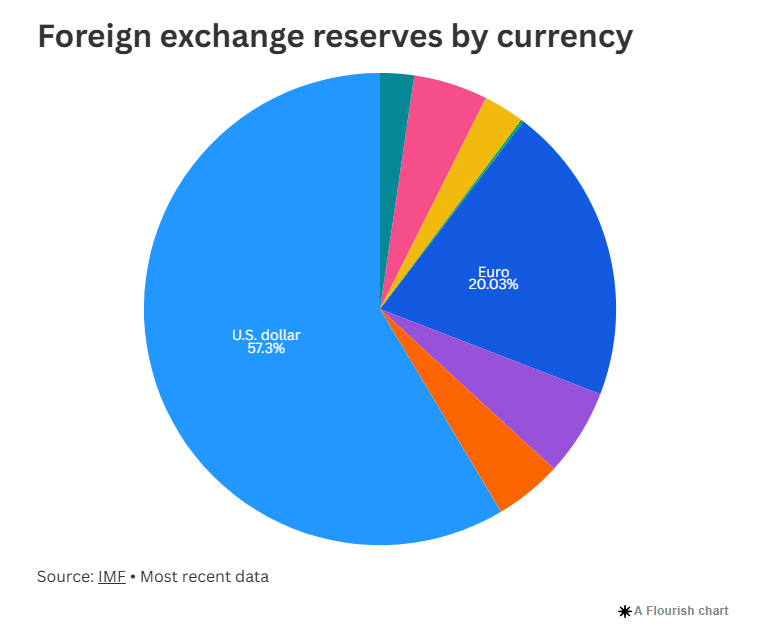
Core Viewpoint - European officials are expressing a desire for the euro to seize the opportunity to replace the dollar as the dominant global reserve currency amid fluctuations in U.S. assets due to Trump's tariff policies [1][2]. Group 1: Euro's Current Position and Potential - The dollar remains the most widely used reserve currency, accounting for nearly 60% of global foreign exchange reserves, while the euro holds about 20% [1]. - The dollar index has dropped over 8% since the beginning of the year, indicating a shift in geopolitical dynamics that may provide an opportunity for the euro's elevation [2]. - ECB President Christine Lagarde highlighted that the changing geopolitical landscape could open doors for the euro to play a larger international role [2]. Group 2: Strategies for Elevating the Euro - Lagarde outlined three key strategies to enhance the euro's global influence: 1. Commitment to open trade and a strong geopolitical foundation [3]. 2. Strengthening the economic base through deeper and more liquid capital markets [3]. 3. Upholding the rule of law and political unity to withstand external pressures [3]. - An increased reserve currency status for the euro could lead to lower borrowing costs for European governments and protection from exchange rate fluctuations [3]. Group 3: Diverging Opinions on Euro's Future - ECB officials, including Lagarde, see potential for the euro as a safe haven amid declining confidence in the U.S. [6]. - Market observers express mixed views on the euro's ability to capture a larger share of global foreign exchange reserves, with some optimistic about its prospects [6][7]. - Nomura's chief European economist noted that as investors seek diversification away from the dollar, the euro could gain more attention, predicting it may rise to 1.20 against the dollar by year-end [6]. - However, some analysts argue that the euro faces significant obstacles, including political fragmentation among member states and reliance on U.S. security frameworks, which limit its global influence [7].