
通感融合

Search documents
工信部等五部门办公厅:积极推进5G-A产业发展 加强低空装备与低空信息通信的融合创新与设备研发
智通财经网· 2026-02-10 07:11
Core Viewpoint - The implementation opinions released by the Ministry of Industry and Information Technology and other departments aim to strengthen the capacity building of the information and communication industry to support the development of low-altitude infrastructure, emphasizing the importance of enhancing industrial supply capacity and promoting the development of 5G-A technology [1][2]. Group 1: Overall Requirements - The initiative is guided by Xi Jinping's thoughts and aims to enhance the technical foundation, industrial supply capacity, network support capacity, and security assurance capacity of the information and communication industry [2]. - The focus is on orderly advancing the construction of low-altitude communication networks and improving navigation accuracy to support the development of the low-altitude economy [2][3]. Group 2: Key Tasks - The plan emphasizes the need to advance low-altitude communication network coverage based on demand, particularly in areas below 300 meters, utilizing existing 5G infrastructure and exploring dedicated low-altitude networks [4]. - It aims to enhance detection capabilities for low-altitude aircraft through the integration of various sensing technologies and improve navigation services using the BeiDou navigation system [4][5]. - The initiative includes the construction of a low-altitude intelligent network system leveraging IoT, AI, and big data technologies to support low-altitude traffic management [5]. Group 3: Industry Supply Capacity - The plan promotes the development of the 5G-A industry, upgrading existing ground station functionalities, and reducing equipment costs while enhancing the integration of low-altitude equipment with communication technologies [6]. - It encourages collaboration among telecom enterprises and the establishment of shared infrastructure to support low-altitude applications [6]. Group 4: Safety and Regulation - The initiative outlines the need for a robust network and data security framework, emphasizing the importance of compliance with security standards and the protection of critical information infrastructure [7]. - It also highlights the necessity of optimizing frequency supply for low-altitude communication and ensuring proper management of radio frequency resources [7][8]. Group 5: Organizational Support - The plan calls for enhanced departmental collaboration and local government involvement to ensure the effective implementation of infrastructure construction, standard formulation, and safety measures [8]. - It encourages the use of various funding channels to support key technology breakthroughs and equipment development in the information infrastructure sector [8].
5部门:加强低空装备与低空信息通信的融合创新与设备研发
3 6 Ke· 2026-02-10 07:10
Core Viewpoint - The implementation opinions released by the Ministry of Industry and Information Technology and four other departments focus on enhancing the capacity building of the information and communication industry to support the development of low-altitude infrastructure [1] Group 1: Industry Supply Capacity - The document emphasizes the need to improve industrial supply capacity [1] - It advocates for the active promotion of 5G-A industry development and further upgrades to existing ground station facilities [1] - There is a call to accelerate the maturity of technologies such as sensing and communication integration while gradually reducing equipment costs [1] Group 2: Low-altitude Equipment and Communication Integration - The opinions highlight the importance of integrating low-altitude equipment with low-altitude information communication for innovative development and equipment research [1] - It encourages the adaptation and verification of 5G/5G RedCap modules with low-altitude aircraft [1] - The exploration of integrated modules for low-altitude communication, navigation, and surveillance functions is also recommended to accelerate technological and industrial maturity [1]
政策护航技术攻坚 6G产业布局加速铺开
Xin Hua Wang· 2025-11-20 02:29
Core Insights - The development of 6G technology in China is accelerating, with over 300 key technology reserves established and significant capital investment in the 6G ecosystem, despite the network not being expected to deploy until 2030 [1][2][3] Group 1: Technological Advancements - The first multi-station multi-intelligent reconfigurable intelligent surface (RIS) network trial for 6G has been completed, providing innovative pathways for wide coverage and seamless connectivity [2] - 6G is expected to evolve towards stronger performance, higher intelligence, and broader coverage, integrating communication with AI, satellite internet, and other domains [2][3] - The Ministry of Industry and Information Technology emphasizes the need for continuous research on core technologies and the integration of technology solutions to lay a solid foundation for 6G standardization and industrialization [3] Group 2: Terminal Innovation - Terminal innovation is seen as a core driver for the successful implementation of 6G, with expectations that future 6G devices will include AI capabilities and support for virtual-physical integration [4][5] - The market research firm Canalys predicts that AI smartphones will account for 16% of global smartphone shipments in 2024, increasing to 54% by 2028 [4] - 6G terminals are expected to evolve beyond smartphones to include various smart devices, with automotive terminals becoming increasingly important as mobile wireless hubs [5][6] Group 3: Market Development - Various regions in China are actively laying out plans for 6G technology innovation and industry cultivation, with significant investments and initiatives being launched [7] - Companies are focusing on integrating satellite technology with AI to enhance applications in smart cities, agriculture, and environmental monitoring [7] - The capital market is also rapidly positioning itself in the 6G industry, with frequent mergers and acquisitions among listed companies to accelerate industry consolidation [7]
触摸“十五五”产业脉搏丨政策护航技术攻坚 6G产业布局加速铺开
Xin Hua She· 2025-11-20 01:51
Core Insights - The article emphasizes the accelerated development of the 6G industry in China, highlighting the completion of the first phase of 6G technology trials and the formation of over 300 key technology reserves, indicating a shift from laboratory concepts to industrial implementation [1][2][3] Group 1: Technological Advancements - The first multi-site, multi-intelligent reconfigurable intelligent surface (RIS) network trial for 6G has been completed, providing innovative pathways for wide coverage and seamless connectivity [2] - The Ministry of Industry and Information Technology (MIIT) has initiated systematic promotion of 6G system design, network architecture, and key technology innovations, engaging over a hundred domestic and international entities in collaborative trials [3] - 6G is expected to evolve towards stronger performance, higher intelligence, and broader coverage, integrating communication with AI, satellite internet, and other domains [2][3] Group 2: Terminal Innovation - Terminal innovation is identified as a core driver for the successful implementation of 6G, with expectations for AI-integrated smartphones and other smart devices to emerge [4][5] - The global market for AI smartphones is projected to grow from 16% of total smartphone shipments in 2024 to 54% by 2028, indicating a significant shift in consumer technology [4] - 6G terminals will encompass a variety of smart devices, including glasses, headphones, and vehicles, transforming them into intelligent hubs with AI capabilities [5][6] Group 3: Market Development - Various regions in China are actively laying out plans for 6G technology and industry cultivation, with local governments promoting initiatives to foster a 6G ecosystem [7] - The integration of satellite technology with 6G is seen as a major opportunity, with companies focusing on making satellites smarter and more reliable to support applications in smart cities and agriculture [7] - The capital market is increasingly involved in the 6G industry, with listed companies engaging in mergers and acquisitions to accelerate industry consolidation [7]
6G正向我们走来!
Ke Ji Ri Bao· 2025-11-14 07:38
Group 1 - The core prediction is that 6G is expected to be commercially available in China, Europe, India, Japan, South Korea, the United States, and Vietnam by 2030, with global connections projected to exceed 5 billion by 2040 [1] - The theme of the conference is "Intelligent Connection of the World, Co-constructing the 6G Technology Innovation Ecosystem," emphasizing the integration of communication, perception, computing, and intelligence technologies [1] Group 2 - 6G is currently in a critical phase of technological innovation and clear industry direction, requiring global collaboration among academia, industry, and users [2] - Terminal innovation is identified as a core aspect of building the 6G ecosystem, with AI smartphones expected to lead the next generation of smartphones, potentially capturing 54% of global smartphone shipments by 2028 [2] - The integration of AI and extended reality (XR) is anticipated to drive 6G development, shifting user experiences from "watching videos" to "entering videos" [2] Group 3 - Spectrum resources are deemed foundational for 6G development, with a significant increase in demand for spectrum in core cities expected over the next five years [3] - The GSMA advocates a "two-step" strategy for 6G, focusing first on maximizing 5G potential before advancing through innovations like AI-native networks and non-terrestrial networks [3] - China has developed over 300 key 6G technologies and established a three-pronged R&D system for technology breakthroughs, testing, and iterative optimization [3] Group 4 - As of November 2025, China is projected to account for 40.3% of global 6G patent applications, with Beijing establishing a collaborative framework to support 6G innovation and commercialization [4]
6G正向我们走来!——2025年6G发展大会描绘全球智联新蓝图
Ke Ji Ri Bao· 2025-11-14 07:24
Group 1 - The core prediction is that 6G is expected to be commercially available in China and several other countries by 2030, with global connections projected to exceed 5 billion by 2040 [1] - The theme of the conference was "Intelligent Connection of the World, Building a 6G Technology Innovation Ecosystem," emphasizing the integration of communication, perception, computing, and intelligence technologies [1] - Experts believe that 6G will expand its service targets from people and machines to intelligent entities, aiming for a vision of "ubiquitous intelligence and digital twins" [1] Group 2 - The year 2023 marks the full launch of 6G standardization research, with a focus on accelerating technological innovation and clear industry direction [2] - Terminal innovation is identified as a core aspect of building the 6G ecosystem, with AI smartphones expected to lead the next generation of smartphones, potentially capturing 54% of global smartphone shipments by 2028 [2] - The integration of AI and extended reality (XR) is anticipated to drive 6G development, shifting user experiences from "watching videos" to "entering videos" [2] Group 3 - Spectrum resources are deemed the foundation for 6G development, with a significant increase in demand for spectrum in core cities expected over the next five years [3] - The GSMA advocates a "two-step" strategy for 6G, focusing first on maximizing 5G potential before leveraging innovations like AI-native networks and non-terrestrial networks [3] - China has established over 300 key 6G technology reserves and is developing a three-pronged R&D system to support technological breakthroughs and testing [3] Group 4 - As of November 2025, China accounts for 40.3% of global 6G patent applications, with Beijing developing a collaborative framework to support 6G innovation and commercial deployment [4] - The conference was co-hosted by the China Academy of Information and Communications Technology and the IMT-2030 (6G) Promotion Group, with support from local government bodies [4]
剑指新时代技术高地 6G发展大会11月在京启幕
Bei Jing Shang Bao· 2025-11-04 14:19
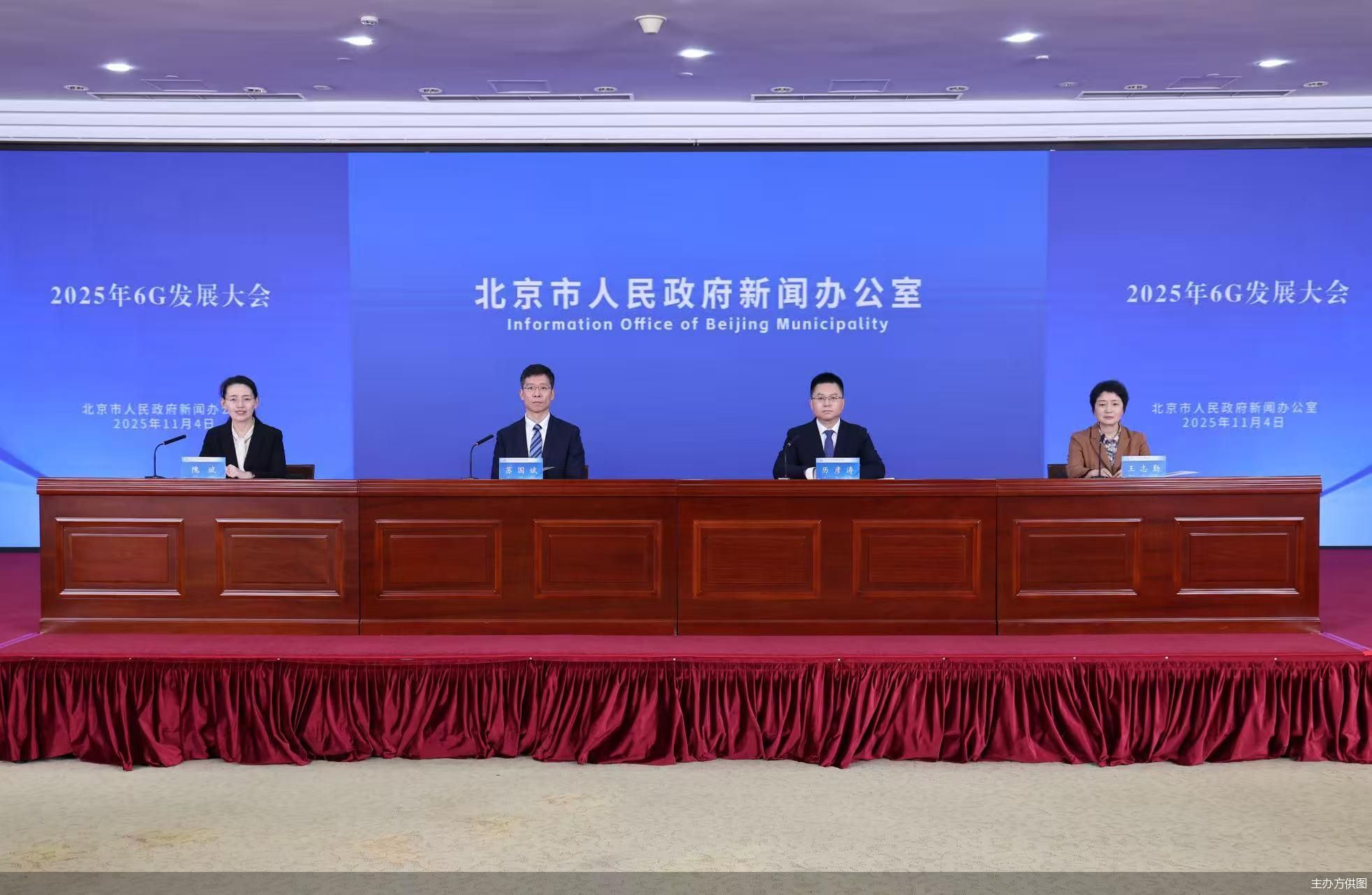
Core Insights - The 6G technology is rapidly advancing even before the public fully understands 5G, with key features like "perception and communication integration" being highlighted [2][3] - The 6G Development Conference is scheduled for November 13-14, 2025, in Beijing, focusing on building a collaborative ecosystem for 6G technology innovation [2][5] Group 1: 6G Development in Beijing - Beijing has established a mature development framework for 6G, characterized by "policy guidance + technological breakthroughs + ecological collaboration" [3] - The city has initiated a top-level design for 6G, forming a collaborative system that includes a central group, a laboratory, and multiple research and industrial bases [3] - Beijing is leading nationally in policy support, having released the "6G Technology Innovation and Industry Cultivation Action Plan (2024-2030)" ahead of other regions [3][4] Group 2: Technological Advancements and Applications - The 6G technology in Beijing has achieved significant breakthroughs, with initiatives like the "6G SPACES" ecosystem community being launched to support testing and innovation [4] - The upcoming conference will feature discussions on the integration of 6G with AI and other advanced technologies, aiming to explore new application scenarios [5][7] - Key technical reports on 6G scenarios such as "intelligent integration" and "immersive communication" will be released during the conference [5] Group 3: Global Context and Future Directions - The standardization of 6G is at a critical stage globally, with new technical challenges arising from the introduction of complex functionalities [6] - Beijing aims to become a core technology source and a hub for high-value enterprises in the global 6G industry, focusing on application ecosystems and core technologies [7] - The city is inviting global stakeholders to collaborate and share opportunities in the development of 6G technology [7]


中兴通讯率先完成IMT-2020(5G)推进组5G-A关键技术通感融合测试
Xin Lang Cai Jing· 2025-10-21 05:59
Core Viewpoint - ZTE Corporation has successfully completed the key technology testing for 5G-A sensory integration, leading the way in technology innovation and commercial deployment in the 5G sector [1] Group 1: Company Achievements - ZTE Corporation is the first to complete the 5G-A key technology sensory integration test organized by the IMT-2020 (5G) Promotion Group [1] - The company has initiated over 100 commercial and pilot projects for 5G-A sensory integration across the country [1] Group 2: Technological Focus - The projects cover critical technologies such as AI sensory models and multi-modal perception integration [1] - Value scenarios include low-altitude security, low-altitude logistics, low-altitude inspection, and water area management [1]
5G-A万兆网发展提速
Zhong Guo Jing Ji Wang· 2025-09-29 02:45
Core Insights - The "Second 5G-A Ten-Gigabit Network Industry Forum" was held in Beijing, highlighting the importance of 5G-A as a critical phase in the evolution from 5G to 6G, offering higher speeds and lower latency while expanding new features such as integrated communication and sensing [1][2] - The development of 5G-A is expected to significantly contribute to the upcoming ten-gigabit era, with various stakeholders in the industry, academia, and research collaborating to enhance the commercial scale of the ten-gigabit network [1][2] - The integration of AI technology with 5G-A is seen as a key driver for future applications, enabling intelligent scenarios and enhancing the capabilities of communication, perception, and computation [3][4] Industry Developments - The Ministry of Industry and Information Technology emphasized the need for collaborative exploration among industry players to create a new pattern of high-quality development in mobile communications [1] - Beijing has achieved significant results in network deployment and user development, marking the sixth year of commercial 5G operations, with 5G-A demonstrating superior network performance compared to its predecessor [2] - In Guangxi, 15.3 million 5G base stations have been built, with 8,000 of them equipped with 5G-A capabilities, showcasing practical applications in low-altitude economy and smart industrial management [3] Technological Advancements - The establishment of standards and testing is crucial for the commercialization and deployment of 5G-A products, ensuring that advantageous technical features are integrated into products [4] - The introduction of new business scenarios and applications, driven by AI and other innovations, is expected to propel the development of 5G-A [4] - The forum called for close collaboration within the industry to focus on intelligent networks, refined capabilities, and diverse scenarios to promote the development of 5G-A networks [4]
世界移动通信大会:创新技术“秀本领”、探索发展“指向标”
Zhong Guo Xin Wen Wang· 2025-06-20 10:47
Core Insights - The 2025 World Mobile Communication Conference (MWC Shanghai) highlights the themes of "interconnection" and "integration" in mobile communication development [1] Group 1: AI Integration - Mobile communication networks are seen as the foundation for the large-scale development of artificial intelligence (AI) [2] - Chinese operators are positioning AI as the core engine for cross-industry intelligent solutions [2] - China Unicom showcased intelligent products for industrial scenarios, while China Telecom presented a robotic dog with various functions, marking a step towards integrating AI into daily life [2] - AI has reached or surpassed human levels in language understanding, image recognition, and efficient learning [2] Group 2: Low-altitude Economy - Mobile communication plays a crucial role in low-altitude economy by supporting low-altitude communication, flight navigation, and airspace regulation [3] - As of March 2025, over 5.6 million base station construction projects are expected to be completed [3] - China Mobile has developed a "four drives and two wings" capability system for the low-altitude economy, focusing on terminals, networks, platforms, and applications, along with AI and security [3] Group 3: Future Development Prospects - Shanghai's authorities are encouraging innovation in 5G-A technologies for the low-altitude economy [4] - A demonstration area for low-altitude intelligent network infrastructure is being established in Hefei, with positive progress reported [4] - The developed low-altitude perception equipment based on TDOA technology can meet the needs for low-altitude flight order protection and important facility safeguarding [4] - Future plans include accelerating the evolution of next-generation communication networks and enhancing collaboration in technology innovation and standard setting [4]