
险资举牌

Search documents
一周保险速览(1.10—1.16)
Cai Jing Wang· 2026-01-21 06:05
Industry Insights - In 2025, multiple insurance companies reported annual claims data showing a continuous increase in both the number and amount of claims, with an overall claim approval rate exceeding 99% [1] - Medical insurance had the highest number of claims, while critical illness insurance had the highest claim amounts, indicating a significant protection gap [1] - Claims processing times have significantly improved, with some companies achieving instant payouts; however, the "claims difficulty" issue persists mainly due to inaccurate health disclosures, misunderstandings of policy terms, and insufficient documentation, rather than widespread claim denials [1] - Experts recommend that consumers scientifically allocate medical and critical illness insurance based on age, income, and family responsibilities, particularly emphasizing adequate coverage for family breadwinners [1] Corporate Developments - Deutsche Bank's insurance subsidiary, Deutsche Bank Life Insurance Co., has increased its registered capital to 3.785 billion yuan, marking a 68.97% increase from 2.24 billion yuan [2] - On January 14, China Pacific Life Insurance Co. announced its participation in a stock acquisition of Shanghai International Airport Co., increasing its holdings to 124,415,684 shares, representing 5.00% of the A-share capital [3] - China Ping An is set to sell a 34% stake in Shenzhen United Property Exchange, comprising 170 million shares, with a listing price of 408 million yuan (2.4 yuan per share) [4] - On January 14, the general manager of Kaibin Property Insurance Co., Xia Dongyou, resigned for personal reasons, with Bai Chengmin appointed as the interim head to ensure a smooth management transition [5] - On January 14, Jiao Yin Life Insurance announced a leadership change, with Li Ya appointed as the new chairman, succeeding Wang Qingyan [6]


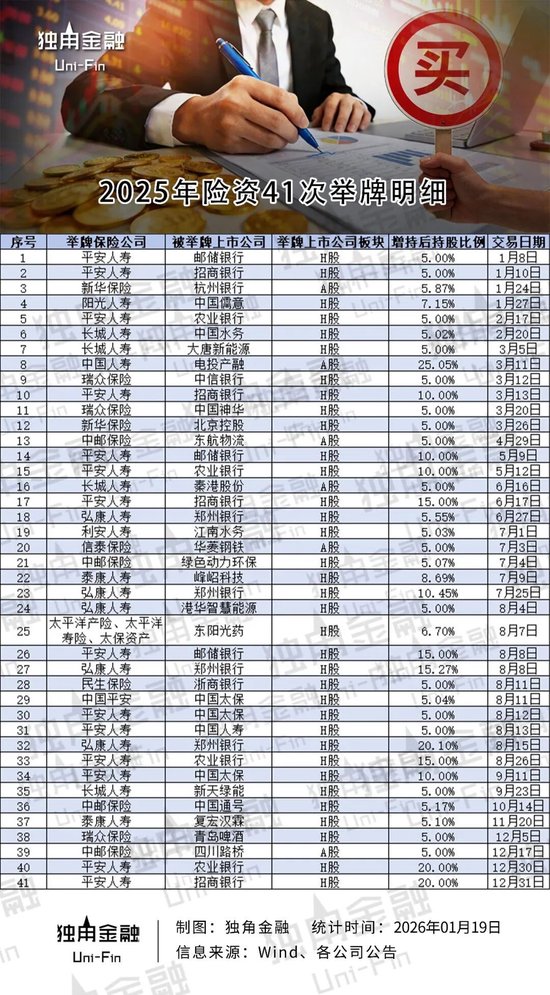
狂揽港股!险资一年41次举牌背后的资本盛宴
Xin Lang Cai Jing· 2026-01-19 12:23
Core Viewpoint - Insurance capital is transitioning from a "barbarian at the gate" to a "strategist in the boardroom," with a focus on long-term investments rather than short-term financial gains, as evidenced by a record 41 public shareholding increases in 2025, the highest in nearly a decade [1][16][19] Group 1: Investment Trends - In 2025, insurance capital engaged in 41 public shareholding increases, more than double the average of recent years, indicating a significant shift in investment strategy [2][16] - The majority of these shareholding increases (over 85%) occurred in H-shares, driven by their substantial valuation discounts and smoother acquisition mechanisms [1][19] - Insurance companies are increasingly focusing on financial stocks, particularly banks, as they seek certainty, safety, and valuation flexibility in a complex market environment [1][9] Group 2: Regulatory Environment - Recent regulatory changes have opened up opportunities for insurance capital in equity investments, shifting from restrictions to encouragement of long-term investments [4][18] - The optimization of solvency regulatory standards has expanded the space for equity investments, allowing insurance companies to better match their long-term liabilities with asset returns [4][18] Group 3: Financial Performance - Insurance companies have reported significant increases in investment income, with 11 companies showing positive growth in 2025, including a remarkable 687.16% increase for New China Life [11][26] - The overall investment yield for major insurers has risen, with Ping An Life and China Life reporting increases exceeding 400% in investment income [12][26] Group 4: Strategic Focus - Insurance capital is not only focusing on traditional financial sectors but is also investing in high-tech fields such as renewable energy, advanced manufacturing, and biotechnology, reflecting a strategic alignment with national economic transformation [9][23] - The long-term nature of insurance capital aligns well with companies that have solid fundamentals and stable cash flows, allowing insurers to share in corporate growth and dividends [3][17]




2026年险资落下“首子”:太保资产举牌上海机场
2 1 Shi Ji Jing Ji Bao Dao· 2026-01-19 09:45
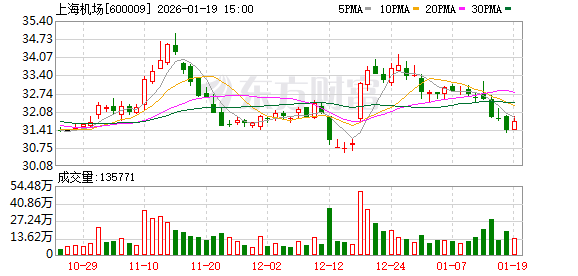
Core Viewpoint - Insurance capital has begun to actively participate in equity investments, with the first significant move in 2026 being the acquisition of shares in Shanghai Airport by Taiping Asset Management, marking a continuation of the trend of insurance capital increasing its stake in high-dividend sectors [2][3]. Group 1: Insurance Capital Movements - On January 9, 2026, Taiping Asset Management increased its stake in Shanghai Airport from 2.09% to 5%, acquiring 72.424 million A-shares through block trading [3]. - The total number of insurance capital acquisitions reached 41 in 2025, more than doubling from 20 in 2024, marking the second-highest annual total in history [2][6]. - The trend of insurance capital acquiring stakes is expected to continue, particularly in sectors like banking and public utilities that offer high dividends [2][6]. Group 2: Investment Rationale - Shanghai Airport's monopoly advantage and strong cash flow align with insurance capital's preference for stable, income-generating assets in a low-interest-rate environment [3][4]. - The investment strategy of insurance capital is increasingly driven by the OCI (Other Comprehensive Income) approach, focusing on stable dividend yields rather than short-term capital gains [7]. - Analysts suggest that the preference for high-dividend stocks is a response to declining yields in traditional fixed-income assets, making stable cash flow assets more attractive [4][7]. Group 3: Market Trends and Future Outlook - The ongoing low-interest-rate environment is expected to sustain the demand for high-dividend stocks, with insurance capital actively seeking opportunities in this area [8]. - The energy sector, particularly companies like Chenzhou International, is gaining attention due to innovative operational models and cost advantages in maintenance services [8][9]. - The overall trend indicates that insurance capital will continue to focus on sectors with strong dividend yields and stable cash flows, providing a stabilizing influence in the capital markets [5][8].
保险行业周报(20260112-20260116):险资举牌再启,”长钱长投“夯实投资端-20260117
Huachuang Securities· 2026-01-17 15:01
Investment Rating - The report maintains a "Recommended" rating for the insurance industry, expecting the industry index to outperform the benchmark index by over 5% in the next 3-6 months [19]. Core Insights - The insurance sector index decreased by 3.64% this week, underperforming the broader market by 3.07 percentage points. Individual stock performances varied, with notable declines in major companies like Ping An and China Pacific [1][3]. - China Pacific Life Insurance increased its stake in Shanghai Airport to 5% through block trading, marking the first significant acquisition by insurance capital in 2026. This trend reflects a growing interest in high-dividend assets amid a low-interest-rate environment [2][3]. - The report highlights a shift towards long-term investments by insurance capital, focusing on stable cash flow and high dividend yield assets, particularly in sectors like banking and public utilities [3]. - Regulatory support for long-term capital market participation is emphasized, with expectations of continued downward pressure on long-term interest rates, prompting insurance companies to seek dividend assets as a strategic choice [3]. Summary by Sections Market Performance - The insurance index fell by 3.64%, with significant declines in major stocks such as Ping An (-3.87%) and China Pacific (-4.97%). The 10-year government bond yield is at 1.84%, down 4 basis points from the previous week [1]. Recent Developments - China Pacific Life's acquisition of 72.424 million shares of Shanghai Airport, increasing its total holdings to approximately 124 million shares, represents a strategic move in the current market [2]. - The establishment of the Honghu Zhiyuan Fund, focusing on well-governed, high-dividend large-cap stocks, indicates a trend towards stable investment strategies among insurance companies [2]. Investment Recommendations - The report suggests focusing on undervalued stocks like China Pacific, which shows strong operational stability and recovery potential in both A and H shares. It also notes that Ping An's performance is expected to remain resilient despite market pressures [3][8]. - Valuation metrics indicate that major players like New China Life and China Life are trading at PEV multiples of 0.92x and 0.91x, respectively, while Ping An is at 0.80x, suggesting potential for upside [4][8].

太保寿险增持上海机场 今年险资首例举牌出现
Zheng Quan Ri Bao· 2026-01-15 22:30
Core Viewpoint - China Pacific Life Insurance Co., Ltd. (CPIC) has increased its stake in Shanghai International Airport Co., Ltd. (Shanghai Airport) by acquiring 72.424 million shares, bringing its total holdings to approximately 124 million shares, which represents 5.00% of the company's A-share capital. This marks the first instance of insurance capital participating in a stake increase in 2024 [1][2]. Group 1: Investment Activity - CPIC's investment in Shanghai Airport is part of its equity investment management strategy, driven by its own investment needs [2]. - The frequency of insurance capital stake increases has been rising, with 20 instances in 2024 and a projected increase to 41 instances in 2025, reaching a near-decade high, second only to the 62 instances recorded in 2015 [2]. Group 2: Reasons for Increased Activity - The rise in stake increases is attributed to three main factors: low interest rates and "asset scarcity," the implementation of new accounting standards, and low market valuations [2]. - Insurance capital is particularly attracted to high-dividend stocks as a means to match long-term liabilities and enhance returns, especially in a low-interest environment [3]. Group 3: Sector Preferences - The sectors favored by insurance capital for stake increases include banking, insurance, renewable energy, infrastructure logistics, and public utilities, with a significant focus on H-shares [3]. - In 2025, 44% of the stake increases were in the banking sector, and over 80% of the targets were H-shares, which often offer higher dividend yields [3]. Group 4: Future Outlook - The demand for stake increases is expected to be categorized into two main types: one focused on stable dividend cash flows and the other on companies with strong return on equity (ROE) and established market positions [4]. - The trend of active stake increases is anticipated to continue, with a shift towards technology and green energy sectors, while maintaining a focus on traditional high-dividend sectors [5].
太保寿险增持上海机场今年险资首例举牌出现
Zheng Quan Ri Bao Zhi Sheng· 2026-01-15 16:34
Core Viewpoint - China Pacific Life Insurance Co., Ltd. (CPIC) has increased its stake in Shanghai International Airport Co., Ltd. (Shanghai Airport) by acquiring 72.424 million shares, bringing its total holdings to approximately 124 million shares, which represents 5.00% of the company's A-share capital. This marks the first instance of insurance capital participating in a stake increase in 2024 [1][2]. Group 1: Investment Activity - CPIC's investment in Shanghai Airport is part of its equity investment management strategy, driven by its own investment needs [2]. - The frequency of insurance capital stake increases has been rising, with 20 instances in 2024 and a projected increase to 41 instances in 2025, marking a near ten-year high [2]. Group 2: Reasons for Increased Activity - The rise in stake increases is attributed to several factors: low interest rates, the implementation of new accounting standards, and low market valuations [2]. - Experts indicate that the low interest rate environment and "asset shortage" pressures have made high-dividend stocks a core choice for insurance capital to match long-term liabilities and enhance returns [2]. Group 3: Target Industries and Preferences - Insurance capital has primarily targeted industries such as banking, insurance, new energy, infrastructure logistics, and public utilities, with a significant focus on H-shares [3]. - In 2025, 44% of the stake increases were in the banking sector, and over 80% of the targets were H-shares, which often have higher dividend yields [3]. Group 4: Future Outlook - The demand for stake increases is expected to be categorized into two main types: one focused on stable dividend cash flows and the other on companies with strong return on equity (ROE) and established market positions [4]. - The active participation of insurance capital in stake increases is anticipated to continue, with a shift towards technology and green energy sectors while maintaining a focus on traditional high-dividend sectors [5].
2026年险资首次!太保寿险“举牌”上海机场
Huan Qiu Lao Hu Cai Jing· 2026-01-15 10:30
Core Viewpoint - China Pacific Life Insurance Co., Ltd. (CPIC Life) has increased its stake in Shanghai International Airport Co., Ltd. to 5% through a block trade, marking the first significant investment by domestic insurance capital in 2026 [1] Group 1: Investment Details - On January 9, CPIC Life acquired 72.424 million shares of Shanghai Airport, raising its total holdings to approximately 124 million shares, which represents 5% of the company's A-share capital [1] - Prior to this acquisition, CPIC Life and its affiliates held 51.9917 million shares, equating to a 2.09% stake [1] - The total expenditure for this increase in stake is estimated at around 2.366 billion yuan, based on the closing price of 32.67 yuan per share on January 9 [1] Group 2: Strategic Rationale - The decision to increase the stake in Shanghai Airport aligns with the long-term investment preferences of insurance capital, as the airport possesses a monopolistic location advantage and a growing flow barrier, ensuring stable operations and strong cash flow [1] - Additionally, with the return of international consumption, the non-aviation business of Shanghai Airport is becoming increasingly valuable, indicating a high certainty of long-term growth [1] Group 3: Historical Context - In 2025, CPIC was active in the insurance capital market, making significant investments across various sectors including pharmaceuticals, finance, and infrastructure [2] - CPIC Life and CPIC Property Insurance passively acquired shares in Dongyang Sunshine Pharmaceutical through a stock conversion process, resulting in a combined holding of 754.6 million shares, or 6.70% of the company [2] - CPIC Asset Management also holds stakes in Shanghai Lingang (5.33%) and Hu Nong Commercial Bank (5.81%), which were built through gradual increases prior to 2025 [2]
险资出手,今年首次举牌
证券时报· 2026-01-15 04:35
Core Viewpoint - The insurance capital is actively participating in the stock market, with significant investments in listed companies, indicating a continued trend of insurance funds entering the market since 2025 [5][9]. Group 1: Recent Investments - On January 9, 2026, Taiping Life Insurance increased its stake in Shanghai Airport by acquiring 72.424 million shares through block trading, raising its total holdings to 124 million shares, which represents approximately 5.00% of the company's A-share capital [1][3]. - Prior to this acquisition, Taiping Life Insurance and its associated party held 51.9917 million shares, accounting for 2.09% of the A-share capital [3]. - The funds for this acquisition were sourced from insurance funds managed by Taiping Asset, including personal dividend product accounts and traditional insurance product accounts [3]. Group 2: Insurance Capital Trends - In December 2025, Ping An Life also made significant investments, acquiring 20% stakes in Agricultural Bank of China and China Merchants Bank, triggering mandatory disclosure [6]. - The total number of insurance capital acquisitions reached 36 in 2025, surpassing the previous high in 2020 and marking the highest since records began in 2015 [6][8]. - The insurance industry has seen a 35.92% year-on-year increase in equity asset allocation, with the total balance reaching 5.59 trillion yuan by the end of Q3 2025 [8]. Group 3: Future Outlook - A survey of insurance investment officers indicates a strong belief that opportunities in the market outweigh risks, with over 70% planning to increase their equity asset allocation in 2026 [9]. - The trend of increasing equity asset allocation is expected to continue, driven by the downward pressure on interest rates and the need for asset-liability matching [9]. - The insurance sector is adapting to a low-interest environment and regulatory changes, which are facilitating a more aggressive approach to equity investments [8][9].

险资新年首次举牌!近两年举牌频次创近十年新高!
Mei Ri Jing Ji Xin Wen· 2026-01-14 07:28
Group 1 - The core viewpoint of the article highlights the increasing trend of insurance capital stake acquisitions, with a notable example being Taiping Asset's acquisition of a 5% stake in Shanghai Airport, marking the first instance of such activity in 2026 [1] - In 2025, the number of stake acquisitions by insurance capital reached 41, a significant increase from 20 in 2024, setting a near ten-year high, second only to the historical peak in 2015 [1] - The current wave of stake acquisitions differs from previous ones, primarily driven by two considerations: the emphasis on high dividend stocks in a low-interest-rate environment and the strategy of long-term equity investments in high-quality targets with stable ROE to optimize asset structure [1] Group 2 - The trend of frequent stake acquisitions by insurance capital is expected to continue in 2026, driven by the same two investment logic considerations [1] - Other funds are focusing more on low-volatility dividend strategies, as exemplified by the low-volatility dividend index (H30269.CSI), which selects securities with stable dividends, high dividend yields, and low volatility [1] - As of January 13, the one-year dividend yield of the low-volatility dividend index was 4.45%, with the Huaxia low-volatility dividend ETF (159547) being the lowest fee ETF tracking this index [1]
2026年险资举牌热度能否延续?
Jin Rong Shi Bao· 2026-01-14 02:37
Core Viewpoint - In 2025, insurance capital's shareholding activities reached a record high of 35 times, driven by regulatory encouragement, the pursuit of higher returns in a low-interest environment, and new accounting standards that help smooth profit fluctuations [1][4]. Group 1: Characteristics of Insurance Capital Shareholding - The number of shareholding activities by insurance capital in 2025 significantly exceeded the average level of recent years, marking the most active year since 2015 [2]. - A total of 14 insurance institutions participated in shareholding activities, including major listed insurance companies, bank-affiliated insurers, and Sino-foreign joint ventures, with Ping An Life being the most active, conducting 12 shareholdings [2]. - Approximately 80% of the shareholding activities were executed through the Hong Kong Stock Connect or continuous purchases in the secondary market, with other methods including agreement transfers and passive shareholding due to mergers [2]. Group 2: Strategic Logic Behind Shareholding - Insurance capital's shareholding activities were not random but followed a clear strategic logic, with a preference for the financial sector, which saw 15 shareholdings involving six banks and two insurance institutions [3]. - Other favored sectors included public utilities, transportation, and environmental protection, indicating a focus on stable, cash-generating industries [3]. - The core demand of insurance capital is for long-term, stable returns, leading to an increased allocation to equity assets as traditional fixed-income returns fail to cover liability costs [3]. Group 3: Factors Driving Shareholding Activities - Regulatory policies have encouraged long-term capital to enter the market, with measures such as increasing the investment limit for insurance companies in equity assets to 50% [4]. - Insurance institutions are responding to downward pressure on interest rates by increasing their allocation to equity assets to enhance long-term investment returns [4]. - New accounting standards impose higher requirements for asset-liability matching, allowing insurance companies to reduce the impact of market value fluctuations on current profits through shareholding [5][6]. Group 4: Future Outlook for Insurance Capital Shareholding - There is optimism that insurance capital will continue to increase equity asset allocations in 2026, with expectations of maintaining high shareholding activity levels [8]. - Analysts suggest that insurance capital's shareholding motivations will focus on stable dividend cash flows and high return on equity (ROE) targets, particularly in sectors aligned with national strategic directions such as high-end manufacturing and technological innovation [8].
