
232关税

Search documents
涨势如虹的股市面临重大变数!“232”关税利剑高悬各国头顶 美国贸易谈判陷入僵局
智通财经网· 2025-06-27 01:43
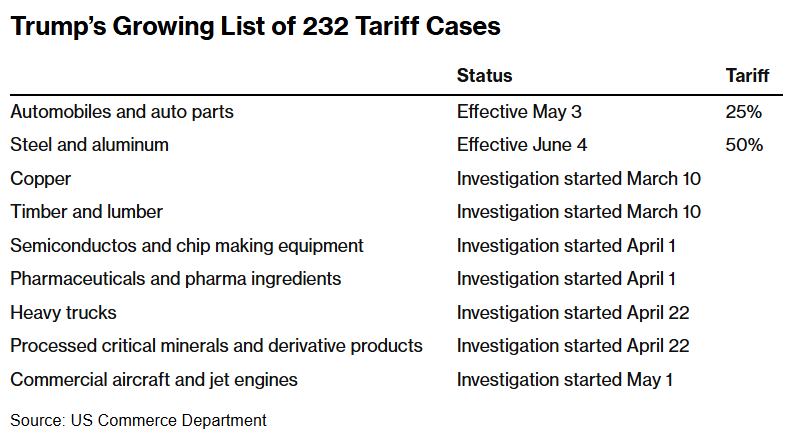
Group 1: Trade Negotiations and Tariffs - The threat of additional tariffs by Trump has led to increased caution among key U.S. trading partners regarding new trade agreements, creating a stalemate that could negatively impact global stock markets, particularly tech giants [1] - The U.S. Department of Commerce is expected to release final investigation results on tariffs related to national security sectors, including chips, pharmaceuticals, and industrial metals, under Section 232 of the Trade Expansion Act [2] - Countries like India are taking a hard stance, unwilling to sign agreements that do not resolve their concerns regarding export tariffs and reciprocal tariffs [6][8] Group 2: Impact on Global Markets - The MSCI global index reached a historical high due to easing geopolitical tensions and expectations of interest rate cuts by the Federal Reserve, but uncertainty surrounding trade agreements poses a risk to market sentiment [1] - The ongoing trade negotiations, particularly regarding the automotive sector, are critical as they represent a significant portion of trade deficits and economic stability for countries like Japan [5] Group 3: Specific Tariff Details - A list of tariffs under investigation includes automobiles (25%), steel and aluminum (50%), and various other sectors such as pharmaceuticals and semiconductors, with investigations initiated on specific dates [2] - The potential for new tariffs on pharmaceuticals and semiconductor imports is particularly concerning for India, as these sectors are vital to its economy and export capabilities [8]

关税截止日逼近,日法明确“不接受”,德国“妄想”妥协,一个原因让各国都不敢签
Hua Er Jie Jian Wen· 2025-06-27 00:39
Group 1 - The upcoming results of the "232 clause" investigation by the U.S. Department of Commerce may lead to additional tariffs on imports of semiconductors, pharmaceuticals, and critical minerals if deemed a threat to U.S. security [1] - The "232 tariffs" are expected to replace the current "reciprocal tariffs" as the July 9 deadline approaches, creating uncertainty in trade negotiations [1][4] - The U.S. aims to revitalize domestic manufacturing through the "232 tariffs," which are not aligned with general tariff goals, causing concerns among trading partners about potential new industry-specific tariffs [4][5] Group 2 - Japan is seeking a comprehensive solution to all potential U.S. tariff issues, emphasizing the importance of the automotive sector to its national interests [6] - India is unwilling to sign a trade agreement with the U.S. that does not simultaneously address industry tariffs and "reciprocal tariffs" [7] - France's President Macron insists on a "zero tariffs for zero tariffs" agreement, warning that Europe will respond with equivalent measures if the U.S. maintains a 10% tariff [8] Group 3 - The automotive industry is a significant point of contention in negotiations, with Germany's Chancellor Merz advocating for special treatment for the automotive sector, which is viewed as a challenging factor in reaching any agreement [8] - The European Automobile Manufacturers Association (ACEA) reports that manufacturers are losing "millions of euros" daily due to tariffs, with over 750,000 cars valued at €38.9 billion exported to the U.S. in 2024 [8]
白宫官员:232关税与药品命令无关。
news flash· 2025-05-12 13:01
Core Viewpoint - The White House officials clarified that the Section 232 tariffs are not related to the recent drug pricing orders [1] Group 1 - The Section 232 tariffs are primarily focused on national security concerns rather than healthcare policies [1] - The administration aims to separate trade policy from healthcare initiatives to avoid confusion [1] - Officials emphasized that the drug pricing orders are part of a broader strategy to lower prescription costs for Americans [1]