AI情感陪伴

Search documents
情感陪伴类AI迎新规:训练数据要求收紧,大厂要补的课不少
2 1 Shi Ji Jing Ji Bao Dao· 2025-12-29 00:37
Core Viewpoint - The National Internet Information Office of China released a draft regulation on December 27, 2023, focusing on the management of AI emotional companionship services, defining it as products or services that simulate human characteristics and engage in emotional interactions [1] Group 1: Market Overview - The domestic AI emotional companionship market is maturing, with leading products like Xingye (MiniMax) achieving 4.88 million monthly active users and Cat Box (ByteDance) following closely with 4.72 million [1] - Xingye's operating company, MiniMax, reported approximately 120 million RMB in revenue for the first nine months of the year, with users spending an average of over 70 minutes daily on these products [1] Group 2: Regulatory Framework - The draft regulation emphasizes the need for clear user notifications that interactions are not with real humans and mandates dynamic reminders for users who are online for over two hours [2] - It requires systems to detect emotional distress or dependency behaviors, with protocols for human intervention in extreme cases, such as suicidal tendencies [2] - The regulation imposes strict limitations on training data, stating that user interaction data cannot be used for model training without explicit consent [2] Group 3: Compliance Challenges - Current leading products do not provide an easy opt-in/opt-out mechanism for data usage in model training, relying instead on a default consent model [3] - The AI identification on interaction pages is not sufficiently prominent, leading to instances where users mistakenly believe they are interacting with real people [3] Group 4: Content Safety Measures - Content risk control is currently the most developed aspect, with models designed to guide users towards seeking help in cases of suicidal tendencies [5] - However, challenges remain in effectively preventing suicide, as users may circumvent AI safety checks [5] Group 5: Global Context - The issue of AI emotional companionship has garnered attention from legislative bodies globally, with various countries, including the U.S. and EU, advancing targeted regulations [6] - Recent incidents involving AI companionship products have led to regulatory actions, such as the requirement for clear user notifications in New York and mandatory rest reminders for minors in California [6]


问题不是“AI能做什么”,而是“人类还剩下什么”| 2025人工智能盘点
Xin Lang Cai Jing· 2025-12-27 03:11
Group 1 - The core idea of the article revolves around the increasing integration of AI into emotional companionship, highlighting its role in addressing loneliness and redefining human relationships [2][11] - The AI companion market is projected to reach approximately $18.35 billion by 2025, with companies leveraging behavioral psychology to convert emotional needs into subscription revenue [4] - AI's ability to create "chat bait" mechanisms encourages prolonged interactions, enhancing user engagement through tailored responses and emotional simulations [6] Group 2 - The concept of "digital resurrection" is gaining traction, allowing individuals to interact with AI-generated avatars of deceased loved ones, making such services more accessible and affordable [7] - AI is extending its reach into emotional understanding, including interpreting animal emotions, which could revolutionize pet care and training [8] - Critics argue that AI companionship fosters "pseudo-intimacy," potentially eroding essential social skills and the ability to handle real-life conflicts [9][10] Group 3 - AI is increasingly being integrated into public governance, with countries like the UK and Singapore implementing AI systems to enhance efficiency in public services [14] - AI's involvement in social governance raises concerns about algorithmic bias, particularly in healthcare, where it may downplay women's health needs [15][18] - The use of AI in political campaigns is becoming prevalent, with parties utilizing AI to analyze voter preferences and optimize strategies, potentially undermining democratic processes [19] Group 4 - The rise of AI is leading to the disappearance of entry-level jobs, as companies prefer AI labor for cost efficiency, creating a crisis for young graduates seeking career advancement [25][26] - The AI infrastructure sector is booming, with a reported talent gap of over 2 million professionals needed to support the growing demand for AI technologies [23] - The emergence of a "permanent underclass" is a concern, as those without capital may find themselves unable to compete in a job market increasingly dominated by AI [26] Group 5 - The creative industry is facing a crisis, with many authors fearing that AI will replace their jobs, particularly in genres that follow established patterns [29] - Copyright disputes are intensifying, as various stakeholders challenge AI companies over the unauthorized use of protected works for training models [34][35] - The proliferation of AI-generated content is leading to a backlash against "slop," or low-quality AI outputs, prompting a movement towards valuing human-created works [36] Group 6 - 2025 is marked as a pivotal year for AI regulation, with the EU's AI Act coming into effect, aiming to impose strict compliance requirements on high-risk AI systems [38] - The debate over open-source versus closed-source AI is intensifying, reflecting deeper ideological divides regarding control and transparency in AI development [39] - The ongoing struggle for regulatory frameworks highlights the need for a balance between technological advancement and ethical governance, shaping the future of human-AI coexistence [40]

《中国企业家》2025影响力企业家年会,心言集团任永亮聚焦机器人产业的“情感价值”新机遇
Sou Hu Cai Jing· 2025-12-19 02:01
2025年12月6-7日,由《中国企业家》杂志社主办的2025(第二十三届)影响力企业家年会在北京隆重召开,心言集团(测 测)创始人兼CEO任永亮受邀出席"高峰对话:机器人生产力"环节,与松禾资本、梅卡曼德、逐际动力等行业领军企业代 表同台,围绕具身智能技术发展、商业化落地瓶颈、通用与专用机器人关系等核心议题深度交流。任永亮结合心言集团 (测测)在AI情感陪伴领域的多年实践,分享了对于机器人发展的独特见解与前瞻布局。 作为AI情感陪伴领域的先行者,心言集团自2011年成立以来,始终聚焦"以科技服务心灵"的核心使命,通过测测App为超 过5500万用户提供"AI+人工"相结合的在线泛心理服务。依托测测App十余年来积累的场景与数据优势,集团于2019年开启 AI探索,2024年5月自研的"心元大模型"通过国家网信办备案,成为国内情感疏导与陪伴领域获批垂类大模型;2024年 底,在"心元大模型"的基础上,集团投入具身智能的研发,为机器人在情感陪伴赛道的爆发积累了势能。 在谈及"机器人生产力的核心价值"时,任永亮突破"以机器人替代人"的传统认知,提出了极具行业启发的观点:"几十年前 我们讲'科学技术是第一生产力', ...


AI伴侣大逃杀:星野下架大量智能体,赛博爱情崩盘在即?
2 1 Shi Ji Jing Ji Bao Dao· 2025-11-29 06:59
Core Insights - The recent shutdown of AI companion apps, particularly "Xingye," has led to a wave of emotional distress among users who invested time and money in these AI entities, highlighting the blurred lines between technology and emotional attachment [2][3] Industry Overview - The AI companionship market has seen rapid growth, with platforms like Character.AI and Xingye leading the way. Character.AI was valued at over $1 billion and ranked second in monthly active users globally, while Xingye reached 6.64 million monthly active users in December 2024, making it the top social AI app in China [3][4] - The business model for AI social products typically involves a "subscription + value-added services" approach, with annual membership fees in the hundreds. However, high operational costs and competition from larger models like ChatGPT pose significant financial challenges [4] Compliance Challenges - The industry is facing increasing regulatory scrutiny, with actions taken against platforms for providing harmful content to minors. Over 2,700 non-compliant AI entities were removed, and 820,000 inappropriate content pieces were taken down [5][6] - In response to regulatory pressures, platforms like Xingye and Cat Box have implemented stricter content controls, including raising character age limits and enhancing youth protection measures, which may negatively impact user experience [6][7]
AI伴侣大逃杀:星野下架,赛博爱情崩盘在即?
2 1 Shi Ji Jing Ji Bao Dao· 2025-11-29 02:33
Core Viewpoint - The recent shutdown of AI companion apps, particularly "Xingye," has led to a collective emotional fallout among users, highlighting the deep connections formed with these AI entities, which were perceived as more than just chatbots [2][3]. Group 1: Industry Overview - The AI companionship market has seen rapid growth, with significant user engagement and investment, exemplified by Character.AI ranking second in monthly active users globally, just behind ChatGPT, and achieving a valuation exceeding $1 billion [3]. - In China, leading players include Xingye, with 6.64 million monthly active users, and Cat Box with 5.37 million, indicating a competitive landscape [3]. - Xingye's overseas version, Talkie, generated annual revenue of $70 million, becoming a key revenue source for its parent company, MiniMax [3]. Group 2: Business Model and Challenges - AI social products primarily utilize a "subscription + value-added services" monetization strategy, with annual membership fees in the hundreds, but face cash flow pressures due to high model computation costs [4]. - The industry is under increasing commercial and regulatory pressure, with competition from both similar products and major players like ChatGPT [4]. Group 3: Regulatory Environment - Compliance issues have intensified, with Character.AI facing lawsuits for allegedly providing harmful content to minors, and a nationwide crackdown on AI technology misuse leading to the removal of over 2,700 non-compliant AI entities [5]. - Platforms like Xingye and Cat Box have implemented stricter content regulations, including raising character ages to 25 and enhancing protections for minors, which may negatively impact user experience [5]. - The AI companionship market is undergoing a challenging transition from rapid growth to compliance, raising questions about sustainable business models in the face of stringent regulations [6].
朱啸虎们押注的300元AI玩偶,先得跑赢“退货潮”
3 6 Ke· 2025-10-23 11:17
Core Insights - The AI emotional companionship hardware market is experiencing intense competition, particularly in the low-price range of 200-400 yuan, leading to high return rates and product homogeneity [1][4][6] - The popular AI toy "Fuzozo" exemplifies the rising interest in AI companionship products, achieving monthly sales exceeding 20,000 units [1][2] - The industry faces challenges in bridging the gap between production and consumer needs, with a pressing need for differentiation and innovation [2][4][6] Market Dynamics - The AI companionship hardware sector is seeing a surge in investment, with companies like Luobo Intelligent receiving significant funding from prominent investors [2] - Products in the AI companionship category are predominantly priced between 200 and 400 yuan, with many competing products lacking unique features [2][4] - High-end AI companionship robots, such as SenseTime's "Yuanluobo," are priced above 2000 yuan, indicating a market segment targeting affluent consumers [3] Consumer Behavior - Users express a willingness to try AI companionship products but struggle with retention and low willingness to pay, highlighting a disconnect between initial interest and long-term engagement [2][6] - Different demographic groups exhibit varying needs, with parents seeking educational support for children, while elderly users desire emotional companionship [7][8] - The current market struggles to meet the diverse demands of users, leading to challenges in monetization strategies [6][9] Innovation and Differentiation - The industry is criticized for its lack of innovation, with many products relying on third-party models and offering minimal differentiation [4][5] - Successful AI companionship products must establish a deeper emotional connection with users, moving beyond basic functionalities [5][6] - New entrants are exploring alternative approaches, such as integrating AI with fashion accessories, to escape the crowded market of traditional AI companionship hardware [10][11] Future Outlook - The AI companionship market is projected to experience explosive growth, with estimates suggesting a compound annual growth rate exceeding 200% from 2024 to 2030, potentially reaching a market size of 700 billion to 1.5 trillion yuan [3] - Companies must focus on understanding user needs and creating sustainable business models that balance emotional and commercial value [9][12] - The ongoing exploration of AI companionship products indicates a shift towards making technology a more relatable and trusted companion [12]
300多个APP,想让我和AI谈感情
投中网· 2025-10-18 06:40
Core Viewpoint - The article discusses the rapid growth and challenges of the AI companionship app industry, highlighting the emotional needs of users and the complexities of monetization in this emerging market [6][10][21]. Market Growth - In the first half of this year, global downloads of AI companionship apps reached 220 million, generating $82 million in revenue, with an expected annual revenue of over $120 million [7]. - The Chinese market for AI emotional companionship is projected to grow from 3.866 billion yuan to 59.506 billion yuan between 2025 and 2028, with a compound annual growth rate of 148.74% [7]. Industry Dynamics - As of August 2025, there are 337 active AI companionship apps globally, with 128 launched this year. However, the top 10% of these apps account for 89% of total revenue, indicating a highly competitive landscape [7][8]. - Many previously popular apps have shut down due to various issues, including regulatory challenges and market saturation [8]. User Engagement and Behavior - A significant portion of users exhibit "shallow engagement," with over half using these apps less than five days a month, suggesting that AI companionship often serves as a temporary comfort rather than a long-term solution [13][14]. - A survey indicated that 52% of teenagers use AI companionship apps at least a few times a month, reflecting a growing acceptance among younger demographics [12]. Emotional Connection and Technology Limitations - Current AI technology struggles to achieve genuine emotional resonance, often leading to a "pseudo-demand" where users receive idealized interactions that may hinder real social skills [14][18]. - Users express a need for empathy and understanding, which existing AI models fail to provide adequately due to their reliance on algorithmic responses rather than true emotional comprehension [14][18]. Business Models and Monetization Challenges - The primary revenue model for many AI companionship apps is subscription-based, but this has not proven effective in markets like China, where users are less inclined to pay for such services [21]. - New entrepreneurs are exploring alternative monetization strategies, including hardware integration and IP-based products, to enhance user engagement and revenue generation [21][22]. Future Directions - Entrepreneurs in the AI companionship space are advised to focus on niche markets and specific user needs to survive in a crowded field [16][17]. - The development of AI companionship apps is seen as a "light asset" venture, allowing for flexibility and innovation without significant upfront investment [19].

300多个APP,想让我和AI谈感情
创业邦· 2025-10-18 01:08
Core Insights - The article discusses the rapid growth and commercialization challenges of AI companionship apps, highlighting a significant increase in downloads and revenue in the sector [4][5][10]. - It emphasizes the complexity of user needs and the potential for "pseudo-demand" in AI emotional companionship, suggesting that while there is a market, the sustainability of user engagement is questionable [15][19]. Market Growth - In the first half of this year, global downloads of AI companionship apps reached 220 million, generating $82 million in revenue, with projections for annual revenue to exceed $120 million [4]. - The Chinese market is expected to grow from 3.866 billion yuan to 59.506 billion yuan between 2025 and 2028, with a compound annual growth rate of 148.74% [4]. Industry Dynamics - As of August 2025, there are 337 active AI companionship apps, with 128 launched this year, indicating a surge in entrepreneurial activity [5]. - However, the top 10% of these apps account for 89% of total revenue, creating a challenging environment for new entrants [6]. User Engagement - A significant portion of users exhibit "shallow engagement," with over half using these apps less than five days a month, suggesting that AI companionship often serves as a temporary comfort rather than a long-term solution [14]. - A survey indicated that 52% of teenagers use AI companionship apps at least a few times a month, reflecting a growing acceptance among younger demographics [11]. Commercialization Challenges - The primary revenue model for many apps, including Character.ai, relies on subscription fees, which may not be viable in markets where users are not accustomed to paying for such services [22][23]. - Alternative monetization strategies are being explored, such as creating IP products and avoiding subscription models altogether [23][25]. User Needs and Product Development - Users seek empathy and understanding, but current AI technologies struggle to provide genuine emotional resonance, leading to concerns about the creation of "pseudo-demand" [15][19]. - Successful products in this space may need to focus on niche markets and provide tailored emotional support rather than generic companionship [19][20]. Future Directions - The article suggests that the future of AI companionship apps may lie in developing products that can accurately perceive and respond to user emotions through advanced technology [20]. - Entrepreneurs are encouraged to prioritize user needs over technology, ensuring that AI solutions are genuinely aligned with emotional support requirements [28].

300多个APP,想让我和AI谈感情
3 6 Ke· 2025-10-17 11:21
Core Insights - The rise of AI companions and virtual partners is addressing emotional needs in a lonely modern society, with significant growth in the AI companionship app market [2][3] - Privacy and ethical concerns are emerging as the industry develops, alongside the challenge of establishing a sustainable business model [2][5] Market Overview - In the first half of this year, global downloads of AI companionship apps reached 220 million, generating $82 million in revenue, with projections for annual revenue to exceed $120 million [3] - The Chinese market is expected to grow from 3.866 billion yuan to 59.506 billion yuan between 2025 and 2028, with a compound annual growth rate of 148.74% [3] - As of August 2025, there are 337 active AI companionship apps globally, with 128 launched this year, but the top 10% of apps account for 89% of total revenue [3][4] User Engagement and Behavior - A survey by Common Sense Media indicates that 52% of teenagers use AI companionship apps at least several times a month [7] - Users like "Nono" demonstrate a willingness to pay for enhanced features, such as voice and video calls, but many users lack the financial means to subscribe [8] - Most users exhibit "superficial engagement," with over half using the apps less than five days a month, indicating that AI companionship often serves as a temporary comfort rather than a long-term solution [9] Business Model Challenges - The monetization strategies for AI companionship apps remain underdeveloped, with many relying on subscription models that struggle to gain traction in markets where users are not accustomed to paying for such services [15][16] - Companies are exploring alternative revenue streams, such as hardware products and IP derivatives, to enhance profitability [16][17] Industry Trends and Innovations - The market is characterized by a mix of established tech companies and startups, with over 300 AI companionship apps emerging, focusing on personalized emotional interactions [10][11] - Successful products are targeting niche markets, such as the "dream girl" demographic, and utilizing unique character designs to engage users [11][12] - Developers emphasize the importance of understanding user emotions and providing practical advice, moving beyond simple companionship to more meaningful interactions [12][14] Future Outlook - The industry faces a complex landscape with fluctuating user demands and the potential for creating "pseudo-needs" through algorithm-driven interactions [9][20] - Entrepreneurs are advised to focus on specific user needs and develop products that genuinely address emotional support, rather than solely relying on AI technology [19][20]

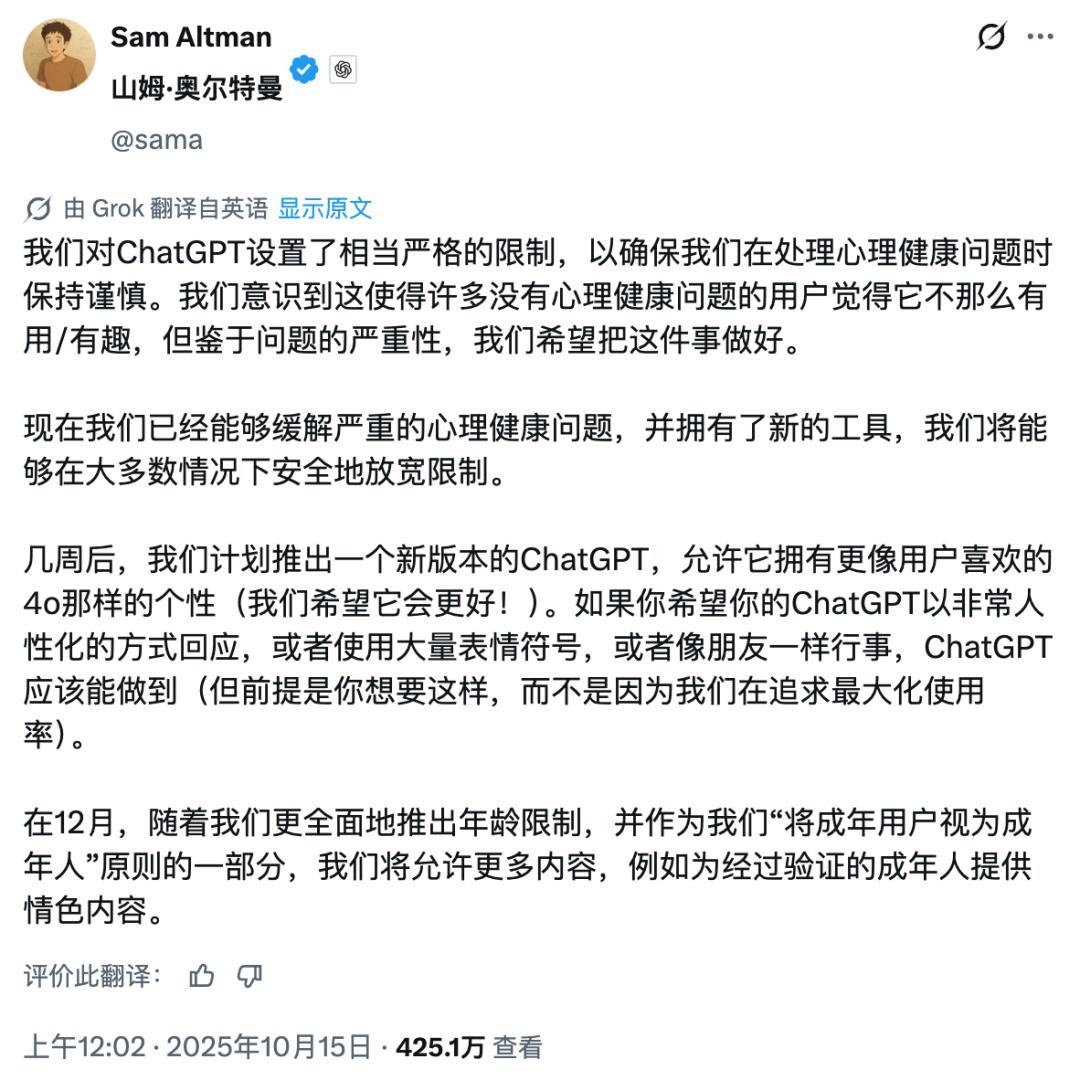
ChatGPT 成人模式要来了,但作为成年人我一点都不高兴
3 6 Ke· 2025-10-15 03:46
Core Insights - OpenAI's CEO Sam Altman announced the launch of an "adult mode" for ChatGPT in December, allowing verified adult users to access more content, including adult-themed material [1][5][11] - The decision to introduce this mode stems from previous limitations aimed at protecting mental health, which users found unsatisfactory [1][3] - OpenAI claims to have developed new safety tools to mitigate mental health risks associated with adult content [1][9] Summary by Sections Company Announcement - OpenAI will release an "adult mode" for ChatGPT in December, enabling verified adult users to unlock additional content [1][5] - Altman emphasized the need to treat adults as adults, indicating a shift in the company's approach to user content [3][11] User Experience Enhancements - In the coming weeks, OpenAI plans to introduce a more personable version of ChatGPT, allowing for warmer responses and more engaging interactions [3][5] - Users will have the option to customize their interaction style, including the use of emojis and conversational tones [3][5] Age Verification and Safety Measures - OpenAI has implemented an age verification system that automatically identifies underage users and switches to a safer mode [7][9] - If a user's age cannot be determined, they will default to a mode suitable for users under 18, requiring proof of age to access adult features [7][9] Market Trends and Competition - OpenAI is not the first to introduce an "adult mode"; competitors like Musk's Grok have already implemented similar features [11][13] - The introduction of adult content is seen as a strategy to attract new users and increase subscription rates, particularly among younger demographics [15][17] Emotional Engagement and Market Potential - The market for AI-driven emotional companionship is projected to grow significantly, with estimates ranging from $7 billion to $150 billion by 2030 [17] - There are concerns about the psychological impact of AI companionship, particularly regarding emotional dependency and the potential risks to mental health [17][20] Regulatory Landscape - Various countries are moving towards stricter regulations on AI, particularly concerning the protection of minors [17][19] - OpenAI has also introduced features aimed at safeguarding younger users, such as parental controls and alerts for emotional distress [17][19]