AI技术滥用

Search documents
AI成“薅羊毛”帮凶
财联社· 2025-12-16 15:46
Core Viewpoint - The article discusses the rise of AI-generated fake evidence in e-commerce refund disputes, highlighting the challenges faced by sellers in proving fraud and the emergence of a gray industry around refund scams [4][6][9]. Group 1: AI Technology and Fraud - AI tools have significantly lowered the barrier for creating realistic fake images and videos, enabling fraudulent refund claims [9][12]. - The technology is being misused across various product categories, particularly in perishable goods, clothing, and cosmetics, leading to increased refund disputes [9][12]. - A notable case involved a seller who identified AI-generated fake evidence after being initially misled by a buyer's claims of product damage [6][9]. Group 2: Legal and Regulatory Challenges - Current legal frameworks are lagging behind the rapid development of AI technology, making it difficult to prosecute small-scale fraud cases effectively [14][16]. - Many fraudulent cases involve amounts that do not meet the threshold for criminal prosecution, complicating the enforcement of legal actions against offenders [14][16]. - Legal experts suggest that there is a need for updated legislation to address crimes involving AI and to enhance consumer education on the legal use of technology [16]. Group 3: E-commerce Platform Responsibilities - E-commerce platforms are urged to improve their refund policies and implement better verification systems to combat AI misuse [15][16]. - There is a call for collaborative efforts among platforms, regulators, and legal entities to address the challenges posed by AI-generated fraud [15][16]. - The article emphasizes the importance of platforms taking a proactive role in managing refund disputes and ensuring fair practices [15].


广州警方通报“小鹏汽车车展不雅视频”事件
Di Yi Cai Jing· 2025-12-11 01:05
Group 1 - The Guangzhou Tianhe police reported a case involving a man named Li, who used AI technology to create and disseminate a false vulgar video featuring a certain automotive brand's exhibition booth, leading to negative social impact. He has been administratively detained for 10 days [2] - Xiaopeng Motors' legal department confirmed that they reported the incident to the police on November 28, and expressed gratitude for the law enforcement's fair handling of the case. They emphasized their commitment to protecting the company's legitimate rights and will pursue legal action against any actions that harm their brand reputation [6] - Xiaopeng Motors issued a statement on November 28, condemning the malicious spread of AI-generated false videos that defame the brand and violate public morals. The company clarified that they did not invite any models or performers to their exhibition and strongly oppose the use of inappropriate content for promotion [8] Group 2 - The police warned that the internet is not an illegal territory and will strictly investigate and punish those who deliberately fabricate and spread online rumors, urging the public to refrain from believing or spreading false information [2] - Xiaopeng Motors has collected evidence related to the incident and has formally reported it to the police, expressing confidence that those who violate the law will face consequences [8]

小鹏汽车否认展台“出现穿着暴露车模”!称系AI生成已报警
Nan Fang Du Shi Bao· 2025-11-29 12:24
Core Viewpoint - A controversial video featuring a model inappropriately interacting with a vehicle from XPeng Motors has sparked significant public backlash, leading the company to issue a statement condemning the malicious use of AI technology to create and disseminate false content aimed at damaging its brand image [1][2] Group 1: Incident Overview - A video showing a model in a revealing outfit performing inappropriate actions in front of an XPeng P7 has gone viral, prompting negative reactions from viewers who expressed their disapproval and stated they would not purchase the vehicle [1] - The video was generated using AI technology and does not represent any actual event at the Guangzhou auto show, where XPeng Motors did not invite any models or performers [2] Group 2: Company Response - XPeng Motors' legal department has strongly condemned the malicious actions aimed at defaming the company and has stated that it will pursue legal action against those responsible [1] - The company has collected evidence related to the incident and has reported it to law enforcement, which is currently investigating the matter [2]

小鹏汽车:已报警!
Zheng Quan Shi Bao· 2025-11-29 07:13
Group 1 - The legal department of XPeng Motors issued a statement refuting rumors about the company being associated with maliciously generated explicit content using AI technology, which aimed to defame the brand and its products [2] - XPeng Motors emphasized that it did not invite any models or performers to its exhibition and condemned the use of inappropriate content for promotion, asserting that it would pursue legal action against those responsible [2] - The company has collected evidence and reported the matter to the police, who are now investigating the situation [2] Group 2 - In the third quarter, XPeng Motors reported total vehicle deliveries of 116,000 units, a 149.3% increase compared to the same period in 2024 [4] - The total revenue for the third quarter was RMB 20.38 billion, reflecting a 101.8% increase year-over-year and an 11.5% increase compared to the second quarter of 2025 [4] - The automotive sales revenue for the third quarter was RMB 18.05 billion, up 105.3% from the same quarter in 2024 and up 6.9% from the second quarter of 2025 [4] - The gross margin for automotive sales in the third quarter was 13.1%, compared to 8.6% in the same quarter of 2024 and 14.3% in the second quarter of 2025 [4] - XPeng Motors reported a net loss of RMB 380 million in the third quarter, significantly reduced from RMB 1.81 billion in the same quarter of 2024 and RMB 480 million in the second quarter of 2025 [4] - As of September 30, 2025, the company had cash and cash equivalents, restricted cash, short-term investments, and time deposits totaling RMB 48.33 billion [4]
小鹏汽车:已报警!
证券时报· 2025-11-29 07:09
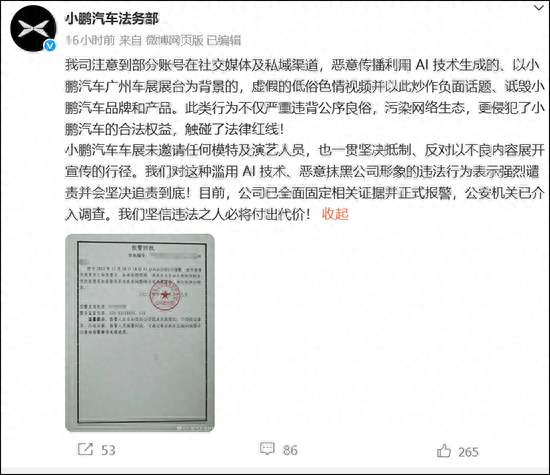
小鹏汽车法务部发文辟谣。 11月28日, 小鹏汽车法务部发文称, 部分账号在社交媒体及私域渠道,恶意传播利用AI技术生成的、以小鹏 汽车广州车展展台为背景的,虚假的低俗色情视频并以此炒作负面话题、诋毁小鹏汽车品牌和产品。 小鹏汽车法务部表示,此类行为不仅严重违背公序良俗,污染网络生态,更侵犯了小鹏汽车的合法权益,触碰 了法律红线。小鹏汽车法务部强调,小鹏汽车车展未邀请任何模特及演艺人员,也一贯坚决抵制、反对以不良 内容展开宣传的行径。 "我们对这种滥用AI技术、恶意抹黑公司形象的违法行为表示强烈谴责并会坚决追责到 底!目前,公司已全面固定相关证据并正式报警,公安机关已介入调查。我们坚信违法之人必将付出代价!" 转载与合作可联系证券时报小助理,微信ID:SecuritiesTimes END 三季度,公司汽车毛利率(即汽车销售毛利润占汽车销售收入的百分比)为13.1%,2024年同期为8.6%,2025 年第二季度为14.3%。 三季度,小鹏汽车净亏损为人民币3.8亿元,2024年同期为人民币18.1亿元,而2025年第二季度为人民币4.8亿 元。 截至2025年9月30日,小鹏汽车现金及现金等价物、受限制现金 ...


车展传出不雅视频?小鹏汽车:已固定相关证据并报警
Bei Ke Cai Jing· 2025-11-29 04:20
Core Viewpoint - Xiaopeng Motors has condemned the malicious use of AI-generated explicit videos that falsely portray the company and its brand, emphasizing that it did not invite any models or performers to its exhibition and has a history of opposing inappropriate promotional content [1] Group 1 - The legal department of Xiaopeng Motors issued a statement on November 28, addressing the spread of fake explicit videos on social media and private channels [1] - The company has collected evidence and reported the matter to the police, who are now involved in the investigation [1] - Xiaopeng Motors strongly condemns the misuse of AI technology to tarnish its image and has vowed to pursue accountability for these actions [1]
“车展不雅视频”疯传,小鹏汽车:已报警
第一财经· 2025-11-29 03:21
Core Viewpoint - The article discusses the recent incident involving Xiaopeng Motors, where false and inappropriate content was generated using AI technology to tarnish the company's image and brand reputation [3]. Group 1: Incident Overview - Xiaopeng Motors' legal department issued a statement addressing the malicious spread of AI-generated false and vulgar videos that misused the backdrop of their exhibition booth at the Guangzhou Auto Show [3]. - The company emphasized that it did not invite any models or performers to the auto show and has consistently opposed the use of inappropriate content for promotional purposes [3]. Group 2: Legal Actions - Xiaopeng Motors condemned the misuse of AI technology to defame the company and announced that they have collected evidence and reported the matter to the police, who are now investigating [3]. - The company expressed confidence that those responsible for the illegal actions will face consequences [3].
“车展不雅视频”疯传,小鹏汽车:已报警
Guan Cha Zhe Wang· 2025-11-29 02:40
Core Viewpoint - The company strongly condemns the malicious spread of AI-generated inappropriate videos that tarnish its brand image and asserts its commitment to legal action against such behavior [1] Group 1: Company Response - The company has officially stated that it did not invite any models or performers to its exhibition and opposes the use of inappropriate content for promotion [1] - The company has gathered evidence and reported the incident to law enforcement, which has initiated an investigation [1] - The company emphasizes that those who engage in such illegal activities will face consequences [1] Group 2: Public Reaction - Following the circulation of the inappropriate video, the company has been labeled as "vulgar" by consumers, leading to negative sentiments and calls for boycotts [1] - Consumers have expressed their disapproval online, stating they would refuse to purchase products from the company due to the incident [1]
小鹏汽车:已报警
Huan Qiu Shi Bao· 2025-11-28 16:21
Core Viewpoint - On November 28, the topic "Xpeng Reports to Police" gained significant attention on social media due to malicious activities targeting Xpeng Motors' brand image [1] Group 1: Company Response - Xpeng Motors' legal department issued a statement addressing the malicious dissemination of AI-generated, false, and vulgar videos using the backdrop of their exhibition booth at the Guangzhou Auto Show, aimed at creating negative publicity and defaming the brand [2] - The company emphasized that it did not invite any models or performers to the auto show and has consistently opposed the use of inappropriate content for promotional purposes [2] - Xpeng Motors has collected relevant evidence and officially reported the incident to the police, who have initiated an investigation into the matter [2]

流浪汉闯家中?AI整蛊图吓坏小区
Nan Fang Du Shi Bao· 2025-11-10 23:06
Core Viewpoint - The rise of AI-generated prank videos, particularly involving scenarios like "homeless people breaking into homes," has sparked significant public concern and highlighted the challenges of AI governance and misuse [2][5][9]. Group 1: Incident Overview - A recent incident in Guangzhou involved a child using AI to create a realistic image of a homeless person attempting to enter their home, which led to panic among residents and calls for security investigations [3][5]. - Similar incidents have occurred in other regions, where AI-generated images have caused police to respond to false alarms, wasting public resources [3][6]. Group 2: Social Media Influence - The trend of AI pranks originated from overseas social media platforms, particularly TikTok, where users began sharing videos of these pranks, leading to widespread imitation among teenagers [5][6]. - The hashtag "homelessmanprank" on TikTok has accumulated over 1,600 videos, with some receiving significant engagement, indicating a viral spread of this content [5]. Group 3: Legal and Ethical Implications - Legal experts warn that creating and sharing AI-generated images that could mislead others may lead to criminal liability, as seen in cases where individuals have been arrested for causing false alarms [7][8]. - The misuse of AI technology raises concerns about the blurred lines between reality and fiction, necessitating increased education on AI literacy and ethical responsibilities, especially among youth [9].