
L4级别自动驾驶

Search documents
无人物流专家交流
2025-06-04 01:50
Summary of Key Points from the Conference Call Industry Overview - The conference call discusses the **unmanned logistics vehicle industry**, focusing on the issuance of vehicle licenses and operational policies across different cities in China [1][2][4]. Key Insights and Arguments - **License Issuance Variability**: The number of unmanned logistics vehicle licenses issued varies by city, influenced by local industrial support. The Yangtze River Delta region is expected to have a higher number of licenses, while emerging cities are gradually opening up [1][2]. - **Conservative vs. Progressive Cities**: Beijing and Guangzhou are relatively conservative regarding road rights for unmanned logistics vehicles, while Shanghai and Shenzhen are more proactive, with Shenzhen leading in route openness and policy support [1][2]. - **Application Scenarios**: Unmanned logistics vehicles are utilized in various scenarios, including express delivery and fresh produce distribution, with each accounting for approximately 20% of the application landscape [1][7]. - **Mainstream Product**: The "Wufangche" (Five-cubic-meter vehicle) is highlighted as the mainstream product, capable of carrying 500-600 packages, with a range of 130 km when fully loaded and 180 km when empty [1][11]. - **Operational Efficiency**: Unmanned logistics vehicles can reduce costs by 15%-20% in certain scenarios, making them attractive to logistics companies despite their slower speed compared to traditional vehicles [2][23]. Additional Important Content - **Fault Rate**: The average fault rate for unmanned logistics vehicles is 1.5 times per 10,000 km, which is considered acceptable [1][14]. - **Business Model**: The primary business model in the market is hardware sales combined with service fees, with major manufacturers moving away from direct leasing to selling hardware and charging for software services [1][16]. - **Competition Landscape**: The industry is competitive, with several manufacturers targeting similar customer bases but employing different strategies. Product homogeneity is high, with a focus on achieving L4 level autonomous driving [1][18][19]. - **Government Support**: Local governments are generally supportive of the unmanned logistics industry, with over 150 cities having issued management measures for logistics and low-speed vehicles [2][32]. - **Future Prospects**: The future of the unmanned logistics vehicle industry will depend on technological advancements and the ability to achieve stable and cost-effective operational models [1][20]. Conclusion The unmanned logistics vehicle industry is evolving with varying levels of government support and operational challenges. The focus on cost reduction, efficiency, and technological advancements will be crucial for future growth and market penetration.
Robotaxi 车辆起火了,小马智行到底行不行?
3 6 Ke· 2025-05-16 09:17
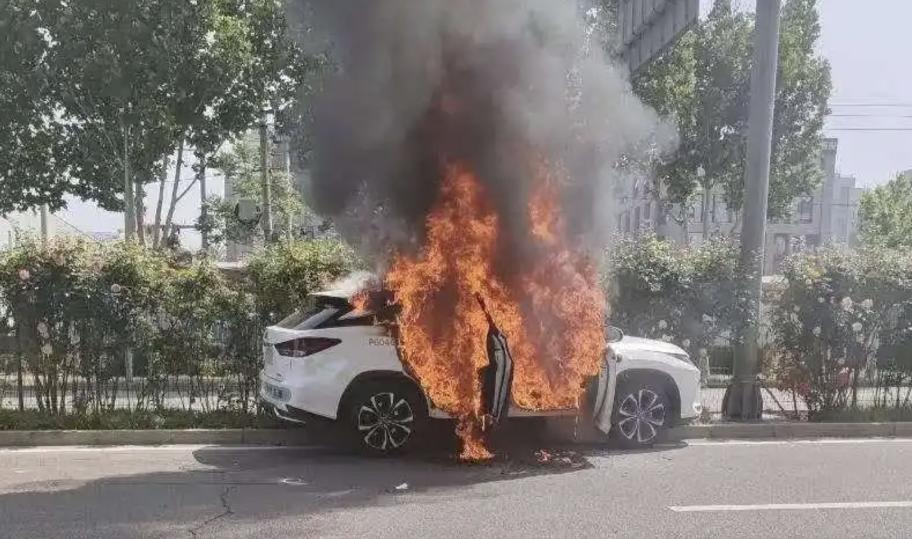
Core Viewpoint - Pony.ai, a prominent player in the autonomous driving sector, faces significant challenges following a recent incident where one of its Robotaxi vehicles caught fire, raising concerns about the safety and reliability of its services [1][3][16]. Group 1: Incident Overview - On May 13, a Pony.ai Robotaxi in Beijing caught fire after hitting a roadside green belt, leading to severe damage to the vehicle [1]. - The company stated that the vehicle detected an abnormal state and triggered an emergency stop, with no passengers on board at the time of the incident [1][3]. - Following the incident, Pony.ai suspended operations in the Beijing Yizhuang area, prompting users to adjust their travel plans [3][18]. Group 2: Financial Impact - Pony.ai's stock price, which was around $20 on May 12, dropped to $16.175 by May 15, marking a nearly 20% decline in just three days [3][16]. - The company has been experiencing continuous financial losses, with net losses of $148 million in 2022, $125 million in 2023, and projected losses of $257 million in 2024, totaling $548 million over three years [8][22]. Group 3: Business Model and Challenges - Pony.ai has struggled with the commercialization of its L4 autonomous driving technology, particularly in the Robotaxi segment, which has not yet contributed significantly to overall revenue [4][22]. - The company has diversified its operations with Robotruck and licensing segments, which have generated higher revenues compared to Robotaxi [6][24]. - Despite the setbacks, the company remains committed to expanding its Robotaxi business, viewing it as a critical component for future growth [10][25]. Group 4: Future Outlook - Pony.ai plans to produce 1,000 Robotaxi vehicles in 2025, aiming for profitability as the market for autonomous taxis is expected to grow significantly [19][27]. - The company’s leadership has expressed confidence in overcoming current challenges, emphasizing the importance of addressing safety concerns to regain market trust [29].

对话小马智行CEO彭军:预计2028年盈亏平衡,Robotaxi规模需达5万辆
Di Yi Cai Jing· 2025-04-30 09:29
Core Insights - The company predicts that it will achieve breakeven around 2028 with a vehicle scale of approximately 50,000 units [1] - The development of L4-level autonomous driving technology is seen as a long-term endeavor requiring collaboration across the industry [2] Group 1: Company Developments - The seventh-generation automotive-grade autonomous driving hardware and software system was launched, with overall costs reduced by 70% compared to the previous generation [1] - The company is collaborating with BAIC, GAC, and Toyota on mass production models, which are currently in trial production and expected to begin regular production in the second half of this year [2] - The partnership with automakers is characterized by a close collaborative model rather than a simple supplier relationship, focusing on joint research and development [2] Group 2: Industry Trends - The financing environment for autonomous driving companies has improved since mid-last year, with increased investment activity in specific segments like Robotaxi and low-speed heavy-duty vehicles [1] - The overall investment situation in the autonomous driving industry is better this year compared to last year, indicating a potential recovery from previous downturns [1] - The commercial progress of L4-level autonomous driving technology requires further accumulation and improvement, including legal regulations, user experience, cost reduction, and a complete industry chain [2]
李想的野心
投资界· 2024-12-31 06:55
以下文章来源于雪豹财经社 ,作者王亚骏 雪豹财经社 . faster , deeper and wiser 理想汽车的使命又变了。 作者 | 王亚骏 来源 | 雪豹财经社 (ID:xuebaocaijingshe) 硅基家人 李想已经不想只做一名汽车企业CEO了,他要做的是一名人工智能企业CEO。 在社交平台上沉寂9个月后,12月25日至27日,李想以对话形式连续进行了三场直播, 人工智能是贯穿这三场直播的主题。 最能让李想兴奋的事情已经不再是汽车销量的提升,而是在有生之年制造出硅基家人。 硅基家人,是李想眼中人工智能产品的终极形态。 用户不需要向它分配任务或给予任何指令,因为它比用户更了解自己、更了解用户的家 人和朋友。硅基家人可以成为用户家庭的重要组织者,"它可以帮我把这个家管理好"。 这款产品甚至可以让用户在生命走到尽头后,依旧让自己的记忆留存于这个世界,"我的 肉体是不存在了,但是我的记忆会变成它的一部分"。 在《我,机器人》《人工智能》《星际穿越》等知名科幻电影中,人工智能或机器人可 以为人类执行某些任务,甚至提供情感陪伴,但还无法实现延续记忆的功能。 马斯克也是人工智能的拥趸。他曾给二级市场画过一 ...
