Wealth effect

Search documents
Moody's Analytics' Mark Zandi: Biggest risk to economy is correction in stocks focused on AI
Youtube· 2025-11-03 17:28
Economic Impact of AI and Wealth Effect - The surge in equity prices is creating a wealth effect that drives consumer spending and economic growth, with a total valuation increase of publicly traded stocks by approximately $10 to $11 trillion over the past year [2][3] - For every dollar increase in wealth, there is an estimated increase of $0.345 in additional spending, highlighting the economy's dependency on the continued rise of AI stocks [3] - Investment spending in AI is significant, with the U.S. having 5,500 data centers compared to 3,500 globally, indicating a strong investment environment fueled by high stock prices [5][6] Risks and Concerns - The current equity market run-up is compared to the Y2K era, suggesting potential overvaluation and vulnerability if the AI-driven growth slows down [7][11] - There are concerns about job losses due to AI advancements, with the job market showing signs of stagnation and potential recession, as companies are laying off employees while maintaining flat headcounts [12][14] - The economy is currently growing at a rate of 1.5% to 2%, which is below its potential, despite the positive contributions from AI and other factors [18] Investment Landscape - The investment landscape is shifting, with many companies, including those that are privately held, relying on their stock prices for growth and expansion [10] - The commentary from major companies indicates a strong commitment to investment despite stock price fluctuations, suggesting a robust investment climate [9][10] - The overall economic growth is being supported by factors beyond AI, including tax reforms and increasing exports, which contribute to a more complex economic environment [15][18]


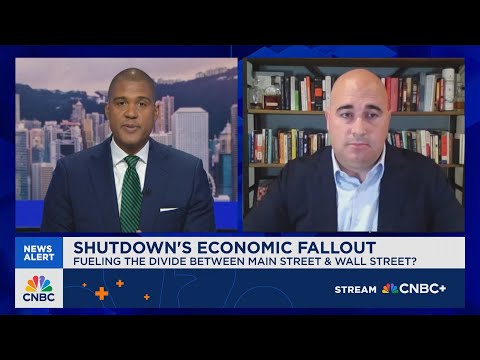
Hodge: If the shutdown drags on, it could cause lasting damage
CNBC Television· 2025-11-03 12:40
All right. So, we've kind of rolled out a stat that we got that for every week of the government shutdown, it negatively impacts uh quarterly GDP by a tenth of a percent. But as this continues to go on potentially to a new record, uh are we seeing bigger impacts than that than that stat really shows.>> Yeah, I think the more concerning thing would be if the shutdown drags on and spirals into something that would have more prolonged impacts. If government contractors and vendors have not been paid, we'll thi ...
It’s getting harder to separate the stock market from the economy. That means the Fed and Congress have more incentive to help Wall Street
Yahoo Finance· 2025-11-02 22:01
Core Insights - The divide between the stock market and the economy is becoming less distinct as higher asset prices encourage consumer spending, which constitutes about 70% of GDP [1] - The wealth effect has intensified over the past 15 years, with a 1% increase in stock wealth now leading to a 0.05% increase in consumer spending, compared to less than 0.02% in 2010 [2][3] - Retirees, who have a higher net worth than younger generations, are expected to rely more on their wealth for consumption, further amplifying the wealth effect [4] Wealth Effect Dynamics - Households are more likely to spend as their wealth increases, allowing them to extract equity from homes or liquidate appreciated stocks [3] - The digital media landscape accelerates consumer sentiment responses to market news, reinforcing the wealth effect [4] Impact on Consumer Spending - The resilience of consumer spending can be attributed to the powerful wealth effect, even amid economic uncertainties such as trade wars and inflation [5] - Stock market gains from the tech sector are projected to boost annual consumption by nearly $250 billion, accounting for over 20% of cumulative spending increases [6] AI-Related Wealth Gains - Analysts at JPMorgan estimate that U.S. households gained over $5 trillion in wealth from 30 AI-linked stocks in the past year, leading to an increase in annualized spending by about $180 billion [7]
MetLife's Drew Matus: There's a split forecasts around job growth, underscores bifurcated economy
Youtube· 2025-10-28 16:57
Economic Outlook - Consumer confidence has fallen to its lowest level since April, indicating potential challenges in the broader markets and economic outlook [1] - There is a split in expectations regarding job growth, with some anticipating higher growth while others foresee lower growth, reflecting a mixed sentiment among consumers [3] Consumer Behavior - Real personal disposable income is declining at an annual rate of approximately 1%, yet consumer spending remains stable, likely supported by equity gains and home appreciation [4] - Consumers are currently relying heavily on the wealth effect to maintain their consumption patterns, despite underlying economic stress [4][5] - There are indications that consumers may be growing weary of spending, which could impact future consumption patterns [7] Market Sentiment - The investment community remains cautious, with widening outcomes in economic forecasts, particularly regarding the impact of AI on productivity and labor markets [9][10] - The expectation is for a slowing economy with decent nominal growth, potentially leading to a resurgence in productivity driven by AI in the coming years [11] Federal Reserve Policy - The Federal Reserve is likely to continue its quantitative tightening through the end of the year, as concerns about the balance sheet size persist among committee members [13][14] - There is ongoing debate about whether the Fed will adjust its inflation target from 2% to 3%, reflecting broader discussions on monetary policy [12]

X @The Economist
The Economist· 2025-10-10 22:20
Rising asset prices can nudge people to spend more, amplifying economic cycles. Such a “wealth effect” has most clearly been observed in housing markets. Now it is also seen in the stockmarket https://t.co/RtPXZdqGmZ ...
The Fed won't get ANYWHERE CLOSE to this, chief investment officer warns
Youtube· 2025-09-26 08:30
Economic Data Overview - Initial jobless claims fell to 218,000, better than the expected 235,000, indicating a strong labor market [1] - Durable goods orders increased by 2.9%, surpassing consensus expectations, with non-defense business investment rising by 0.6% [2] - The second quarter GDP growth was reported at 3.8%, significantly higher than the anticipated 3.3%, suggesting robust economic activity [2] Consumer Behavior and Market Dynamics - Despite positive economic indicators, consumer sentiment appears mixed, with CarMax's stock plummeting 25% after missing revenue and earnings expectations, raising concerns about auto loan debt [3][4] - The housing market shows a disparity, with sales of million-dollar homes increasing while properties priced below $500,000 struggle [4] Inflation and Federal Reserve Considerations - The market is concerned about inflation, with discussions on whether the Federal Reserve should adjust interest rates in response to economic data [5] - The current economic environment is characterized as a two-tier economy, influenced heavily by asset markets, with a noted slowdown in consumer spending earlier in the year [6][7] - The cumulative number of unemployed workers has risen nearly 25% from its cycle low, indicating ongoing labor market challenges [9] Asset Prices and Inflationary Pressures - The significant rise in the S&P 500, up 85% over the past three years, is contributing to inflationary pressures, as wealth effects trickle down to consumer prices [11][14] - There is skepticism about a sustained high baseline inflation, with the potential for a downturn in stock prices to alleviate inflationary concerns [16]
中国_实体经济会从股市繁荣中受益吗_-China_ Will the real economy benefit from the stock market boom_
2025-08-31 16:21
Summary of Key Points from the Conference Call Industry Overview - The focus is on the **Chinese stock market** and its impact on the **real economy** amidst a sluggish economic backdrop. The analysis draws comparisons with the **2014-15 stock market boom** and its subsequent effects. Core Insights and Arguments 1. **Stock Market Surge vs. Real Economy** - Onshore stock markets have reached a decade-high despite economic sluggishness, but historical data suggests that stock market rallies provide limited boosts to the real economy [1][2][3] 2. **Historical Context of 2014-15 Boom** - The Shanghai Composite Index (SSECI) rose approximately **150%** from mid-2014 to June 2015, driven by retail investor enthusiasm, but subsequently fell over **40%** due to overvaluation and panic selling [2][3] 3. **Production and Investment Decline** - During the 2014-15 boom, industrial production growth fell from **8.3%** in 2014 to **6.3%** in H1 2015, while fixed asset investment growth dropped from **15.7%** to **11.4%** [3] 4. **Weak Consumption Growth** - Retail sales growth decreased from **12.0%** in 2014 to **10.4%** in H1 2015, indicating that the wealth effect from rising stock prices did not significantly stimulate consumption [4] 5. **Wealth Effects in Tier-1 Cities** - The stock market boom led to wealth redistribution favoring higher-tier cities, yet retail sales growth in tier-1 cities weakened in H1 2015 compared to 2014, suggesting that increased wealth did not translate into higher consumption [5] 6. **Household Asset Structure** - Chinese households primarily hold property (60% of total assets) and cash savings, with direct stock holdings accounting for only **1.3%** of total assets, limiting the wealth effect from stock market gains [7] 7. **Impact on Housing Markets** - The relationship between stock market performance and housing demand is complicated by property stimulus measures. The limited wealth effect from stocks suggests that the housing market's recovery was more influenced by these measures than by stock market performance [10][11] 8. **Property Market Recovery** - New home sales growth in tier-1 cities showed significant recovery, but this was likely driven by property stimulus measures rather than the stock market boom itself [14][15] Additional Important Insights - The **2014-15 stock market boom** was accompanied by various property stimulus measures, complicating the analysis of their separate impacts on housing markets [13] - The **financial sector's income boost** from the stock market boom is expected to be less significant this time due to reduced brokerage fees and a freeze on IPOs [1][10] This summary encapsulates the key points discussed in the conference call, highlighting the complex interplay between the stock market and the real economy in China, particularly in the context of historical trends and current economic conditions.
Bentley Debuts Bentayga Speed SUV
Bloomberg Television· 2025-08-16 15:30
Product & Demand - The new Bentayga Speed, an ice-only engine version of the Bentayga, is receiving very positive feedback and is expected to be in customer's hands by the end of the year or early next year [1][2] - The market is experiencing a wealth effect, potentially driven by equities and Bitcoin, leading to strong demand [3] - New Continental models with high power are well-received, with shipments expected in the third quarter, contributing to sales momentum [4] - Customers are showing excitement and anticipation for future Bentley models, with discussions already underway [8][9][10] Production & Craftsmanship - Bentley production is exclusive to Crewe, emphasizing the brand's British heritage and the craftsmanship of its artisans [4][5] Tariffs & Pricing - The UK has a special deal with the US on auto exports, with a flat 10% tariff, up from 25%, but Bentley has not raised prices and does not anticipate a significant impact on business [5][6] - Bentley is closely monitoring market conditions and pricing but has not taken any action regarding supplier pricing or adjustments [7] Motorsport - Bentley has a rich history in motorsport, including victories in Le Mans, and recognizes its importance to brand image [12] - The company is considering re-entering motorsport but is evaluating the timing, technology, and financial investment required [13][14]

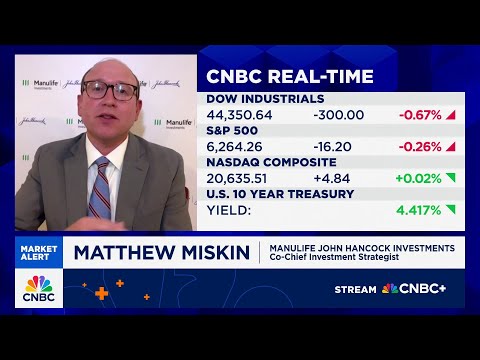
Tariffs can make a negative wealth effect, says Manullife John Hancock's Matthew Miskin
CNBC Television· 2025-07-11 18:10
As investors worry about the latest round of tariff announcements, maybe this war footing and so forth, but there's another concern maybe can take off the list or push down a little bit. My next guest says inflation is slowing way more than the markets think. Let's bring in Matt Mskin.He's the co-chief investment strategist at Manulife, John Hancock Investments. Matt, it's great to see you. And this is precisely the moment you just heard Jimmy and others have talked about this, like is the hard data going t ...